Fidelity/Schwab After India Move: Keep, Freeze, Options?
Keep Fidelity or Schwab after return: W-8BEN, options level, trading limits, Schedule FA — before the first restricted India login.
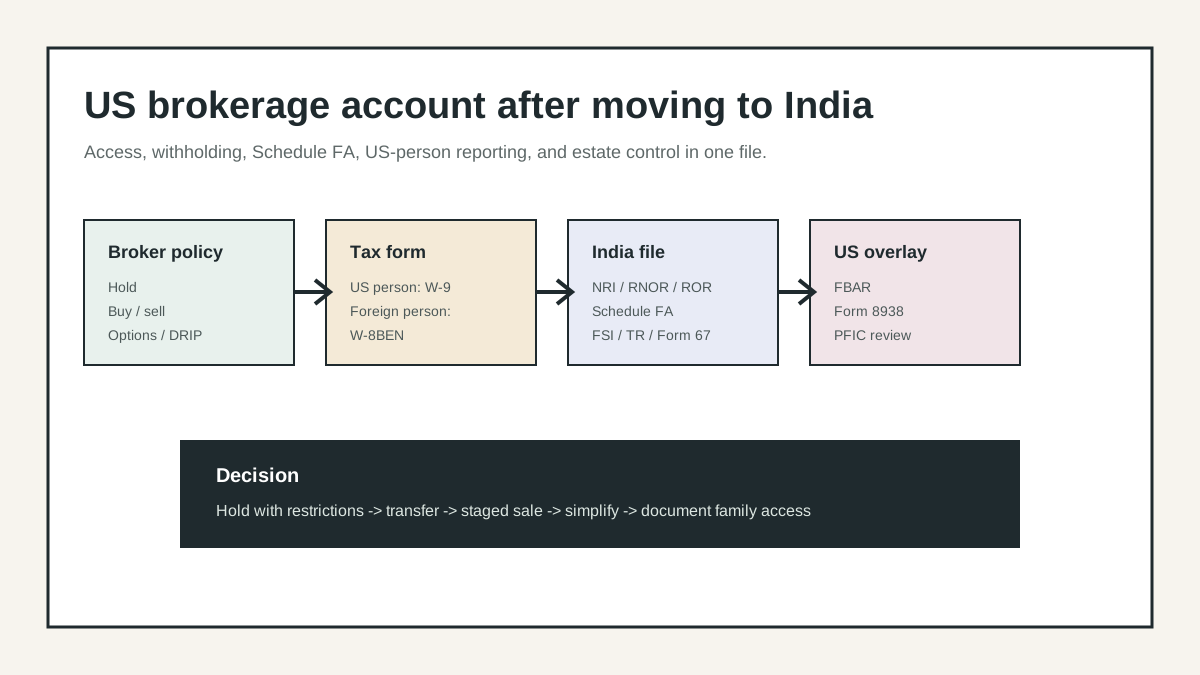
The 60-second version
The brokerage question is usually asked too late. Before updating an address, selling shares, transferring assets, or filing a return, a returnee needs one access-and-tax file that separates broker policy, US tax status, India residency, foreign asset disclosure, treaty withholding, and beneficiary control.
Why the US brokerage question is not only a tax question
You are probably asking one thing: can I keep Fidelity, Schwab, E*TRADE, Morgan Stanley, or Interactive Brokers after I move to India? I do not give a blanket yes or no. I walk you through broker policy, US tax status, Indian residency, asset type, and whether you still have login, mail, beneficiary, and tax-document access.
I have seen four ways these accounts break. The broker blocks new buys after an India address change. W-8BEN or W-9 is wrong for your status. India taxes or needs Schedule FA once you are resident. Survivors cannot access the account because beneficiaries were never updated.
This guide is not the capital-gains sale guide. That page covers tax on selling. This one covers keeping the account alive: what to export, what to ask the broker, how Schedule FA and FBAR fit, and when to pause before an irreversible trade.
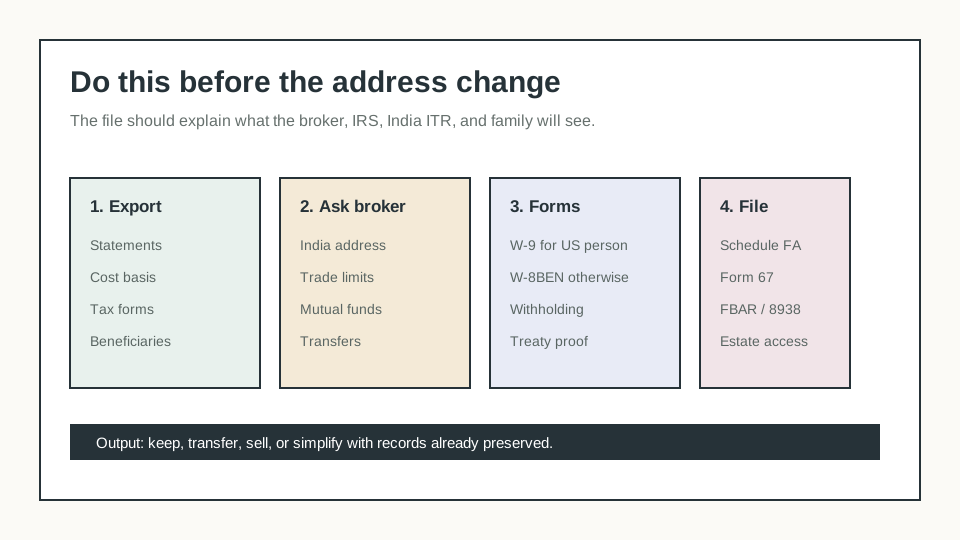
US brokerage account decision matrix after moving to India
Use this matrix before updating an address, submitting a tax form, transferring assets, or selling a concentrated position.
| Decision lane | What to ask | Proof to save | Common mistake |
|---|---|---|---|
| Broker policy | Does the broker allow India-resident clients to hold, buy, sell, reinvest dividends, trade options, or hold mutual funds? | Broker message, country-policy page, account restriction notice, accepted address record, and service ticket. | Assuming an account that stays open also allows every trade or reinvestment action. |
| Tax form | Are you a US person using W-9, or a non-US person using W-8BEN and treaty certification where eligible? | Submitted form, expiry or recertification date, treaty article entry, tax-residency certificate if requested, and broker acknowledgement. | Submitting W-8BEN because you live in India even though you are still a US citizen or green-card holder. |
| Income and withholding | How are dividends, interest, sale proceeds, backup withholding, and treaty rates handled by the broker? | Dividend statements, 1042-S or 1099 where applicable, withholding ledger, exchange-rate note, and Form 67 mapping. | Treating broker withholding as the final India tax answer. |
| India Schedule FA | Are you a resident assessee with a foreign custodial account, equity interest, foreign income, or signing authority? | Year-end statement, account country, institution address, holdings list, income derived, and ITR schedule mapping. | Reporting gains but forgetting the account and asset disclosure layer. |
| US-person reporting | If you remain a US person, do Indian accounts or non-US assets trigger FBAR, Form 8938, PFIC, or other filings? | US-status memo, Indian account list, peak balances, asset values, FBAR filing proof, Form 8938 threshold file, and PFIC review. | Solving only the US brokerage account while missing Indian accounts created after landing. |
| Transfer or liquidation | Is moving assets to another broker, DRS, Indian platform, or bank account operationally allowed and tax-aware? | Transfer form, receiving-broker acceptance, cost-basis transfer proof, sale confirmations, and cash movement records. | Liquidating under panic because a broker email sounded urgent but did not require an immediate sale. |
| Estate and beneficiary control | Can family access the account if something happens, and are beneficiaries accepted for the account type and residence status? | Beneficiary confirmation, TOD settings where available, nominee or estate memo, will or trust coordination note, and emergency owner file. | Leaving a large US brokerage account with stale beneficiaries and no family access plan. |
Ten-step proof file before changing address or selling
This is the operating sequence for returnees who already have US stocks, ETFs, RSUs, ESPP shares, options, or cash in a US brokerage account.
Export the account before changing anything
Download monthly statements, annual tax forms, cost-basis lots, dividend history, trade confirmations, wire instructions, beneficiary settings, margin or options approvals, and open orders.
Classify your US tax status first
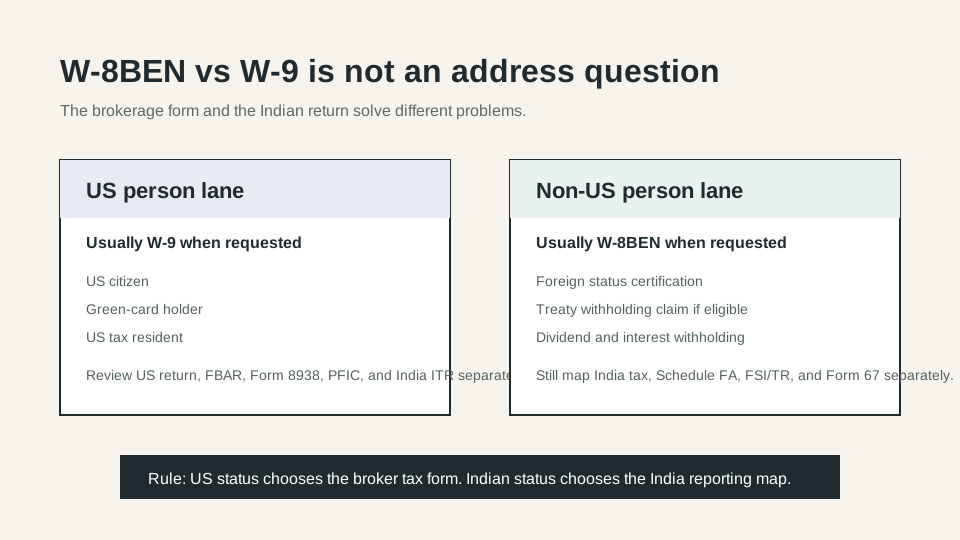
A US citizen, green-card holder, or US tax resident normally stays in the US-person lane even while living in India. A non-US person generally uses the foreign-person certification lane. Do not pick W-8BEN or W-9 from address alone.
Ask the broker the exact India-resident question
Ask whether an India address permits holding, selling, buying, dividend reinvestment, options, mutual funds, ETFs, stock-plan shares, ACH, wire, debit card, and beneficiary changes. Get the answer in writing.
Freeze new activity until restrictions are known
Do not start new options, margin, mutual fund, or automatic-investment activity until the broker confirms what is permitted after the address change.
Build the withholding map
For non-US persons, map W-8BEN, treaty claims, dividends, interest, and possible backup withholding. For US persons, preserve 1099 reporting and US return documents. In both cases, keep cash withholding separate from final India tax.
Map India residency and Schedule FA
Calculate NRI, RNOR, or ROR status for the Indian financial year, then decide whether the brokerage account, custodial account, securities, dividends, and gains enter Schedule FA, FSI, TR, or Form 67 files.
Separate sale tax from account access
A sale decision needs cost basis, holding period, FX conversion, foreign withholding, India tax treatment, and Form 67 proof. Account access needs broker policy and operational continuity. Keep those decisions separate.
Check US estate and beneficiary exposure
US situs assets can create estate and transfer questions for non-US persons. Even where estate tax is not the immediate issue, beneficiary access and documentation should be tested before the account becomes hard to operate.
Choose hold, transfer, sell, or simplify
After the files are ready, choose a lane: keep with restrictions, transfer to a broker that accepts India residents, sell gradually, consolidate concentrated positions, or preserve only retirement/stock-plan assets.
Write one page for your tax filer and family
Summarize account owner, broker, address, tax form, status, holdings, reporting schedules, beneficiaries, family access route, and open risks. This prevents every tax season from becoming a reconstruction exercise.

Document checklist for the US brokerage file
Keep this file for the broker, Indian tax return, US return if applicable, adviser review, and family continuity.
- Broker access file: username recovery path, mobile/email OTP access, India address policy response, restriction notice, country eligibility note, and support-ticket transcript.
- Tax form file: W-8BEN or W-9 copy, treaty claim inputs if any, recertification date, broker acknowledgement, and withholding-status screenshot.
- Holding file: year-end statement, month-end statement near India return date, cost-basis lot report, dividend history, interest history, cash ledger, and FX conversion working.
- Trade file: sale confirmations, option assignment or exercise records, RSU/ESPP transfer records, wash-sale notes if relevant, and broker fee details.
- India filing file: residency computation, Schedule FA mapping, Schedule FSI/TR working, Form 67 acknowledgement, AIS/TIS review, and ITR form choice.
- US-person file if applicable: US citizenship or green-card status memo, Form 8938 threshold file, FBAR review for Indian accounts, PFIC review for non-US funds, and US return records.
- Transfer file: outbound transfer request, receiving-broker acceptance, cost-basis transfer proof, DRS or transfer-agent record if used, and rejected-transfer explanation if any.
- Estate file: beneficiaries, TOD status where accepted, will/trust coordination note, emergency contact, spouse/family read-only access process, and death-claim document list.
Infographic: W-8BEN vs W-9 is a status question
Need help with Tax & Residency?
Share your blocker in one line. Our experts will reply with practical next steps.
Community signal: the broker conversion email is where people panic
"Returnee threads repeatedly mix broker conversion, W-8BEN treaty entries, dividend withholding, and India gains reporting. The practical takeaway is to create the proof file before converting or transferring the account."
Read on reddit ->Professional signal: a foreign brokerage account can be a Schedule FA asset
"Practitioner posts around Schedule FA repeatedly mention foreign brokerage accounts, securities, RSUs, ESOPs, and foreign income. That is why this page treats broker access and Indian disclosure as one operating file."
Read on linkedin ->Short-form signal: people remember accounts after the moving date is fixed
"Short videos about US accounts before moving back to India are popular because the issue feels administrative until a login, withholding, or broker restriction breaks. The missing step is a written account-control file."
Read on instagram ->Need help with Tax & Residency?
Share your blocker in one line. Our experts will reply with practical next steps.
Question pattern: can I keep it is too vague
"Searchers ask whether they can keep a US brokerage account. The more useful question is what the account will still allow: holding, buying, selling, dividend reinvestment, tax certification, transfer, and beneficiary updates."
Read on quora ->Decision flow: keep, transfer, sell, or simplify
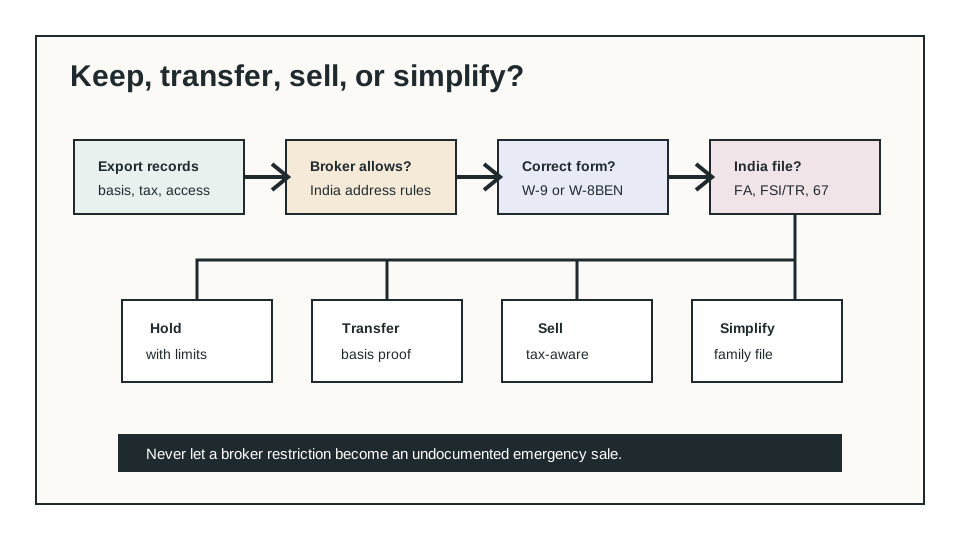
Operating map
Need help with Tax & Residency?
Share your blocker in one line. Our experts will reply with practical next steps.
Do not use a stale US address as the plan
A stale address may keep the screen working for a while, but it does not solve tax certification, account restrictions, statements, withholding, estate access, or Indian disclosure. For large portfolios, options, margin, employer stock, retirement accounts, US-person status, or conflicting broker guidance, get written broker confirmation and cross-border tax advice before changing forms or trading.
Interactive checkpoint
Turn this guide into a decision file
0 of 4 checked
Can I keep a US brokerage account after moving to India?
Possibly, but the answer depends on the broker, account type, assets, residence address, and tax status. Some accounts may stay open but restrict new purchases, mutual funds, options, margin, dividend reinvestment, or transfers. Get the broker's India-resident policy in writing before changing the account.
Should I file W-8BEN or W-9 after moving to India?
Do not decide from address alone. A US citizen, green-card holder, or US tax resident generally remains in the US-person lane and may use W-9 when requested. A non-US person may use W-8BEN to certify foreign status and treaty position where applicable.
Does W-8BEN settle my India tax on US stocks?
No. W-8BEN is a US withholding and documentation form for the broker. India tax depends on Indian residential status, income type, capital gains, foreign tax credit proof, Schedule FA, and return filing.
Does a US brokerage account go in Schedule FA?
Schedule FA must be reviewed when a resident assessee holds, owns, or has beneficial interest in foreign assets, foreign custodial accounts, foreign securities, signing authority, or foreign income. NRI/RNOR/ROR status and ITR form choice matter.
Do US persons in India need FBAR or Form 8938 for brokerage accounts?
A US brokerage account itself is usually domestic from a US reporting perspective, but US persons in India must separately review Indian and other non-US financial accounts and assets for FBAR, Form 8938, PFIC/Form 8621, and related filings.
Should I sell all US stocks before updating my address?
Not automatically. First export records, confirm broker restrictions, model tax consequences, check concentration risk, preserve cost basis, review estate access, and decide whether holding, transferring, staged selling, or simplifying is the better lane.
Can I claim Form 67 for US dividend withholding?
Only when the same income is taxable in India, eligible foreign tax was paid or withheld, proof is available, and the claim is mapped through Schedule FSI/TR and Form 67. Broker withholding alone does not make the claim automatic.
What is the first thing to do before changing a US brokerage account?
Export the full account file: statements, cost basis, dividends, tax forms, trade confirmations, beneficiary settings, transfer details, and broker policy messages. That record is much harder to reconstruct after restrictions or account conversion.
Your tax year is already running.
RNOR status, exit timing, and DTAA benefits all depend on decisions you make before you land. Don't guess.