VPF (Voluntary Provident Fund) for Returning NRIs: top-up to EPF, 8.25% interest, and the EEE tax benefit
Step-by-step VPF guide for returning NRIs: how VPF differs from the statutory EPF contribution, the 100% of basic + DA ceiling, 8.25% sovereign interest, the EEE tax...
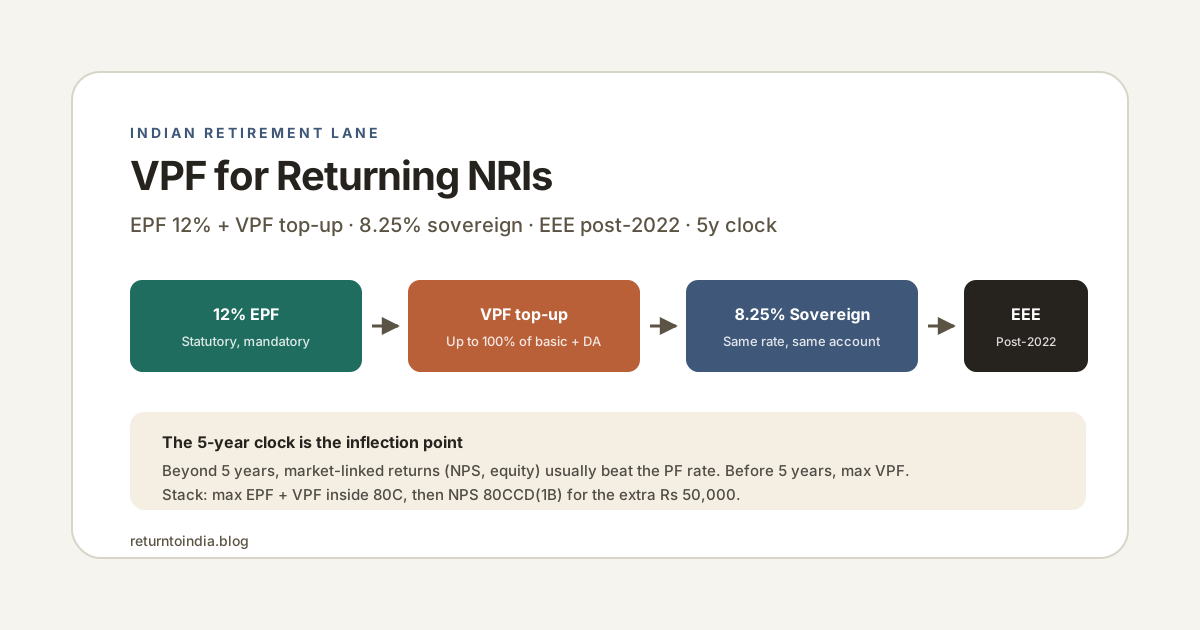
The 60-second version
VPF is the cleanest top-up to the statutory EPF for salaried employees. The 2022 amendment moved VPF into the EEE tax bucket (matching EPF), so every rupee of contribution, interest, and final withdrawal is now exempt. For a returning NRI with stable Indian income, VPF is often the first stop after the mandatory 12% EPF, before NPS, PPF, or discretionary equity.
Why VPF is the cleanest retirement top-up for a salaried returning NRI
VPF is voluntary Provident Fund. The statutory EPF is mandatory at 12% of basic + DA (with a matching 12% employer contribution, of which 8.33% goes to EPS pension). VPF sits on top of the statutory EPF, in the same account, at the same interest rate (8.25% per annum, sovereign-backed), with the same tax treatment (EEE under Section 10(11) and 10(12) since the 2022 amendment). The contribution ceiling is 100% of basic + DA, less whatever the statutory EPF is already taking.
For a returning NRI, VPF is the cleanest retirement top-up because the contribution is payroll-deducted (no manual transfer required), the account is the same as the EPF account (so UAN, KYC, and the 5-year continuous service clock are all shared), and the tax treatment is identical to EPF. The decision is not whether VPF is worth it on the merits — it is. The decision is how high to set the VPF top-up given the rest of the retirement stack (NPS 80CCD(1B), PPF, discretionary equity).
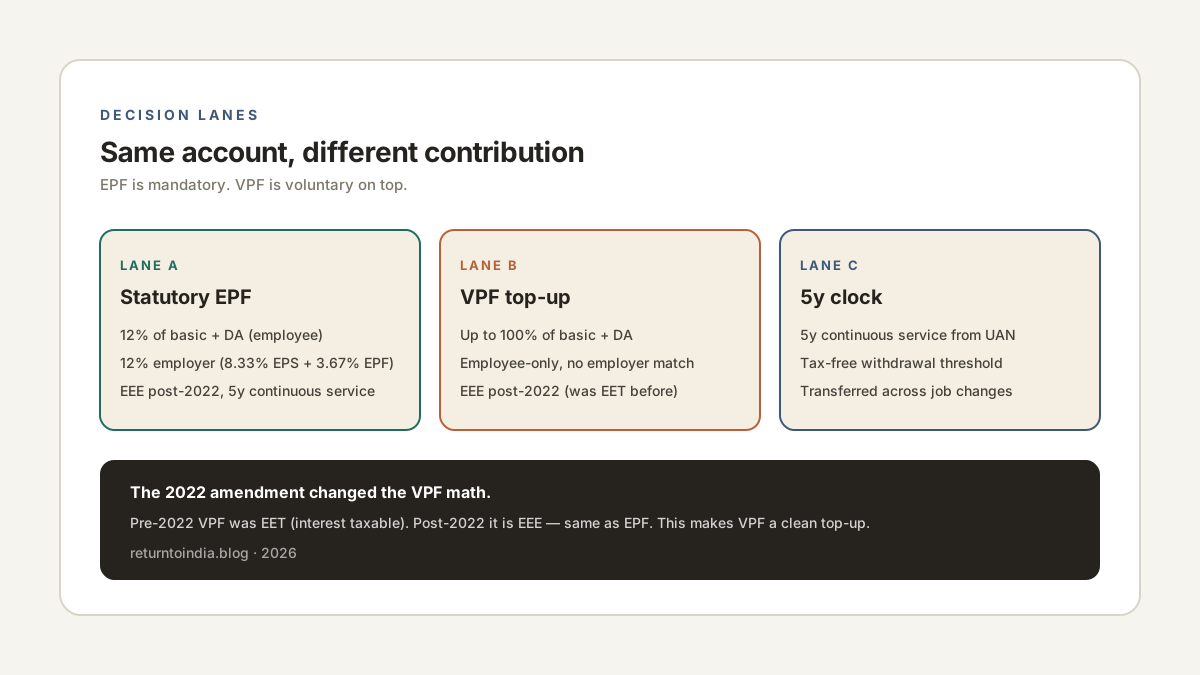
Statutory EPF vs VPF: same account, different contribution rates
VPF is not a separate scheme. It is a top-up contribution to the same EPF account, governed by the same rules, with the same EEE tax status since the 2022 amendment.
| Dimension | Statutory EPF | VPF (Voluntary Provident Fund) | Practical difference |
|---|---|---|---|
| Contribution rate (employee) | 12% of basic + DA (mandatory for salaried) | Up to 100% of basic + DA (voluntary top-up) | You can deploy 88% more of basic + DA into the same account |
| Contribution rate (employer) | 12% of basic + DA (mandatory; 8.33% to EPS, 3.67% to EPF) | No employer contribution | Employer match stops at the statutory 12%; VPF is employee-only |
| Interest rate | 8.25% per annum (currently, sovereign-backed) | Same: 8.25% per annum, same rate, same account | No rate differential between the two contributions |
| Tax status (Section 10(11) and 10(12)) | EEE (post-2022 amendment, treated alongside VPF) | EEE (post-2022 amendment; was EET before) | Both now tax-free at all three stages; pre-2022 VPF was taxable on interest |
| Section 80C deduction | Employee EPF contribution counts against 80CCE cap (Rs 1.5L) | VPF also counts against 80CCE cap (Rs 1.5L) | Plan EPF voluntary + VPF together inside the 80C ceiling |
| Withdrawal / exit rules | Tax-free at 5+ years continuous service (Sec 10(10B)) | Same: tax-free at 5+ years continuous service | Same 5-year clock; same UAN; same Form 19 / Form 10C |
| NRI continuation | EPF account continues; new EPF cannot be opened (statutory) | VPF cannot be opened by NRIs; existing VPF stops at NRI status change | Pre-NRI: max the VPF top-up. Post-NRI: rely on EPF and other layers |
Execution sequence: from opening to optimal exit
VPF is a payroll-deducted top-up. The decision is at the start of every financial year.
Decide the VPF top-up percentage
You can choose any VPF percentage from 0 to 100% of basic + DA, in whole-percentage increments. The 12% statutory EPF is deducted first, then VPF takes the next slice up to your chosen percentage. Most returning NRIs in a stable Indian job pick 100% (full deployment of basic + DA into the EPF + VPF account).
Set the VPF percentage through HR or the EPFO member portal
For most employers, you set the VPF contribution in a written request to HR. The EPFO member portal also lets you submit a VPF election form. The election is generally for a minimum of 6 months — you cannot flip the VPF percentage up and down monthly.
Stack the VPF deduction with NPS and PPF inside the 80C ceiling
VPF + statutory EPF + PPF + ELSS all share the 80CCE Rs 1.5L cap. NPS Tier 1 (80CCD(1)) also sits inside the cap. NPS Tier 1 self-contribution (80CCD(1B)) and 80CCD(2) employer contribution are OUTSIDE the cap. Plan the order: max EPF + VPF inside the 80C ceiling first, then add NPS 80CCD(1B) on top for an extra Rs 50,000.
Plan the 5-year continuous service clock
EPF and VPF withdrawals are tax-free only if you complete 5 years of continuous service. The clock starts from the date you joined the EPF scheme (UAN-linked). If you change jobs, transfer your EPF balance to the new employer's EPF account within the prescribed window — the continuous service clock survives the transfer. Closing the EPF before 5 years triggers taxable withdrawal of the employer's contribution + interest (employee's contribution + interest stays tax-free under Section 10(12) post-2022 amendment).
If leaving service before 5 years, plan the tax cost
Premature exit (before 5 years) makes the employer's contribution + interest taxable as salary. The employee's contribution + interest is tax-free under Section 10(12) post-2022 amendment. If you know you are leaving before 5 years, consider whether to top up VPF in the final year at all — the employer's portion is the only taxable chunk and VPF does not get any employer match.
If becoming an NRI mid-term, stop VPF at the change of status
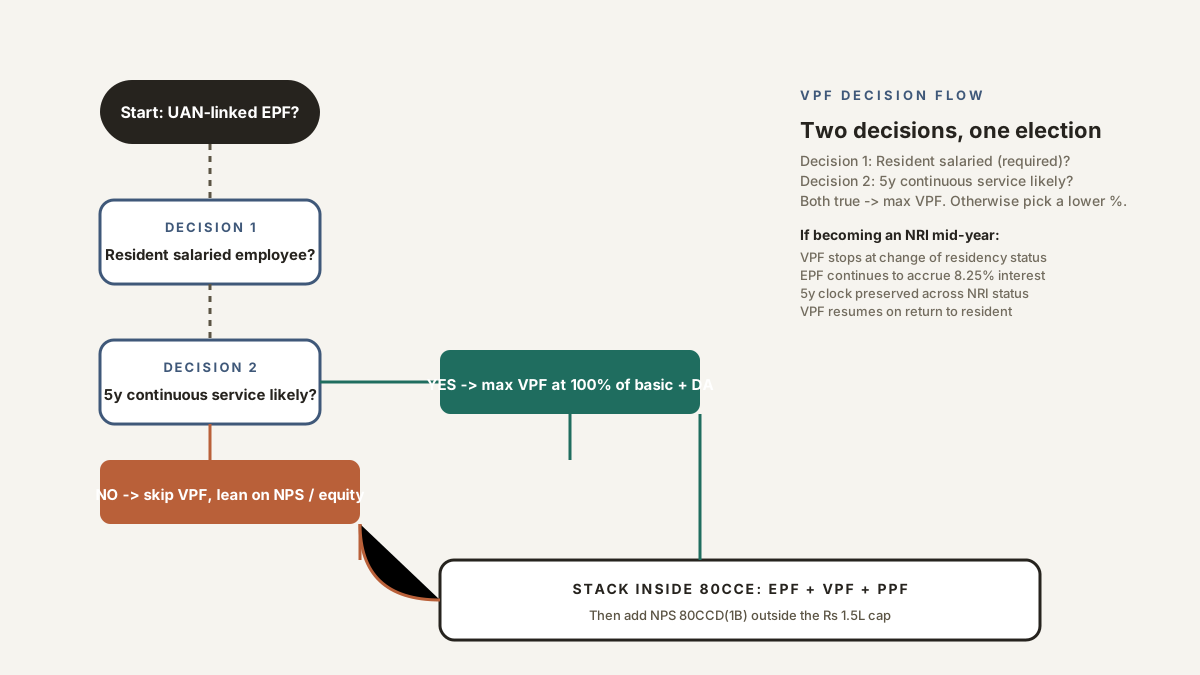
VPF cannot be continued by NRIs (the payroll deduction stops at the change of residency status). The existing EPF account continues to accrue 8.25% interest, and the 5-year continuous service clock is preserved as long as the UAN is active. The cleanest plan: max the VPF top-up in the years you are a resident, then rely on the EPF corpus and other layers (NPS, PPF, equity) once you are NRI.
Before you elect VPF for the financial year
VPF is a one-year commitment (with a 6-month minimum lock per EPFO rules). Confirm each item before electing.
- You are a salaried employee with a UAN-linked EPF account (VPF requires an active EPF).
- Your employer supports VPF deductions (most do, but some smaller employers do not offer VPF in payroll).
- You have a written HR confirmation that the VPF election is accepted for at least 6 months.
- The VPF percentage you pick fits inside the 80CCE Rs 1.5L ceiling (combined with EPF and any other 80C contributions).
- You have planned the rest of the retirement stack: NPS 80CCD(1B) is OUTSIDE 80C and can be added on top.
- You have a clear horizon for the 5-year continuous service clock — VPF top-up only makes sense if you will reach 5 years of continuous service with the same UAN.
- If becoming an NRI mid-year, plan the VPF election to stop at the change of status, not at year-end.
VPF election and exit decision flow
Need help with Tax & Residency?
Share your blocker in one line. Our experts will reply with practical next steps.
VPF workflow map from election to exit
The 2022 amendment changed everything
Before 2022, VPF was EET — the interest was taxable every year (which undermined the long-term compounding advantage vs EPF). The Finance Act 2022 moved VPF into the EEE bucket: every rupee of contribution, every rupee of interest, and every rupee of final withdrawal is now exempt. This is why VPF became the cleanest retirement top-up for salaried returning NRIs in 2022 onwards. If you are evaluating old advice, ignore any pre-2022 comparison that says VPF is worse than EPF on tax grounds — that is no longer true.
Animated decision map

Community signal
What to watch in real discussions
Treat repeated complaints as risk signals rather than official advice. This page does not link to community search results.
Interactive checkpoint
Turn this guide into a decision file
0 of 4 checked
What is the difference between EPF and VPF?
EPF is the mandatory Provident Fund contribution: 12% of basic + DA (employee), with a matching 12% from the employer (of which 8.33% goes to EPS pension, 3.67% to EPF). VPF is a voluntary top-up: the employee can contribute additional amounts up to 100% of basic + DA, less the 12% statutory EPF. The interest rate (8.25% per annum) and the tax treatment (EEE under Section 10(11) and 10(12) post-2022 amendment) are the same. The account is the same UAN-linked account. The only real difference is who contributes: EPF is mandatory (employee + employer), VPF is voluntary (employee only).
Can an NRI contribute to VPF after returning to India?
VPF is restricted to resident salaried employees. If you are an NRI, you cannot elect VPF (or any new EPF). When you return to India and establish resident status, you can re-open your EPF (if it was closed) or reactivate it, and then elect VPF. The 5-year continuous service clock for tax-free EPF withdrawal is preserved across NRI status changes as long as the UAN is active.
What is the maximum VPF contribution per year?
VPF can be up to 100% of basic + DA, less the 12% statutory EPF contribution. In practice, this means VPF can be up to 88% of basic + DA. For example, on a basic + DA of Rs 1 lakh per month, the statutory EPF is Rs 12,000, and the VPF top-up can be up to Rs 88,000 per month, for a total EPF + VPF deployment of Rs 1 lakh per month (100% of basic + DA). The annual cap is then Rs 12 lakh of basic + DA × 12 months, fully deployed into the EPF account at 8.25% sovereign interest.
Is VPF better than NPS for tax-efficient retirement savings?
They serve different roles. VPF is sovereign-backed (zero market risk) at 8.25%, EEE post-2022, locked until 5 years of continuous service. NPS is market-linked (8-12% historical range, no guarantee), EEE on 60% at exit, with 40% forced into an annuity. The 80CCD(1B) extra Rs 50,000 deduction for NPS is OUTSIDE the 80CCE cap, so NPS can be added on top of a maxed VPF without affecting the VPF/EPF deduction. The cleanest stack for a returning NRI: max EPF + VPF inside 80CCE, then add NPS 80CCD(1B) for the extra Rs 50,000.
What happens to my VPF if I leave my job before 5 years?
If you withdraw the EPF + VPF balance before completing 5 years of continuous service, the treatment is: (a) the employee's contribution + interest is tax-free under Section 10(12) post-2022 amendment, (b) the employer's contribution + interest becomes taxable as salary in the year of withdrawal. Before 2022, the employee's interest was also taxable, but the 2022 amendment made the employee's portion fully tax-free. The 5-year continuous service clock is preserved if you transfer the EPF + VPF balance to your new employer's EPF account within the prescribed window.
Should I max VPF at 100% of basic + DA?
It depends on your retirement horizon and the rest of your stack. If you are within 5 years of the continuous service clock expiring, maxing VPF locks in the full 8.25% sovereign, EEE compounding. If you are 10+ years from the clock, the marginal value of VPF (8.25% sovereign) is likely less than the marginal value of NPS (8-12% market-linked) or equity (10-12% long-term historical). The cleanest answer: max VPF up to the 80CCE ceiling, then add NPS 80CCD(1B), then discretionary equity. Re-evaluate each financial year.
Your tax year is already running.
RNOR status, exit timing, and DTAA benefits all depend on decisions you make before you land. Don't guess.