PPF (Public Provident Fund) for Returning NRIs: 15-year rule, triple-E tax status, and the NRI continuation trap
Step-by-step PPF guide for returning NRIs: the 15-year lock-in, 7.1% government-backed interest, EEE tax status, premature withdrawal rules, loan-against-PPF...
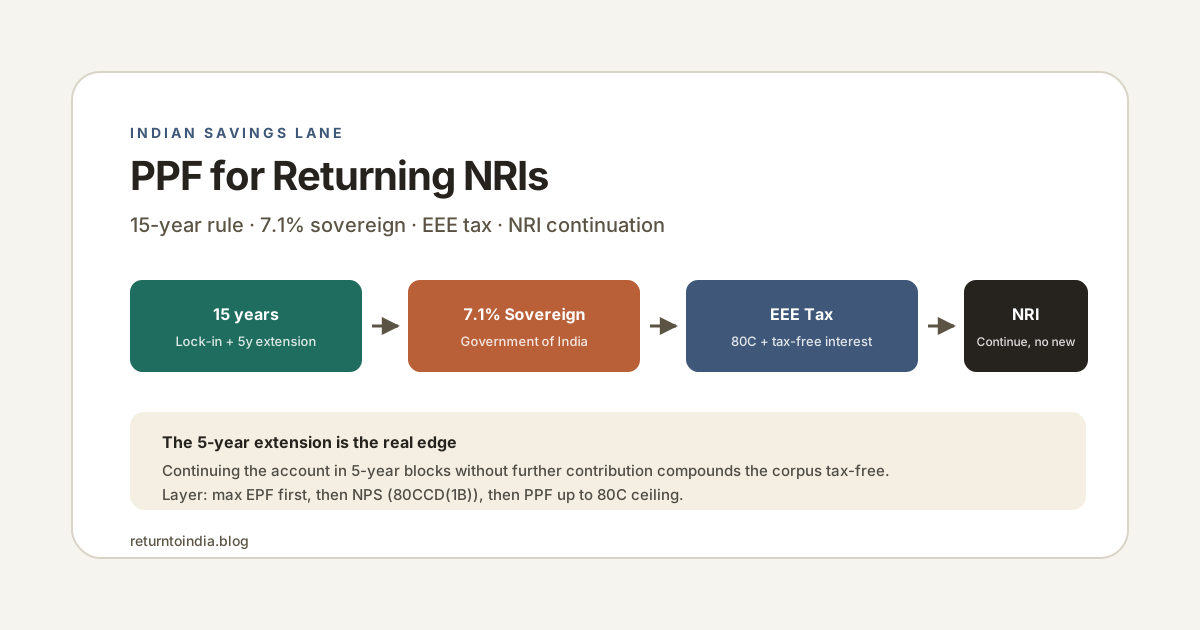
The 60-second version
PPF is the only Indian savings product that combines sovereign backing, a 15-year lock-in, and a fully exempt-exempt-exempt tax treatment. For returning NRIs, the decision is not whether to use PPF but whether existing accounts stay useful, whether new contributions are still allowed after residency changes, and how PPF pairs with EPF and NPS in a layered retirement stack.
Why PPF is a different kind of decision for a returning NRI
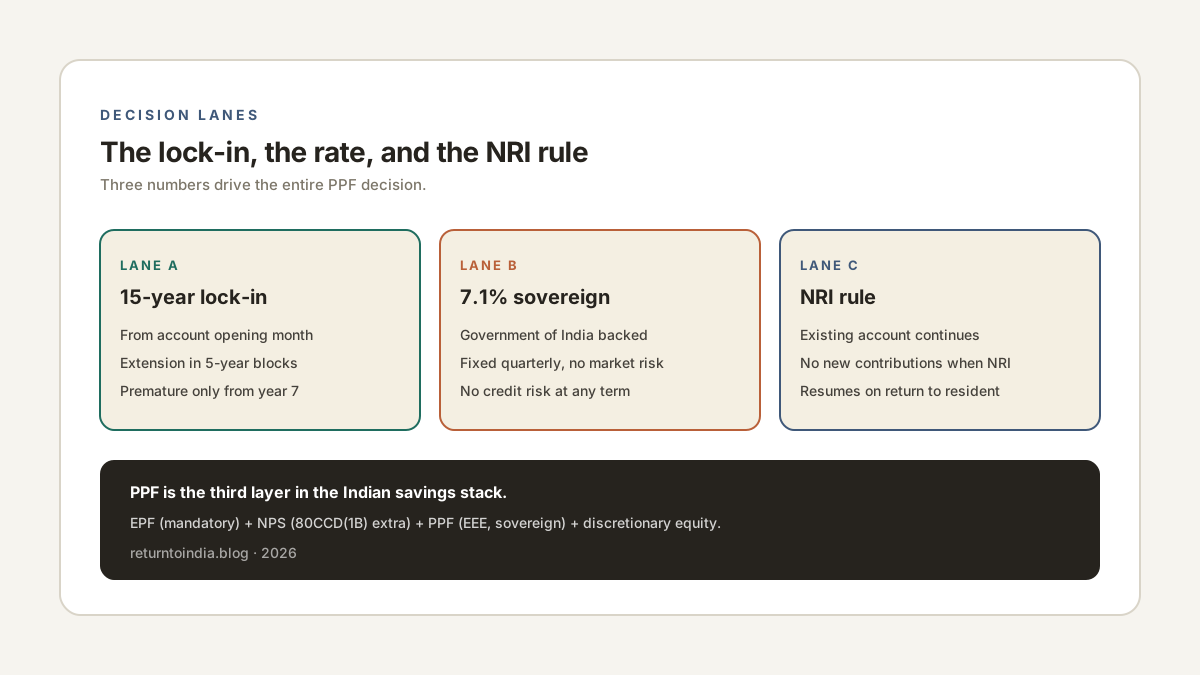
PPF is the only Indian savings product where every rupee of principal, interest, and final withdrawal is exempt from income tax. The Section 80C deduction on contributions, the tax-free interest accrual, and the tax-free maturity amount together form the EEE (exempt-exempt-exempt) status. For a returning NRI with stable Indian income, PPF is often the second or third layer in a retirement stack — after EPF and NPS, before discretionary equity.
The catch is the 15-year lock-in. PPF is designed as a long-horizon product, and the rules assume a stable Indian-resident contributor. Three questions drive the NRI decision: can the existing account continue, can new contributions be made after residency changes, and how does the 15-year timeline interact with the actual retirement plan. The pattern that hurts most contributors is treating PPF as a short-term tax-saving product and discovering at year 6 that premature withdrawals are restricted to specific purposes.
PPF vs EPF vs NPS vs FD: the tax-efficient savings matrix
PPF is one of four major Indian savings products. The right answer is usually a layered portfolio, not a single choice.
| Product | Risk | Interest / return | Lock-in | Tax status | NRI continuation |
|---|---|---|---|---|---|
| PPF | Sovereign (Government of India) | 7.1% per annum, fixed quarterly | 15 years (extendable in 5-year blocks) | EEE (Section 80C + tax-free interest + tax-free maturity) | Existing accounts continue, no new PPF for NRIs |
| EPF | Sovereign (EPFO-managed) | 8.25% per annum | Till age 58 (or 5 years of continuous service for tax-free withdrawal) | EEE under Section 10(10B) after 5y continuous service | Account continues for NRIs; withdrawals follow specific rules |
| NPS Tier 1 | Market-linked (PFM-managed) | 8-12% historical range, not guaranteed | Till age 60 (40% forced into annuity) | EEE on the 60% lump sum; annuity is taxable | Existing account continues; new contributions allowed for NRIs |
| Bank FD (5-year tax-saver) | Insured up to Rs 5L by DICGC | 7-7.5% per annum | 5 years | Section 80C deduction on contribution; interest fully taxable | NRI FCNR/NRE FDs available; resident FDs may need closure on NRI status change |
Execution sequence: from opening to optimal 15-year exit
PPF is a multi-decade product. The execution decisions matter at year 0, year 6, year 15, and every 5-year extension.
Open at a Post Office or authorised bank
Open a PPF account at any Post Office, State Bank of India, or a handful of other authorised banks. The minimum deposit is Rs 500 per financial year (in multiples of Rs 50), and the maximum is Rs 1.5 lakh per year. The annual deposit cap is shared with other 80C investments, so plan against the 80CCE ceiling before adding PPF on top.
Decide the contribution cadence
You can deposit monthly, quarterly, or in a single lump sum before March 31 each year. Missing the minimum of Rs 500 in a year triggers account deactivation (revivable with a small penalty). Automating monthly deposits is the cleanest way to avoid the deactivation penalty and to spread interest accrual across the year.
Time the lock-in to your real retirement plan
PPF matures at the end of year 15 from the account opening month. If you open in June 2026, the first maturity is May 2041. The 15-year horizon is the floor; the product becomes more powerful if extended in 5-year blocks with no further contribution (continued compounding on the full corpus).
If you become an NRI mid-term, do not close the account
Per RBI rules, an existing PPF account can continue to accrue interest even after the holder becomes an NRI. New contributions are not allowed for NRIs (this changed with the 2019 PPF scheme revision; check the latest India Post notification). The full maturity amount is still tax-free under the EEE status. Closing the account early forfeits the lock-in advantage.
Plan the extension in 5-year blocks after year 15
At maturity, you can withdraw the entire corpus OR extend the account in 5-year blocks. Extensions without further contribution let the corpus continue to compound at 7.1%. Extensions with contribution are allowed but the 80C deduction is subject to the overall cap. Most long-horizon savers pick the no-contribution extension for the compounding benefit.
Plan premature withdrawal before you need it
Premature withdrawal is allowed from year 7 onwards, but only for specific purposes (higher education, medical treatment, housing loan repayment). The amount is limited to a percentage of the balance, and the interest is recalculated at a lower rate. The cleanest path is to never need premature withdrawal; if you might, plan for it in year 7 onwards.
Before you make your first PPF contribution
PPF is low-risk but has rules that catch contributors off-guard. Confirm each item before opening.
- You are a resident individual (PPF is not open to NRIs at opening; existing NRIs can continue but cannot extend in 5-year blocks beyond 15 years for fresh deposits, depending on the latest scheme notification).
- Aadhaar is linked to PAN (required for any Section 80C claim and ITR filing).
- PAN is on file at the bank or Post Office branch where the PPF account is held.
- The bank branch is on the authorised PPF list (most public-sector banks are; private banks vary).
- You have a deposit cadence (monthly, quarterly, or annual) that meets the Rs 500 minimum every year without fail.
- You have planned the 15-year horizon: the lock-in is the cost; the compounding is the benefit. Both are decisions, not accidents.
- If you plan to become an NRI during the 15 years, the account can be continued (per current rules) but new contributions stop at the point of NRI status change. Plan your corpus target accordingly.
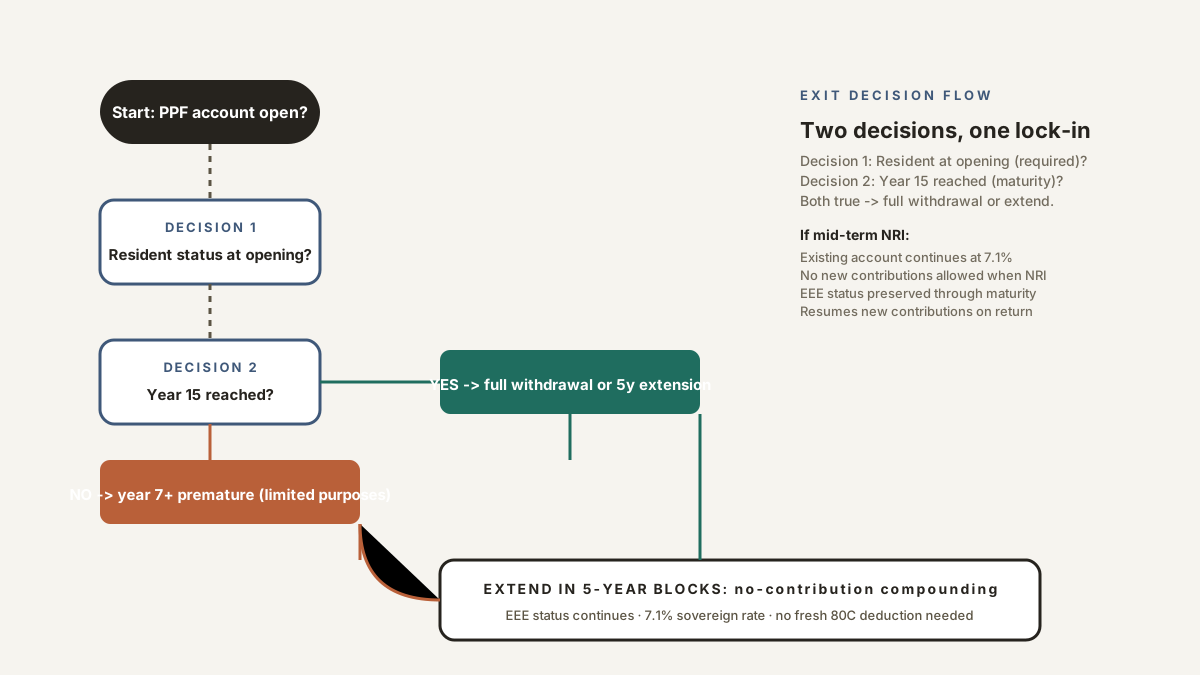
PPF 15-year exit decision flow
Need help with Tax & Residency?
Share your blocker in one line. Our experts will reply with practical next steps.
PPF workflow map from opening to extension
The NRI continuation rule is the trap that catches people
If you opened a PPF account as a resident and later become an NRI, the account does NOT auto-close. It continues to accrue interest at 7.1%. But new contributions are not allowed once you are an NRI. The cleanest plan: max out the PPF before the year you become an NRI, then let the existing corpus compound. Do not close the account early in panic — you would forfeit both the lock-in compounding and the EEE status. If you return to India later, the account can be reactivated for new contributions from the year of return.
Animated decision map

Community signal
What to watch in real discussions
Treat repeated complaints as risk signals rather than official advice. This page does not link to community search results.
Interactive checkpoint
Turn this guide into a decision file
0 of 4 checked
Can an NRI continue an existing PPF account?
Yes, per the PPF scheme rules, an existing PPF account opened while you were a resident Indian continues to accrue interest even after you become an NRI. The 7.1% per annum rate continues, and the maturity amount remains fully tax-free under the EEE status. However, new contributions are not allowed once you become an NRI — the account continues to grow on the existing corpus only. If you return to India and become a resident again, new contributions can resume from the financial year of return.
Can an NRI open a new PPF account?
No. PPF is restricted to resident individuals at the time of account opening. The Post Office and authorised banks will reject an NRI's application to open a new PPF account. If you want to start a PPF and you are currently an NRI, the cleanest path is to first establish resident status (which happens automatically in your RNOR year if you meet the 182-day rule), and then open the PPF in that resident year.
What is the lock-in for PPF and can I extend it?
PPF has a mandatory 15-year lock-in from the account opening month. At maturity, you can withdraw the entire corpus (tax-free) OR extend the account in 5-year blocks. Each extension lets you choose: contribute fresh (subject to the 80CCE cap) OR not contribute (continued compounding on the full corpus). Most long-horizon savers pick the no-contribution extension for pure compounding benefit. Extensions can continue indefinitely as long as you make at least one deposit in each 5-year block if you opt for further contribution.
Can I take a loan against my PPF account?
Yes, from year 3 onwards, you can take a loan against your PPF account. The loan amount is up to 25% of the balance at the end of the second year before the loan application. The interest rate on the PPF loan is 2 percentage points above the prevailing PPF interest rate (currently ~9.1%). The loan must be repaid within 36 months. This is a useful feature for short-term liquidity without breaking the PPF itself, but the loan rate is high enough that you should compare against a personal loan or overdraft before choosing PPF-loan.
Is PPF better than a 5-year bank FD?
For tax-equivalent comparison, a 5-year tax-saver FD gives the same Section 80C deduction as PPF but with a shorter lock-in and fully taxable interest. PPF's EEE status makes the post-tax return materially higher. A simple rule of thumb: if your marginal tax rate is 30%, the equivalent post-tax FD rate would need to be ~10.1% to match PPF's 7.1% tax-free rate. Most 5-year FDs do not deliver that. If your tax rate is lower or you can find a tax-free instrument elsewhere, the comparison is closer, but PPF is rarely beaten on a post-tax, post-inflation basis for a 15-year horizon.
How does PPF interact with EPF and NPS in a layered stack?
The cleanest pattern for a returning NRI with stable Indian income: max EPF first (mandatory for salaried, 12% of basic + DA), then add NPS up to the 80CCD(1B) extra Rs 50,000, then max PPF within the 80C ceiling, then discretionary equity or debt. The Rs 1.5L 80C cap is shared by EPF voluntary contributions, ELSS, home loan principal, life insurance, and PPF. PPF's lock-in means you should treat it as the last 80C addition, not the first — the other 80C products offer more flexibility if you need to free up cash mid-term.
Your tax year is already running.
RNOR status, exit timing, and DTAA benefits all depend on decisions you make before you land. Don't guess.