NPS (National Pension System) for Returning NRIs: 80CCD(1B) tax benefit, 60% tax-exempt rule, and the annuity trap after 60
Step-by-step NPS guide for returning NRIs: Tier 1 vs Tier 2, 80CCD(1), 80CCD(1B), 80CCD(2) tax benefits, the 60% tax-free and 40% annuity rule at exit, and the...
The 60-second version
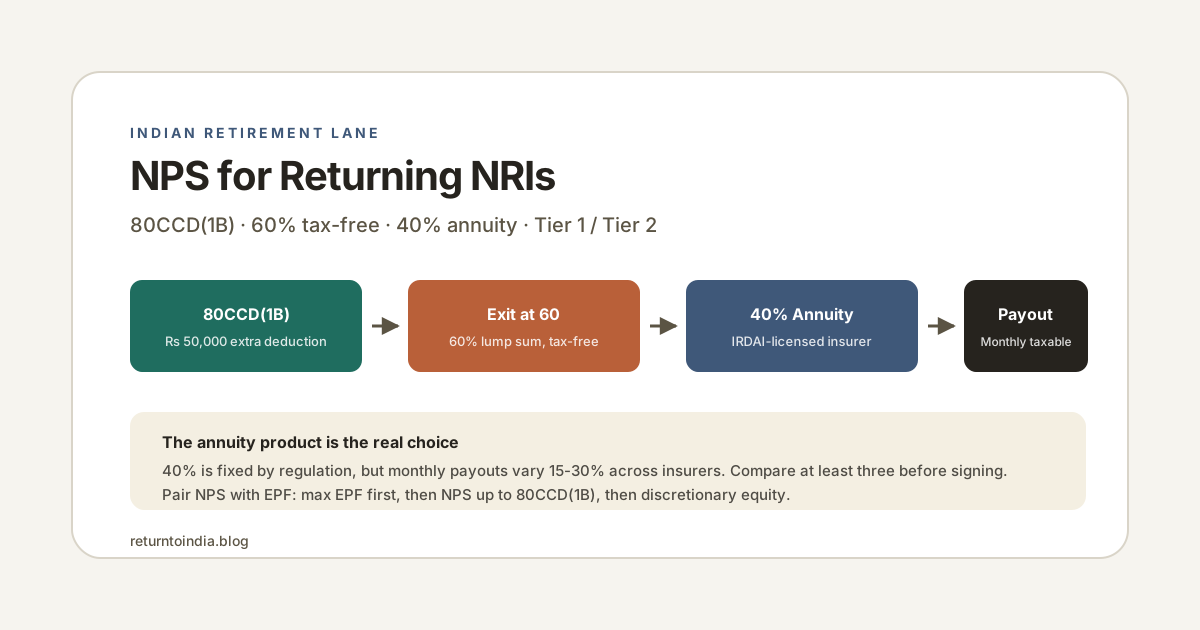
NPS is the most tax-efficient Indian retirement vehicle on paper, but the exit rules catch most contributors off-guard. The 60% tax-free portion, the 40% mandatory annuity, the asset-allocation constraints, and the way RNOR/ROR residency status affects new contributions after you return are the four things to understand before you add a single rupee.
Why NPS deserves a careful look on a return-to-India move
NPS is the only Indian retirement vehicle that gives you an extra ₹50,000 deduction under Section 80CCD(1B) on top of the ₹1.5 lakh Section 80C ceiling. For a returning NRI with a stable Indian salary, that extra deduction often decides whether the contribution is worth it. The decision is not, however, only about tax. NPS is also the only retirement product where 40% of your corpus is forced into an annuity at exit, and the annuity you choose is rarely the annuity you would have picked yourself.
Four questions drive the entire decision: which tier to open, how to maximise the Section 80CCD deductions without breaching the Section 80CCE overall cap, what happens at age 60 (or earlier exit), and how your status as NRI versus resident affects new contributions after you return. The pattern that hurts most NRIs is contributing through an Indian employer in a low-income year, then trying to exit in a higher-income year and discovering that 40% of the corpus is locked in an annuity that pays less than the inflation rate.
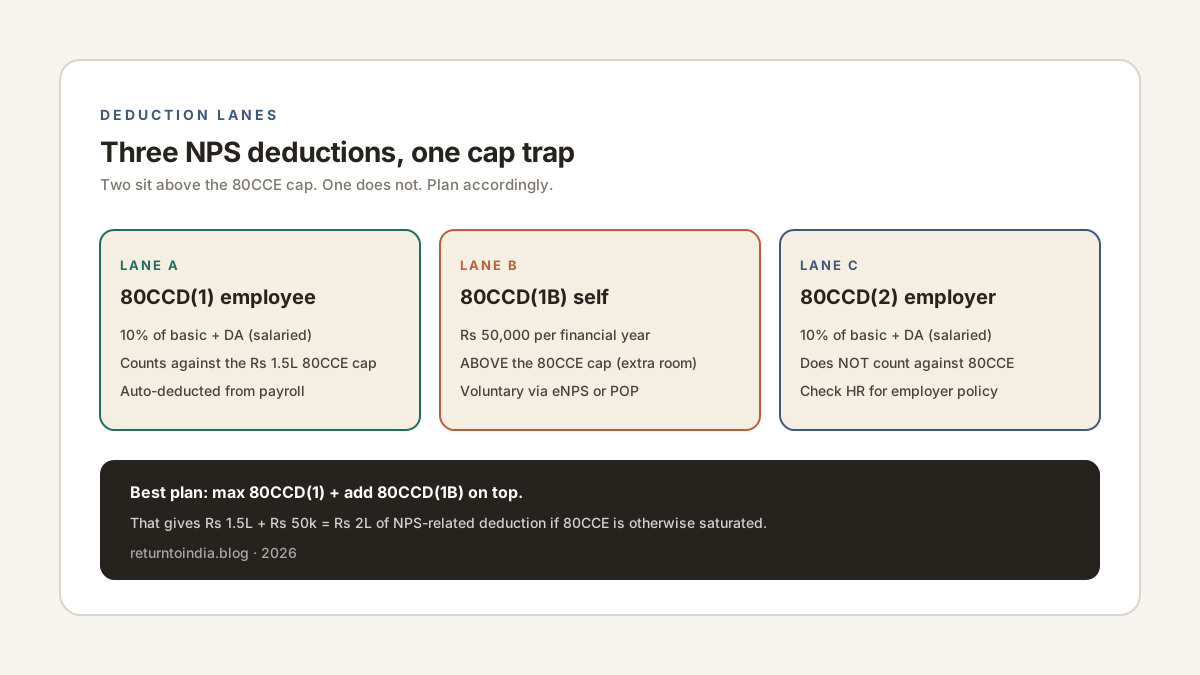
NPS deduction matrix: 80CCD(1), 80CCD(1B), 80CCD(2), and the 80CCE cap
All three NPS deductions sit under Section 80CCE, which has an overall ceiling of ₹1.5 lakh per financial year (combined with 80C, 80CCC, and 80CCD). Only 80CCD(1B) gives you extra room above that cap.
| Deduction | Who contributes | Max limit | Counts against 80CCE cap? | Practical trigger |
|---|---|---|---|---|
| Section 80CCD(1) — employee NPS | Salaried employee (NRI or resident) | 10% of basic + DA (salaried) | Yes — counts against the ₹1.5L 80CCE cap | Auto-deducted from salary if employer runs NPS |
| Section 80CCD(1B) — self NPS | Any individual (salaried, self-employed, or NRI with Indian income) | ₹50,000 per financial year | No — sits ABOVE the 80CCE cap | Voluntary contribution via eNPS or Point of Presence |
| Section 80CCD(2) — employer NPS | Salaried employee | 10% of basic + DA (salaried, no 80CCE cap) | No — does not count against 80CCE | Employer policy; check offer letter or HR confirmation |
| 80CCE overall cap | Combined 80C + 80CCC + 80CCD(1) contributions | ₹1.5 lakh per financial year | This is the cap | Plan 80C, ELSS, EPF, home loan principal against this cap first |
Execution sequence: from opening to optimal exit
Treat NPS as a multi-decade decision with four checkpoints. Re-evaluate at each one.
Decide Tier 1 vs Tier 2 before opening
Tier 1 is a pension account with tax benefits, restricted withdrawals, and mandatory annuitisation at exit. Tier 2 is a flexible savings account that does not get 80CCD benefits but allows full withdrawal at any time. Most people need only Tier 1; Tier 2 is for parking NPS-PFM money temporarily.
Open the account via eNPS or your employer's payroll
If your Indian employer offers NPS, contribute through payroll — the 80CCD(1) auto-deducts and the 80CCD(2) employer contribution is also captured. For self-employed or salary without employer NPS, open a Tier 1 account on eNPS and contribute manually for 80CCD(1B).
Pick the right Pension Fund Manager and asset allocation
PFM choice is a low-impact decision over 30+ years (the difference between the best and worst active PFMs is small), but the active vs auto choice is high-impact. The Aggressive Life Cycle fund suits a returning NRI in their 30s with a 25+ year horizon; the Conservative fund suits someone within 5 years of exit. Do not default to the Equity scheme without reading the PFRDA fact sheet.
Time your contributions to maximise the deduction in the right year
If you are a returning NRI landing in a low-income RNOR year, the 80CCD(1B) deduction is the most tax-efficient use of that year's lower tax bracket. Conversely, in a high-income ROR year, consider whether the deduction is worth locking 40% of the corpus in an annuity. The deduction is good, but not always good in every year.
Plan the exit, not just the entry
At age 60, you can withdraw up to 60% of the corpus tax-free. The remaining 40% must buy an annuity from an IRDAI-licensed insurer. Pick the annuity product before the PFM exit window opens. Most retirees pick a default life annuity that pays a fixed monthly amount — but the payout is modest and inflation-adjusted options are limited. Compare at least 3 insurers before signing the annuity proposal.
If exiting before 60, count the cost
Premature exit (before age 60) is allowed only for specific reasons (terminal illness, critical illness, or after 25% of the corpus has been built). The 20% tax-free bucket shrinks to 25% in those cases, and 75% goes to annuity. Voluntary full exit before 60 is not permitted; the NPS is a long-horizon product by design.
Before you make your first NPS contribution
These are the items that, when missing, cause the most common NRI-specific NPS mistakes.
- You are eligible to contribute — Indian citizen, NRI, or OCI cardholder; resident status confirmed for the contribution year.
- PAN is on file with the PFM (required for any deduction claim and 80CCD(1B) tax credit).
- Aadhaar is linked to PAN (mandatory for ITR filing and AIS reconciliation).
- Your chosen PFM is the active one (you can switch PFMs once a year, but each switch is a churn event).
- If contributing through employer: confirm in writing that 80CCD(2) employer contribution is enabled — many Indian employers do not default to it.
- If contributing via eNPS: keep the PRAN (Permanent Retirement Account Number) in a safe place and update the bank account to an NRO/NRE account after returning.
- You have planned the exit year in advance, not as a surprise. The 60% tax-free bucket is the upside; the 40% annuity is the constraint. Both are decisions, not accidents.
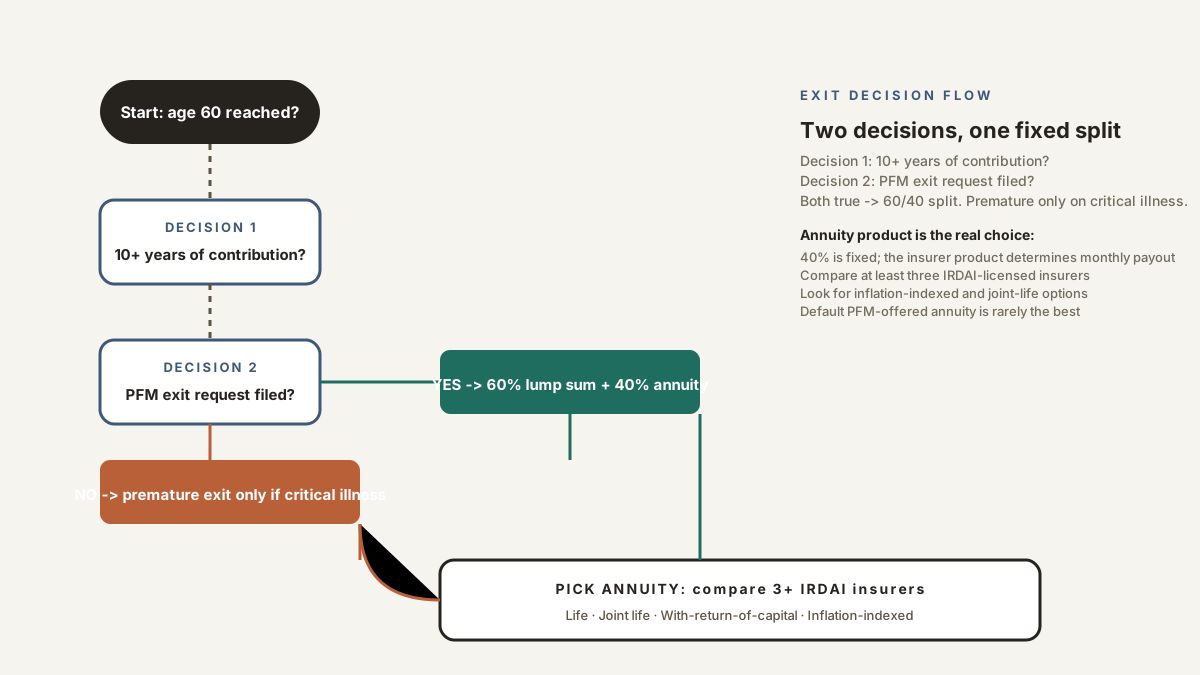
NPS exit decision flow at age 60
Need help with Tax & Residency?
Share your blocker in one line. Our experts will reply with practical next steps.
NPS workflow map from contribution to exit
The annuity is not the end of the decision
NPS forces 40% of the corpus into an annuity at age 60. The product inside that bucket is your real choice. The default offer from the PFM is rarely the best available product — IRDAI-licensed insurers offer different annuity products (life annuity, joint life, with-return-of-capital, inflation-indexed) at different payouts. Compare at least three insurers before signing. The 40% bucket is fixed, but the monthly payout inside it can vary by 15-30% across providers.
Animated decision map

Community signal
What to watch in real discussions
Treat repeated complaints as risk signals rather than official advice. This page does not link to community search results.
Interactive checkpoint
Turn this guide into a decision file
0 of 4 checked
Can an NRI contribute to NPS after returning to India?
Yes. NRIs who are Indian citizens or OCI cardholders can open a Tier 1 NPS account via eNPS and contribute. The 80CCD(1B) self-contribution deduction of ₹50,000 per financial year is available as long as you have Indian taxable income in the year of contribution. If you contributed through an Indian employer while you were still NRI, those contributions are valid and the deduction is allowed. The key constraint is that you cannot be a citizen of a country that does not allow NPS contributions (currently no such restriction exists, but the PFM may ask for KYC confirmation).
What is the 60% tax-free rule and the 40% annuity rule at NPS exit?
At age 60 (or at exit after 10 years of contribution, whichever is later), you can withdraw up to 60% of the NPS corpus as a lump sum that is completely tax-free under Section 10(10A) of the Income Tax Act. The remaining 40% must be used to purchase an annuity from an IRDAI-licensed insurer. The annuity payouts are taxable as salary income in the year you receive them. The lump sum portion is fully exempt; the annuity portion is fully taxable but spread over your lifetime.
Is the 80CCD(1B) ₹50,000 deduction over and above Section 80C?
Yes, and this is the unique NPS advantage. The Section 80CCE overall cap is ₹1.5 lakh per financial year, covering 80C + 80CCC + 80CCD(1) combined. The 80CCD(1B) deduction of ₹50,000 sits outside this cap, so a salaried employee can claim up to ₹1.5 lakh (80C + 80CCD(1)) plus another ₹50,000 (80CCD(1B)) = ₹2 lakh of NPS-related deduction per year. The 80CCD(2) employer contribution (up to 10% of basic + DA) is also outside the 80CCE cap.
What happens if I exit NPS before age 60?
Premature full exit is not allowed under standard rules. You can only withdraw from NPS before 60 under specific conditions: terminal illness, critical illness, or after building at least 25% of the corpus (typically after 10+ years of contribution). In those cases, only 20% of the corpus is tax-free, and 75% must go to annuity. The remaining 5% is at the PFM's discretion but typically retained in your NPS account. Voluntary surrender before 60 will lock your corpus in the annuity pool until you reach 60.
Does NPS continue to be useful after I become a Returning NRI?
Yes, with one nuance. Your existing NPS account continues to accrue value at the PFM's chosen rate. New contributions can be made as long as you have Indian taxable income, and the 80CCD(1B) deduction is still available. The asset allocation cannot include foreign securities if you become an NRI under PFRDA rules (the PFM will rebalance to a NRI-compliant allocation). The 60% tax-free exit rule applies equally to NRIs and residents. The main risk is over-contributing in a low-income RNOR year and then having the 40% annuity constraint lock you in.
Should I prefer NPS or EPF for my Indian retirement?
They serve different roles. EPF is mandatory for salaried employees (12% of basic + DA, with 8.25% interest), offers tax-free withdrawal at 5+ years of continuous service, and is governed by the EPFO. NPS is voluntary, has market-linked returns (8-12% historically depending on allocation), gives the extra 80CCD(1B) deduction, but forces 40% into an annuity. The most common mistake is choosing one over the other. For most returning NRIs, the right answer is: max EPF, then add NPS up to the 80CCD(1B) limit, and treat the rest as discretionary equity or debt mutual funds.
Your tax year is already running.
RNOR status, exit timing, and DTAA benefits all depend on decisions you make before you land. Don't guess.