EPF Withdrawal After Returning to India: UAN, Form 19, Form 10C, and the 2026 TDS Reality
Step-by-step EPF and PF withdrawal for returning NRIs: UAN activation, KYC update, Form 19 (PF) and Form 10C (pension), bank account link to NRO or NRE, TDS rates...
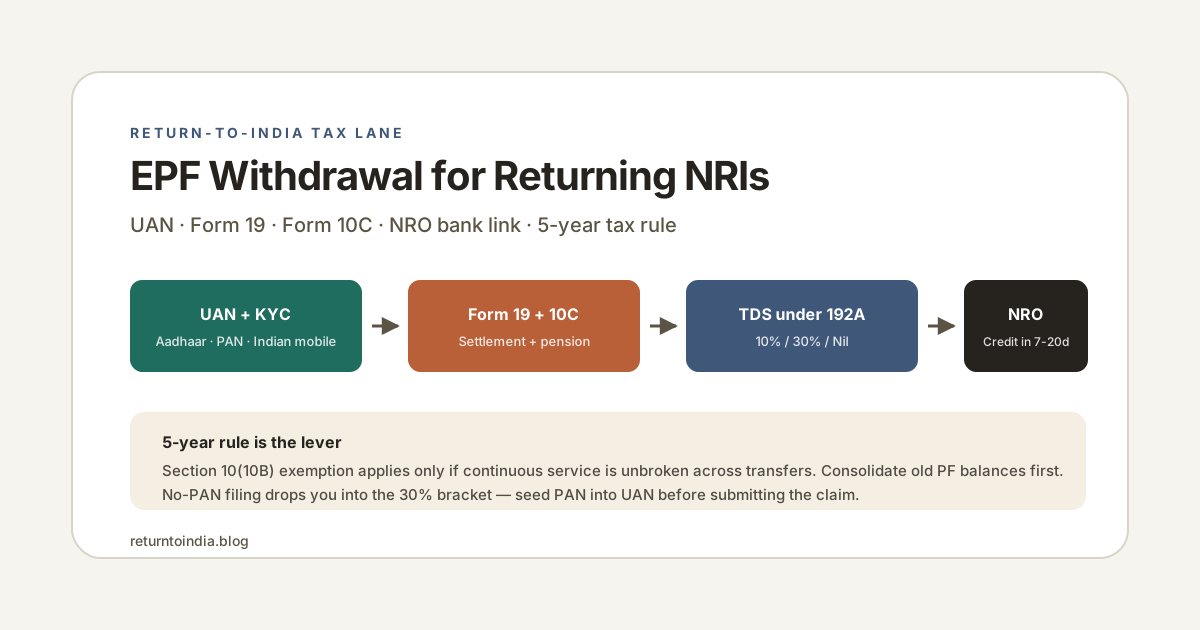
The 60-second version
Most returning NRIs leave money in their EPF account because the first claim gets bounced on KYC mismatch or wrong bank account mapping. The real job is not filing a form — it is preparing UAN, KYC, bank account, and tax-residency status in the right order so the settlement clears in one cycle.
Why most first-time PF claims by NRIs get bounced
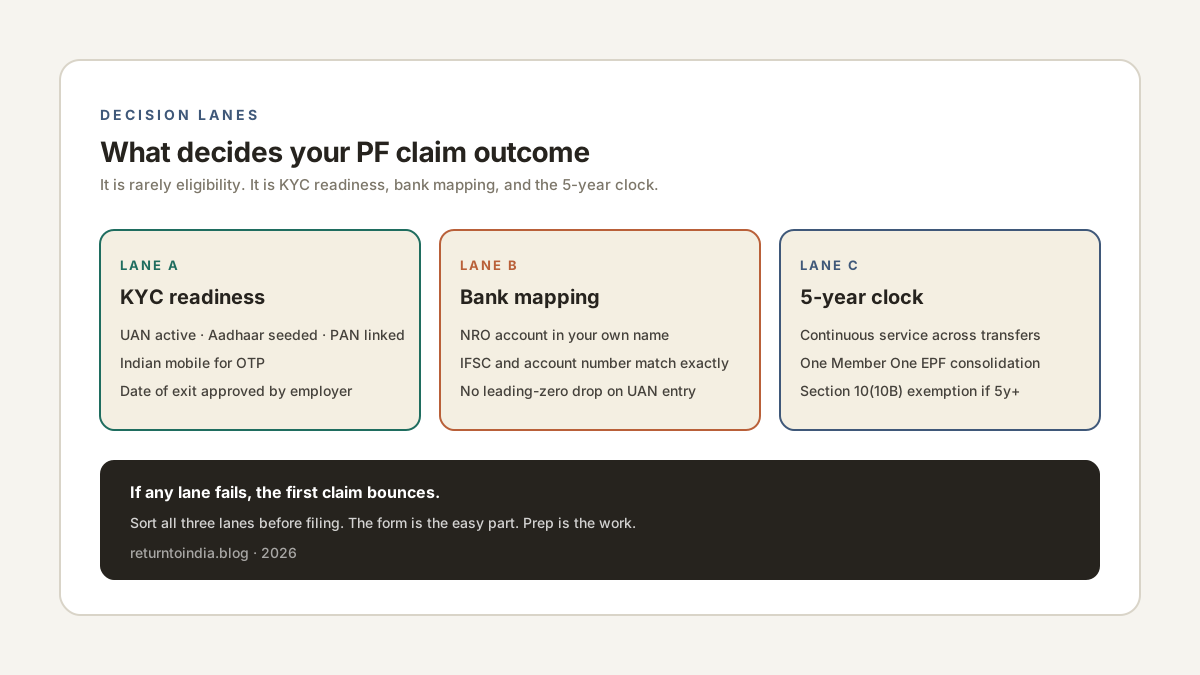
Every year, a large share of PF withdrawal claims filed by returning NRIs get rejected on the first attempt. The rejection is almost never about eligibility — it is about the order in which UAN activation, KYC, bank account mapping, and tax-residency updates are done. EPFO does not adjudicate the underlying claim when the KYC is mismatched. It simply returns the form, sometimes after a 30 to 60 day cycle, and the member has to start over.
The four pre-conditions are UAN activation with a working mobile number, Aadhaar seeding (which is mandatory for online claims), a PAN linked to UAN, and a bank account that is in the name of the UAN holder and accepts inward credits of the type EPFO initiates. For a returning NRI, the bank account in India is usually an NRO account — and that is where the first mistake happens, because the account number or IFSC entered into UAN does not match the bank record exactly.
Once the KYC and bank are clean, the actual claim is straightforward. Form 19 settles the EPF corpus, Form 10C settles the pension (Employees' Pension Scheme) withdrawal benefit, and Form 31 is the partial advance route. Tax treatment depends on continuous service length, the reason for leaving service, and whether PAN is on file.
TDS on EPF withdrawal: 2026 rates by PAN, service length, and reason
Section 192A of the Income Tax Act governs TDS on EPF withdrawals. The matrix below is the practical version of the rule, not the legal one — always cross-check the latest circular before filing.
| Scenario | TDS rate | Practical trigger | What to file |
|---|---|---|---|
| PAN available, continuous service 5 years or more, withdrawal ≤ ₹50,000 | Nil | Form 15G / 15H not required; declare non-taxable status in Form 19 | Form 19 + Form 10C with service reason 'retirement' or 'superannuation' |
| PAN available, continuous service 5 years or more, withdrawal > ₹50,000 | Nil (exempt under Section 10(10B) for non-government employees) | Continuous service must be unbroken; verify the joining and exit dates on UAN | Form 19 + Form 10C, with exit reason matching service record |
| PAN available, continuous service less than 5 years, withdrawal ≤ ₹50,000 | Nil (no TDS below threshold) | Threshold is per PAN per financial year for EPF withdrawals | Form 19 + Form 10C |
| PAN available, continuous service less than 5 years, withdrawal > ₹50,000 | 10% on the amount exceeding ₹50,000 | If you have DTAA-eligible NRI status, claim relief via Form 67 in ITR | Form 19 + Form 10C; retain TDS certificate for ITR |
| PAN not available, any withdrawal > ₹50,000 | 30% (or maximum marginal rate) — non-PAN rate | Link PAN to UAN before filing, even if PAN is not yet active for ITR | Link PAN via UAN portal → re-submit claim; do not file without PAN |
| Recognised provident fund with employer contribution + interest qualifying for Section 10(10B) exemption | Nil | 5-year rule applies per employer; multiple employers reset the count | Form 19 only; Form 10C not required if total service < 6 months in EPS |
Execution sequence: from UAN check to money in the NRO account
Do these in order. Skipping ahead is exactly what causes the first-claim rejection.
Activate UAN and link mobile number
If you have never logged into the UAN member portal, activate the UAN against your employer records first. A working Indian mobile number is required to receive OTPs and claim status updates. International numbers work only if EPFO has whitelisted them in the portal settings, which is rare.
Seed Aadhaar and PAN into UAN
Aadhaar seeding is mandatory for online Form 19 / 10C claims. PAN seeding is required for the 10% TDS rate and for any refund path. If your PAN has changed (for example, due to name correction after marriage), update it in the UAN portal before the next step.
Update KYC: Aadhaar, PAN, bank account, IFSC
Open the KYC section in the UAN portal. Submit Aadhaar (already seeded), PAN, and the Indian bank account you want the credit to land in. For returning NRIs, this is usually an NRO account in the member's own name. The IFSC and account number must match the bank passbook or statement exactly — including leading zeros.
Wait for employer approval of KYC and exit date
Your last employer must approve the KYC and the date of exit on the UAN portal. If the employer is unresponsive, raise an EPFiGMS grievance. Without employer approval, the online claim form will not be accepted.
File Form 19 and Form 10C online
Use the UAN member portal 'Online Claim' section. Select 'Only PF (Form 19)' if you have less than 9.5 years of service and want the pension withdrawal benefit too, or 'PF Advance (Form 31)' for partial withdrawal. For most returning NRIs, the standard claim is Form 19 + Form 10C together.
Track the claim on the EPFO portal and via SMS
After submission, the claim enters the employer-approval queue, then the PF office queue. The portal shows the current stage. Credit usually takes 7 to 20 working days after the PF office approves. If it takes longer, raise an EPFiGMS grievance with the claim number.
Reconcile TDS against Form 26AS / AIS
After the credit lands, download the TDS certificate (Form 16A) from the TRACES portal. Cross-check the amount with your Form 26AS and AIS. For a refund or treaty relief, file Form 67 before the ITR for that financial year and claim credit for the tax deducted.
Before you file Form 19, confirm every line on this list
These are the items that, when missing, cause the first rejection. Do not skip any of them.
- UAN is active, and the mobile number on UAN receives OTPs (Indian mobile required for online claim).
- Aadhaar is seeded into UAN and verified (mandatory for online claims).
- PAN is linked to UAN — even a name mismatch between PAN and UAN will reject the claim.
- Bank account is in the member's own name, type NRO (or NRE for fully repatriable cases), and the IFSC and account number match the passbook exactly.
- Date of exit is updated by the employer in the UAN portal. Without this, the online claim form is unavailable.
- Continuous service length is correctly visible in the service history — if any employer is missing, fix this first via EPFiGMS.
- Form 15G / 15H is filed in the ITR if you are eligible (total income below basic exemption) — though Form 19 does not accept Form 15G for EPF specifically.
- Your Indian address is current and matches the Aadhaar record, because EPFO communicates by post for any discrepancy.
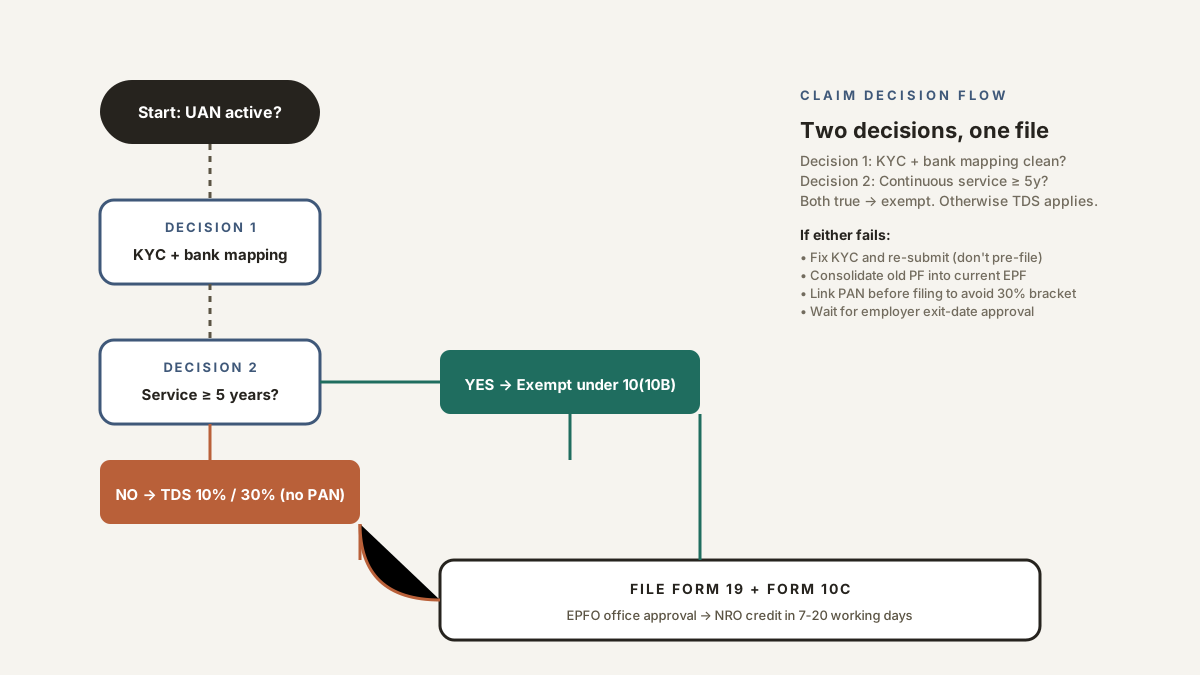
EPF claim decision flow for returning NRIs
Need help with Tax & Residency?
Share your blocker in one line. Our experts will reply with practical next steps.
Workflow map from UAN prep to reconciled ITR
The 5-year rule is the single biggest lever
If you have 5 years or more of continuous service with the same employer (or with overlapping EPS-eligible service), the EPF withdrawal is exempt under Section 10(10B) for non-government employees. The 5-year clock resets when you change employers and do not transfer the PF balance, which is common for NRI returnees. Before filing, check the service history in UAN and transfer old PF balances into the current EPF account — this is what preserves the 5-year count for the final withdrawal.
Animated decision map

Community signal
What to watch in real discussions
Treat repeated complaints as risk signals rather than official advice. This page does not link to community search results.
Interactive checkpoint
Turn this guide into a decision file
0 of 4 checked
Is EPF withdrawal taxable when I am returning to India as an NRI?
It depends on continuous service length, not on your residential status. If you have 5 years or more of continuous service and the employer is a non-government establishment, the withdrawal is exempt under Section 10(10B). For shorter service, TDS at 10% (with PAN) or 30%+ (without PAN) applies to amounts above ₹50,000. The residential status — NRI, RNOR, or ROR — does not by itself change the tax treatment at the point of withdrawal, but it does affect how the TDS is reconciled in the ITR via Form 67 if you are claiming treaty relief.
Do I need to change my EPF bank account to an NRO before withdrawing?
Yes, for a returning NRI, the credit needs to land in an Indian account in your own name. The most common choice is an NRO account, because it accepts both Indian and foreign currency credits and treats the EPF payout as a domestic inward remittance. NRE accounts are also acceptable, but NRE balances must be from foreign sources — if the EPFO credit is treated as Indian-source income (which it usually is), NRO is the technically correct destination. Update the bank account in the UAN KYC section before filing, and confirm the IFSC and account number match exactly.
What is the 5-year rule for tax-free PF withdrawal, and does changing jobs reset it?
The 5-year rule is part of the recognised provident fund exemption under Section 10(10B). For non-government employees, the entire corpus (employer contribution + interest) is tax-free if you have completed 5 years or more of continuous service with the same employer. If you change jobs, the PF balance is supposed to be transferred to the new employer's EPF account — and only the continuous service across both employers counts. In practice, many NRIs skip the transfer, which restarts the 5-year clock. Before you file, check the service history in UAN and use the 'Track Claim' or 'One Member One EPF' service to consolidate older balances. This preserves the 5-year count.
How long does PF withdrawal take after I submit Form 19 and Form 10C?
For online claims with clean KYC, the typical cycle is 7 to 20 working days from the date the PF office approves the claim. The full timeline has three stages: (1) employer approval of the date of exit and KYC, usually 3 to 10 days, (2) PF office adjudication, usually 3 to 7 days, and (3) credit through the bank, usually 2 to 5 working days. The total tends to be 2 to 4 weeks when everything is clean. If the claim sits in any queue beyond 30 days, raise an EPFiGMS grievance with the claim number from the portal — the grievance is usually resolved within 7 to 15 days.
Can I withdraw PF without PAN, and what happens if I do?
You can technically file the claim without PAN, but the TDS is then applied at 30% (or the maximum marginal rate) on any withdrawal above ₹50,000. For most returning NRIs, that is a meaningful tax wedge — easily several lakhs in TDS on a typical 10-year EPF corpus. The fix is to link PAN to UAN before filing, even if your PAN is not yet active in the ITR database. Once PAN is seeded, the claim is automatically re-adjudicated at the 10% rate and the excess TDS is refundable in the ITR via Form 67 and the regular return filing process.
What is the difference between Form 19, Form 10C, and Form 31?
Form 19 is for final PF settlement — it pays out your entire EPF corpus (employee + employer contribution + interest). Form 10C is for the pension withdrawal benefit under the Employees' Pension Scheme (EPS-1995) — it is filed alongside Form 19 if you have less than 10 years of eligible service. Form 31 is for partial PF advance — used for specific purposes like house construction, medical emergencies, or wedding expenses. For a returning NRI who has left service and wants the full settlement, the standard combination is Form 19 + Form 10C filed together online. Form 31 is only for cases where you want to keep your PF active and take a partial advance.
Your tax year is already running.
RNOR status, exit timing, and DTAA benefits all depend on decisions you make before you land. Don't guess.