US Bank Account After Moving to India: Keep or Close?
Keep or close a US bank account after moving to India with address rules, ACH, Social Security, IRS refunds, FBAR, Form 8938, and Schedule FA.
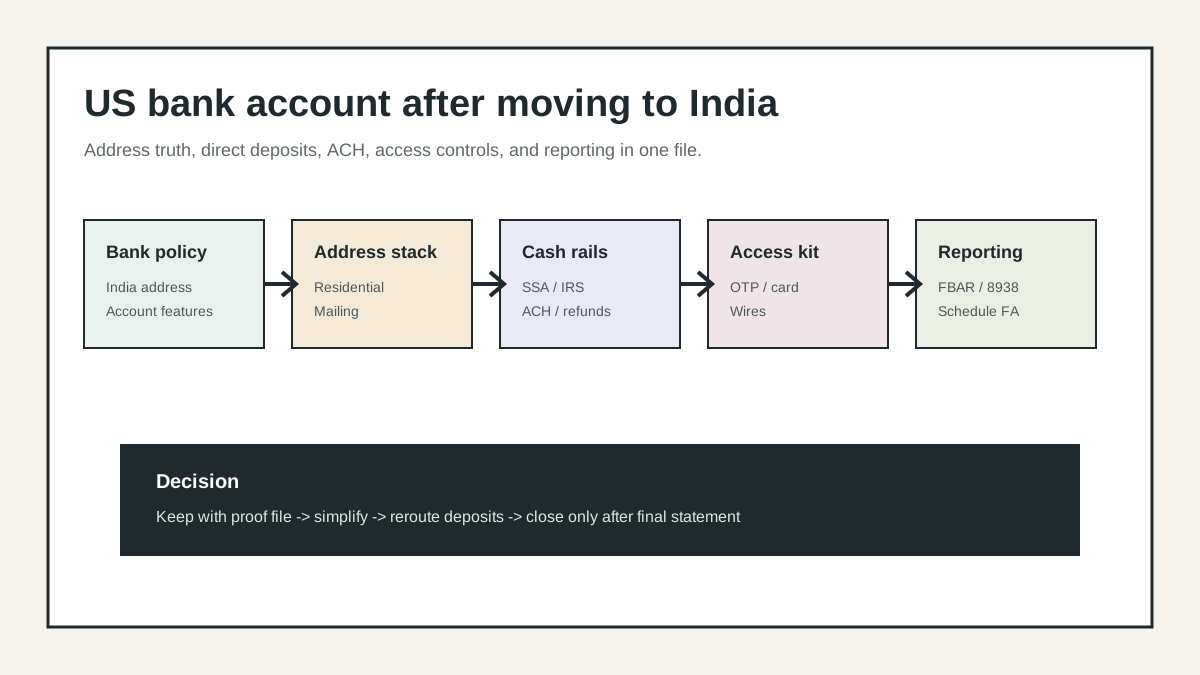
The 60-second version
A US checking or savings account can be useful after the move, but only if the returnee separates bank policy, true residential address, mailing address, tax status, benefit deposits, foreign account reporting, and India disclosure into one operating file.
Why this is not just a bank-login question
A US checking or savings account feels simple until the address changes. The account may still receive Social Security, IRS refunds, dividend sweeps, employer reimbursements, card refunds, ACH pulls, or family transfers. At the same time, the bank may ask for a true residential address, a mailing address, identity recertification, mobile verification, or country-policy confirmation.
The mistake is treating the account as either safe forever or doomed immediately. The useful answer is operational: what does the bank allow after an India move, which address is real for compliance, what deposits still need the account, what login and card controls can fail from India, and how does the account sit inside US and Indian reporting systems?
This guide is separate from the US brokerage guide. Brokerage controls investments. This guide controls cash rails: checking, savings, ACH, direct deposit, tax refunds, debit card, recurring debits, proof files, and closure timing.
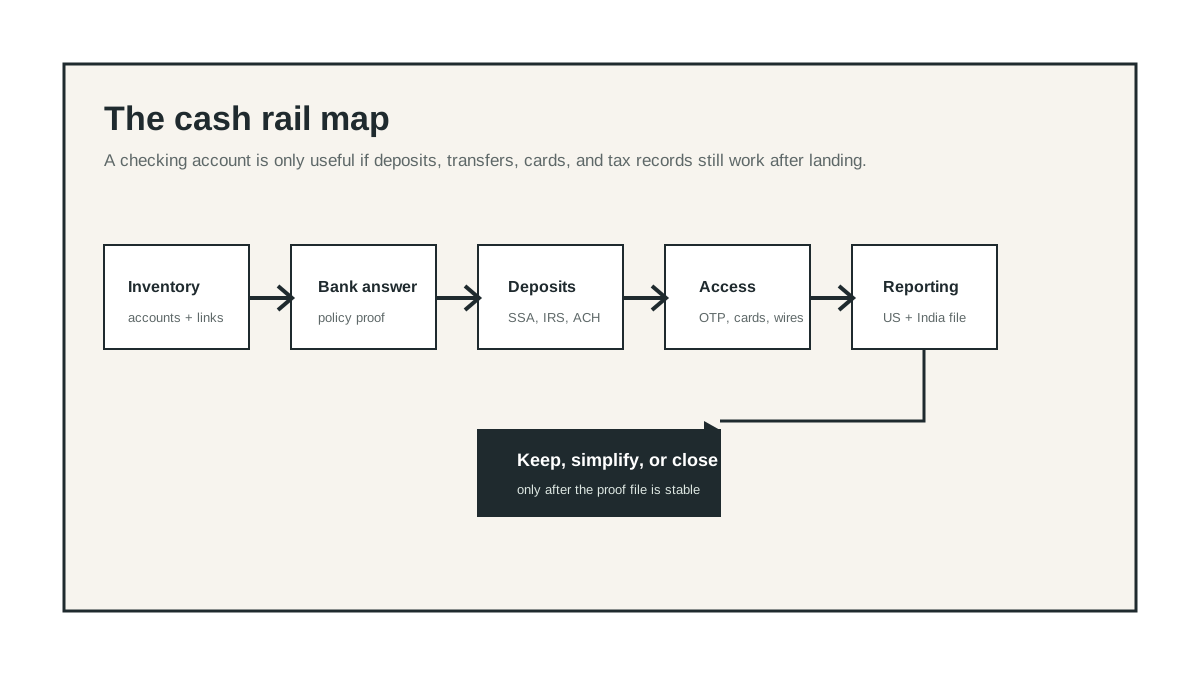
US bank account decision matrix after moving to India
Run this matrix before changing the address, closing the account, moving all funds, or relying on it for one-time-password access.
| Lane | What to check | Proof to save | Common failure |
|---|---|---|---|
| Bank policy | Does the bank allow India-resident customers to keep checking, savings, debit card, online banking, and ACH access? | Secure message, policy page, service-ticket number, and accepted address record. | Assuming an account that stays open will also keep every feature. |
| Address stack | What is the bank asking for: residential address, mailing address, contact address, or tax address? | Profile screenshot, correspondence preference, address-change confirmation, and identity documents used. | Using a convenience mailing address as if it were the true residential address. |
| Deposit dependency | Does Social Security, IRS refund, employer plan payout, brokerage sweep, rent, or card refund still land there? | Direct deposit form, IRS refund record, 1099/SSA-1099, ACH authorization, and bank statement. | Closing the account before the final deposit, refund, or reversal arrives. |
| Access and OTP | Will login, password reset, debit card, wire approval, Zelle, and two-factor authentication work from India? | Authenticator backup, Indian and US phone plan record, debit-card expiry, wire template, and trusted contact. | Discovering during a blocked transfer that the only OTP route was a US SIM that expired. |
| Reporting bridge | Does the account affect FBAR/Form 8938, India Schedule FA, interest income, or foreign tax credit records? | Year-end and peak-balance statements, interest forms, India ITR workpaper, and US filing confirmation. | Treating a US bank account as only a convenience account after Indian resident disclosure begins. |
Nine-step US bank account workflow for returnees
Use this as a T-minus and landing checklist. Do not start by emptying the account.
List every US cash account and linked product
Include checking, savings, CDs, debit cards, credit-card autopay, brokerage sweep links, employer plan payout links, IRS refund destination, Social Security deposit route, PayPal/Venmo-style rails, and ACH authorizations.
Ask the bank what changes after an India address
Get bank-specific answers for foreign residential address, US mailing address, online access, debit cards, ACH, wire transfers, international phone numbers, and closure rules.
Separate residential address from mailing address
FinCEN and bank CIP rules are built around knowing the customer. Save exactly what the bank records as residential, mailing, and tax address instead of improvising later.
Freeze the final US deposit map
Confirm whether Social Security, IRS refunds, payroll leftovers, 401(k)/IRA distributions, broker transfers, or subscription refunds still need a US account.
Build a login survival kit
Set up authenticator backup, trusted device review, password manager recovery, card expiry calendar, US SIM or alternative OTP route, and a secure family emergency access note.
Export statements before restrictions start
Download monthly statements, annual interest forms, direct deposit confirmations, wire receipts, ACH authorizations, closure notices, and debit-card transaction history.
Map US and India reporting separately
A US bank account does not usually create FBAR for itself if it is a US account, but Indian accounts can create US FBAR/Form 8938 duties for US persons, and US accounts can enter India Schedule FA once Indian resident disclosure applies.
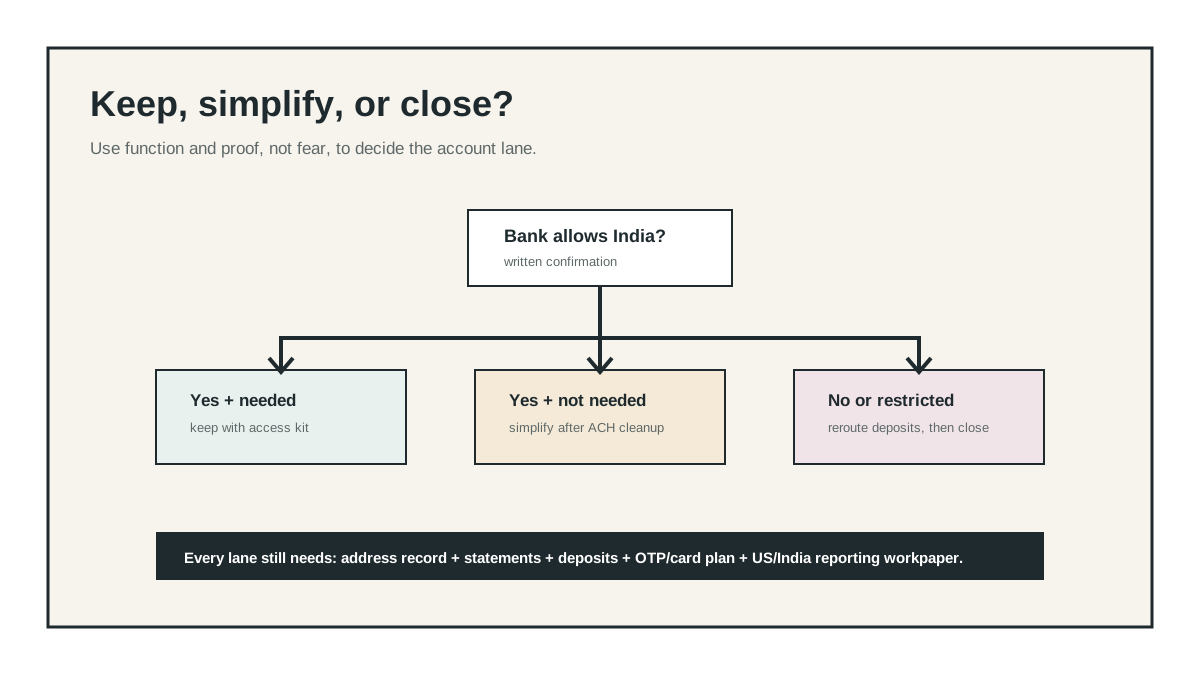
Decide keep, convert, or close by function
Keep if it is still needed and permitted. Convert or simplify if features are restricted. Close only after the final deposit, refund, and linked payment rails are moved.
Save the proof file with tax records
Keep the bank policy response, address record, statements, interest forms, direct deposit proof, closure confirmation, and reporting workpaper in the same folder as the US and India tax returns.
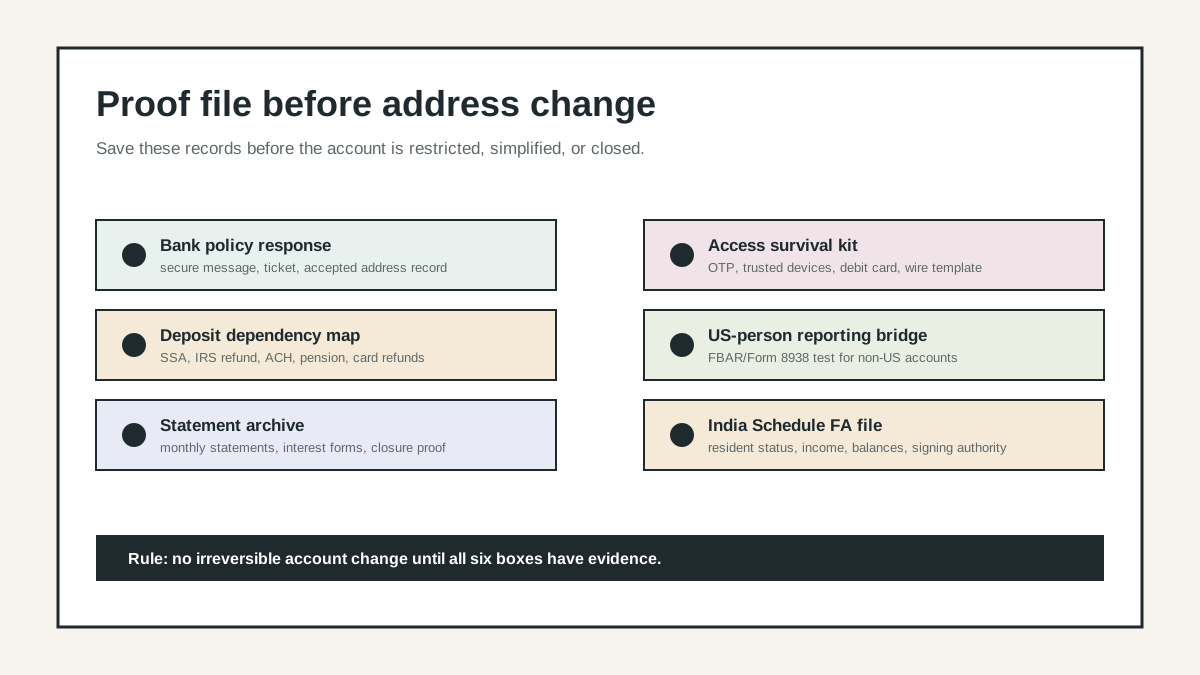
The proof file to build before changing anything
This is the file that prevents future tax, bank, and family-access confusion.
- Bank secure-message response or branch note confirming what happens after an India address is added.
- Profile screenshots showing residential address, mailing address, email, phone, trusted devices, and beneficiary or payable-on-death settings if available.
- Twelve months of statements plus year-end tax forms, interest forms, and account closure documents if closed.
- Direct deposit records for Social Security, IRS refunds, pension/retirement distributions, employer reimbursements, and brokerage transfers.
- ACH and autopay list: credit cards, insurance, subscriptions, taxes, broker funding, loan payments, and family transfers.
- Debit-card and wire-access file: card expiry, replacement mailing path, wire template, travel notice, and transaction limit evidence.
- US-person reporting file: FBAR/Form 8938 status for Indian accounts if applicable, plus proof that the US bank account itself is a US account.
- India reporting file: Schedule FA and foreign income workpaper once the person is Indian resident and disclosure rules apply.
- Closure decision note: why the account was kept, simplified, transferred, or closed, with the date and final balance.
Visual: the six-lane US bank account control board
Need help with Banking?
Share your blocker in one line. Our experts will reply with practical next steps.
Community signal: address friction is the recurring pain point
"Real-world threads repeatedly focus on mailing addresses, bank policy, account opening before departure, and what happens when an institution asks for updated residency information."
Read on reddit ->Community signal: US reporting confusion follows the move
"People often discover too late that US-person reporting follows account ownership and signature authority, not only where the person currently lives."
Read on reddit ->Professional signal: relocation banking is an operations problem
"Professional discussions around keeping bank accounts active abroad repeatedly point to the same operating issues: tell the bank, keep contact details current, avoid dormant-account surprises, and understand tax consequences."
Read on linkedin ->Need help with Banking?
Share your blocker in one line. Our experts will reply with practical next steps.
Short-form signal: bank access fails at the smallest controls
"Short-form banking content around moving abroad often starts with transfer fees, but the same operating issue sits underneath: which account is used, who controls it, and whether it still works after relocation."
Read on instagram ->Question signal: people ask the wrong yes/no question
"The recurring question is whether the account can be kept. The better question is what functions survive: deposits, cards, transfers, address record, tax forms, and online access."
Read on quora ->Decision diagram: keep, simplify, or close
Need help with Banking?
Share your blocker in one line. Our experts will reply with practical next steps.
Do not confuse mailing convenience with compliance truth
A US mailing address may be useful for cards and paper mail, but the bank may still ask for a residential address or other identity information. Keep the record truthful, save the bank's response, and do not build a tax or compliance position on an address shortcut.
Interactive checkpoint
Turn this guide into a decision file
0 of 4 checked
Can I keep a US bank account after moving to India?
Often yes, but it depends on the bank's country policy, the account type, address requirements, online access, phone verification, and whether the bank continues to support your profile after an India move. Ask the bank in writing before changing an address or relying on the account for critical deposits.
Can I use a US mailing address while living in India?
A mailing address and a residential address are not the same thing. Banks may collect residential or business street address information under customer identification rules and may separately allow a mailing address. Save how the bank classifies each address rather than assuming a mailing address solves every requirement.
Should I close my US bank account before moving to India?
Do not close it until final deposits, refunds, ACH debits, card refunds, tax forms, and transfer routes are mapped. If the bank does not support India-resident clients, plan a staged closure after moving deposits and saving final statements.
Can Social Security be deposited into an Indian bank account?
The Social Security Administration says people living outside the United States can receive benefits electronically in countries where payments can be sent, and SSA provides an India-specific direct deposit form. Whether to use a US or India account should be decided after tax, currency, access, and banking-document needs are reviewed.
Does a US bank account go on FBAR?
FBAR is for foreign financial accounts for US persons. A US bank account itself is generally not a foreign account for FBAR, but Indian NRE, NRO, resident, demat, mutual fund, or signature-authority accounts may need FBAR review if you are a US person and thresholds are met.
Does a US bank account go in India's Schedule FA?
Once Indian resident disclosure rules apply, a foreign bank account can become relevant to Schedule FA and foreign income reporting. The exact requirement depends on Indian residential status, account ownership, signing authority, income, and the applicable ITR schedule for the year.
What happens to ACH transfers and debit cards after moving to India?
They may continue, be limited, or fail depending on the bank, card network, security controls, country settings, phone verification, and account status. Build a list of every ACH authorization and card dependency before relying on the account from India.
What records should I download before changing the address?
Download monthly statements, year-end tax forms, direct deposit confirmations, ACH authorizations, card transaction history, beneficiary records if available, secure messages about foreign address support, and closure confirmations if you close the account.
Your NRE account redesignation has a deadline.
Banks don't remind you. You need the right account stack before salary, rent, and EMIs start moving. Get the exact sequence.