School Admission After Return: Documents + Grade Place
Mid-year NRI admission: transcripts, grade placement, CBSE/IB/ICSE docs, assessments, fee deposit rules, and board-choice backup seats.

The 60-second version
The school problem for returning families is not just board choice. It is whether the child can be placed into the right class, with the right records, at the right time, without discovering too late that a school needs transfer, eligibility, or document formalities you have not prepared.
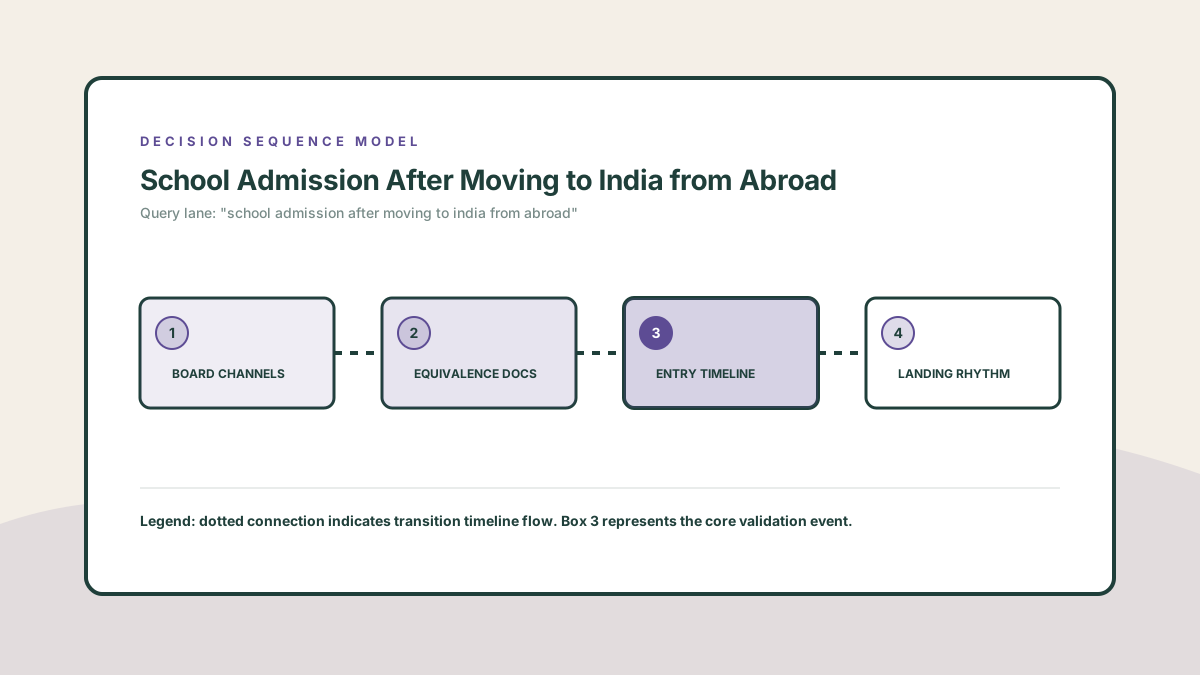
The School Admission Lifecycle for NRIs
Key steps before you start talking to twenty schools
The school shortlist should narrow as your document clarity improves, not the other way around.
Choose the landing window first
Before comparing schools, decide whether you are targeting a clean academic-year start or a mid-year entry. That single timing decision changes the shortlist more than families expect.
Build the records pack before outreach
Pull report cards, transcripts, proof of date of birth, passport copies, address trail, and school-issued leaving or transfer records before you contact the shortlist. Schools respond faster when they can see the child is document-ready.
Ask each school how they handle foreign-board or foreign-school entrants
Do not ask only whether seats are open. Ask how they map the child into grade level, what records they require, whether they accept mid-cycle entry, and what extra approvals they need when the child is arriving from outside India.
Only then compare the shortlist on fit
Once you know who can admit on your timing and documents, then compare commute, board, teaching style, transition support, and long-term fit.
The document pack most families should prepare before the move
| Document | Why it matters | Who usually asks for it | What to check now |
|---|---|---|---|
| Recent report cards or transcripts | These help the receiving school understand current level and progression | Almost every school on the shortlist | Make sure the grade labels and academic year are easy to interpret from an India-side context. |
| Transfer or school leaving certificate | CBSE admission rules explicitly refer to a school leaving or transfer certificate for admission | Schools using formal transfer-led admissions workflows | Ask the current school exactly when and how they issue it so it does not become a last-minute blocker. |
| Date of birth evidence | CBSE admission rules refer to a date-of-birth certificate as proof | Schools that need formal age verification | Check whether the birth certificate and passport naming format match the child's school records. |
| Passport, visa, and address proofs | These help schools place the student file and complete admissions administration | Most private-school admissions teams | Keep clean scans and a physical set ready because some schools still ask for both. |
| Apostilled or otherwise legalized records where needed | Some schools may ask for legalized foreign educational or personal documents when records were issued abroad | Schools handling overseas records with stricter document validation | If a school asks for legalization, use the exact country-specific process rather than guessing from generic forum advice. |
Why timing matters even more if CBSE schools are on the shortlist
CBSE's admission and transfer rules are useful because they show how formal the process can become once a child is entering from a foreign school. CBSE says a student coming from a school in a foreign country, other than a CBSE-affiliated school, is not eligible for admission unless an eligibility certificate is obtained from the Board through the receiving principal with the relevant records.
The same rules also say that admission to Class IX and above after 31 August generally requires prior permission from the competent authority. That does not mean every family is blocked after that date, but it does mean late-entry plans need school-specific clarity earlier than most families expect.
How to handle a mid-year move without turning the child into an admissions exception
Ask whether the school even accepts mid-cycle entry at the relevant grade
Some schools will discuss admissions in principle but become cautious once they hear the exact month and grade. Force that answer early.
Ask how prior coursework will be interpreted
The practical issue is continuity: syllabus overlap, language expectations, and assessment style. Ask what the school needs in order to place the child confidently.
Ask whether transition support exists in practice
A school saying it welcomes returnee families is not enough. Ask what it actually does when a child joins mid-year after studying abroad.
Protect the child from adult indecision loops
If the family is still unsure about city, board, or housing, narrow to a smaller operating shortlist. A child should not live through three parallel admission stories because the adults are leaving every variable open.
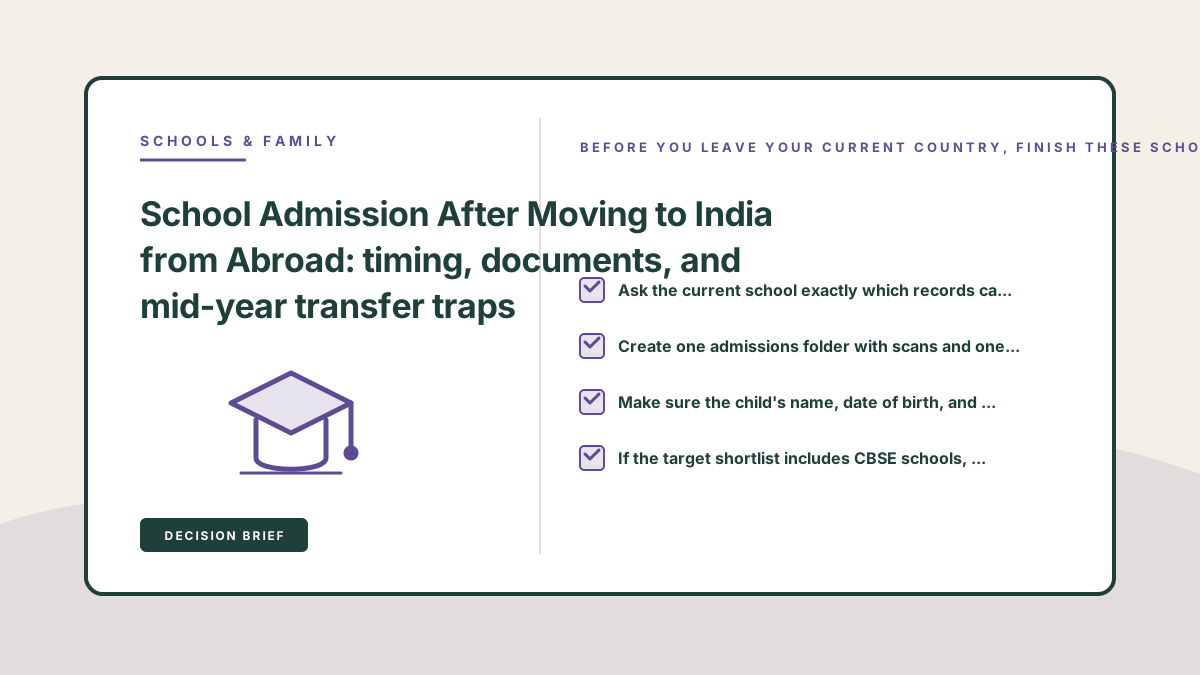
Before you leave your current country, finish these school tasks
These are the items most likely to create slow, expensive rework if they are left until after landing.
- Ask the current school exactly which records can be released before final withdrawal and which are released only after the last day.
- Create one admissions folder with scans and one physical folder with originals or certified copies.
- Make sure the child's name, date of birth, and parent names are consistent across passport, school records, and birth documents.
- If the target shortlist includes CBSE schools, ask each one whether a foreign-school entrant would trigger a board eligibility step.
- If any school mentions legalization or apostille, confirm the exact requirement with that school instead of assuming every foreign document needs the same process.
- Store digital academic records in a retrievable format so you are not depending on one inbox thread or one device when admissions accelerates.
Need help with Schools & Family?
Share your blocker in one line. Our experts will reply with practical next steps.
The admissions mistake that keeps reopening everything
Families often debate boards for weeks while the document pack is still incomplete. In reality, the first narrowing filter is usually timing plus records. If the file is not ready, the shortlist is not real.
School Admission Records Pack
Animated decision map

Interactive checkpoint
Turn this guide into a decision file
0 of 4 checked
What documents do schools in India usually ask from a child returning from abroad?
Common requests include recent report cards or transcripts, proof of date of birth, passport and address records, and a transfer or school leaving certificate. The exact combination varies by school, so confirm it against your shortlist rather than relying on a generic list alone.
Can a child join a school in India mid-year after studying abroad?
Sometimes, yes, but the answer is school-specific and grade-specific. The practical issues are seat availability, how the school maps prior coursework, and whether any formal board or document approvals apply.
Do foreign school records need apostille for admission in India?
Not always. Some schools may ask for legalized or apostilled records when documents were issued abroad, while others may not. The right move is to confirm the receiving school's exact requirement and then follow the Ministry of External Affairs guidance where apostille is relevant.
Is this the same decision as choosing between CBSE, ICSE, Cambridge, and IB?
No. Board choice answers which academic lane fits best. Admissions planning answers whether the child can actually enter the right school and class on the timeline you have.
School admissions close fast — and some only take students in April.
Curriculum, timing, and location all need to be decided before you choose a neighborhood. Get clarity now.