Moving Back to India Checklist: 6-Month Landing Plan
6-month return checklist: RNOR timing, banking redesignation, schools, shipping, documents, H-1B/exit cleanup, and first-30-day tasks.
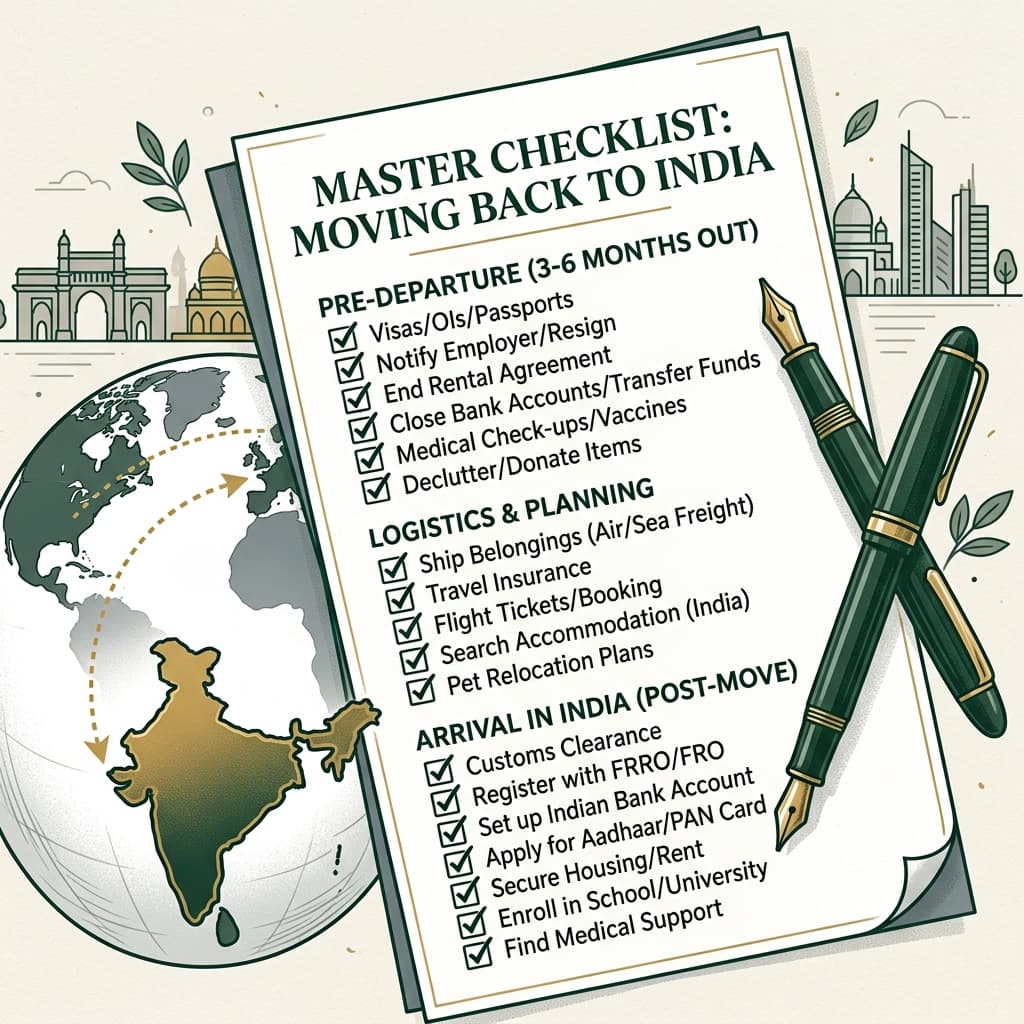
The 60-second version
The strongest move plans are date-led, not emotion-led. This checklist helps you decide what has to be locked before tickets, what can wait until landing, and where official rules matter most.
Why most move-back plans feel harder than they should
A return to India usually breaks down in the same way: one person is solving for tax timing, another is solving for school admissions, and nobody is sequencing the dependencies. That is why even well-prepared families still end up reopening bank questions, rethinking housing, or paying rush-shipping costs they could have skipped.
A better plan starts with the few decisions that change everything else: your intended landing date, your probable RNOR/residency status for the year, the bank account setup you will need on day one, the school board you are targeting if children are involved, and whether shipping household goods actually beats rebuying locally.
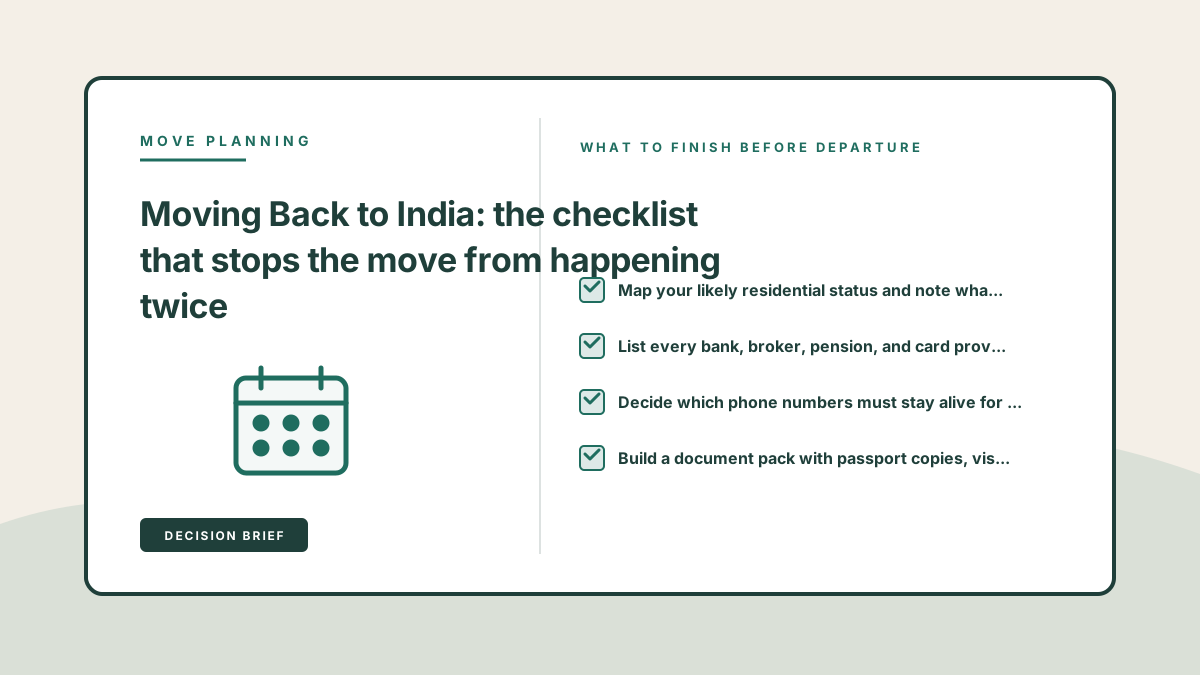
6-Month Move-Back Timeline
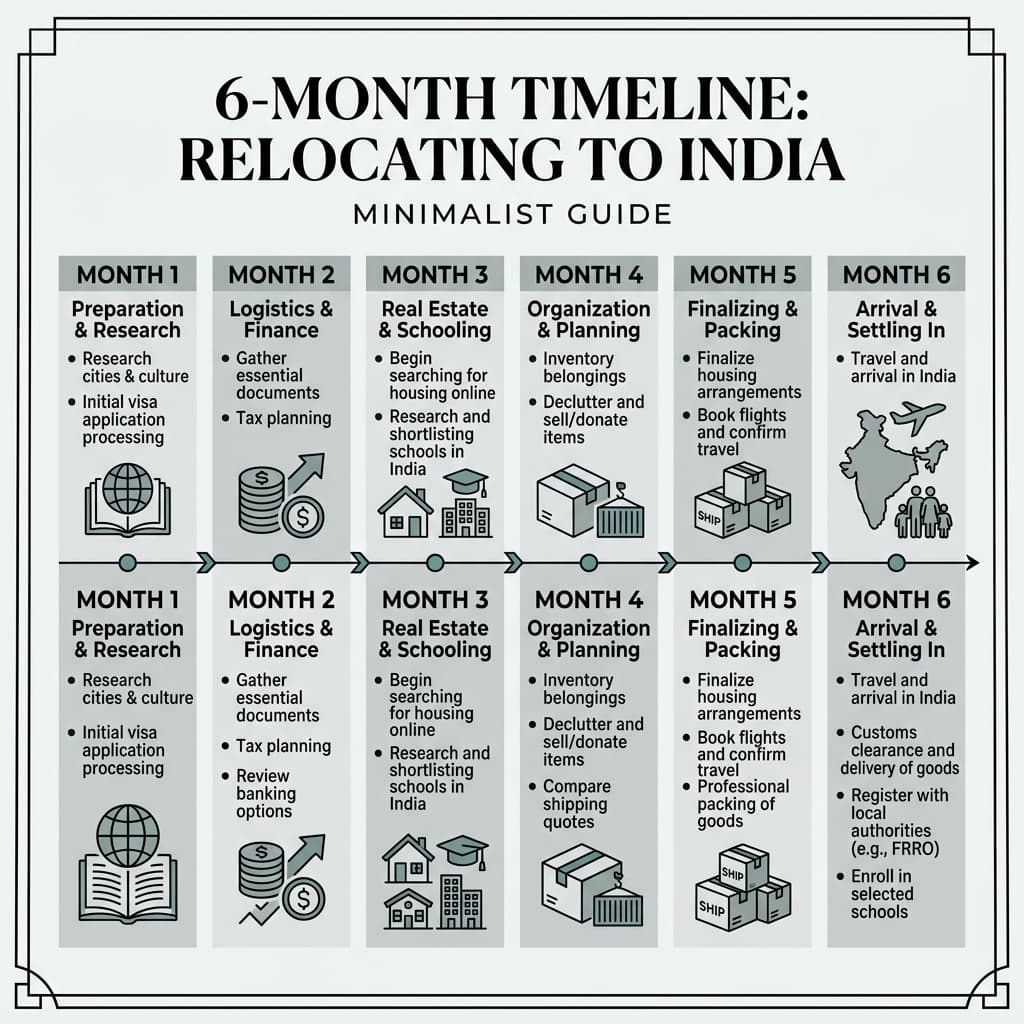
The high-level move timeline: T-6 months to Landing
Lock these five decisions before you book the move
If these are still vague, every downstream task stays fuzzy too.
Set a tax date, not just a travel month
Residency and RNOR outcomes are driven by days and prior-year history, so decide what financial year you are optimising for before you buy tickets.
Define your day-one banking stack
Know whether you will need redesignation, a resident account, NRO continuity, or an RFC lane before salary, rent, school fees, or reimbursements start moving.
Choose a schooling lane early
If children are moving, shortlist the curriculum before choosing the neighbourhood because commute, admissions timing, and academic fit all follow from that decision.
Decide whether shipping is strategic or sentimental
Some moves justify a container. Others are better served by checked baggage plus targeted rebuying in India.
Decide your first 90-day city plan
The first city does not have to be the forever city, but you should know whether you are optimising for schools, parents, cost control, or work access.
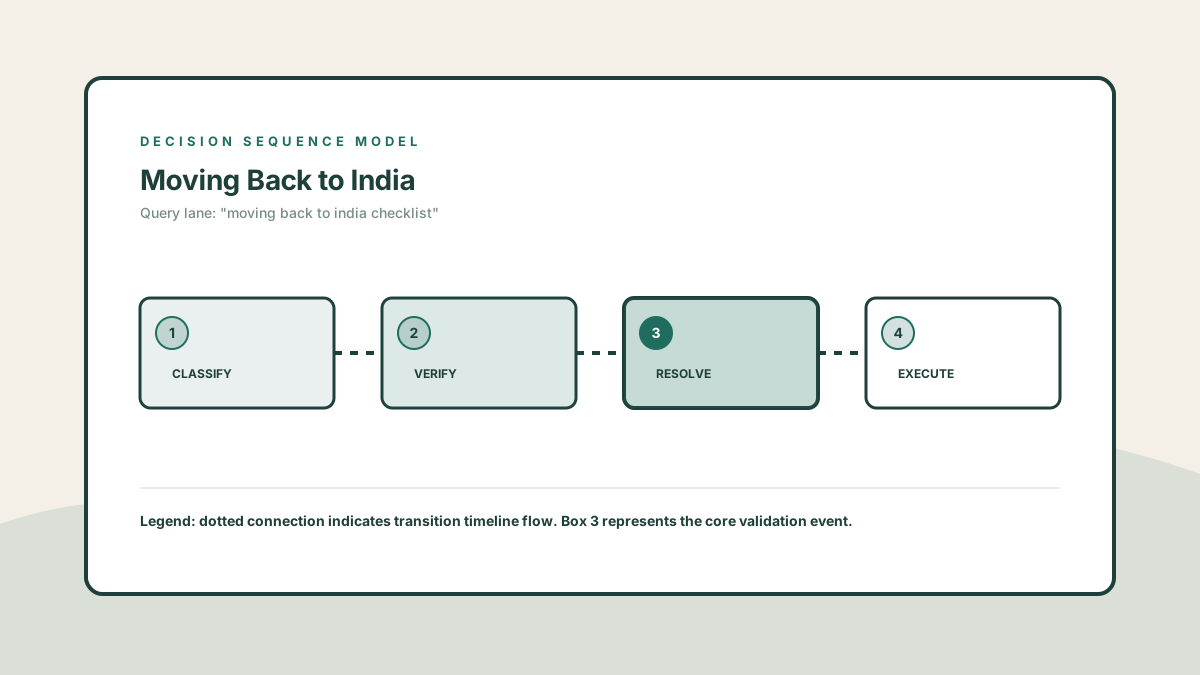
What to finish before departure
These are the tasks that become slower, noisier, or more expensive if you postpone them.
- Map your likely residential status and note what documents support the day count you plan to rely on.
- List every bank, broker, pension, and card provider that needs a change-of-residency notification.
- Decide which phone numbers must stay alive for banking OTPs and immigration or pension correspondence.
- Build a document pack with passport copies, visa or status records, tax records, proof of address, school transcripts, and shipment papers.
- If you may claim transfer-of-residence relief, read the concession conditions before you start packing.
- If children are moving mid-cycle, ask target schools exactly which records they need before they will hold a seat.
- Write down your first 30-day cash-flow plan in rupees and in your current currency so you know what needs to move first.
What belongs before departure and what can wait until landing
| Decision | Before departure | After landing | Why it matters |
|---|---|---|---|
| Residency and RNOR analysis | Yes | Review only | Move timing is hard to fix after the year has already moved on. |
| Bank account redesignation plan | Yes | Execution can continue | Salary, fees, and reimbursements create friction fast if the account plan is unclear. |
| School shortlist | Yes | Campus validation continues | Neighbourhood and admissions paperwork depend on the shortlist. |
| Customs and shipment strategy | Yes | Documentation follow-through | Concessions and shipment timing are easier to preserve when planned up front. |
| Long-term housing choice | Not always | Usually yes | A temporary landing setup is often better than making a permanent decision under fatigue. |
Need help with Move Planning?
Share your blocker in one line. Our experts will reply with practical next steps.
Use the first 30 days to reduce rework, not to prove commitment
Stabilise payments and paperwork first
Get essential banking, rent, and school payment rails working before taking on non-critical admin.
Test your temporary assumptions
Commute length, school fit, family support, and climate routine feel different in practice than they do on spreadsheets.
Only then lock long-horizon costs
Buy cars, commit to long leases, and rebuild domestic help or school transport systems only after the first-round assumptions survive real life.
Common pitfalls
The common failure mode is solving every detail separately. Use this checklist to decide the order of operations, then go deeper into the country, banking, tax, shipping, and schools guides only where the move actually needs detail.
Animated decision map

Interactive checkpoint
Turn this guide into a decision file
0 of 4 checked
What should I decide before I book flights back to India?
At minimum: your intended landing date, likely tax-residency outcome, day-one bank-account plan, whether children need a school shortlist immediately, and whether shipping beats rebuying.
Is a return-to-India move mostly a tax problem or a logistics problem?
It is usually a sequencing problem. Tax, banking, schooling, and shipping become expensive only when they are solved in the wrong order.
Should I choose the city first or the school first?
For families, the school shortlist often narrows the city and neighbourhood options. For singles or couples without children, work access and support systems may matter more.
Can I figure out RNOR after I land?
You can confirm it later, but if timing matters for your move, the analysis should happen before the travel date is fixed.
The plan is only as good as the sequence.
Tax, banking, schools, shipping — they all have dependencies. A wrong order costs months and lakhs. Get it right.