Return to India Jobs: Salary Reset and 90-Day Plan
Plan your India job search with salary reset logic, role positioning, networking, interview checks, and a 90-day execution plan.

The 60-second version
This guide is built for high-intent searchers asking where to start a return-to-India job search. It gives a no-fluff execution sequence, compensation framing, and interview pipeline structure for the first 90 days.
Why this query needs a dedicated page
People searching return-to-India jobs are rarely looking for generic job portals. They are trying to answer a harder question: how to re-enter India without taking a random compensation cut or joining a role that collapses after six months.
The useful plan is a sequence: choose role lane first, then city-cost fit, then compensation architecture, then interview signal positioning, and only then offer conversion. If you reverse that order, you optimize for speed and lose quality.
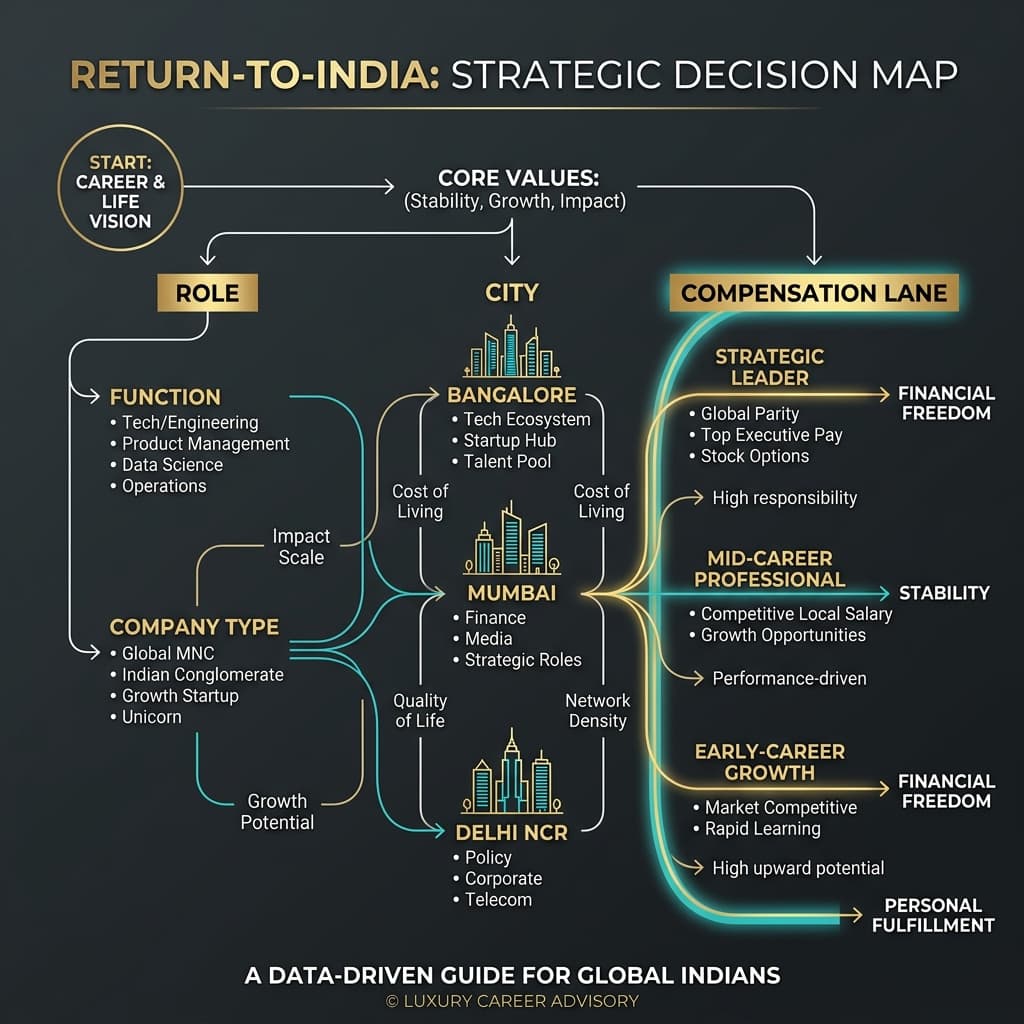
Choose the right lane before you apply
| Lane | When it fits | Main risk | Execution move |
|---|---|---|---|
| Internal transfer | Strong current employer and India office | Role mismatch after transfer | Ask for written role scope and review cycle before relocation |
| Direct external switch | Clear niche skill and fresh market demand | Compensation reset shock | Benchmark total compensation, not base alone |
| Consulting/contract bridge | Need fast landing income | No long-term progression | Set a 180-day conversion plan from day one |
| Founder/early-stage role | High risk appetite and upside focus | Cash-flow instability | Cap exposure with a runway rule before signing |
90-day return-to-India jobs execution plan
Days 1-10: build one role thesis
Define target functions, expected level, and non-negotiables. A vague multi-role search lowers recruiter confidence.
Days 11-25: localize resume and proof stack
Convert achievements into India-market language with metrics, cost impact, and team-scope clarity.
Days 26-45: network in batches
Run focused outreach cohorts by company type and role family instead of random connection requests.
Days 46-70: interview-loop calibration
Track rejection patterns, tighten stories, and iterate pitch by role lane. Treat interviews as a feedback system.
Days 71-90: offer-risk checks
Validate variable-pay assumptions, reporting line stability, role charter, and location flexibility before acceptance.
Community signal: returning professionals discuss interview and salary friction
"Don't convert your US salary to INR and expect a match. Look at purchasing power parity (PPP). A 40-50% nominal cut is standard, but you might actually save more in absolute terms."
Read on reddit ->Professional signal: role-transition conversations
"We see many returning NRIs fail interviews because they pitch their international experience as inherently superior. You must localize your impact. How does your experience solve an India-market problem?"
Read on linkedin ->Need help with Move Planning?
Share your blocker in one line. Our experts will reply with practical next steps.
Short-form demand pulse
"If you are an OCI moving back, make sure you mention it prominently on your resume. Companies often hesitate thinking they need to sponsor a visa. Remove that friction."
Read on twitter ->Reel-format career transition snippets
"How to negotiate your Indian salary when returning from the US or UK. (Rule #1: Focus on your value to the Indian team, not what you used to make in dollars)."
Read on instagram ->Question-led query cluster
"If you have 10+ years of experience and can operate at an Architect or Staff level, the Indian market pays exceptionally well, sometimes matching European compensation in PPP. If you're a junior dev, the local competition is intense."
Read on quora ->Need help with Move Planning?
Share your blocker in one line. Our experts will reply with practical next steps.
Interview pipeline control board
Offer acceptance checklist
- Written role charter with first 90-day outcomes.
- Total compensation split: base, variable, ESOP, joining, retention.
- PF, gratuity, insurance, and notice-period terms checked.
- Manager stability and team attrition risk reviewed.
- Location and return-to-office expectations documented.
- Backup plan if offer start date shifts.
High-cost mistake
Do not run a mass-application sprint before choosing a lane. Volume without positioning creates weak interview conversion and pushes you toward bad-fit offers.
Need help with Move Planning?
Share your blocker in one line. Our experts will reply with practical next steps.
Animated decision map

Interactive checkpoint
Turn this guide into a decision file
0 of 4 checked
What is the first step in a return-to-India job search?
Freeze one role thesis first: role family, level, and city fit. Without that, your resume, outreach, and interview stories stay inconsistent.
Should I accept a lower base salary if variable pay looks high?
Only after testing payout realism, business model stability, and target definitions in writing. Compare total compensation quality, not headline upside.
Can I run India interviews before physically relocating?
Yes. Many professionals close early interview loops remotely, then schedule final rounds around relocation windows.
Is this legal, tax, or investment advice?
No. This is an execution framework for job-search planning. Validate legal, tax, and compensation specifics with qualified professionals.
The plan is only as good as the sequence.
Tax, banking, schools, shipping — they all have dependencies. A wrong order costs months and lakhs. Get it right.