PFIC Form 8621 for Indian Mutual Funds: US Persons
US citizen or green-card holder with Indian mutual funds? Check PFIC, Form 8621, SIPs, FBAR, Form 8938, FATCA, and exit choices.
The 60-second version
Indian mutual funds can be normal India investments and a hard US tax problem at the same time. If you are a US citizen, green-card holder, or other US person in India, do not look only at Indian capital-gains tax. Build a fund-by-fund PFIC file before buying, switching, redeeming, inheriting, or redesignating mutual fund units.
Why this is not only an India mutual fund question
A returning family often looks at an Indian mutual fund as a simple rupee investment: SIP, folio, NRE or NRO bank mapping, KYC, redemption, and Indian capital-gains tax. That is not enough for a US citizen, green-card holder, or other US person. From the US side, the same Indian mutual fund can become a Passive Foreign Investment Company review, and the relevant form is usually IRS Form 8621.
The core mistake is timing. People usually discover PFIC after they already bought years of SIP units, switched schemes, reinvested dividends, became a US tax resident, moved back to India without surrendering US status, inherited fund units, or filed FBARs while missing the fund-level tax form. At that point the problem is no longer, 'Can I buy Indian mutual funds?' It is, 'Which fund, which year, which transaction, which election, which account report, and which income-tax return did this touch?'
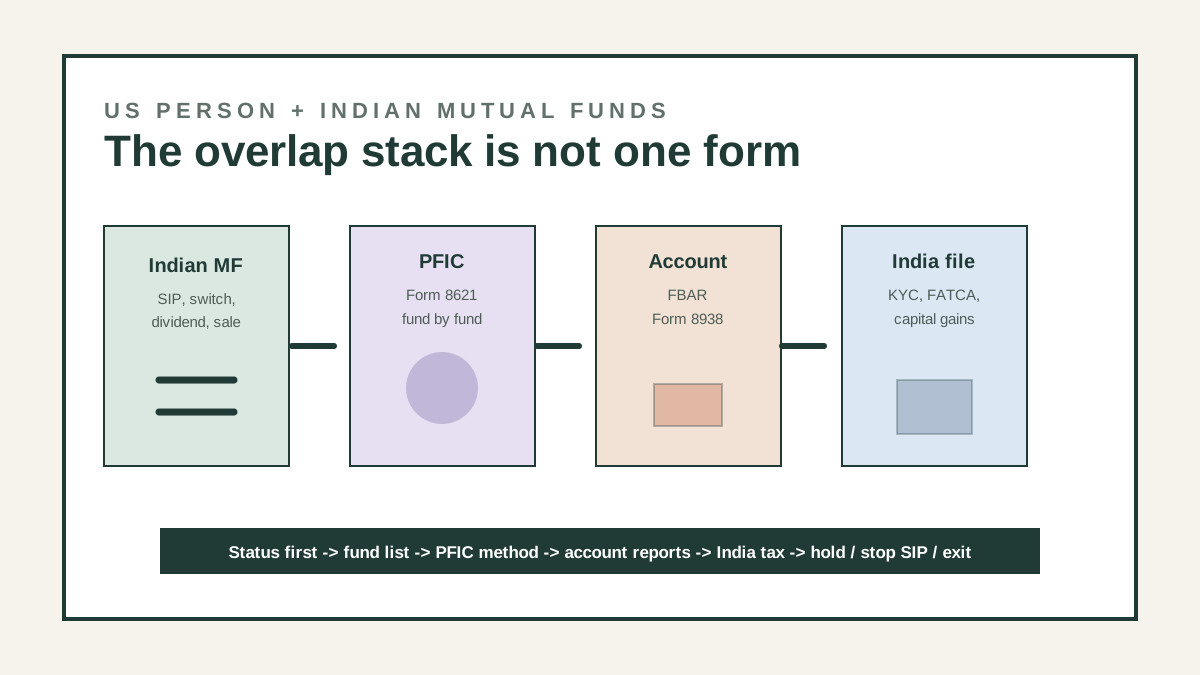
This page deliberately separates the lanes. Indian mutual fund eligibility and India tax belong to the India lane. PFIC/Form 8621 belongs to the US income-tax lane. FBAR and Form 8938 are separate US reporting lanes. FATCA/KYC is an institution lane. You may need more than one lane for the same holding, and one completed lane does not close the others.
PFIC, Form 8621, FBAR, Form 8938, FATCA, and India tax are not substitutes
Use this table before buying, switching, redeeming, or deciding to keep Indian mutual funds after a US status change.
| Lane | What it asks | Typical Indian mutual fund fact | What goes wrong |
|---|---|---|---|
| PFIC / Form 8621 | Is the US person a direct or indirect shareholder of a Passive Foreign Investment Company, and did the year require annual information, an election, a distribution, or gain reporting? | Many non-US pooled funds, including foreign mutual funds and ETFs, are commonly treated by US advisers as PFIC candidates. Each fund and year needs review. | FBAR was filed, but the fund-level income-tax form was missed. Switches, dividends, and redemptions are discovered years later. |
| Section 1291 default method | If no timely election applies, how are excess distributions or disposition gains allocated and taxed? | A sale or switch can create a gain after years of holding units. The default method can be punitive and record-heavy. | The taxpayer assumes Indian long-term capital-gains logic controls the US result. It does not. |
| QEF or mark-to-market election | Was a valid election made on time, and can the fund provide the information needed to support it? | QEF often requires an annual PFIC information statement that Indian retail funds may not provide. Mark-to-market may be considered only if the stock is marketable under the rules. | An election is chosen casually after the fact, or the filer cannot support the election with fund data. |
| FBAR / FinCEN Form 114 | Did aggregate foreign financial accounts exceed $10,000 at any time in the calendar year? | Bank, demat, brokerage, and some pooled investment arrangements may need account-level review from a US perspective. | Only bank accounts are listed while investment accounts or signature-authority accounts are ignored. |
| IRS Form 8938 | Did specified foreign financial assets cross the relevant threshold for filing status and living-abroad facts? | Indian mutual funds, demat holdings, and other foreign financial assets may be part of the threshold test. | The filer assumes FBAR replaces Form 8938 or Form 8938 replaces FBAR. IRS guidance treats them separately. |
| FATCA / CRS / KYC | What tax residency, TIN, and US-person status did the Indian financial institution collect? | Indian AMCs, RTAs, brokers, and banks collect tax-residency declarations through KYC channels. | The institution has a US-person declaration, but the taxpayer's US return does not include matching reporting. |
| India ITR and capital gains | How is the Indian mutual fund redemption taxed in India, and does the bank mapping affect repatriation? | Indian mutual funds are Indian assets for Indian tax purposes; India capital-gains rules and NRE/NRO mapping still matter. | The family solves US PFIC but forgets India tax, or solves India tax and forgets the US PFIC layer. |
Eight-step PFIC file before buying, selling, switching, or inheriting Indian mutual funds
This workflow is built for US citizens, green-card holders, US tax residents, and families whose US status is not fully closed after returning to India.
Confirm the US-person year before looking at the fund
Start with citizenship, green-card status, substantial-presence facts, treaty position, expatriation date, and whether the year is a US filing year. If the person is not a US person for that year, the US PFIC lane may not apply; if they are, it can apply even while they live in India.
List every fund at folio and scheme level
Export AMC/RTA statements for every SIP, switch, STP, SWP, dividend, reinvestment, bonus, merger, and redemption. Do not list only the platform name. Form 8621 analysis is usually fund-by-fund, not app-by-app.
Separate Indian tax category from US PFIC category
India may classify a fund as equity, debt, hybrid, or specified fund for Indian capital-gains tax. The US PFIC question is different. Do not assume an Indian equity fund escapes PFIC review because India taxes it favorably.
Check whether a limited Form 8621 exception is actually available
IRS instructions and regulations include narrow exceptions for some passive holders below small aggregate PFIC value thresholds and without excess distributions or dispositions. Do not use the exception if there was a sale, switch, gain event, election, or missing prior-year issue without specialist review.
Choose the tax method before the first US filing deadline if possible
The default section 1291 method, QEF election, and mark-to-market election lead to different annual files and tax results. QEF may be impractical without fund-provided annual information. Mark-to-market depends on whether the holding qualifies. The best time to decide is before the first US return that touches the fund.
Run FBAR and Form 8938 separately
A mutual fund problem may also be an account or specified-asset reporting problem. Calculate FBAR aggregate peak value separately from Form 8938 thresholds, and keep the account statements behind both. Filing Form 8621 does not file FBAR or Form 8938.
Map India tax and repatriation at the same time
For Indian mutual funds, keep India purchase cost, holding period, fund category, tax statement, AIS/TIS entry, NRE/NRO redemption account, Form 15CA/15CB need if NRO repatriation applies, and India ITR evidence together. US PFIC work does not replace Indian tax work.
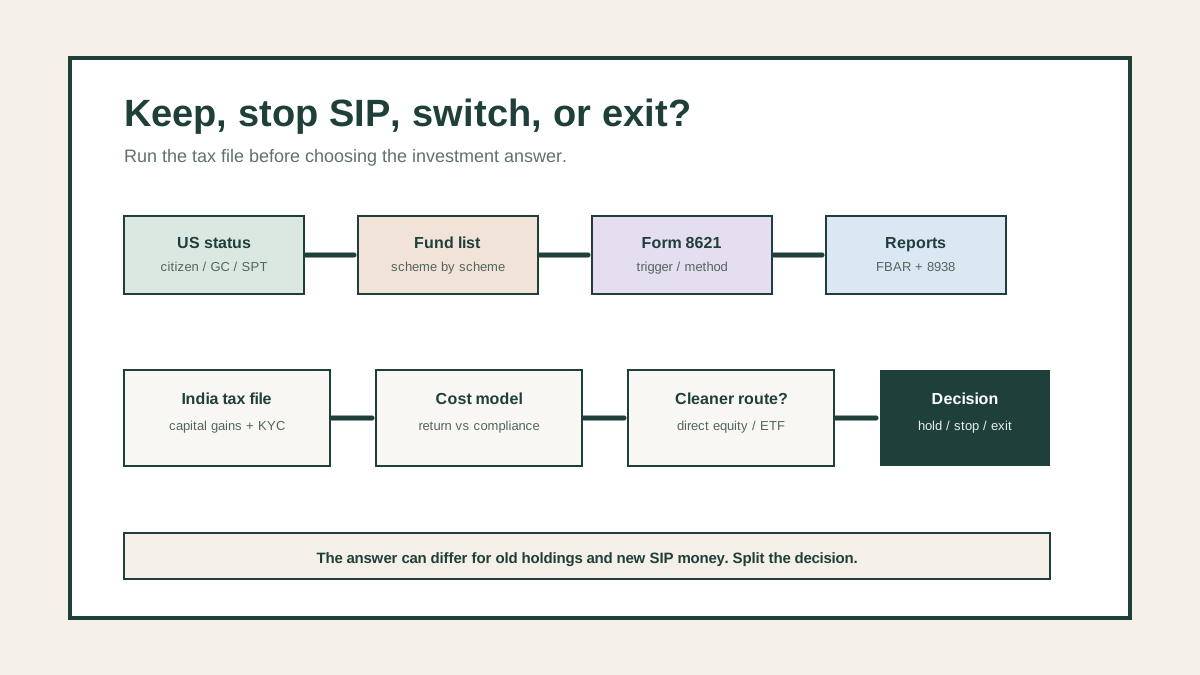
Decide hold, stop SIP, switch to direct stocks, or exit
The decision is operational, not emotional. Compare expected return, compliance cost, annual adviser effort, election feasibility, FBAR/Form 8938 overlap, India tax, exit tax, and whether a US-listed India ETF or direct Indian equity route is cleaner for your facts.

Document checklist for the PFIC adviser review
Collect this before paying a US cross-border tax adviser. It shortens review time and prevents guesswork.
- US status file: passport/citizenship, green-card dates, substantial-presence days, expatriation or abandonment documents if applicable, and prior US filing history.
- Fund inventory: AMC, scheme name, ISIN if available, folio number, regular/direct plan, growth/dividend option, purchase dates, switch dates, redemption dates, and current units.
- Transaction history: SIP debits, STP/SWP, switches, mergers, dividends, reinvestments, bonus units, and full statement from the first US-person year through the current year.
- Valuation file: year-end values, highest values if needed for account reporting, exchange-rate source, and USD conversion working papers.
- US reporting file: prior FBAR confirmations, Form 8938 if filed, Form 8621 if filed, Form 1116/foreign tax credit workpapers, and prior adviser notes.
- India reporting file: capital-gains statement, AIS/TIS extract, India ITR acknowledgement, tax payment challans, and NRE/NRO bank statements for purchase and redemption.
- KYC/FATCA file: SEBI KYC acknowledgement, FATCA/CRS declaration, US TIN provided to Indian institutions, bank account mapping, and AMC acceptance records.
- Decision note: whether the plan is to hold, pause SIPs, switch, redeem, consolidate, move to direct equity, or use US-listed India exposure going forward.
Infographic: the PFIC overlap stack
Need help with Tax & Residency?
Share your blocker in one line. Our experts will reply with practical next steps.
Decision flow: keep, stop SIP, direct equity, or exit
Operating map
Do not blindly backfill Form 8621 without checking income and account reporting
A missed Form 8621 issue, a missed FBAR issue, a missed Form 8938 issue, and omitted income are different problems. If prior years are involved, pause before filing late forms casually. Build the transaction history, identify whether gains or distributions happened, and get US cross-border tax advice on the correction path.
Community signal
What to watch in real discussions
Treat repeated complaints as risk signals rather than official advice. This page does not link to community search results.
Interactive checkpoint
Turn this guide into a decision file
0 of 4 checked
Are Indian mutual funds PFICs for US citizens or green-card holders?
They are not automatically labeled by the investor platform, but many non-US pooled funds are treated by US tax advisers as PFIC candidates. A US citizen, green-card holder, or US tax resident should review each Indian mutual fund before assuming the normal Indian tax treatment is the full answer.
Do I need Form 8621 for every Indian mutual fund?
Possibly. IRS instructions describe several circumstances where a US person files Form 8621 for a PFIC, including certain distributions, dispositions, QEF or mark-to-market reporting, and annual information reporting. There are limited exceptions for some small passive holders, but they are not available in every fact pattern, especially if there was a sale, switch, distribution, election, or prior-year issue.
Does filing FBAR solve PFIC reporting?
No. FBAR is an account report filed with FinCEN. PFIC/Form 8621 is an income-tax and information-return analysis for the foreign fund. The same mutual fund or investment account can require both reviews, but one does not replace the other.
Does Form 8938 replace Form 8621?
No. Form 8938 reports specified foreign financial assets with the US income tax return when thresholds are met. Form 8621 is the PFIC form. A holding can appear in Form 8938 asset analysis and still need Form 8621 review.
Should US persons in India stop Indian mutual fund SIPs?
Do not stop or continue only from fear. First calculate the compliance cost, election feasibility, expected return, existing unrealized gain, India tax, and cleaner alternatives such as US-listed India exposure or direct Indian equity where appropriate. Existing holdings and new money may deserve different decisions.
Is a QEF election practical for Indian mutual funds?
Often it is difficult because QEF treatment generally needs fund-provided annual PFIC information. Some Indian retail mutual funds may not provide the required statement. A US tax adviser should confirm whether QEF is available before relying on it.
Can mark-to-market solve Indian mutual fund PFIC issues?
It can be considered only if the holding qualifies under the mark-to-market rules and the election is made properly. It may simplify some future annual reporting, but it can also tax unrealized gains. Do not make the election without modelling the tax and recordkeeping effect.
Are Indian mutual funds reported in India Schedule FA?
Indian mutual funds are Indian assets for Indian tax purposes. Schedule FA is for foreign assets in the Indian ITR. A returning resident may still need Indian capital-gains reporting for Indian mutual funds, while foreign brokerage accounts, US ETFs, or overseas funds may need Schedule FA review separately.
Your tax year is already running.
RNOR status, exit timing, and DTAA benefits all depend on decisions you make before you land. Don't guess.