NRI Mutual Fund Investment in India: FEMA route, KYC, FATCA, capital-gains tax, and the repatriation stack
A practical 2026 guide for NRIs and returning NRIs investing in Indian mutual funds and equities: FEMA 1999 NRI route, PIS vs non-PIS, KYC + FATCA/CRS declaration,...
The 60-second version
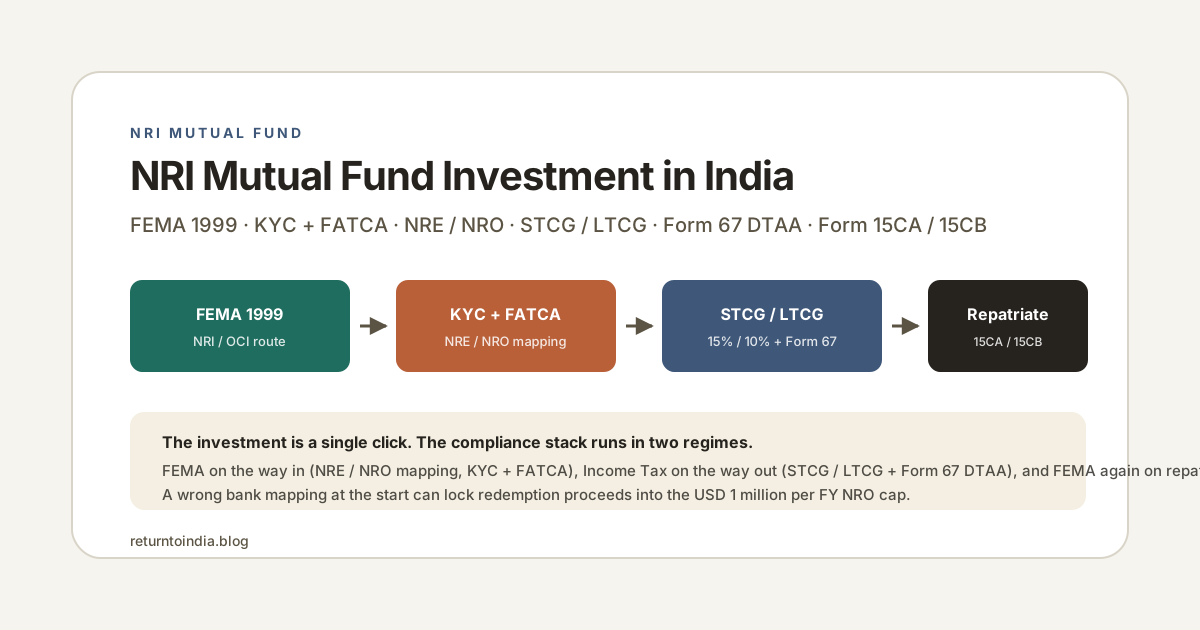
NRIs can invest in most Indian mutual funds and equity markets, but the route is not generic Indian KYC. There are two distinct investment lanes (PIS for direct equity, non-PIS for mutual funds), two bank-account mapping options (NRE or NRO), a FATCA/CRS declaration that US-person NRIs cannot skip, capital-gains tax that is steeper than the resident schedule, and a repatriation stack that depends on the funding source. The order is fixed; the deliverables are not optional.
Why NRI mutual fund investing is two regimes, not one
Indian mutual fund investing is the easiest entry point for NRIs who want exposure to Indian equities, debt, and hybrid funds, but the route is not the same as the resident KYC path. NRIs face two separate regulators' rules: FEMA 1999 (RBI) governs who can invest, how the money can come in, and what can be repatriated out; and SEBI's KYC and FATCA/CRS framework governs identity verification, tax-residency declaration, and the bank-account mapping that every fund house will require before activating the folio. The two regimes are not negotiable, and the most common failure mode is doing the SEBI KYC and then assuming the FEMA layer is automatic.
Three rules bind almost every NRI investment in Indian mutual funds: (1) the investment must come from an NRE or NRO account (or a direct foreign remittance routed through a regulated channel) — direct cash, third-party cheques, and non-NRI third-party wires are not accepted; (2) the KYC must include a valid FATCA/CRS declaration (US-person NRIs cannot skip this) and a recent in-force Indian address proof or overseas address proof; (3) the bank-account mapping on the folio determines the repatriation character of the funds at the time of redemption and sale, and changing the mapping after the fact requires a fresh KYC + re-designation exercise. The good news is that the cost is modest (a few hundred rupees per fund house for KYC + a CA / chartered accountant fee for the redesignation), and the bigger risk is the tax and repatriation surprise that comes from getting the bank-account mapping wrong at the start.
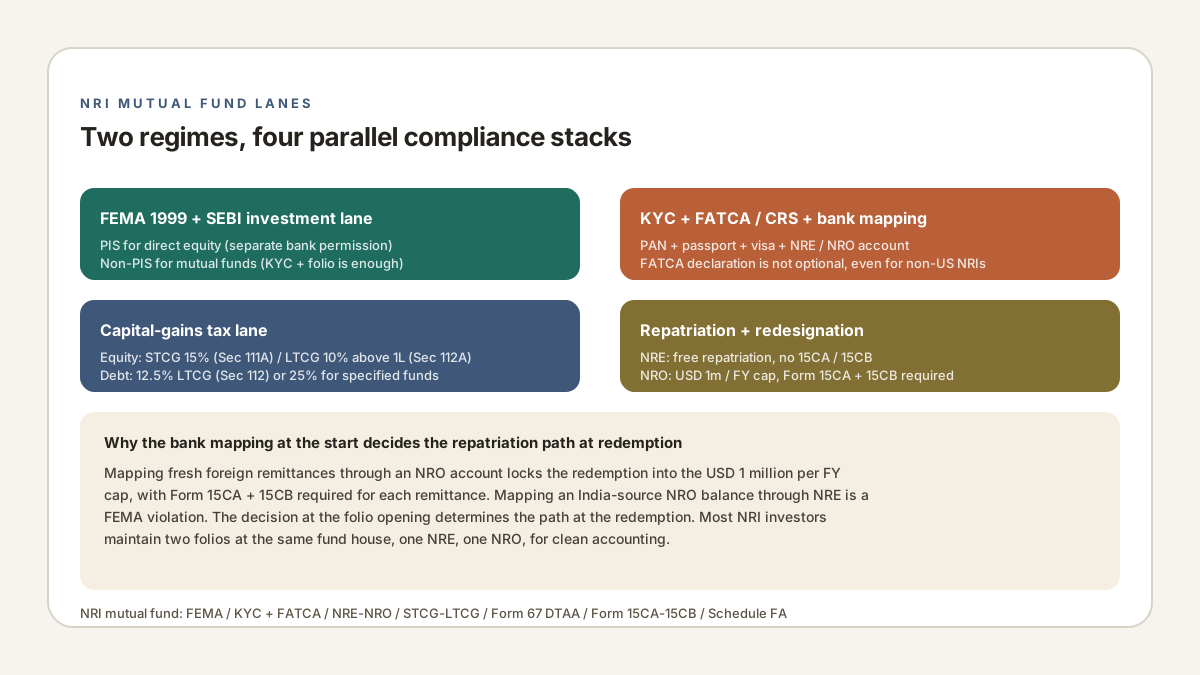
NRI mutual fund: investment lane, bank mapping, and what each decision locks
FEMA + SEBI distinguish two investment lanes for NRIs (PIS for direct equity, non-PIS for mutual funds), two bank-account mapping options (NRE vs NRO), and two capital-gains tax schedules (resident vs non-resident, with debt funds on a special 25% rate).
| Decision | Option A | Option B | What clean execution looks like | What usually goes wrong |
|---|---|---|---|---|
| Investment lane (PIS vs non-PIS) | PIS — Portfolio Investment Scheme for direct equity / listed shares (requires a PIS permission letter from an Indian bank + separate demat) | Non-PIS — mutual funds (equity, debt, hybrid), government securities, corporate bonds (no PIS permission required; mutual fund KYC alone is enough) | Use non-PIS for 90% of retail mutual fund investing. Open PIS only if you intend to buy / sell listed Indian stocks directly. | Trying to route direct equity purchases through a non-PIS demat leads to frozen accounts and forced reversal. Trying to buy mutual funds through a PIS demat is over-engineered for most investors. |
| Bank-account mapping on folio (NRE vs NRO) | NRE — for fresh foreign remittances; preserves the repatriation character of the funds | NRO — for funds already in India (rental income, prior NRO balance, sale of India property) | Match the bank mapping to the source of the funds. NRE mapping on a redemption moves the proceeds to a freely-repatriable NRE account. NRO mapping sends the proceeds to a partially-repatriable NRO account (USD 1 million per FY cap under the Liberalised Remittance Scheme). | Mapping a fresh foreign remittance through an NRO account locks the redemption into the USD 1 million per FY repatriation cap. Mapping an India-source NRO balance through an NRE account is a FEMA violation. |
| KYC + FATCA / CRS declaration | Standard KYC + FATCA / CRS declaration (mandatory for all NRIs, especially US-person NRIs under FATCA) | In-person verification (IPV) at a fund house branch, KRA-registered intermediary, or via video IPV (post-2020 SEBI rules) | Complete KYC once at the KYC Registration Agency (KRA) level, then mirror it at each fund house via a CKYC number. Re-KYC every 2 years or on any material change (address, status, bank). | Missing FATCA / CRS declaration triggers a 30% withholding on US-source income at the fund house. Submitting FATCA only at one fund house does not propagate to others. |
| Capital-gains tax on equity mutual fund redemption (NRI) | STCG (held <= 12 months): 15% under Section 111A, surcharge + cess applicable; TDS not deducted at fund house (the fund pays, NRI claims in ITR) | LTCG (held > 12 months): 10% on gains above Rs 1 lakh per FY under Section 112A; indexation not available; surcharge + cess applicable | Use a chartered accountant to compute the tax, then file the ITR for the assessment year. Claim DTAA relief via Form 67 if the country of residence taxes the same gain. | Confusing the resident vs non-resident schedule. US-person NRIs taxed on worldwide income face US tax on the same gain — DTAA relief is recoverable but only if Form 67 is filed. |
| Capital-gains tax on debt mutual fund redemption (NRI) | STCG (held <= 24 months for non-equity, listed): slab rate (30% + surcharge + cess for high-income NRI) | LTCG (held > 24 months): 12.5% (post-2024 Budget change) without indexation under Section 112; surcharge + cess applicable | Note the special 25% rate for certain specified funds (earlier 111A / 112A didn't apply). Use the CA for the exact fund category classification. | Assuming the 10% LTCG rate applies to debt funds. It does not, since the 2024 Budget change. |
| Repatriation of redemption proceeds | NRE mapping: free repatriation, no FEMA cap | NRO mapping: USD 1 million per FY cap under LRS, requires Form 15CA + 15CB for each remittance | Choose the bank mapping that matches the source of the investment. Avoid re-mapping after the fact. | Forgetting Form 15CB and submitting only 15CA — the bank will reject the SWIFT. Filing the CA certificate with the wrong AY — the income-tax department will issue a notice. |
| Schedule FA disclosure in India ITR (if becoming a resident) | Disclose foreign mutual fund units + foreign brokerage / fund-house accounts in Schedule FA | On a redemption, gain is part of worldwide income, taxed under the resident schedule for the AY of return (not the NRI schedule) | Run a redesignation stack: KYC redesignation + bank account remap + Schedule FA + ITR filing for the AY of return. | Skipping Schedule FA carries a Rs 10 lakh penalty under Section 42 of the Black Money Act, 2015. |
Execution sequence: from foreign earnings to invested Indian mutual fund folio
Plan the order. The FEMA bank mapping, the SEBI KYC, the FATCA declaration, and the IT registration are not simultaneous — but they are interdependent, and an error in one is hard to fix after the folio is live and the units are held.
Decide the funding lane: NRE, NRO, or fresh foreign remittance
If you are remitting fresh foreign earnings, route them to an NRE account (preserves repatriation character). If you are investing from India-source funds (rental income, prior Indian investments, sale of India property), use an NRO account. Do not mix the two. The decision at this step locks the bank mapping for the folio and the repatriation path at redemption. It also affects Schedule FA disclosure if you become an Indian resident in the same FY.
Complete SEBI KYC + FATCA / CRS declaration at the KRA level
Submit KYC documents (PAN, passport, visa or OCI card, Indian or overseas address proof, recent photograph, bank account proof) to a KYC Registration Agency (KRA) — CVL, NDML, Karvy, etc. Include the FATCA / CRS declaration: country of tax residence, TIN, and a statement on whether you are a US person. US-person NRIs cannot skip FATCA. Once KRA registration is done, your CKYC number mirrors across all SEBI-registered intermediaries (mutual fund houses, brokers, registrars).
Open a folio with the chosen mutual fund house and map the bank account
Choose the fund house (HDFC, ICICI, SBI, Nippon, Parag Parikh, PPFAS, etc.). For each fund house, open a folio using the PAN + CKYC. The folio application will ask for a bank account for redemption and dividend payout. Map the correct NRE or NRO account based on step 1. Map the correct NRE or NRO account based on step 1. Map the bank account that matches the funding source — do not re-map later without a CA-reviewed redesignation. For fresh investments, use the same account for the SIP or lumpsum debit.
Start the SIP or lumpsum investment from the mapped account
Set up the SIP ECS / debit mandate on the mapped NRE or NRO account, or initiate a lumpsum purchase from the same account. The fund house will match the bank account name with the PAN, and any mismatch will trigger a redemption-payment failure. Keep the bank-account statement showing the debit, with the folio number as the reference. This is the paper trail that will support the repatriation claim at redemption.
Hold units for the right period for tax-efficient redemption
Equity-oriented mutual fund units held for > 12 months qualify for the 10% LTCG rate under Section 112A (vs 15% STCG). Debt-oriented units held for > 24 months qualify for the 12.5% LTCG rate under Section 112 (post-2024 Budget). The holding period starts from the date of purchase, not the date of the SIP debit. Plan redemptions around the holding period to manage the tax bill. Partial redemptions use FIFO for tax purposes.
On redemption, compute the tax and (for the NRI) file the Indian ITR
At redemption, the fund house does not deduct TDS on equity-fund capital gains for NRIs (the NRI pays via self-assessment in the ITR). The fund house does deduct TDS on certain dividend income under Section 194BA. Use a chartered accountant to compute the STCG / LTCG split, apply the DTAA with the country of residence (e.g. US-India DTAA, UK-India DTAA, Canada-India DTAA), and file Form 67 to claim relief against the foreign tax paid in that country. For a US-person NRI, the IRS taxes the same gain on a worldwide basis — DTAA relief recovers the higher of the two taxes.
Repatriate the net proceeds via Form 15CA + 15CB (if NRO mapping)
If the redemption proceeds are credited to an NRO account, repatriation to a foreign account is capped at USD 1 million per FY under the Liberalised Remittance Scheme. Each remittance requires Form 15CA (self-declaration by the remitter) and Form 15CB (chartered-accountant certificate confirming the India-tax treatment of the remittance). The chartered-accountant certificate determines whether the remittance is a capital-repatriation, a current-income remittance, or a gift, and the tax rate applied. Banks will reject the SWIFT if the 15CA / 15CB is missing or inconsistent with the LRS cap. NRE mapping does not require 15CA / 15CB for repatriation — the proceeds can be freely transferred back to a foreign account.
On returning to India, redesignate the folio and remap the bank account
When you become an Indian resident, the NRI folio and KYC must be redesignated as resident. The fund house will require (a) a fresh KYC with Indian address proof, (b) a fresh bank account (savings) with the Indian address, (c) PAN and Aadhaar linkage, and (d) a fresh FATCA / CRS declaration. The redesignation does not change the units already held, but it changes the tax treatment of future dividends and redemptions to the resident schedule. Schedule FA disclosure in the India ITR is required for the foreign mutual fund units if they were held during the NRI period, with the country of the fund house, the units, and the peak value in INR.
Document checklist before the first SIP / lumpsum is placed
Most NRI mutual fund investing failures are caused by missing or mismatched documents at the folio opening stage. Confirm each item before the first debit.
- PAN card (mandatory for any investment above Rs 50,000; for SIP it is also mandatory).
- Valid passport with visa page (or OCI card / PIO card, whichever is current).
- Recent overseas address proof (utility bill, bank statement, lease) for the KYC. If you have a recent Indian address, include that too.
- NRE or NRO bank account statement showing the funding balance, with the account in the same name as the PAN.
- FATCA / CRS declaration (mandatory for all NRIs, especially US-person NRIs). Provide TIN for the country of tax residence (US TIN is the SSN or ITIN; UK TIN is the UTR; Canada TIN is the SIN).
- KYC Acknowledgement (KRA-registered) with CKYC number, or fresh KYC submission to the fund house.
- In-Person Verification (IPV) completed at a fund house branch, KRA-registered intermediary, or via video IPV (post-2020 SEBI rules).
- Bank account name and PAN match exactly. A mismatch causes redemption-payment failure and re-KYC.
- Mandate form for SIP ECS / debit, or a one-time lumpsum transfer with the folio number as reference.
- A written note on the source of funds (NRE / NRO / fresh remittance) and the repatriation plan, kept for the future redemption.
- If you are a US person (citizen, green-card holder, or substantial-presence test), the fund house will share your account information with the IRS under FATCA. This is not optional.
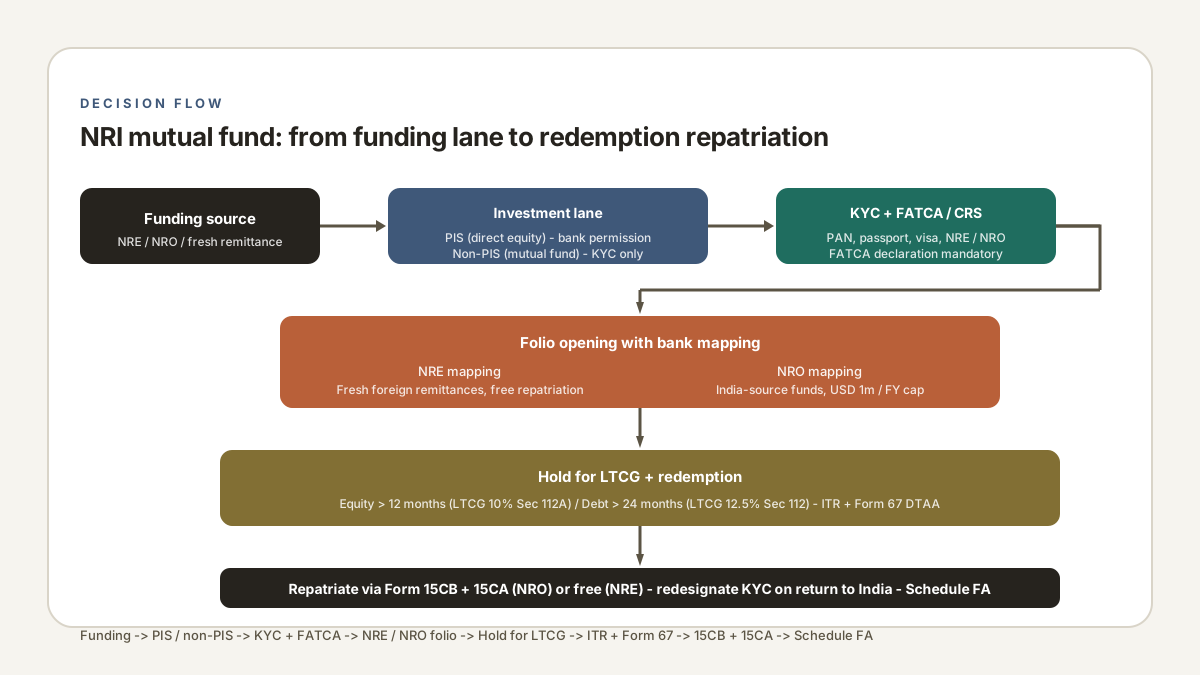
NRI mutual fund investment decision flow
Need help with Tax & Residency?
Share your blocker in one line. Our experts will reply with practical next steps.
NRI mutual fund -> redemption -> foreign account: the five-layer stack
FATCA / CRS is not optional, even if you are not a US person
All SEBI-registered intermediaries (mutual fund houses, brokers, registrars) must collect a FATCA / CRS declaration from every NRI investor. If you skip the declaration, the fund house will apply a 30% withholding on US-source income and may freeze the folio for redemption. US-person NRIs (citizens, green-card holders, or substantial-presence-test residents) must provide a US TIN (SSN or ITIN) and acknowledge that the account information will be shared with the IRS. Even non-US NRIs must declare their country of tax residence, their TIN for that country, and confirm they are not a US person. The declaration is one form, signed once at the KRA level, and mirrored at every fund house through the CKYC number.
Animated decision map

Community signal
What to watch in real discussions
Treat repeated complaints as risk signals rather than official advice. This page does not link to community search results.
Interactive checkpoint
Turn this guide into a decision file
0 of 4 checked
Can I invest in Indian mutual funds as an NRI?
Yes. FEMA 1999 allows NRIs and OCIs to invest in Indian mutual funds (equity, debt, hybrid) on a repatriable or non-repatriable basis, subject to SEBI KYC + FATCA / CRS declaration. The investment must come from an NRE or NRO account, or via a fresh foreign remittance routed through a regulated channel. Direct cash and third-party cheques are not accepted. The investment lane for mutual funds is non-PIS — you do not need a separate PIS permission letter from an Indian bank.
Should I map my mutual fund folio to an NRE or NRO account?
Match the mapping to the source of the funds. Map to NRE if you are investing fresh foreign remittances — this preserves the repatriation character and at redemption the proceeds can be freely moved back to a foreign account. Map to NRO if you are investing India-source funds (rental income, prior Indian investments, sale proceeds from an India property). The NRO mapping means at redemption the proceeds are in NRO and repatriation to a foreign account is capped at USD 1 million per FY under the Liberalised Remittance Scheme, with Form 15CA + 15CB required for each remittance. Most NRI investors maintain two folios at the same fund house — one NRE, one NRO — for clean accounting.
What is the capital-gains tax on NRI mutual fund redemptions?
For equity-oriented mutual funds (held <= 12 months, STCG): 15% under Section 111A, plus surcharge + cess. For equity-oriented mutual funds (held > 12 months, LTCG): 10% on gains above Rs 1 lakh per FY under Section 112A, plus surcharge + cess. For debt-oriented mutual funds (held > 24 months, LTCG): 12.5% without indexation under Section 112 (post-2024 Budget). For specified funds, the special 25% rate may apply — consult a CA for the exact fund category. TDS is not deducted by the fund house on equity-fund capital gains for NRIs; the NRI pays via self-assessment in the ITR. The fund house does deduct TDS on certain dividend income under Section 194BA. The NRI must file the ITR in India and claim DTAA relief via Form 67 for any tax paid in the country of residence (e.g. US-India DTAA, UK-India DTAA, Canada-India DTAA).
Do I need to disclose Indian mutual fund units in Schedule FA?
Schedule FA disclosure is for foreign assets held by an Indian resident. If you held Indian mutual fund units while you were an NRI and the units are still on the books at the time of becoming an Indian resident, they are Indian assets, not foreign assets — they are disclosed in the Indian assets schedule of the ITR, not Schedule FA. If, however, you hold units in a fund domiciled outside India (e.g. a US-domiciled ETF that invests in Indian stocks), that is a foreign asset and must be disclosed in Schedule FA with the country, the units, the peak value in INR during the FY, and the income derived. Failure to disclose foreign assets carries a Rs 10 lakh penalty under Section 42 of the Black Money Act, 2015, plus the tax + interest on the income.
Can I repatriate my mutual fund redemption proceeds to a foreign account?
Yes, but the route depends on the bank mapping. NRE mapping: free repatriation, no FEMA cap, no Form 15CA / 15CB required. NRO mapping: USD 1 million per FY cap under the Liberalised Remittance Scheme, and each remittance requires Form 15CA + Form 15CB. The chartered-accountant certificate under Form 15CB confirms the India-tax treatment of the remittance and is filed with the income-tax department. Banks will reject the SWIFT if the 15CA / 15CB is missing, inconsistent, or if the LRS cap is exhausted. Some banks also require an LRS-self-declaration for each remittance. For US-person NRIs, the remittance may also attract US tax-reporting obligations on the foreign account.
What is the worst-case scenario if I invest without FATCA / KYC planning?
Three things can go wrong: (1) the fund house applies 30% withholding on US-source income for missing or inconsistent FATCA declarations, locking up the redemption value until the declaration is corrected. (2) The folio is frozen for redemption because the PAN and the bank-account name do not match, requiring a fresh KYC and a re-designation exercise. (3) On returning to India and redesignating, the units are not disclosed in Schedule FA or the redesignation paperwork is incomplete, triggering a Rs 10 lakh penalty under the Black Money Act plus the tax + interest on the income. Each of these is fixable, but the cost is Rs 5 lakh to Rs 30 lakh in additional tax + penalties, plus 2 to 3 years of audit and reassessment. The cleanest plan is a CA-reviewed KYC + FATCA + bank-mapping plan, completed before the first SIP is placed.
Your tax year is already running.
RNOR status, exit timing, and DTAA benefits all depend on decisions you make before you land. Don't guess.