
The 60-second version
When you return to India, your financial identity shifts. Keeping mutual funds and demat accounts under an NRI status is a FEMA violation. This guide breaks down the exact sequencing, documentation, and the critical step of Re-KYC to smoothly transition your portfolio without triggering frozen accounts or tax penalties.
Why keeping an NRI investment account is a FEMA violation
Returning NRIs often delay updating their investment accounts, assuming that as long as they pay taxes, the status does not matter. This is a critical error. Under the Foreign Exchange Management Act (FEMA), an individual's residential status changes the moment they return to India with the intention to stay indefinitely.
Continuing to operate a Non-Resident Ordinary (NRO) or Non-Resident External (NRE) Demat account, or holding Mutual Funds under an NRI KYC when you are officially a resident, is a compliance violation. It can lead to frozen folios, blocked redemptions, and regulatory penalties. The solution is a structured Re-KYC and status conversion process that follows one immovable rule: sort the bank accounts first, then change the investment status.
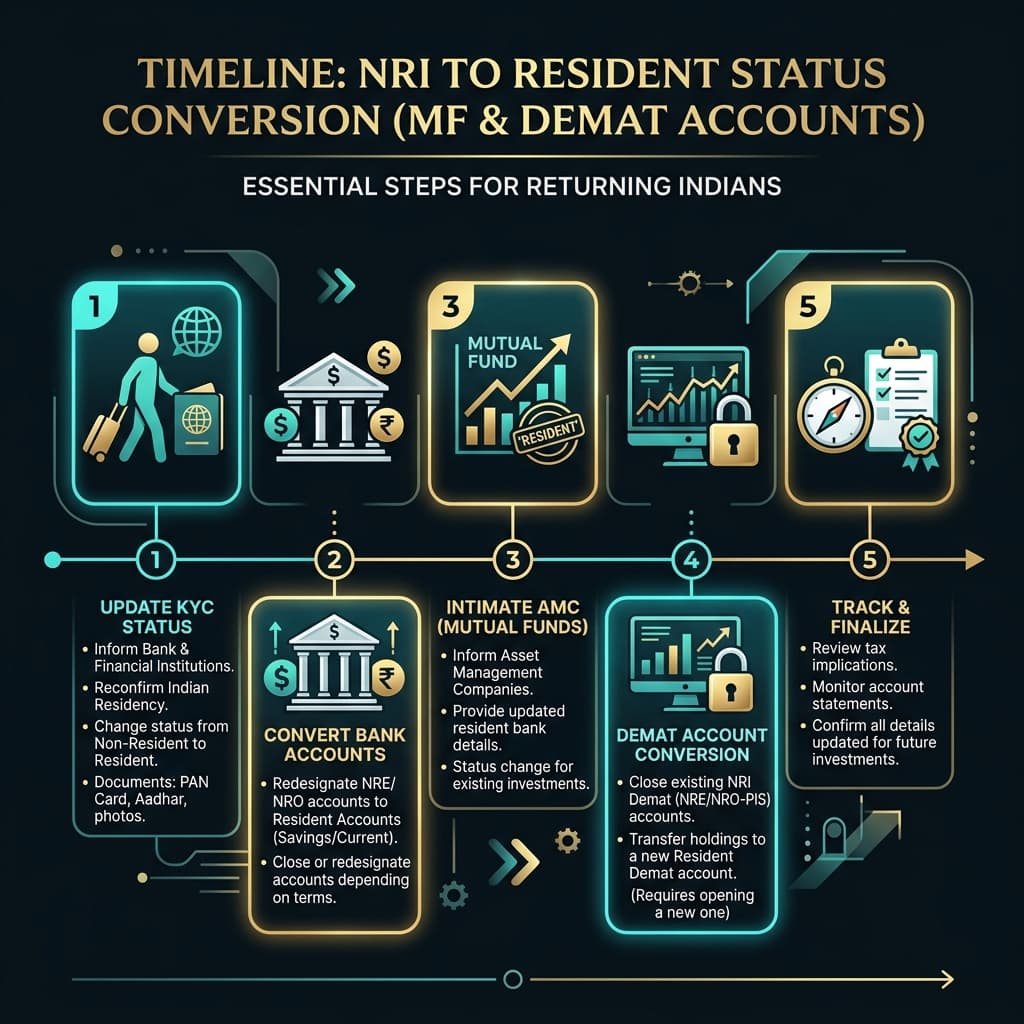
The Re-KYC Timeline: When to trigger the change
Demat Account Conversion: Close-and-Transfer vs. Status Update
| Account Type | Action Required | Friction Level | End Result |
|---|---|---|---|
| NRO Demat Account | Submit a closure-cum-transfer DIS request. Securities move to a new Resident Demat account. | High — Requires physical forms, new account opening, and DIS slips. | A clean Resident Demat account linked to a Resident Savings Bank account. |
| NRE Demat Account (with PIS) | Close the PIS account with the bank. Close the NRE Demat account. Transfer shares via off-market transfer to your new Resident Demat. | Very High — Requires bank PIS clearance and broker coordination. | NRE holdings become resident holdings; future capital gains are taxed under resident tax rules. |
| Mutual Fund Folios (Non-Demat) | Submit a KYC Modification form (Re-KYC) to a KRA or AMC with your new resident address and Resident bank details. | Medium — Can often be initiated online via CAMS or KFintech, but may require wet signatures for some AMCs. | Folio status updates to Resident Individual. TDS deduction on redemptions ceases. |
The Step-by-Step Re-KYC Playbook
Do not attempt to change your investment status before your bank accounts are sorted. The dependencies are strict and flow in one direction only.
Step 1: Secure Resident Proof of Address
Aadhaar is the gold standard for Re-KYC. Wait until your Aadhaar is updated with your new Indian resident address before initiating any changes. Without this, your Re-KYC will be rejected.
Step 2: Redesignate Your Bank Accounts
Convert your NRO or NRE accounts to Resident Savings Accounts. You will need a new Resident cancelled cheque to update your Demat and Mutual Fund folios. The AMC and depository will reject a cancelled cheque that says 'NRO' on it.
Step 3: Open a New Resident Demat Account
If you hold stocks, open a new Resident Demat account with any registered depository participant (DP) before initiating the transfer. You cannot transfer shares without a destination account.
Step 4: Execute the Demat Off-Market Transfer
Submit a Delivery Instruction Slip (DIS) and a closure form to your old NRI broker or DP. The shares will move off-market to your new Resident Demat. Since it is a transfer to your own account with no change in beneficial ownership, it does not trigger a capital gains tax event.
Step 5: Submit Mutual Fund Re-KYC
Download the KYC Modification form from CAMS or KFintech. Attach your updated Aadhaar, PAN, and a cancelled cheque from your new Resident savings account. Submit to the KRA. Once updated, the new status cascades to all AMCs linked to your PAN.
Re-KYC document checklist before you submit
Keep this packet ready before you ask the broker, DP, AMC, KRA, or bank to change status.
- Updated PAN and Aadhaar records with resident India address.
- Resident savings account cancelled cheque or bank proof.
- Old NRI demat account details, client master report, and closure-cum-transfer form.
- Delivery Instruction Slip details for off-market transfer to the new resident demat account.
- KYC modification form for CAMS, KFintech, or the relevant KRA.
- Folio list, AMC login access, and proof of all pending redemptions or SIP mandates.
The Re-KYC Dependency Chain

Need help with Banking?
Share your blocker in one line. Our experts will reply with practical next steps.
The Community Experience: Common Friction Points
"The biggest bottleneck is always the bank account. AMCs will reject your Re-KYC if the attached cancelled cheque still says NRO on it. Get the bank sorted first, then tackle the mutual funds. Some AMCs also require you to physically visit or send notarized documents by post."
Read on reddit ->The TDS benefit you are leaving on the table
Changing your status from NRI to Resident does NOT trigger a capital gains tax event. However, it does stop unnecessary TDS leakage. NRIs face a flat TDS of 20% on short-term equity fund redemptions and 10% on long-term. Resident Individuals are not subject to TDS on equity mutual fund redemptions. Updating your status promptly saves real money on every redemption.
Demat and mutual fund re-KYC workflow after returning
Animated decision map

Interactive checkpoint
Turn this guide into a decision file
0 of 4 checked
Is it mandatory to convert Demat and Mutual Funds to Resident status after returning?
Yes. Under FEMA regulations, continuing to hold or operate investment accounts under an NRI status when you are a resident of India is a compliance violation and can lead to frozen accounts, penalties, and rejected redemptions.
Can I simply update the address on my existing NRI Demat account?
No. Depositories (CDSL and NSDL) require you to open a new Resident Demat account, transfer your holdings via an off-market Delivery Instruction Slip (DIS), and then close the old NRI Demat account.
Does transferring shares from an NRI Demat to a Resident Demat trigger capital gains tax?
No. Since you are transferring securities to your own account with no change in beneficial ownership, it is not treated as a 'transfer' under the Income Tax Act and does not trigger any capital gains tax.
How do I change my KYC status for Mutual Funds?
Submit a KYC Modification form with your updated Aadhaar (showing your resident address), PAN, and a cancelled cheque from your new Resident savings account to a KYC Registration Agency (KRA) like CAMS or KFintech. Once updated, it cascades to all linked AMCs.
What happens to TDS on my mutual fund redemptions after the status change?
As an NRI, mutual fund redemptions attract high TDS. Once your folio is updated to Resident Individual, TDS is generally not deducted on equity mutual fund redemptions, allowing you to manage the tax yourself when you file your ITR.
How long does the Re-KYC process take?
KRA updates typically take 5 to 10 working days after submitting a completed KYC Modification form. Demat closure and transfer can take 2 to 4 weeks depending on the broker and whether all documents are in order.
Your NRE account redesignation has a deadline.
Banks don't remind you. You need the right account stack before salary, rent, and EMIs start moving. Get the exact sequence.