NRI / OCI Senior Living Facility in India 2026: Ashiana, Antara, Columbia Pacific, VataVriksha, cost matrix Rs 30k to Rs 3L per month, and the location decision
A practical 2026 guide for returning NRIs and OCI parents considering senior living facilities in India: independent living vs assisted living vs memory care vs...
The 60-second version
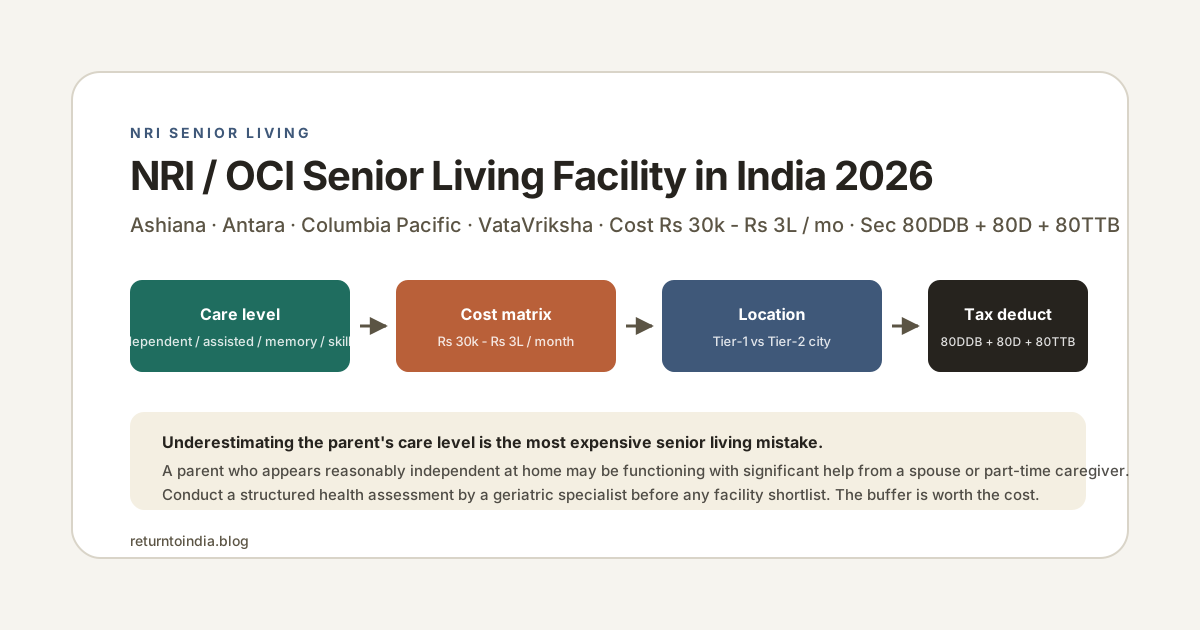
Senior living facility planning is the most important housing decision a returning NRI makes for aging parents. The 2026 landscape offers four distinct care levels (independent living, assisted living, memory care, skilled nursing) at a 10x cost spread (Rs 30,000 per month entry-level to Rs 3 lakh per month premium), a handful of major operators (Ashiana, Antara, Columbia Pacific, VataVriksha), and a critical location decision (Tier-1 city near NRI family vs Tier-2 city near parent's existing home). The order is fixed; the deliverables are not optional.
Why senior living facility planning is the most important housing decision a returning NRI makes (and why 2026 expanded the options)
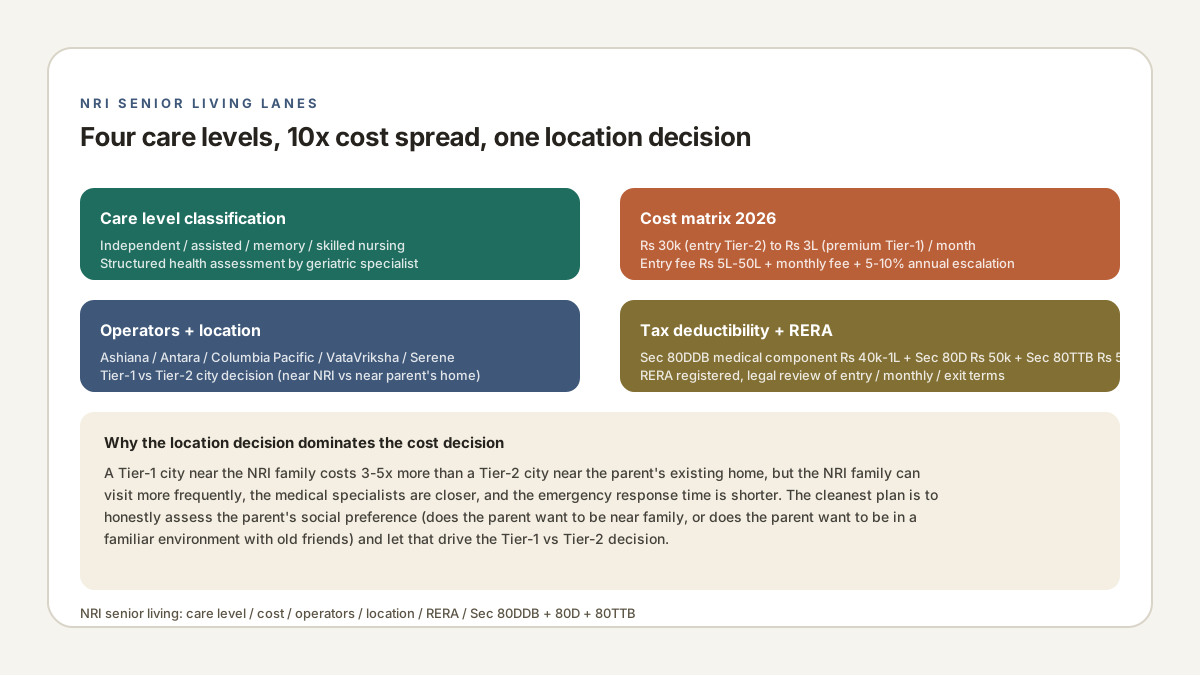
Every returning NRI with aging parents faces a four-layer care decision stack: (1) independent living at home - the parent continues to live in their existing home with a part-time caregiver, suitable for parents in their 60s with reasonable health; (2) independent living at a senior living community - the parent moves to a dedicated senior living community with a 1BHK / 2BHK apartment, community dining, and on-call medical, suitable for parents in their 60s-70s who want social engagement; (3) assisted living at a senior living community - the parent moves to a dedicated assisted living apartment with daily living assistance (bathing, dressing, medication reminders, meals), suitable for parents in their 70s-80s with moderate health; (4) memory care or skilled nursing - the parent moves to a dedicated memory care unit or skilled nursing facility, suitable for parents with dementia, Alzheimer's, or significant medical needs. The 2026 landscape has expanded the options at every level: Ashiana Housing has launched independent living in Tier-2 cities (Bhiwadi, Jaipur, Chennai) at Rs 30,000 per month, Antara Senior Living has launched premium assisted living in Tier-1 cities (Gurugram, Bengaluru, Chennai) at Rs 1.5-3 lakh per month, and Columbia Pacific has launched memory care and dementia-specific communities in Tier-1 and Tier-2 cities at Rs 2-3 lakh per month.
The decision is not just about cost. It is also about the location trade-off: Tier-1 city (near the NRI family, near the medical specialists, but at a 3-5x higher cost and a less familiar environment for the parent) vs Tier-2 city (near the parent's existing home, familiar environment, but at a 1-2x lower cost and a less convenient medical infrastructure). The cleanest plan is to start the decision 3-6 months before any planned transition, with at least 3 in-person visits to shortlisted facilities, a financial plan that covers the cost for at least 10 years (the typical senior living tenure), and a legal framework that includes the senior living contract review, the RERA registration check, and the senior parent's own KYC and decision-making capacity. The order is fixed; the deliverables are not optional.
Independent vs assisted vs memory care vs skilled nursing: what each level actually does
The four care levels have different services, cost, eligibility, and location. The right choice depends on the parent's health, age, social preference, and budget.
| Care level | What it covers | Who is it for | Typical cost (Rs / month) | Typical location |
|---|---|---|---|---|
| Independent living at home (with part-time caregiver) | Parent continues to live in their existing home; part-time caregiver for daily living assistance; family visits and coordination by the NRI | Parent in their 60s with reasonable health, prefers familiar home, has family / community nearby | Rs 15,000 - Rs 50,000 (caregiver salary + groceries + utilities + medical) | Parent's existing home; no relocation needed |
| Independent living at senior living community (1BHK / 2BHK apartment) | Dedicated senior living community with 1BHK / 2BHK apartment, community dining, on-call medical, social activities, housekeeping, security | Parent in their 60s-70s, wants social engagement and on-call medical, family lives in different city, parent is reasonably independent | Rs 30,000 - Rs 1,00,000 (entry-level Tier-2 to mid-tier Tier-1) | Ashiana (Bhiwadi, Jaipur, Chennai, Pune) at Rs 30-60k; Antara / Columbia Pacific (Bengaluru, Coimbatore) at Rs 60-100k |
| Assisted living at senior living community (apartment with daily living assistance) | Dedicated assisted living apartment with daily living assistance (bathing, dressing, medication reminders, meals, housekeeping), 24x7 nursing, on-call doctor, social activities | Parent in their 70s-80s, needs daily living assistance but not skilled nursing, has some mobility, has some cognitive clarity | Rs 60,000 - Rs 2,00,000 (entry-level Tier-2 to mid-tier Tier-1) | Antara / Columbia Pacific (Bengaluru, Gurugram, Noida) at Rs 1.5-2L; Primus / VataVriksha (Pune, Cochin) at Rs 80-150k |
| Memory care / dementia care (specialised unit) | Dedicated memory care unit with 24x7 specialised nursing, secure environment, cognitive stimulation activities, family support | Parent with dementia, Alzheimer's, or significant cognitive decline; needs specialised care that assisted living cannot provide | Rs 1,00,000 - Rs 3,00,000 (entry-level Tier-2 to premium Tier-1) | Antara NUDES (Gurugram), Serene Dementia Care (Bengaluru, Chennai), Columbia Pacific (Coimbatore) at Rs 1.5-3L |
| Skilled nursing facility (medical-grade care) | 24x7 medical-grade nursing, doctor on call, ventilator / ICU support, post-operative recovery, end-of-life care | Parent with significant medical needs (post-surgery, chronic disease, end-of-life), needs hospital-grade care at home | Rs 80,000 - Rs 3,00,000 (depending on medical intensity) | Standalone skilled nursing (Manipal, Apollo, Max) at Rs 1-3L; within premium assisted living (Antara, Columbia Pacific) at Rs 1.5-3L |
Execution sequence: from decision to move-in
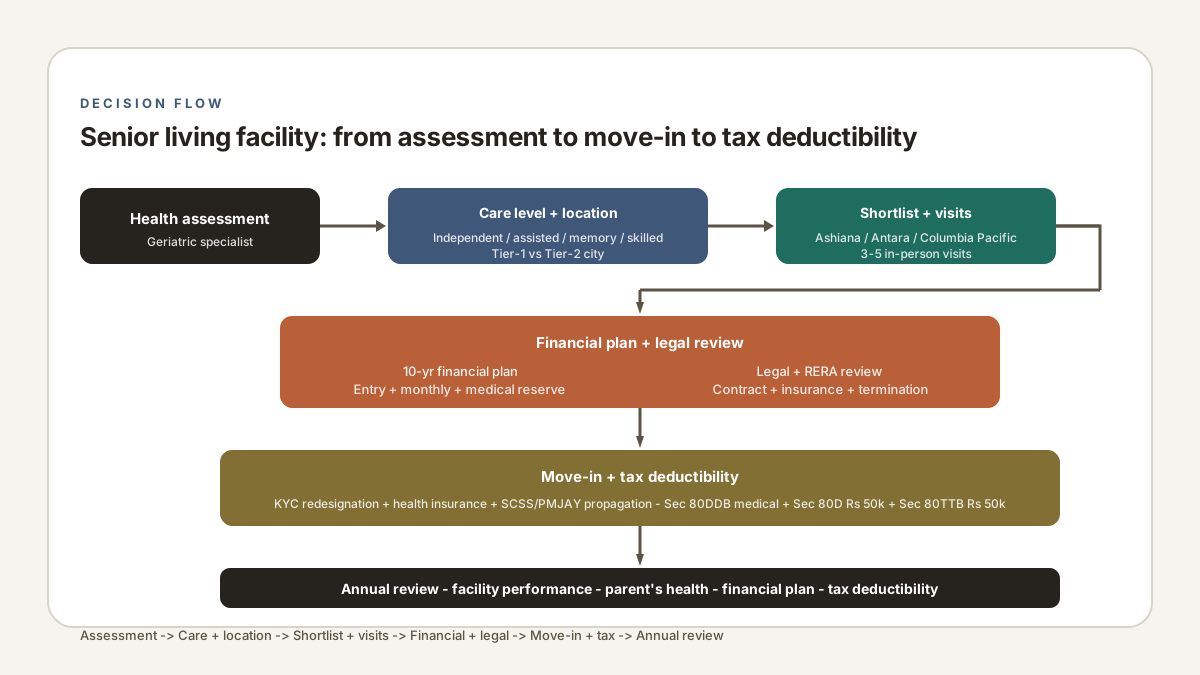
Plan the order. The parent's health assessment, the facility shortlist, the in-person visits, the financial plan, the legal framework, and the move-in coordination are not simultaneous — but they are interdependent, and an error in one is hard to fix after the contract is signed.
Conduct a structured health assessment of the parent
Before any facility shortlist, conduct a structured health assessment of the parent: current medical conditions, mobility, cognitive clarity, daily living activities (bathing, dressing, eating, continence, transferring, toileting), medication list, recent hospitalisations, and projected health trajectory. The assessment is best done by the parent's primary care doctor and a geriatric specialist (if available). The output of the assessment is a clear classification: independent living candidate, assisted living candidate, memory care candidate, or skilled nursing candidate. The classification drives the entire downstream decision: facility type, cost, location, and timeline. Do not skip the assessment - it is the most important step, and most senior living mistakes are caused by underestimating the parent's care needs.
Build a facility shortlist with the major operators and the care level match
Build a facility shortlist of 3-5 communities from the major operators: Ashiana Housing (Ashiana Advik, Ashiana Shashank, Ashiana Vrindavan, Ashiana Anantara) for independent + assisted living in Tier-1 and Tier-2 cities, Antara Senior Living (Dehradun, Noida, Gurugram, Bengaluru, Chennai) for premium independent + assisted + memory care, Columbia Pacific Communities (Bengaluru, Coimbatore, Cochin, Kodaikanal) for independent + assisted + memory care, VataVriksha and Primus for budget-to-mid assisted living, Max Towers and Primus for premium independent living. The shortlist should match the parent's care level classification and the family's location preference (Tier-1 vs Tier-2 city, near NRI family or parent's existing home).
Conduct at least 3 in-person visits to the shortlisted facilities
Visit at least 3 shortlisted facilities in person, with the parent if possible. The visit should include: (1) a tour of the apartment / unit, common areas, dining, medical, social, and outdoor areas; (2) a meal at the dining facility (if possible); (3) a meeting with the facility manager, the medical staff, and 2-3 current residents; (4) a review of the financial contract (entry fee, monthly fee, exit fee, refundable deposit, escalation terms); (5) a review of the medical protocol (on-call doctor, hospital tie-up, ambulance, emergency response time, medication management); (6) a review of the activities and social calendar. The visit is the most important step - a good facility on paper can be a bad fit in person, and a good facility in person is worth the trip. Do not commit to a facility without at least 3 in-person visits.
Build a 10-year financial plan covering the entry fee, monthly fee, and escalation
The typical senior living tenure is 10-20 years (the parent's remaining life expectancy from age 70-75). The financial plan must cover: (1) the entry fee (typically Rs 5 lakh to Rs 50 lakh, partly refundable, depending on the facility and the apartment size), (2) the monthly fee (Rs 30,000 to Rs 3 lakh per month, with 5-10% annual escalation), (3) the exit fee (some facilities charge a percentage of the resale value, others charge a flat exit fee), (4) the medical reserve (Rs 5 lakh to Rs 20 lakh for unplanned medical events, beyond the monthly fee), (5) the inflation cushion (the monthly fee typically escalates 5-10% per year, faster than general inflation). The financial plan should be funded from the parent's SCSS, Section 80TTB-eligible interest income, the parent's mutual fund or fixed deposit, and the NRI's monthly support transfer. The cleanest plan is to fund the entry fee from the parent's existing savings, the monthly fee from the SCSS interest + NRI support transfer, and the medical reserve from the parent's health insurance + PMJAY card.
Review the legal framework: senior living contract, RERA registration, refundable deposit
Engage a lawyer with senior living contract experience to review the facility contract: (1) the entry fee terms (refundable portion, lock-in period, exit calculation, transferability to spouse or children), (2) the monthly fee escalation terms (annual cap, notice period for any increase beyond the cap), (3) the medical protocol (on-call doctor, hospital tie-up, emergency response time, medication management, escalation to hospital), (4) the termination clause (notice period, refund calculation, grounds for termination by either party), (5) the RERA registration (the senior living project should be registered under the Real Estate (Regulation and Development) Act, 2016, with the RERA registration number on the contract), (6) the insurance framework (the facility should have comprehensive general liability insurance, professional liability insurance, and fire and safety insurance). The legal review protects the parent from unfair contract terms and the NRI from financial risk.
Coordinate the move-in: KYC redesignation, senior living contract, health insurance portability, SCSS / PMJAY propagation
On move-in, coordinate the full senior care stack: (1) redesignate the parent's KYC to the new address (PAN + Aadhaar + new Indian address proof + Indian bank account + Indian mobile number), (2) execute the senior living contract in the parent's name with the parent's PAN, (3) port the health insurance to a senior-friendly plan with the new address, (4) propagate the SCSS, PMJAY, Section 80TTB, and Form 15H to the new address (the interest income payout, the PMJAY card, the bank account, the bank declaration all need to be updated), (5) update the parent's NRI family coordination (the parent's primary contact at the senior living facility, the parent's primary physician on call, the parent's emergency contact). The cleanest plan is to coordinate the full senior care stack within 30 days of move-in, so the parent's care is uninterrupted.
On tax deductibility, claim Section 80DDB for the medical component, Section 80D for health insurance, Section 80TTB for senior interest
On the ITR for the AY of payment, claim: (1) Section 80DDB for the medical component of the senior living cost (the portion that covers medical care, nursing, medication, therapy) - up to Rs 40,000 (60-79y) or Rs 1 lakh (80+y) per AY, with a chartered-accountant certificate in Form 10-I attached to the ITR, (2) Section 80D for the health insurance premium for the parent (up to Rs 50,000 if senior parent covered), (3) Section 80TTB for the senior interest income from SCSS, POMIS, and bank deposits (up to Rs 50,000 per AY). The medical component of the senior living cost is typically 30-50% of the total monthly fee (the rest covers accommodation, dining, housekeeping, activities, security). Only the medical component qualifies for Section 80DDB - the accommodation and dining component does not. The facility contract should clearly separate the medical component from the accommodation component for clean tax deductibility.
Document checklist before the senior living contract is signed
Most senior living contract failures are caused by missing or mismatched documents at the decision or contract stage. Confirm each item before signing.
- Parent's PAN, Aadhaar, and Indian address proof of 182+ days (for the KYC redesignation and the senior living contract).
- Parent's Indian bank account statement and Indian mobile number (for the monthly fee debit and the emergency contact).
- Structured health assessment from the parent's primary care doctor and a geriatric specialist - current medical conditions, mobility, cognitive clarity, daily living activities, medication list, recent hospitalisations, projected health trajectory.
- Shortlist of 3-5 senior living communities matched to the parent's care level classification and the family's location preference.
- At least 3 in-person visits to the shortlisted facilities - tour, meal, meeting with facility manager and medical staff, review of contract, review of medical protocol, review of activities.
- 10-year financial plan covering entry fee (Rs 5L-50L), monthly fee (Rs 30k-3L per month with 5-10% annual escalation), exit fee, medical reserve, inflation cushion.
- Legal review of the senior living contract - entry fee terms, monthly fee escalation, medical protocol, termination clause, RERA registration, insurance framework.
- RERA registration check - the senior living project should be registered under the Real Estate (Regulation and Development) Act, 2016, with the RERA registration number on the contract.
- Medical protocol review - on-call doctor, hospital tie-up, ambulance, emergency response time, medication management, escalation to hospital.
- Insurance framework review - facility's general liability insurance, professional liability insurance, fire and safety insurance, parent's health insurance, parent's PMJAY card.
- NRI family coordination plan - parent's primary contact at the senior living facility, parent's primary physician on call, parent's emergency contact, monthly visit schedule (if NRI family is in the same city).
- Power of attorney (POA) document in favour of a representative in India if the NRI is not personally present for the contract signing or the move-in. The POA must be specific to the senior living contract, executed on stamp paper, and notarized / apostilled by the Indian consulate in the country of residence.
Senior living facility decision flow
Need help with Move Planning?
Share your blocker in one line. Our experts will reply with practical next steps.
NRI senior living: the five-layer stack
Underestimating the parent's care level is the most expensive senior living mistake
The most common senior living mistake is underestimating the parent's care level. A parent who appears 'reasonably independent' at home may be functioning with significant help from a spouse, a child, or a part-time caregiver. Once the parent moves to a senior living facility without that daily help, the care gap is exposed, the parent may have a fall or a medical event within weeks of move-in, and the family is forced to either upgrade the care level (with a higher monthly fee) or move the parent to a different facility (with a second entry fee). The fix is to conduct a structured health assessment by a geriatric specialist before any facility shortlist, to classify the parent's care level honestly (independent / assisted / memory / skilled nursing), and to choose a facility that matches the classification with a small buffer for the first 6-12 months. The buffer is worth the cost - the average senior living tenure is 10-20 years, and a wrong classification is much more expensive to fix than a slightly higher initial cost.
Animated decision map

Community signal
What to watch in real discussions
Treat repeated complaints as risk signals rather than official advice. This page does not link to community search results.
Interactive checkpoint
Turn this guide into a decision file
0 of 4 checked
What is the cost of senior living in India in 2026?
The 2026 cost of senior living in India ranges from Rs 30,000 per month (entry-level independent living in Tier-2 cities like Bhiwadi, Jaipur, Coimbatore) to Rs 3 lakh per month (premium assisted living + memory care in Tier-1 cities like Gurugram, Bengaluru, Chennai). The cost depends on (1) the care level (independent < assisted < memory < skilled nursing), (2) the city (Tier-2 cheaper than Tier-1), (3) the apartment size (1BHK < 2BHK < 3BHK), (4) the operator (Ashiana / Antara / Columbia Pacific premium vs Primus / VataVriksha budget). The typical entry fee is Rs 5 lakh to Rs 50 lakh (partly refundable on exit), plus the monthly fee. Some operators offer a 'lifetime' package (entry fee + monthly fee + lifetime medical) that simplifies the financial planning for the 10-20 year tenure.
Which are the major senior living operators in India?
The 2026 senior living landscape in India has 4-5 major operators plus several regional players. Ashiana Housing (Bhiwadi, Jaipur, Chennai, Pune) is the largest with multiple communities for independent + assisted living at the mid-tier price point. Antara Senior Living (Dehradun, Noida, Gurugram, Bengaluru, Chennai) is the premium operator with full continuum-of-care (independent + assisted + memory + skilled nursing) under the Max Group. Columbia Pacific Communities (Bengaluru, Coimbatore, Cochin, Kodaikanal) is the mid-to-premium operator with strong memory care and dementia-specific communities. VataVriksha (Pune) and Primus (Delhi NCR) are the budget-to-mid operators. Serene Dementia Care (Bengaluru, Chennai) and Parijmaani (Pune) are the specialised memory care operators. Most operators have a waitlist of 6-12 months for the most popular communities, so the planning should start 12-18 months before any planned move.
Is the senior living cost tax-deductible in India?
Partially. The medical component of the senior living cost (the portion that covers medical care, nursing, medication, therapy) is deductible under Section 80DDB up to Rs 40,000 (60-79y) or Rs 1 lakh (80+y) per AY, with a chartered-accountant certificate in Form 10-I attached to the ITR. The health insurance premium for the parent is deductible under Section 80D up to Rs 50,000 if senior parent covered. The senior interest income from SCSS, POMIS, and bank deposits is deductible under Section 80TTB up to Rs 50,000 per AY. The accommodation and dining component of the senior living cost is NOT tax-deductible. The cleanest plan is to choose a facility that clearly separates the medical component from the accommodation component in the monthly fee structure, and to claim the deductions in the ITR with the appropriate Form 10-I and Form 16 / health insurance certificate.
What is the difference between independent living, assisted living, memory care, and skilled nursing?
The four care levels differ in the services, staff, and cost. Independent living is a 1BHK / 2BHK apartment in a senior living community with community dining, on-call medical, housekeeping, security, and social activities. The parent is reasonably independent and does not need daily living assistance. Assisted living is an apartment with daily living assistance (bathing, dressing, medication reminders, meals, housekeeping), 24x7 nursing, and on-call doctor. The parent needs daily help but not skilled nursing. Memory care is a specialised unit with 24x7 specialised nursing, secure environment, cognitive stimulation activities, and family support, designed for parents with dementia, Alzheimer's, or significant cognitive decline. Skilled nursing is a medical-grade care unit with 24x7 medical-grade nursing, doctor on call, ventilator / ICU support, post-operative recovery, and end-of-life care, designed for parents with significant medical needs. The cost rises with the care level: independent < assisted < memory < skilled nursing.
How long does the senior living contract last?
The typical senior living contract is for a 5-year tenure with an option to renew, or a lifetime contract. The 5-year contract is more common for the mid-tier operators and includes an annual escalation cap (typically 5-10% per year) and a refundable entry fee (typically 50-75% of the entry fee is refundable on exit, with the refund calculated on a sliding scale over the 5-year tenure). The lifetime contract is more common for the premium operators and includes the entry fee (refundable on a sliding scale, typically 0% after 10 years), the monthly fee (with annual escalation), and a lifetime medical component. The choice between 5-year and lifetime depends on the parent's age and the family's preference: a parent in their 60s may prefer the lifetime for the security, while a parent in their 80s may prefer the 5-year for the flexibility. The contract terms are negotiable, and the legal review should cover the tenure, the escalation, the refund, and the termination clause.
What is the worst-case scenario if I choose the wrong senior living facility?
Three things can go wrong: (1) the parent's care level is underestimated, and the facility cannot provide the medical or daily living assistance the parent needs - the parent has a fall or a medical event within weeks of move-in, and the family is forced to either upgrade the care level (with a higher monthly fee) or move the parent to a different facility (with a second entry fee), (2) the senior living contract has unfavourable terms (high non-refundable entry fee, steep escalation, broad termination clause) - the NRI is locked into a high-cost contract with limited exit options, and the cost of the entry fee is partially or fully forfeited on exit, (3) the facility is over-promised and under-delivered (the apartment is smaller than the brochure, the medical staff is part-time, the dining is institutional) - the parent's quality of life deteriorates, the family is forced to move the parent, and the second entry fee is paid. Each of these is fixable, but the cost is Rs 5 lakh to Rs 50 lakh in entry fees, Rs 30,000 to Rs 1 lakh per month in higher monthly fees, and 3-6 months of disrupted care for the parent. The cleanest plan is to conduct a structured health assessment, visit at least 3 facilities in person, review the legal contract, and plan for a 6-12 month settling period before committing to a long-term contract.
The plan is only as good as the sequence.
Tax, banking, schools, shipping — they all have dependencies. A wrong order costs months and lakhs. Get it right.