NRI Senior Citizen Care in India 2026: SCSS, PMJAY, Section 80DDB + 80TTB + 80D, reverse-parent-dependent visa, and the maintenance tribunal
A practical 2026 guide for returning NRIs caring for aging parents in India: Senior Citizens Savings Scheme (SCSS) at 8.2% for 5-year tenure with quarterly payout,...
The 60-second version
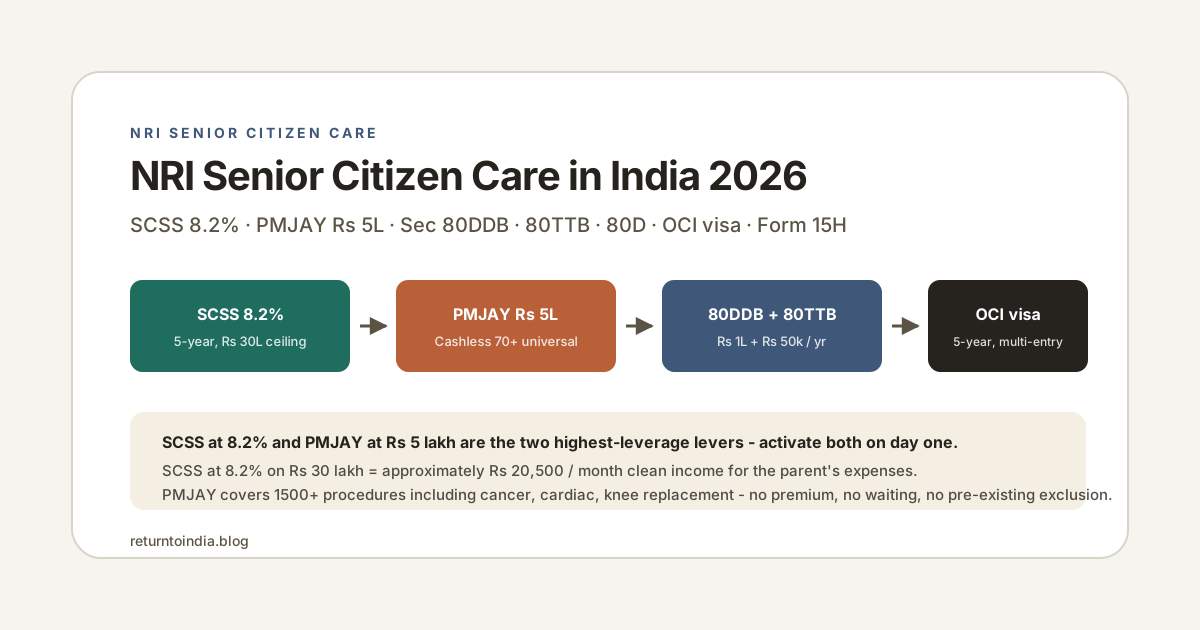
Senior citizen care planning is the highest-leverage financial and emotional decision a returning NRI makes for their aging parents. The 2026 framework offers five parallel financial levers (SCSS at 8.2%, PMJAY cashless up to Rs 5 lakh, Section 80DDB up to Rs 1 lakh, Section 80TTB up to Rs 50,000, Section 80D up to Rs 50,000), plus a long-term visa framework (reverse-parent-dependent OCI visa), plus a maintenance tribunal if the parents are not in a position to support themselves. The order is fixed; the deliverables are not optional.
Why senior citizen care planning is the highest-leverage decision a returning NRI makes (and why 2026 added three new levers)
Every returning NRI with aging parents faces a six-layer decision stack: (1) financial support - the monthly / annual transfer from the NRI's foreign income to the parent's Indian bank account, with the FEMA + LRS cap and the tax implications on both sides; (2) investment planning - the parent's portfolio (bank deposits, SCSS, post office schemes, mutual funds) needs to be optimized for senior-friendly risk-return and for the senior-specific tax deductions; (3) health insurance - the parent's health insurance is the second-largest monthly expense after housing, and the Section 80D senior-parent deduction of Rs 50,000 is the largest single tax deduction in the parent's name; (4) medical treatment - any major illness (cancer, cardiac, kidney) triggers the Section 80DDB deduction of Rs 40,000 (senior) to Rs 1 lakh (very senior), and the PMJAY cashless treatment of up to Rs 5 lakh for eligible senior families; (5) long-term visa - the parent may need a long-term Indian visa to stay in India with the returning NRI, and the reverse-parent-dependent OCI visa is the natural path; (6) legal protection - if the parent cannot support themselves, the maintenance tribunal under Section 125 of the Criminal Procedure Code can be invoked, and the returning NRI may be the respondent.
The 2026 framework has added three new levers. First, the Senior Citizens Savings Scheme (SCSS) interest rate has been revised to 8.2% per annum (compounded quarterly, paid quarterly), making it the highest-yielding sovereign-backed savings instrument for seniors. Second, the PMJAY (Ayushman Bharat) scheme has been extended to all senior citizens aged 70+ years regardless of income, with cashless treatment up to Rs 5 lakh per family per year at empanelled hospitals. Third, the reverse-parent-dependent OCI long-term visa is now processed within 30-60 days at Indian consulates, with a validity of 5 years (renewable) and no requirement for the parent to visit India. The catch: most of these levers require the parent to be a tax-resident in India (which they typically are, even if the NRI is not), the bank and post office accounts must be in the parent's PAN, and the Section 80DDB deduction requires a chartered-accountant certificate. The cleanest plan is to start the senior care stack on day one of the return, with all five financial levers activated and the OCI visa in process.
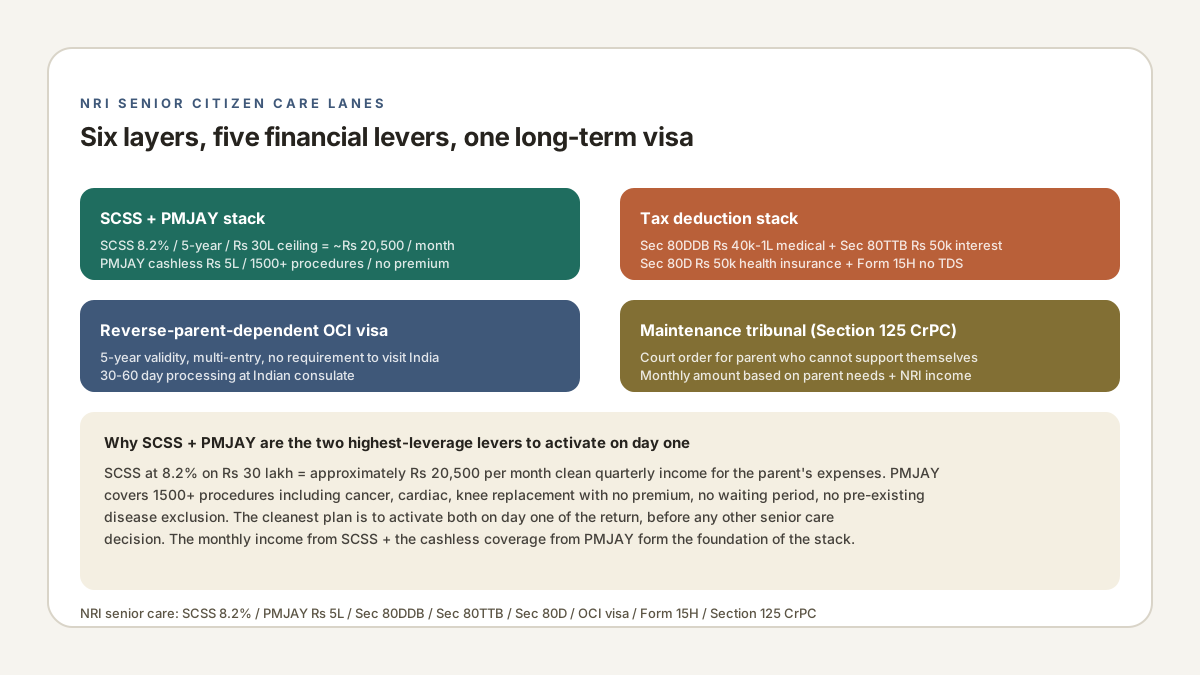
Five financial levers + one long-term visa: what each lever actually does
The senior citizen care stack has six distinct levers. Each has its own eligibility, document set, and tax treatment.
| Lever | What it does | Eligibility | Benefit amount | Practical use |
|---|---|---|---|---|
| SCSS (Senior Citizens Savings Scheme) | Sovereign-backed 5-year savings scheme at 8.2% per annum, compounded and paid quarterly, with a ceiling of Rs 30 lakh per depositor | Indian resident aged 60+ years (or 55+ for retired defense personnel); opened at a designated post office or bank | 8.2% per annum on the deposit, fully taxable at the senior's slab rate | Highest-yielding sovereign-backed senior savings scheme; quarterly payout for monthly expenses; 5-year tenure with extension option |
| PMJAY (Ayushman Bharat) | Cashless treatment at empanelled hospitals for senior citizens aged 70+ years, up to Rs 5 lakh per family per year | Senior citizens aged 70+ years (universal eligibility post-2024 expansion), based on Aadhaar-linked ID | Up to Rs 5 lakh per family per year cashless at empanelled hospitals | No premium, no waiting period, no pre-existing disease exclusion. Coverage for 1500+ procedures including cancer, cardiac, knee replacement. |
| Section 80DDB (medical treatment) | Deduction for medical treatment of dependent parent (60-79 years: Rs 40,000, 80+ years: Rs 1 lakh per AY) | Indian tax-resident parent (any age), claimed by the NRI / family member who paid for the treatment | Rs 40,000 - Rs 1 lakh per AY, in addition to Section 80D | Requires a chartered-accountant certificate in Form 10-I and the hospital prescription / treatment proof |
| Section 80TTB (senior interest) | Deduction for senior interest income from bank deposits, post office savings, and senior savings schemes | Indian tax-resident aged 60+ years (or 55+ for retired defense personnel) | Rs 50,000 per AY, on top of the basic senior slab rate | Covers interest from savings account, fixed deposits, recurring deposits, SCSS, POMIS, etc. Excludes interest from company deposits and NRI deposits. |
| Section 80D (senior parent health insurance) | Deduction for health insurance premium paid for senior parent (Rs 50,000 if senior parent covered, within the overall 80D cap) | Indian tax-resident parent (any age), claimed by the NRI / family member who paid the premium | Rs 50,000 per AY for senior parent + Rs 5,000 for preventive health check-up | Combined with self + family deduction (Rs 25,000), the total potential deduction is Rs 80,000 per AY. The largest personal-finance tax deduction in the stack. |
| Reverse-parent-dependent OCI visa | Long-term Indian visa for parent of returning NRI / OCI cardholder, allowing multi-year stay in India without re-application | Parent of Indian / OCI / PIO cardholder; processed at the Indian consulate in the country of residence | 5-year validity (renewable), no requirement for parent to visit India; multi-entry | Most senior parents of returning NRIs prefer to live in India with the NRI family. The OCI visa removes the need for repeated tourist visa renewals. |
| Maintenance tribunal (Section 125 CrPC) | Court order for maintenance of parent who cannot support themselves, against the returning NRI / family member | Parent who cannot maintain themselves from own income or property; the NRI is the legal heir and potential respondent | Monthly maintenance amount determined by the tribunal based on the parent's needs and the NRI's income | Used as a last resort. The NRI's legal obligation is enforceable under Indian law, and a foreign-earner NRI may be ordered to pay. Pre-empt by maintaining the parent voluntarily. |
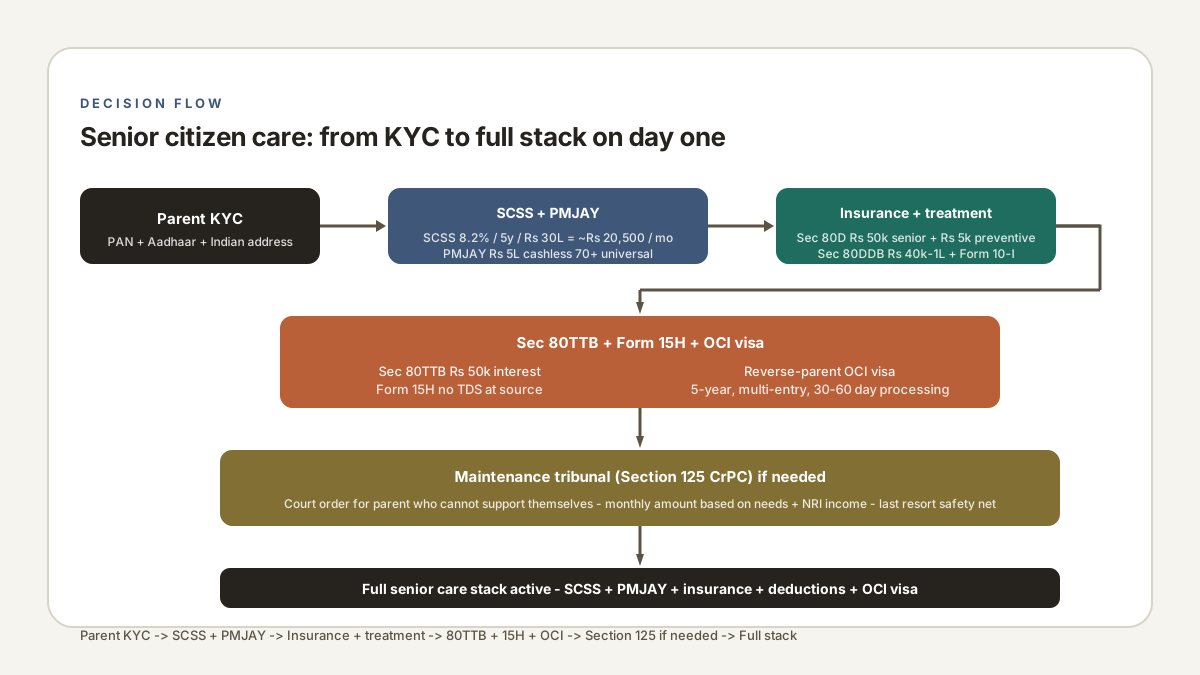
Execution sequence: from arrival to full senior citizen care stack
Plan the order. The parent's KYC redesignation, the SCSS opening, the PMJAY card, the Section 80DDB / 80TTB / 80D claims, the OCI visa, and the maintenance tribunal framework are not simultaneous — but they are interdependent, and an error in one is hard to fix after the parent's health deteriorates.
Confirm the parent's residential status and redesignate the parent's KYC
On the parent's situation, confirm the residential status under Section 6 of the Income Tax Act (typically the parent is a resident if they are in India for 182+ days, even if the NRI is not). Confirm the parent's KYC: PAN, Aadhaar (Indian address proof of 182+ days, Indian bank account, Indian mobile number). For an OCI parent returning to live in India with the NRI family, the KYC redesignation is the same as the NRI's redesignation (covered in a separate article). The parent's KYC redesignation enables the SCSS opening, the PMJAY card, the health insurance application, and the OCI visa application.
Open the SCSS account at a designated post office or bank
Visit the nearest designated post office or bank (most public-sector banks are authorised) with the parent's PAN, Aadhaar, Indian address proof, Indian mobile number, and a recent photograph. The SCSS account is opened with a minimum deposit of Rs 1,000 and a maximum of Rs 30 lakh per depositor. The interest rate is 8.2% per annum, compounded and paid quarterly, for a 5-year tenure. The account can be extended for an additional 3 years at the prevailing rate. The deposit is fully taxable at the parent's slab rate, but the quarterly payout is a clean monthly-income source. Multiple accounts can be opened across different post offices or banks, with a combined ceiling of Rs 30 lakh per depositor.
Apply for the PMJAY (Ayushman Bharat) card for the parent
For senior citizens aged 70+ years (universal eligibility post-2024 expansion), apply for the PMJAY card at the nearest empanelled hospital, Common Service Centre (CSC), or online via the PMJAY portal. The application requires the parent's Aadhaar (linked to mobile number), a recent photograph, and an address proof. The card is generated within 7-15 days and is valid for life. The card enables cashless treatment at empanelled hospitals for 1500+ procedures, with a coverage of up to Rs 5 lakh per family per year. No premium, no waiting period, no pre-existing disease exclusion. For the returning NRI, the PMJAY card is the cleanest path for the parent's medical treatment without out-of-pocket expense.
Apply for the health insurance policy covering the parent (with Section 80D deduction)
Choose a senior-friendly health insurance plan (e.g. Star Health Senior Citizens Red Carpet, HDFC ERGO Optima Restore, Niva Bupa Health Companion) with the parent's age profile and the network hospital list in the parent's city. The plan should be a separate senior-citizen plan or a family-floater plan that includes the parent (covered in the NRI health insurance article). Apply with full disclosure of the parent's pre-existing conditions. The Section 80D deduction for the senior parent's premium is Rs 50,000 per AY, in addition to the Rs 25,000 for the NRI's own family - for a total potential deduction of Rs 80,000 per AY. The premium is paid by the NRI from the NRE / NRO account (or by the parent from the Indian savings account), and the deduction is claimed in the ITR of the person who paid.
On medical treatment, claim Section 80DDB deduction (Rs 40,000 - Rs 1 lakh per AY)
For any major illness treatment of the parent (cancer, cardiac, kidney, neurological, haematological, or specified chronic disease), claim the Section 80DDB deduction: Rs 40,000 if the parent is 60-79 years, Rs 1 lakh if the parent is 80+ years. The deduction is on the actual medical expenditure (not the insurance claim) and is available only for treatment at a government hospital, a government-recognised hospital, or a hospital with a registration number under the Clinical Establishments Act. The deduction requires a chartered-accountant certificate in Form 10-I, attached to the ITR for the AY of treatment. The deduction is in addition to the Section 80D health insurance premium deduction.
Claim Section 80TTB deduction on the parent's interest income (Rs 50,000 per AY)
For interest income earned by the parent on bank deposits, post office savings, SCSS, POMIS, and other specified senior savings schemes, claim the Section 80TTB deduction: Rs 50,000 per AY. The deduction is available only to Indian tax-resident seniors aged 60+ years, and is in addition to the basic senior slab rate (which is lower than the regular slab rate). Combined with Form 15H (no TDS at source on bank deposits if the parent's total income is below the basic exemption), the parent's interest income can be largely tax-free up to Rs 5.5 lakh per AY (basic exemption + 80TTB deduction + interest on Rs 30 lakh SCSS at 8.2% = Rs 2.46 lakh per year).
Apply for the reverse-parent-dependent OCI visa at the Indian consulate
If the parent is an OCI / PIO cardholder or eligible for OCI (parents of Indian citizens or OCI cardholders), apply for the reverse-parent-dependent OCI visa at the Indian consulate in the country of the parent's current residence. The application requires the parent's foreign passport, OCI booklet (if held), the NRI / OCI cardholder's relationship proof (birth certificate, OCI booklet), and the standard OCI document set (photograph, address proof, etc.). The visa is processed within 30-60 days, with a 5-year validity (renewable), and allows the parent to stay in India for the full 5-year period without re-application. The visa is multi-entry, so the parent can travel to India and back as needed.
If the parent cannot support themselves, invoke the maintenance tribunal framework (Section 125 CrPC)
If the parent cannot support themselves from their own income or property (e.g. due to age, illness, or disability), they can file a maintenance petition under Section 125 of the Criminal Procedure Code against the returning NRI / family member. The tribunal determines the monthly maintenance amount based on the parent's needs (medical, housing, food) and the NRI's income. The order is enforceable under Indian law, and a foreign-earner NRI may be ordered to pay. The cleanest plan is to maintain the parent voluntarily (via monthly transfer, SCSS interest, and health insurance) so that the tribunal is not needed. The tribunal is a safety net, not a substitute for active care.
Document checklist before the first senior care lever is activated
Most NRI senior care failures are caused by missing or mismatched documents at the SCSS opening, PMJAY card, health insurance, or OCI visa application. Confirm each item before starting.
- Parent's PAN card (mandatory for SCSS, bank deposits, ITR filing, Section 80DDB / 80TTB / 80D claims).
- Parent's Aadhaar (or Aadhaar non-eligibility letter for the redesigned KYC) - required for the PMJAY card, bank account, mobile number, and government portal access.
- Parent's Indian address proof of 182+ days: utility bill in the parent's name, OR a registered rent agreement + landlord NOC.
- Parent's age proof: PAN, Aadhaar, passport, or birth certificate (required for SCSS eligibility 60+, PMJAY 70+, and the senior-specific tax deductions).
- Parent's senior-specific medical report: hospital prescription / treatment proof, chartered-accountant certificate in Form 10-I for Section 80DDB claim.
- Parent's recent photograph (35mm x 35mm, white background) and signature scan (for SCSS, PMJAY, OCI visa).
- Parent's Indian bank account statement - the SCSS interest payout, the PMJAY card benefits, the Form 15H declaration are all routed through the Indian bank account.
- NRI's OCI booklet or Indian passport (for the parent-child relationship proof and the reverse-parent-dependent OCI visa).
- NRI's Form 16 or ITR (for the NRI's income proof, used in the maintenance tribunal if invoked).
- Power of attorney (POA) document in favour of a representative in India if the NRI is not personally present for the SCSS opening, PMJAY application, or OCI visa filing. The POA must be specific to the senior care application, executed on stamp paper, and notarized / apostilled by the Indian consulate in the country of residence.
- A written plan for the parent's monthly financial support: monthly transfer from NRE / NRO to parent's Indian savings, SCSS interest payout, health insurance premium, and the future use of Section 80DDB / 80TTB / 80D deductions.
- An estimate of the parent's annual income and tax liability (to determine the slab rate and the eligibility for the senior-specific deductions).
Senior citizen care decision flow
Need help with Move Planning?
Share your blocker in one line. Our experts will reply with practical next steps.
NRI senior citizen care: the five-layer stack
SCSS at 8.2% and PMJAY at Rs 5 lakh are the two highest-leverage levers - activate both on day one
The two highest-leverage senior care levers in the 2026 framework are the Senior Citizens Savings Scheme (SCSS) at 8.2% per annum and the PMJAY (Ayushman Bharat) card for cashless treatment up to Rs 5 lakh. Both are free or near-free, both have minimal eligibility requirements, and both are irrecoverable if the parent's health deteriorates before activation. SCSS requires only a PAN, Aadhaar, and Indian address proof - it is opened at a designated post office or bank within 30 minutes. PMJAY requires only an Aadhaar-linked identity - the card is generated within 7-15 days. The cleanest plan is to activate both on day one of the return, before any other senior care decision. The monthly income from SCSS at 8.2% on Rs 30 lakh is approximately Rs 20,500 per month - a clean monthly-income source for the parent's expenses. The PMJAY card covers 1500+ procedures including cancer, cardiac, knee replacement - the most expensive medical events in the parent's life.
Animated decision map

Community signal
What to watch in real discussions
Treat repeated complaints as risk signals rather than official advice. This page does not link to community search results.
Interactive checkpoint
Turn this guide into a decision file
0 of 4 checked
What is the SCSS interest rate and how much can my parent deposit?
The Senior Citizens Savings Scheme (SCSS) interest rate in 2026 is 8.2% per annum, compounded and paid quarterly, for a 5-year tenure (with an option to extend for an additional 3 years at the prevailing rate). The minimum deposit is Rs 1,000 and the maximum is Rs 30 lakh per depositor. Multiple accounts can be opened across different post offices or banks, with a combined ceiling of Rs 30 lakh per depositor. The deposit is fully taxable at the parent's slab rate, but the quarterly payout is a clean monthly-income source. The SCSS account is opened at a designated post office or bank (most public-sector banks are authorised) with the parent's PAN, Aadhaar, Indian address proof, Indian mobile number, and a recent photograph. The account can be opened in 30 minutes and the deposit starts earning interest from the date of opening.
Who is eligible for PMJAY (Ayushman Bharat) and what does it cover?
PMJAY (Ayushman Bharat) is the Indian government's flagship health insurance scheme. The 2024 expansion made all senior citizens aged 70+ years universally eligible, regardless of income. The application requires the parent's Aadhaar (linked to mobile number) and a recent photograph. The card is generated within 7-15 days and is valid for life. The card enables cashless treatment at empanelled hospitals (10,000+ across India) for 1500+ procedures including cancer, cardiac, knee replacement, and other major surgeries. The coverage is up to Rs 5 lakh per family per year. There is no premium, no waiting period, and no pre-existing disease exclusion. For the returning NRI, the PMJAY card is the cleanest path for the parent's medical treatment without out-of-pocket expense, and it complements (does not replace) the parent's private health insurance.
What is the Section 80DDB deduction and how is it claimed?
Section 80DDB of the Income Tax Act, 1961, allows a deduction for medical treatment of a dependent parent (or self or family member) for specified major illnesses: cancer, cardiac, kidney, neurological, haematological, or specified chronic disease. The deduction is Rs 40,000 per AY if the parent is aged 60-79 years, and Rs 1 lakh per AY if the parent is aged 80+ years. The deduction is on the actual medical expenditure (not the insurance claim) and is available only for treatment at a government hospital, a government-recognised hospital, or a hospital with a registration number under the Clinical Establishments Act. The deduction requires a chartered-accountant certificate in Form 10-I, attached to the ITR for the AY of treatment. The deduction is in addition to the Section 80D health insurance premium deduction. The cleanest plan is to retain all hospital prescriptions, treatment proofs, and Form 10-I certificates for at least 8 years (the IT reassessment window).
What is the Section 80TTB deduction and how does Form 15H work?
Section 80TTB of the Income Tax Act, 1961, allows a deduction of Rs 50,000 per AY on interest income earned by an Indian tax-resident senior (aged 60+ years) from bank deposits, post office savings, SCSS, POMIS, and other specified senior savings schemes. The deduction is in addition to the basic senior slab rate (which is lower than the regular slab rate). Form 15H is a declaration by the senior that the total income for the FY is below the basic exemption limit, and the bank should not deduct TDS at source on the interest income. Combined with Form 15H and Section 80TTB, a senior's interest income up to Rs 5.5 lakh per AY can be largely tax-free (basic exemption + 80TTB deduction + interest on Rs 30 lakh SCSS at 8.2% = Rs 2.46 lakh per year). The Form 15H must be submitted to the bank at the start of each FY, and the bank will not deduct TDS at source on the interest.
How does the reverse-parent-dependent OCI visa work?
The reverse-parent-dependent OCI long-term visa is for parents of Indian / OCI / PIO cardholders who want to stay in India for an extended period. The application is made at the Indian consulate in the parent's country of residence, and requires the parent's foreign passport, OCI booklet (if held), the NRI / OCI cardholder's relationship proof (birth certificate, OCI booklet), and the standard OCI document set. The visa is processed within 30-60 days, with a 5-year validity (renewable), and allows the parent to stay in India for the full 5-year period without re-application. The visa is multi-entry, so the parent can travel to India and back as needed. The cleanest plan is to apply for the OCI visa at the same time as the OCI renewal of the NRI / family head, and to coordinate the application with the senior care stack (SCSS + PMJAY + health insurance).
What is the worst-case scenario if I skip the senior care stack?
Three things can go wrong: (1) the parent has a major medical event (cancer, cardiac, kidney) and the NRI is not in India to coordinate the treatment, the SCSS is not opened, the PMJAY card is not applied for, and the parent's existing health insurance has a 2-4 year pre-existing waiting period - the medical expense of Rs 5 lakh to Rs 50 lakh is borne out-of-pocket or by the NRI's emergency remittance. (2) The parent's interest income is taxed at the higher non-senior rate, the Section 80TTB deduction is missed, and Form 15H is not filed - the parent loses Rs 50,000 per AY in deduction and pays 10% TDS at source on the bank deposits. (3) The maintenance tribunal under Section 125 CrPC is invoked by the parent (or a relative on the parent's behalf) against the NRI, and the tribunal orders a monthly maintenance payment based on the parent's needs and the NRI's income - typically Rs 30,000 to Rs 2,00,000 per month. Each of these is fixable, but the cost is Rs 5 lakh to Rs 50 lakh in uncovered medical expense, Rs 50,000 to Rs 1.5 lakh per year in lost deduction, and Rs 30,000 to Rs 2,00,000 per month in tribunal-ordered maintenance. The cleanest plan is to activate the full senior care stack on day one of the return, with SCSS, PMJAY, health insurance, Section 80DDB / 80TTB / 80D claims, and the OCI visa in process.
The plan is only as good as the sequence.
Tax, banking, schools, shipping — they all have dependencies. A wrong order costs months and lakhs. Get it right.