NRI Health Insurance in India 2026: portability from US / UK / Canada / UAE, IRDAI family-floater plans, Section 80D, and the waiting-period trap
A practical 2026 guide for returning NRIs buying health insurance in India: 2026 IRDAI rules on portability, family-floater plans (Star Health, HDFC ERGO, ICICI...
The 60-second version
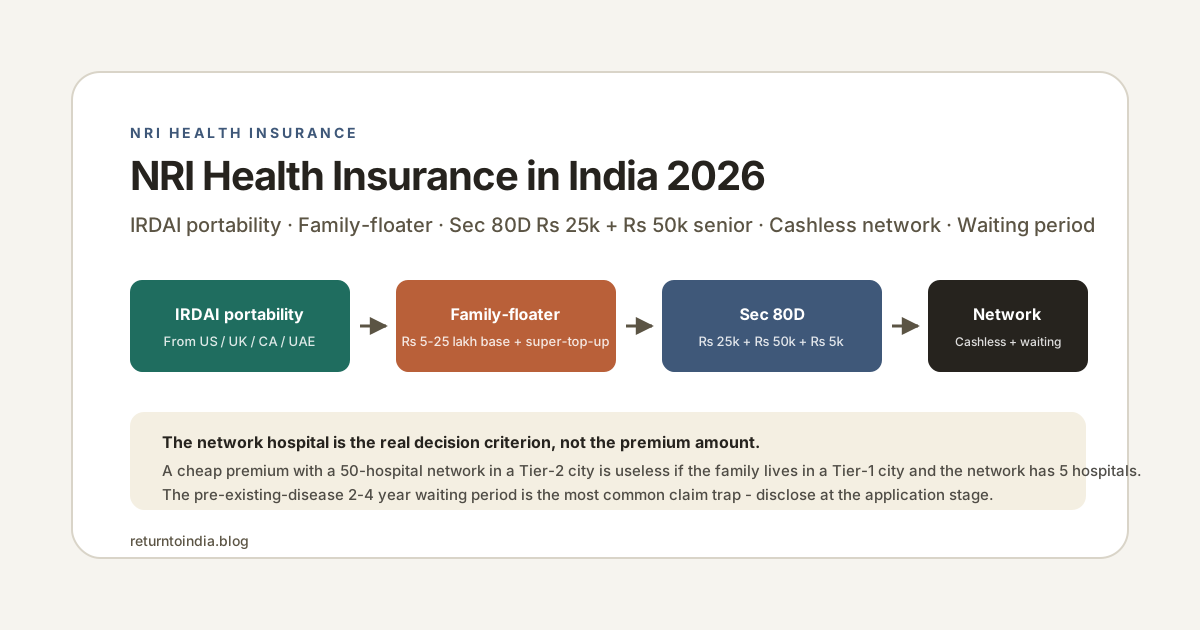
Health insurance is the most-painful-returning-NRI pain point, and the 2026 IRDAI rules have made the porting process both easier and stricter at the same time. The new family-floater plans cover the entire family for a single premium with a single sum insured, the waiting periods are now standardised at 30 days initial + 2-4 years pre-existing disease exclusion, and the Section 80D deduction is Rs 25,000 for self + family (Rs 50,000 if senior parent covered, Rs 5,000 for preventive health check-up). The catch: the porting from an overseas policy (US / UK / Canada / UAE) is not automatic, the new India policy requires the redesignated India KYC, the network hospital is the real decision criterion (not the premium), and a missed Section 80D claim is Rs 75,000 per year in lost deduction. The order is fixed; the deliverables are not optional.
Why health insurance is the most painful returning-NRI decision (and why 2026 changed it)
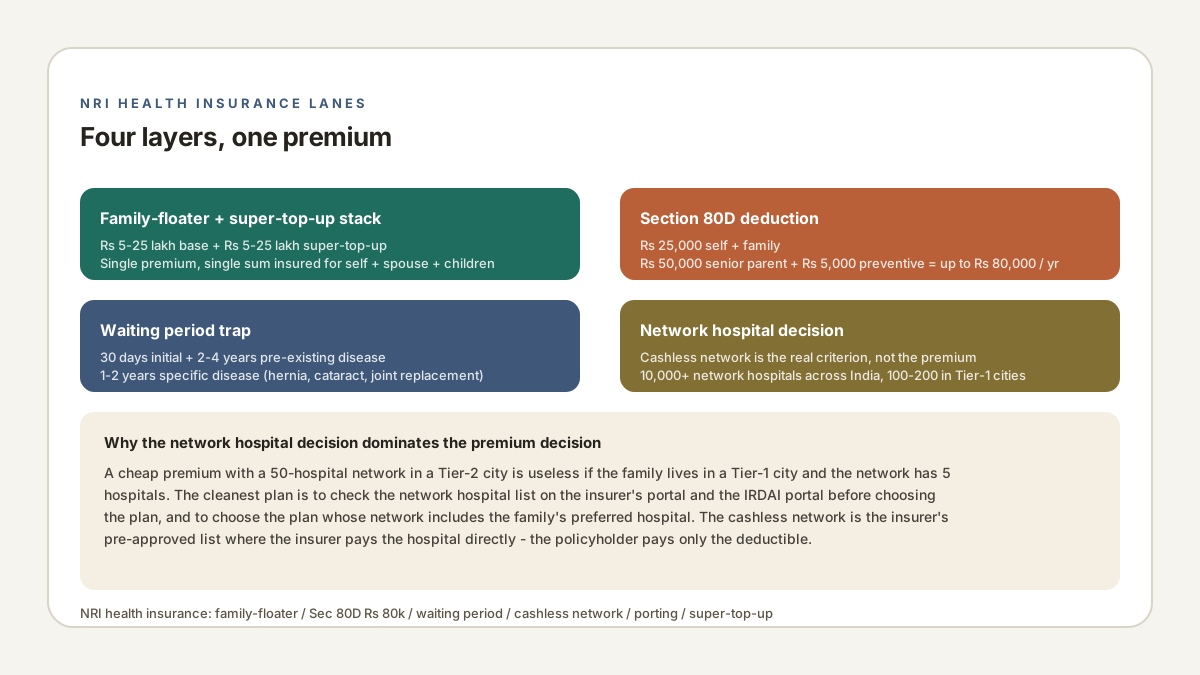
Every returning NRI who lands in India with an active overseas health insurance (US, UK, Canada, UAE) faces a four-layer compliance and decision stack: (1) the overseas policy is geographically limited - most US plans cover only emergency care abroad with high deductibles, most UK NHS plans do not cover non-residents, most Canadian provincial plans have a 90-day waiting period, and most UAE plans terminate on residency change. (2) The new India policy must be chosen before any planned treatment - the waiting period (30 days initial + 2-4 years pre-existing disease exclusion + 1-2 years specific disease) means a heart condition diagnosed in the US is not covered by a fresh India policy for 2-4 years. (3) The Section 80D deduction is the largest tax-saving opportunity in the personal-finance stack - Rs 25,000 for self + family + Rs 50,000 if senior parent covered + Rs 5,000 for preventive health check-up, for a total potential deduction of Rs 80,000 per year. (4) The network hospital is the real decision criterion - a cheap premium with a 50-hospital network in a Tier-2 city is useless if the family lives in a Tier-1 city and the network has 5 hospitals.
The 2026 IRDAI changes are the most significant in a decade. The portability framework has been streamlined - an NRI can port from an overseas policy to an Indian policy without losing waiting-period credit for the same insurer (e.g. Star Health to Star Health), the family-floater plan structure has been standardised (single premium + single sum insured for the entire family), the cashless network is now searchable in real time on the IRDAI portal, and the Section 80D deduction has been increased to Rs 50,000 for senior parents (was Rs 30,000 before the 2018 revision, then Rs 50,000 in the 2018 budget). The catch: the porting is not automatic, the new India policy requires the redesignated India KYC (which we covered in a separate article), and the network hospital decision requires the family to actually live in a Tier-1 city for the network to be useful. The cleanest plan is to research the family-floater plan and the network hospital before the first medical visit, and to port the overseas policy to the Indian policy at the same insurer if possible.
Family-floater vs individual vs top-up vs super-top-up: what each plan actually does
The four health insurance plan types have different premium, sum-insured, family-coverage, and waiting-period profiles. The right choice depends on family size, age profile, and city tier.
| Plan type | What it covers | Sum insured | Typical premium (Rs) | Best for |
|---|---|---|---|---|
| Family-floater (base plan) | Self + spouse + dependent children (some plans include parents) under a single sum insured | Rs 5 lakh to Rs 1 crore (Rs 5-25 lakh most common) | Rs 15,000 to Rs 1,50,000 per year for a family of 4 (age 30-50) | Young families with children, single-premium budget, single sum-insured shared across the family |
| Individual plan | One person, one sum insured | Rs 5 lakh to Rs 1 crore | Rs 5,000 to Rs 50,000 per year per person | Older parents (separate floater), high-risk individuals, separate budgets per family member |
| Top-up plan | Kicks in after the base plan's sum insured is exhausted, on a per-claim basis | Rs 5 lakh to Rs 25 lakh (in addition to base plan) | Rs 5,000 to Rs 30,000 per year | Filling specific gaps in the base plan, low premium for a specific claim threshold |
| Super-top-up plan | Kicks in after the base plan's sum insured is exhausted, on an aggregate basis across all claims in a year | Rs 5 lakh to Rs 1 crore (in addition to base plan) | Rs 5,000 to Rs 50,000 per year | Broader gap coverage for high-claim years (multiple smaller claims that add up) |
Execution sequence: from overseas policy to India family-floater + Section 80D claim
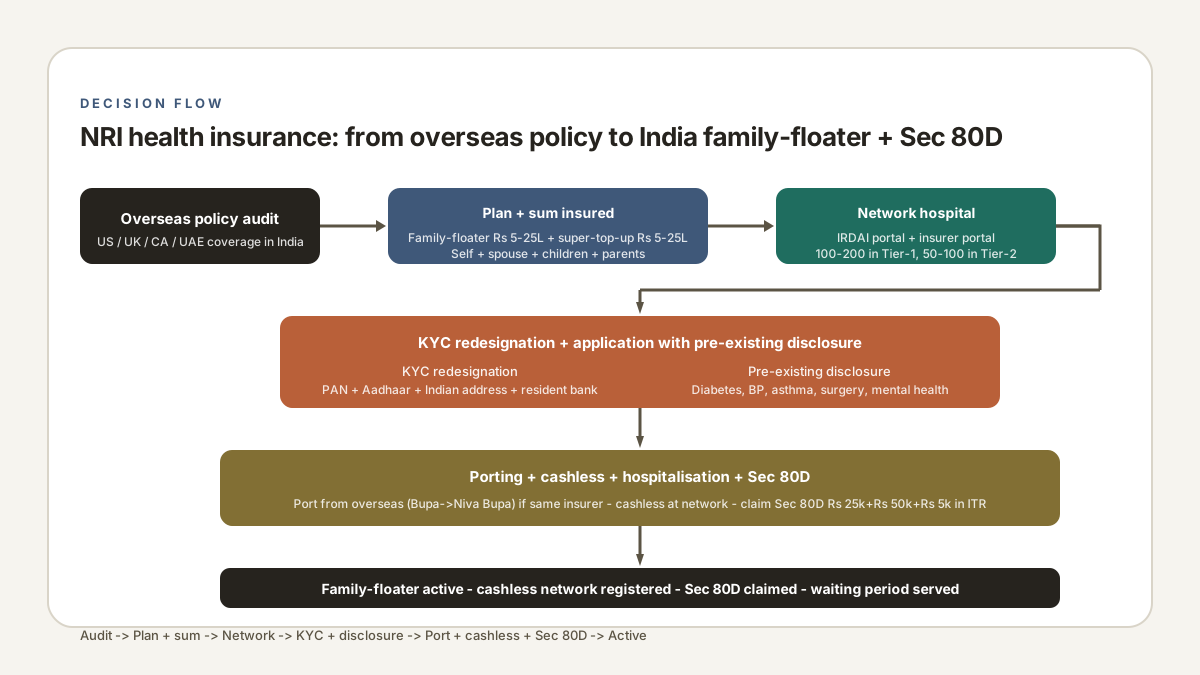
Plan the order. The overseas policy porting, the family-floater selection, the network hospital decision, the redesignation, and the Section 80D claim are not simultaneous — but they are interdependent, and an error in one is hard to fix after a hospitalisation.
Audit the overseas policy and the porting eligibility
Contact the overseas health insurer (US, UK, Canada, UAE) and ask for: (1) the policy's coverage for treatment in India (most US plans cover emergency care abroad with high deductibles, UK NHS is residency-based and does not cover non-residents, Canadian provincial plans have a 90-day waiting period after re-registration, UAE plans terminate on residency change), (2) the porting eligibility to the same insurer's Indian arm (if any - e.g. Aetna has no Indian arm, Bupa has Niva Bupa in India, AXA has AXA in India), (3) the waiting-period credit that can be transferred to the Indian policy. The audit determines whether porting is possible at all, and which insurer to choose in India for the new policy.
Research the family-floater plan and the network hospital before the first medical visit
Choose 2-3 family-floater plans from the major insurers (Star Health, HDFC ERGO, ICICI Lombard, Care, Niva Bupa, Tata AIG, ManipalCigna). For each plan, check: (1) the family coverage (self + spouse + dependent children, and whether parents are covered), (2) the sum insured (Rs 5-25 lakh most common for a family of 4), (3) the network hospital list in the city of residence (searchable on the insurer's portal and on the IRDAI portal), (4) the waiting periods (30 days initial + 2-4 years pre-existing disease + 1-2 years specific disease), (5) the premium for the family profile (age, sum insured, city, parents covered). Compare 2-3 plans on a spreadsheet, including the total cost of the base plan + a super-top-up plan for the desired total coverage.
Complete the KYC redesignation before the policy application
The India health insurance application requires the redesignated India KYC: PAN, Aadhaar (or Aadhaar non-eligibility letter), Indian address proof of 182+ days, redesigned bank account (NRE / NRO redesignated as resident savings or a new resident savings account), and a passport-size photograph. Without the redesignated KYC, the insurer cannot issue a resident policy and the policy defaults to a higher-premium NRI policy. Complete the KYC redesignation stack (covered in a separate article) before the policy application.
Apply for the family-floater plan and disclose pre-existing conditions
Submit the application with the full disclosure of pre-existing conditions for every family member covered. The disclosure is a critical step: failure to disclose a pre-existing condition (e.g. diabetes, hypertension, asthma, prior surgery) can lead to a claim rejection at the time of hospitalisation, even if the condition is not the primary cause of the hospitalisation. The pre-existing waiting period (2-4 years) starts from the policy inception date, and the pre-existing condition is covered only after the waiting period is served. The disclosure is a one-time step; subsequent renewals do not reset the waiting period for the disclosed conditions.
Port the overseas policy if the insurer has an Indian arm
If the overseas insurer has an Indian arm (e.g. Bupa International to Niva Bupa in India, AXA to AXA in India), apply for porting the waiting-period credit. The IRDAI portability framework allows the waiting period to be transferred to the Indian policy if: (1) the new insurer is the same as the old insurer (or accepts portability from the old insurer), (2) the sum insured is at least equal to the previous sum insured, (3) the policy is renewed without a break, (4) the application is made within 30 days of the policy renewal. The porting process takes 7-15 days and the insurer will issue a porting certificate that preserves the waiting-period credit.
Activate the cashless network hospital list and the reimbursement process
On policy issuance, register the family members on the insurer's portal and the IRDAI portal, and activate the cashless network hospital list for the city of residence. The cashless network is the insurer's pre-approved list of hospitals where the insurer pays the hospital directly, and the policyholder pays only the deductible / non-covered amount. For treatment at a non-network hospital, the policyholder pays the full amount and files for reimbursement (which takes 14-30 days to settle). Most major insurers have 10,000+ network hospitals across India, with a 100-200 hospital network in Tier-1 cities and 50-100 in Tier-2 cities. Choose the plan whose network includes the family's preferred hospital.
On hospitalisation, use the cashless network where possible, file reimbursement otherwise
For planned hospitalisation, the cashless network is the cleanest path: the insurer pre-authorises the treatment, pays the hospital directly, and the policyholder pays only the deductible. For emergency hospitalisation, the cashless process can still be initiated by the hospital's insurance desk (most major hospitals have a 24x7 cashless desk). For non-network hospitals, the policyholder pays the full amount, collects all original bills and discharge summary, and files for reimbursement with the insurer within 7-30 days of discharge. The reimbursement is settled within 14-30 days of submission, with the insurer typically settling 80% to 100% of the covered amount.
Claim the Section 80D deduction in the ITR for the AY of premium payment
On the ITR for the AY of premium payment, claim the Section 80D deduction: Rs 25,000 for self + spouse + dependent children (across all insurers combined), Rs 50,000 if senior parent covered (across all senior parents combined), and Rs 5,000 for preventive health check-up (within the overall Rs 25,000 / Rs 50,000 cap). The deduction is available only if the premium is paid by net-banking, cheque, or any mode other than cash, and the insurer is an Indian insurer (overseas insurance premiums do not qualify for Section 80D). The total potential deduction is Rs 80,000 per year (Rs 25,000 + Rs 50,000 + Rs 5,000) - the largest personal-finance tax deduction in the stack. Missed deductions are unrecoverable after the ITR is filed for the AY, so claim in the ITR even if the premium is not a large amount.
Document checklist before the family-floater application is submitted
Most NRI health insurance application failures are caused by missing or mismatched documents at the application stage. Confirm each item before submission.
- PAN card (mandatory for any health insurance application).
- Aadhaar (or Aadhaar non-eligibility letter for the redesignated KYC) - required for the redesigned resident profile.
- Indian address proof of 182+ days: utility bill in the applicant's name, OR a registered rent agreement + landlord NOC.
- Age proof for every family member covered (PAN, Aadhaar, passport, birth certificate for children).
- Pre-existing condition disclosure for every family member covered: diabetes, hypertension, asthma, prior surgery, mental health, cardiac, oncology, etc. The disclosure is a one-time step; subsequent renewals do not reset the waiting period.
- Recent passport-size photograph for the primary insured.
- Resident bank account proof (the redesigned savings account from the KYC redesignation article) - for premium payment and for cashless settlement.
- Previous policy details (if porting from an overseas policy): policy number, sum insured, waiting period served, claim history, porting certificate from the previous insurer.
- A written plan for the family coverage: who is covered (self + spouse + children, and whether parents are covered separately), the sum insured (Rs 5-25 lakh for a young family, Rs 25 lakh - Rs 1 crore for an older family), the city of residence (determines the network hospital list), the budget (premium + super-top-up).
- A list of preferred network hospitals in the city of residence - check the insurer's portal and the IRDAI portal to confirm the network includes the family's preferred hospital.
- Power of attorney (POA) document in favour of a representative in India if the applicant is not personally present for the application or the first hospitalisation. The POA must be specific to the health insurance, executed on stamp paper, and notarized / apostilled by the Indian consulate in the country of residence.
- An estimate of the Section 80D deduction: Rs 25,000 self + family + Rs 50,000 senior parent + Rs 5,000 preventive health check-up, for a total potential deduction of Rs 80,000 per year.
Health insurance plan decision flow
Need help with Move Planning?
Share your blocker in one line. Our experts will reply with practical next steps.
NRI health insurance: the five-layer stack
The pre-existing-disease 2-4 year waiting period is the most common claim trap
Most health insurance policies in India have a 30-day initial waiting period (no claims can be made in the first 30 days for any condition), a 2-4 year pre-existing disease exclusion (no claims for any pre-existing condition for 2-4 years from the policy inception), and a 1-2 year specific disease exclusion (e.g. hernia, cataract, joint replacement, heart condition - the list varies by insurer). For a returning NRI with a pre-existing condition (e.g. diabetes, hypertension, asthma, prior surgery), the 2-4 year waiting period means the condition is not covered by the fresh India policy for 2-4 years. The fix is straightforward: disclose every pre-existing condition at the application stage, accept the waiting period, and plan any planned treatment (e.g. elective surgery, dental work) before the waiting period starts. The waiting period can be reduced or waived by paying a higher premium (loading) for a pre-existing condition, and can be transferred from the overseas policy if the porting is done at the same insurer. The cleanest plan is to start the family-floater policy on day one of the return, accept the waiting periods, and treat any planned condition after the waiting period is served.
Animated decision map

Community signal
What to watch in real discussions
Treat repeated complaints as risk signals rather than official advice. This page does not link to community search results.
Interactive checkpoint
Turn this guide into a decision file
0 of 4 checked
Can an NRI port their US / UK / Canada / UAE health insurance to an Indian policy?
Porting is possible only if the overseas insurer has an Indian arm and accepts the porting. The IRDAI portability framework allows the waiting period to be transferred to the Indian policy if: (1) the new insurer is the same as the old insurer (or accepts portability from the old insurer), (2) the sum insured is at least equal to the previous sum insured, (3) the policy is renewed without a break, (4) the application is made within 30 days of the policy renewal. For example, Bupa International (UK) can port to Niva Bupa in India, AXA (global) can port to AXA in India. For US insurers (Aetna, Cigna, UnitedHealth), there is no Indian arm, so porting is not possible - the returning NRI must apply for a fresh India policy and serve the 2-4 year pre-existing disease waiting period. The cleanest plan is to research the overseas insurer's Indian arm before landing, and to port if the arm exists.
What is the Section 80D deduction for health insurance premium?
Section 80D of the Income Tax Act, 1961, allows a deduction for health insurance premium paid for self + spouse + dependent children, and for parents (separate cap for senior parents). The deduction is: Rs 25,000 per year for self + spouse + dependent children (across all insurers combined), Rs 50,000 per year if senior parent covered (across all senior parents combined, and for the family if both senior parents and senior self are covered), and Rs 5,000 per year for preventive health check-up (within the overall Rs 25,000 / Rs 50,000 cap). The total potential deduction is Rs 80,000 per year (Rs 25,000 + Rs 50,000 + Rs 5,000) for a family with senior parents. The deduction is available only if the premium is paid by net-banking, cheque, or any mode other than cash, and the insurer is an Indian insurer. The deduction is claimed in the ITR for the AY of premium payment.
What is the waiting period for a fresh health insurance policy?
Most health insurance policies in India have three waiting periods: (1) 30-day initial waiting period - no claims can be made for any condition in the first 30 days, (2) 2-4 year pre-existing disease exclusion - no claims for any pre-existing condition for 2-4 years from the policy inception, and (3) 1-2 year specific disease exclusion - no claims for specific diseases (e.g. hernia, cataract, joint replacement, heart condition, kidney stone) for 1-2 years. The waiting periods can be reduced or waived by paying a higher premium (loading) for a pre-existing condition, and can be transferred from the overseas policy if the porting is done at the same insurer. After the waiting period is served, the condition is covered at the sum-insured limit, subject to the co-pay clause and the network hospital terms.
Cashless vs reimbursement: which is better?
Cashless is better for most cases. The cashless network is the insurer's pre-approved list of hospitals where the insurer pays the hospital directly, and the policyholder pays only the deductible / non-covered amount. For planned hospitalisation, the cashless process can be initiated 7-15 days before the treatment, and the insurer pre-authorises the amount. For emergency hospitalisation, the cashless process can still be initiated by the hospital's insurance desk (most major hospitals have a 24x7 cashless desk). For non-network hospitals, the policyholder pays the full amount, collects all original bills and discharge summary, and files for reimbursement with the insurer within 7-30 days of discharge. The reimbursement is settled within 14-30 days of submission, with the insurer typically settling 80% to 100% of the covered amount. The cleanest plan is to choose the plan whose network includes the family's preferred hospital and to use the cashless network for all planned and emergency hospitalisation.
What is the difference between a top-up plan and a super-top-up plan?
A top-up plan kicks in after the base plan's sum insured is exhausted, on a per-claim basis - i.e. the top-up covers a specific claim above the base plan threshold. A super-top-up plan kicks in after the base plan's sum insured is exhausted, on an aggregate basis across all claims in a year - i.e. the super-top-up covers the total of all claims above the base plan threshold. The super-top-up is more useful for high-claim years where multiple smaller claims add up, and is the more common choice for a returning NRI family. For a family-floater base plan of Rs 25 lakh + a super-top-up of Rs 25 lakh, the effective total coverage is Rs 50 lakh per year across all claims, with the super-top-up kicking in only after the base plan's Rs 25 lakh is exhausted. The super-top-up premium is typically Rs 5,000 to Rs 50,000 per year for Rs 5-25 lakh of super-top-up coverage, depending on the family age profile and the deductible.
What is the worst-case scenario if I skip the India health insurance on return?
Three things can go wrong: (1) a medical emergency in the first 30 days after landing (the standard waiting period for any fresh India policy) is not covered by any India policy, and the overseas policy may not cover treatment in India (most US, UK, Canada, UAE plans have limited or no coverage in India). The hospitalisation cost is borne out-of-pocket, often Rs 5 lakh to Rs 50 lakh for a serious event. (2) A pre-existing condition (e.g. diabetes, hypertension, prior surgery) is not covered by a fresh India policy for 2-4 years from the policy inception, and the policyholder cannot serve the waiting period retroactively. The condition is uncovered for the full 2-4 year period. (3) The Section 80D deduction is missed for the AY, leading to Rs 25,000 to Rs 80,000 in lost deduction. Each of these is fixable, but the cost is Rs 5 lakh to Rs 50 lakh in uncovered hospitalisation, plus Rs 25,000 to Rs 80,000 in lost deduction per year. The cleanest plan is to apply for the family-floater plan on day one of the return, complete the KYC redesignation before the application, and disclose every pre-existing condition at the application stage.
The plan is only as good as the sequence.
Tax, banking, schools, shipping — they all have dependencies. A wrong order costs months and lakhs. Get it right.