Nri Rnor Ror Transition Year Tax India 2026 Itr Form 67...
A practical 2026 guide for US / UK / UAE NRIs returning to India in the middle of a financial year: the NRI to RNOR to ROR status change in one AY, the ITR form...
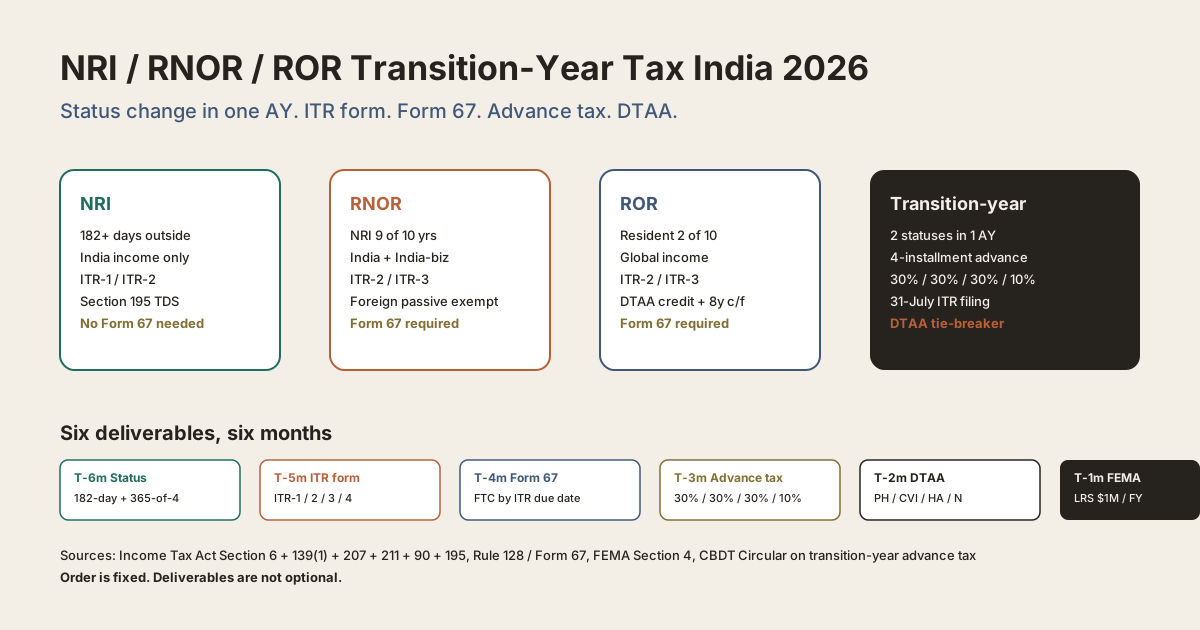
Why the NRI / RNOR / ROR transition-year tax is the most under-served and most expensive mistake a returning NRI makes (and why 2026 expanded the trap)
Every returning NRI faces a four-layer transition-year tax stack that the tax-filing community consistently under-serves. The four layers are: (1) the residential status change in one AY - the day of physical return, the 182-day rule (182 days in India in the FY of return, or 60 days in India + 365 days in 4 preceding FYs), and the 365-of-4-preceding-years rule for RNOR all activate on the same day; (2) the ITR form selection must change mid-year - an NRI who filed ITR-1 or ITR-2 in the US for the prior FY may need to file ITR-3 (with business income) or ITR-2 (with capital gains + foreign income) for the transition-year FY, even if the underlying income sources are unchanged; (3) the advance tax schedule is doubled - the standard 15% / 45% / 75% / 100% cumulative thresholds for non-corporate assessees on 15-Jun / 15-Sep / 15-Dec / 15-Mar are replaced by 30% / 30% / 30% / 10% for the transition year per CBDT Circular, because the resident portion of the year is unknown at 15-Jun; (4) Form 67 must be filed for any foreign tax credit - India does not have automatic DTC, and Form 67 is the only way to claim US federal tax credit against India tax on the same income, with the form due by the ITR due date and the foreign tax paid certificate from the foreign tax authority. The 2026 landscape has expanded the trap at every layer: more US / UK / UAE NRIs are returning under the OCI long-term visa, more are carrying US equity + 401(k) + IRA + Social Security that triggers Section 195 withholding on the day of return, more are carrying UK pension + ISA + rental income that triggers Section 195 withholding, more are carrying UAE salary + end-of-service gratuity + property that triggers Section 195 withholding, and the dual-residency trap (US citizen + India resident) is now the most common edge case in the cross-border tax workflow.
The decision is not just about which ITR form to file. It is also about the DTAA tie-breaker rule for US / UK / UAE (the Permanent Home + Centre of Vital Interests + Habitual Abide + Nationality test for the dual-resident individual), the FEMA repatriation of US / UK / UAE income (the NRO / NRE / FCNR account framework + the $1 million USD per FY ceiling under the Liberalised Remittance Scheme for residents on the day of return), the Section 195 withholding on the NRI portion of the year (the NRI's rental income, dividend, interest, capital gains, and pension are still subject to Section 195 TDS at 30% + surcharge + cess for non-DTAA country, or DTAA rate for DTAA country), and the Section 139(1) 31-July deadline (the ITR for the transition year is due 31-July of the assessment year, with the 139(4) belated return window of 31-Dec and the 139(5) revised return window of 31-Mar of the AY). The cleanest plan is to start the transition-year tax planning 6 months before the planned return date, with a status change check, an ITR form pre-selection, a Form 67 pre-staging, a 4-installment advance tax schedule, a DTAA tie-breaker review by a chartered accountant with cross-border tax experience, and a FEMA repatriation framework. The order is fixed; the deliverables are not optional.
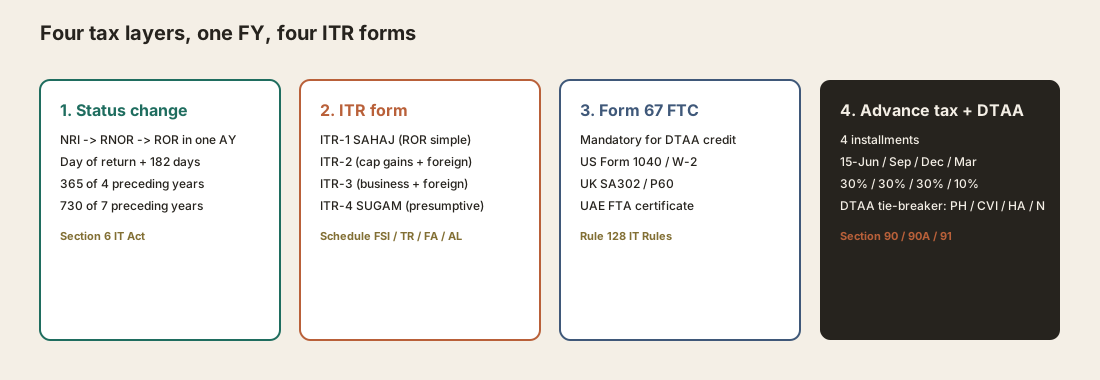
NRI vs RNOR vs ROR: what each status means for the transition year
The three residential statuses have different tax scopes, DTAA applications, and ITR forms. The right classification depends on the day of return, the 182-day rule, and the 365-of-4-preceding-years rule.
| Status | Definition (Section 6 IT Act) | Tax scope for the FY | ITR form | DTAA / Form 67 |
|---|---|---|---|---|
| NRI (Non-Resident Indian) | Indian citizen who is outside India for 182+ days in the FY, or 60 days in the FY + 365 days in 4 preceding FYs (for Indian citizens visiting India) | India income only: salary for services rendered in India + India rental income + India capital gains + India business income + India interest + India dividend. NO foreign income (US / UK / UAE salary, US / UK / UAE interest, US / UK / UAE dividend, US / UK / UAE capital gains) is taxed in India. | ITR-1 (SAHAJ) for pure salary + 1 house property + other sources (interest + dividend) up to Rs 50 lakh, ITR-2 for capital gains + multiple house properties, ITR-3 for business income | Section 195 TDS on India income paid to NRI (30% + surcharge + cess for non-DTAA country, DTAA rate for DTAA country). NO Form 67 needed for the NRI portion of the year. |
| RNOR (Resident but Not Ordinarily Resident) | Resident in India for the FY, but either (1) NRI in 9 of 10 preceding FYs, or (2) Indian citizen / PIO leaving India for employment outside India in 7 of 10 preceding FYs, and resident in India for 0-729 days in 7 preceding FYs | India income + foreign income from business controlled from India + foreign income from profession set up in India. NO foreign salary + foreign interest + foreign dividend + foreign capital gains for non-India-source business. This is the 'sweet spot' for the transition year - foreign passive income is exempt. | ITR-2 for RNOR (with foreign income disclosure in Schedule FSI + Schedule TR), ITR-3 for RNOR with business income, ITR-1 not available for RNOR | Section 90 / 90A DTAA credit for foreign tax paid on India-source income, Section 91 unilateral relief for non-DTAA country, Form 67 for the foreign tax credit (mandatory for any DTAA credit) |
| ROR (Resident and Ordinarily Resident) | Resident in India for the FY AND resident in India for 2 of 10 preceding FYs AND 730+ days in India in 7 preceding FYs (or Indian citizen / PIO leaving India for employment outside India in 2 of 7 preceding FYs) | Global income: India + foreign salary + foreign interest + foreign dividend + foreign capital gains + foreign rental + foreign pension. The full world is taxed. | ITR-2 for ROR with foreign income, ITR-3 for ROR with business income, ITR-1 not available for ROR with foreign income | Section 90 / 90A DTAA credit for foreign tax paid on foreign-source income (the credit is allowed up to the India tax on the same income, with the excess foreign tax carried forward 8 years per Section 90(4)), Section 91 unilateral relief for non-DTAA country, Form 67 for the foreign tax credit (mandatory for any DTAA credit) |
| Deemed resident (Section 6(1A)) | Indian citizen + PIO coming on visit to India + total India income > Rs 15 lakh (other than foreign sources) + not liable to tax in any other country | Foreign income is included in India total income, even if the individual is technically a non-resident by the 182-day rule | ITR-2 for deemed resident with foreign income | Section 90 / 90A DTAA credit available, Form 67 for the foreign tax credit |
Execution sequence: from NRI to ROR over 6 months
Plan the order. The status change check, the ITR form pre-selection, the Form 67 pre-staging, the advance tax schedule, the DTAA tie-breaker review, and the FEMA repatriation are not simultaneous — but they are interdependent, and an error in one is hard to fix after the ITR is filed.
Confirm the status change date and the FY of return (T-6m)
Before any tax planning, confirm the status change date: the day of physical return to India + 182 days in India in the FY of return + 365-of-4-preceding-years for RNOR eligibility. The status change is in one AY (the AY of the FY of return), and the AY in which the ITR is filed may be different. For example: physical return on 1-Sep-2026 in FY 2026-27 (1-Apr-2026 to 31-Mar-2027) -> status becomes ROR for FY 2026-27 if 730+ days in India in 7 preceding FYs, or RNOR for FY 2026-27 if NRI in 9 of 10 preceding FYs. The FY of return determines the ITR form, the advance tax schedule, the DTAA tie-breaker, and the FEMA repatriation framework. Do not skip the status change confirmation - it is the most important step, and most transition-year tax mistakes are caused by misclassifying the status.
Pre-select the ITR form for the transition year (T-5m)
Once the status is confirmed, pre-select the ITR form for the transition-year FY: ITR-1 (SAHAJ) for pure salary + 1 house property + other sources (interest + dividend) up to Rs 50 lakh - only available for ROR, not for RNOR; ITR-2 for ROR / RNOR with capital gains + multiple house properties + foreign income; ITR-3 for ROR / RNOR with business income + foreign income; ITR-4 (SUGAM) for presumptive taxation under Section 44AD / 44ADA / 44AE - rarely applicable for the transition year. The ITR form selection drives the income disclosure (Schedule FSI for foreign income, Schedule TR for foreign tax relief, Schedule FA for foreign assets, Schedule AL for assets and liabilities), the TDS claim, and the DTAA credit. The pre-selection should be done by a chartered accountant with cross-border tax experience, ideally with the foreign tax paid certificate (Form W-2 / 1099 / 1040-SR for US, P60 / SA302 / HMRC for UK, salary certificate + gratuity for UAE) and the foreign bank statements (1-Apr of FY of return to date of return for foreign-source income, date of return to 31-Mar for India-source income).
Pre-stage Form 67 for the foreign tax credit (T-4m)
Pre-stage Form 67 for the foreign tax credit on the foreign income that will be reported in the transition-year ITR. India does not have automatic DTC, and Form 67 is the only way to claim US federal / state tax credit, UK income tax / NIC credit, or UAE corporate tax credit against India tax on the same income. The form must be: (1) filed by the due date of the ITR (31-July of AY for non-audit, 31-October for audit), (2) attested by the assessee, (3) accompanied by the foreign tax paid certificate from the foreign tax authority (IRS Form 1040 / 1040-SR for US, HMRC SA302 / P60 for UK, FTA certificate for UAE), (4) attached to the ITR. The form is mandatory for any DTAA credit, and the credit is allowed up to the India tax on the same income, with the excess foreign tax carried forward 8 years per Section 90(4). The cleanest plan is to pre-stage Form 67 in June (T-1m) so the form is ready for filing at 31-July.
Build the 4-installment advance tax schedule with the transition-year thresholds (T-3m to T-0)
The standard advance tax schedule for non-corporate assessees is 15% / 45% / 75% / 100% cumulative thresholds on 15-Jun / 15-Sep / 15-Dec / 15-Mar of the FY. For the transition year, CBDT Circular allows the resident portion of the year to be excluded from the 15-Jun installment (because the resident portion is unknown at 15-Jun), and the cumulative thresholds for the 15-Sep / 15-Dec / 15-Mar installments are 30% / 30% / 30% / 10% (cumulative 30% / 60% / 90% / 100%). The advance tax is due on the estimated total tax liability for the FY, less the TDS / TCS already paid. The cleanest plan is to: (1) estimate the India tax liability for the resident portion of the year (April-return date for prior year, return date-March for current year), (2) compute the advance tax for each installment, (3) pay the advance tax on the 15-Sep / 15-Dec / 15-Mar dates, (4) keep the challan (CHALLAN-280) for the ITR. Section 234B (interest for default in payment of advance tax) and Section 234C (interest for deferment of advance tax) apply if the advance tax is underpaid or paid late.
Review the DTAA tie-breaker rule for US / UK / UAE (T-2m)
For US / UK / UAE NRIs who remain citizens of the source country (US citizen + India RNOR / ROR is the most common case, UK citizen + India RNOR / ROR is the second most common, UAE citizen + India RNOR / ROR is the third), the dual-residency is resolved by the DTAA tie-breaker rule: (1) Permanent Home (where the individual has a permanent home available - the India house that the NRI moved into, the US / UK / UAE house that was sold or rented out), (2) Centre of Vital Interests (personal and economic ties - family, employment, business, bank accounts, social connections), (3) Habitual Abode (where the individual spends more time), (4) Nationality (the citizenship of the individual). The tie-breaker is applied in order, and the first test that resolves the dual-residency is the determining test. The cleanest plan is to engage a chartered accountant with cross-border tax experience to review the tie-breaker, ideally 3-6 months before the planned return, so the tax planning is structured to optimise the India tax liability for the transition year.
Coordinate the FEMA repatriation of US / UK / UAE income (T-1m to T-day)
On the day of return, the NRI's US / UK / UAE bank accounts (USD / GBP / AED denominated) are re-classified as resident foreign currency accounts, and the FEMA repatriation framework kicks in: (1) the NRE / FCNR accounts (which were NRI accounts) are re-classified as resident foreign currency accounts on the day of return, (2) the NRO accounts (which were NRI accounts for India-source income) are re-classified as resident ordinary accounts on the day of return, (3) the $1 million USD per FY ceiling under the Liberalised Remittance Scheme (LRS) applies to all outward remittances from India, including the transfer of US / UK / UAE income to the India accounts, (4) the transfer of US / UK / UAE income to the India accounts must be routed through the banking channel (no cash, no third-party), (5) the Form 15CB (chartered accountant certificate) and Form 15CA (taxpayer declaration) are required for any remittance to the US / UK / UAE for the FY of return (especially for the NRI portion of the year). The cleanest plan is to coordinate the FEMA repatriation with the bank 30-60 days before the day of return, so the bank accounts are re-classified on the day of return and the remittances are uninterrupted.
On ITR filing, choose the ITR form, attach Form 67, claim DTAA credit, and file by 31-July (T+1y)
On ITR filing for the transition-year AY, the ITR form must match the status and the income sources (ITR-1 for ROR with simple income, ITR-2 for ROR / RNOR with capital gains + foreign income, ITR-3 for ROR / RNOR with business income + foreign income). The ITR must include: (1) Schedule FSI for foreign income (US / UK / UAE salary, interest, dividend, capital gains), (2) Schedule TR for foreign tax relief (with the foreign tax paid certificate), (3) Schedule FA for foreign assets (US / UK / UAE bank accounts, US / UK / UAE brokerage accounts, US / UK / UAE property, US 401(k) / IRA, UK pension / ISA), (4) Schedule AL for assets and liabilities (the India house, car, jewellery, etc. above the Rs 1 lakh threshold). The ITR must be filed by 31-July of the AY (31-October for audit, 31-November for transfer pricing), with the 139(4) belated return window of 31-Dec and the 139(5) revised return window of 31-Mar of the AY. The cleanest plan is to file the ITR by 31-July to avoid the 139(4) late fee of Rs 1,000 to Rs 5,000 per AY (extended to Rs 5,000 / 10,000 / 50,000 / 1,00,000 per AY in the 2023 Finance Act for small / medium / large / very large assessees).
On tax deductibility, claim Section 80C / 80CCD(1B) / 80D / 80TTB / 80DDB for the resident portion of the year (T+1y)
On the ITR for the AY of return, claim the India-specific tax deductions for the resident portion of the year: (1) Section 80C for the resident portion of EPF / VPF / PPF / ELSS / home loan principal / tuition fees / NSC / 5-year FD (up to Rs 1.5 lakh per FY, prorated for the resident portion of the year), (2) Section 80CCD(1B) for the resident portion of NPS contribution (up to Rs 50,000 per FY, prorated), (3) Section 80D for the resident portion of health insurance premium for self + family + parents (up to Rs 25,000 self + family + Rs 50,000 senior parent + Rs 5,000 preventive health check-up, total up to Rs 80,000 / year, prorated), (4) Section 80TTB for the resident portion of senior interest income from SCSS / POMIS / bank deposits (up to Rs 50,000 per AY, prorated for the resident portion of the year if 60+ senior), (5) Section 80DDB for the medical treatment of dependent senior parent (up to Rs 40,000 for 60-79y or Rs 1 lakh for 80+y per AY, prorated, with Form 10-I chartered accountant certificate). The deductions are prorated for the resident portion of the year, and the NRI portion of the year is not eligible for most India-specific deductions.
Document checklist before the day of return
Most transition-year tax failures are caused by missing or mismatched documents at the return or filing stage. Confirm each item before the day of return.
- Passport with the date of departure stamp (for the NRI portion of the year) and the date of arrival stamp (for the day of return).
- I-94 / UK BRP / UAE residence visa for the prior 7-10 FYs (for the 365-of-4-preceding-years rule for RNOR eligibility and the 730-of-7-preceding-years rule for ROR eligibility).
- Foreign bank statements for the prior FY (1-Apr to 31-Mar) and the FY of return (1-Apr to date of return for foreign-source income, date of return to 31-Mar for India-source income).
- Foreign tax paid certificate from the foreign tax authority (IRS Form 1040 / 1040-SR + state tax return for US, HMRC SA302 / P60 for UK, FTA certificate for UAE) for the prior FY and the FY of return.
- Form W-2 / 1099 for US source income, P60 / P11D for UK source income, salary certificate for UAE source income, for the prior FY and the FY of return.
- Foreign brokerage statements for the prior FY and the FY of return (US 1099-B, UK broker tax statement, UAE broker statement) for the capital gains calculation.
- Indian bank account statements (NRE / FCNR / NRO) for the prior FY and the FY of return, with the day of return clearly marked.
- PAN + Aadhaar + Indian address proof of 182+ days (for the KYC redesignation and the ITR filing).
- Indian mobile number and Indian email (for the ITR acknowledgement and the e-filing portal).
- Chartered accountant engagement letter with cross-border tax experience (for the ITR form selection, the Form 67 pre-staging, the DTAA tie-breaker review, and the FEMA repatriation).
- DTAA tie-breaker analysis for the US / UK / UAE dual-residency (Permanent Home + Centre of Vital Interests + Habitual Abode + Nationality test).
- Form 15CB (chartered accountant certificate) and Form 15CA (taxpayer declaration) for any remittance to the US / UK / UAE for the FY of return.
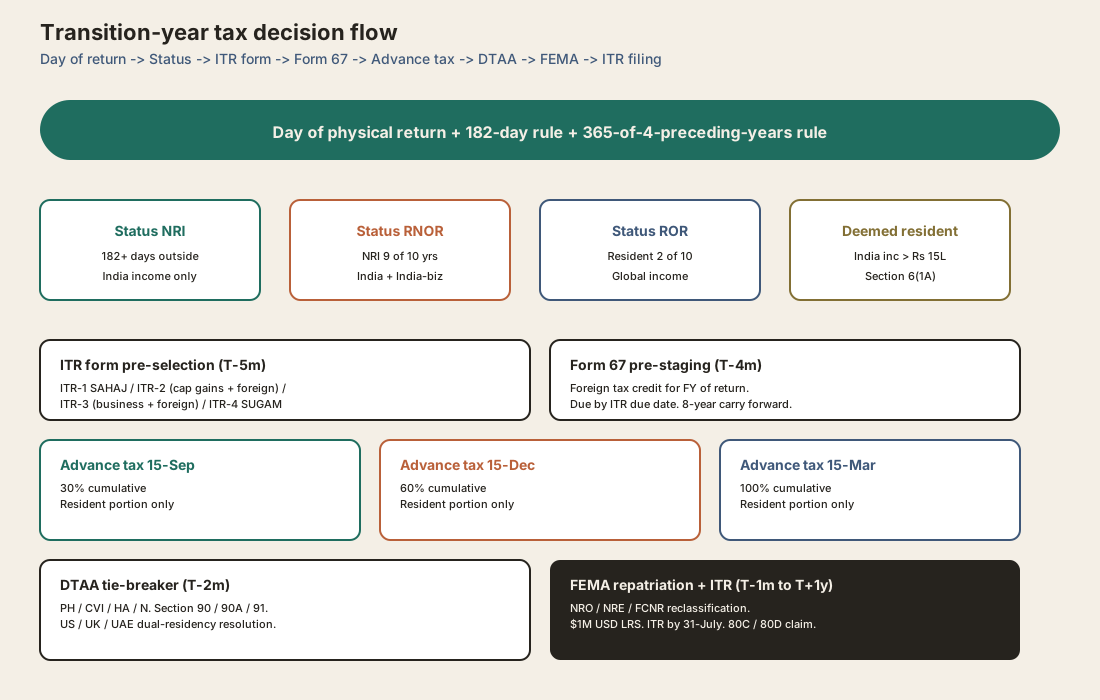
Transition-year tax decision flow
Community pattern: where NRI / RNOR / ROR transition-year tax actually breaks
Unable to embed reddit content. View on reddit
"The repeated pattern: returning NRIs who file ITR-1 (SAHAJ) for the transition year, only to find on the CPC processing that the ITR form is invalid because the assessee is RNOR / ROR with foreign income. The fix is straightforward: file ITR-2 or ITR-3 for RNOR / ROR with Schedule FSI (foreign income), Schedule TR (foreign tax relief), and Schedule FA (foreign assets). The other repeated pattern: returning NRIs who do not file Form 67, only to find on the CPC processing that the DTAA credit is disallowed and the foreign tax paid in the US / UK / UAE is wasted. The fix is to file Form 67 by the ITR due date, with the foreign tax paid certificate from the foreign tax authority. The third repeated pattern: returning NRIs who do not pay advance tax for the resident portion of the year, only to find on the ITR filing that Section 234B and 234C interest is levied on the underpaid advance tax. The fix is to compute the advance tax for the resident portion of the year and pay it on the 15-Sep / 15-Dec / 15-Mar dates with the 30% / 30% / 30% / 10% cumulative thresholds per CBDT Circular."
Read on reddit ->Need help with Tax & Residency?
Share your blocker in one line. Our experts will reply with practical next steps.
NRI / RNOR / ROR transition-year tax: the seven-layer stack
The US citizen + India ROR dual-residency is the most expensive transition-year tax trap
The most common transition-year tax trap is the US citizen + India ROR dual-residency. The US taxes its citizens on worldwide income regardless of residence, and India taxes its residents on worldwide income regardless of citizenship. The DTAA tie-breaker (Permanent Home + Centre of Vital Interests + Habitual Abode + Nationality) may resolve the dual-residency as India-resident (if the India ties outweigh the US ties), but the US citizen is still required to file US Form 1040 with the worldwide income, and the IRS may not honor the DTAA tie-breaker if the US ties (US bank accounts, US brokerage accounts, US 401(k) / IRA, US Social Security) are significant. The fix is to engage a chartered accountant with US-India cross-border tax experience (ideally a US-licensed CPA + India-licensed CA, or a firm with both) to review the dual-residency, the DTAA tie-breaker, the Form 67 for the foreign tax credit, the Form 1116 (US Foreign Tax Credit), the FBAR (FinCEN 114), the Form 8938 (FATCA), the Schedule B (US interest + dividend), and the Schedule D (US capital gains). The cost of the dual-residency review is Rs 50,000 to Rs 2 lakh, but the cost of getting it wrong is Rs 5 lakh to Rs 50 lakh in India tax + US tax + interest + penalty for the transition year and the 7 preceding years. The cleanest plan is to engage the cross-border tax expert 6 months before the planned return, so the dual-residency is resolved correctly and the tax planning is structured to optimise the India tax liability for the transition year.
Animated decision map

Interactive checkpoint
Turn this guide into a decision file
0 of 4 checked
What is the NRI / RNOR / ROR status change in the transition year?
The NRI / RNOR / ROR status change in the transition year is determined by Section 6 of the Income Tax Act. NRI: Indian citizen who is outside India for 182+ days in the FY, or 60 days in the FY + 365 days in 4 preceding FYs (for Indian citizens visiting India). RNOR: Resident in India for the FY, but either (1) NRI in 9 of 10 preceding FYs, or (2) Indian citizen / PIO leaving India for employment outside India in 7 of 10 preceding FYs, and resident in India for 0-729 days in 7 preceding FYs. ROR: Resident in India for the FY AND resident in India for 2 of 10 preceding FYs AND 730+ days in India in 7 preceding FYs (or Indian citizen / PIO leaving India for employment outside India in 2 of 7 preceding FYs). The status change happens on the day of physical return + 182 days in India in the FY of return, and the FY of return determines the tax scope, the ITR form, the advance tax schedule, the DTAA application, and the FEMA repatriation framework.
Which ITR form should I file for the transition year?
The ITR form for the transition year depends on the status and the income sources. ITR-1 (SAHAJ) for pure salary + 1 house property + other sources (interest + dividend) up to Rs 50 lakh - only available for ROR, not for RNOR. ITR-2 for ROR / RNOR with capital gains + multiple house properties + foreign income (the most common transition-year form). ITR-3 for ROR / RNOR with business income + foreign income. ITR-4 (SUGAM) for presumptive taxation under Section 44AD / 44ADA / 44AE - rarely applicable for the transition year. The ITR form must include Schedule FSI (foreign income), Schedule TR (foreign tax relief), Schedule FA (foreign assets above Rs 1 lakh threshold), and Schedule AL (assets and liabilities above Rs 1 lakh threshold) for any foreign income or foreign asset. The ITR form must be filed by 31-July of the AY (31-October for audit, 31-November for transfer pricing), with the 139(4) belated return window of 31-Dec and the 139(5) revised return window of 31-Mar of the AY.
What is Form 67 and when is it required?
Form 67 is the statement of income from a country outside India and the foreign tax credit claimed, mandated by Rule 128 of the Income Tax Rules. The form is mandatory for any DTAA credit (Section 90 / 90A) or unilateral relief (Section 91), and must be: (1) filed by the due date of the ITR (31-July of AY for non-audit), (2) attested by the assessee, (3) accompanied by the foreign tax paid certificate from the foreign tax authority (IRS Form 1040 / 1040-SR for US, HMRC SA302 / P60 for UK, FTA certificate for UAE), (4) attached to the ITR. The credit is allowed up to the India tax on the same income, with the excess foreign tax carried forward 8 years per Section 90(4). The form is not required for the NRI portion of the year (where the foreign income is not taxed in India), but is required for the RNOR / ROR portion of the year (where the foreign income is taxed in India and the foreign tax credit is claimed).
What is the advance tax schedule for the transition year?
The standard advance tax schedule for non-corporate assessees is 15% / 45% / 75% / 100% cumulative thresholds on 15-Jun / 15-Sep / 15-Dec / 15-Mar of the FY. For the transition year, CBDT Circular allows the resident portion of the year to be excluded from the 15-Jun installment (because the resident portion is unknown at 15-Jun), and the cumulative thresholds for the 15-Sep / 15-Dec / 15-Mar installments are 30% / 30% / 30% / 10% (cumulative 30% / 60% / 90% / 100%). The advance tax is due on the estimated total tax liability for the FY, less the TDS / TCS already paid. Section 234B (interest for default in payment of advance tax at 1% per month) and Section 234C (interest for deferment of advance tax at 1% per month for 3 months) apply if the advance tax is underpaid or paid late. The cleanest plan is to estimate the India tax liability for the resident portion of the year and pay the advance tax on the 15-Sep / 15-Dec / 15-Mar dates, keeping the challan (CHALLAN-280) for the ITR.
What is the DTAA tie-breaker rule for US / UK / UAE?
The DTAA tie-breaker rule for dual-resident individuals (the same person is resident in both India and the US / UK / UAE under their respective domestic tax laws) is governed by the India-US DTAA (signed 1990, amended by protocol 2019), the India-UK DTAA (signed 1993), and the India-UAE DTAA (signed 1993, amended 2019). The tie-breaker is applied in order: (1) Permanent Home (where the individual has a permanent home available - the India house that the NRI moved into, the US / UK / UAE house that was sold or rented out), (2) Centre of Vital Interests (personal and economic ties - family, employment, business, bank accounts, social connections), (3) Habitual Abode (where the individual spends more time), (4) Nationality (the citizenship of the individual). The first test that resolves the dual-residency is the determining test. If the tie-breaker resolves as India-resident, the India tax is computed on the worldwide income and the foreign tax credit is claimed under Section 90 / 90A. If the tie-breaker resolves as US / UK / UAE-resident, the India tax is computed on the India-source income only and the foreign tax credit is not relevant.
What is the worst-case scenario if I get the transition-year tax wrong?
Four things can go wrong: (1) the status is misclassified (NRI instead of RNOR / ROR, or ROR instead of RNOR) - the India tax is underpaid or overpaid, the ITR is processed incorrectly, and the CPC may issue a notice under Section 143(1) or 143(2) for scrutiny assessment, (2) the ITR form is wrong (ITR-1 instead of ITR-2 for RNOR with foreign income) - the ITR is treated as defective under Section 139(9), and the assessee is given 15 days to file a corrected ITR, (3) Form 67 is not filed - the DTAA credit is disallowed, the foreign tax paid in the US / UK / UAE is wasted, and the assessee is taxed twice on the same income (once in the US / UK / UAE and once in India), (4) advance tax is not paid for the resident portion of the year - Section 234B and 234C interest is levied at 1% per month on the underpaid advance tax, and the assessee may also face a penalty under Section 270A for underreporting of income. Each of these is fixable, but the cost is Rs 50,000 to Rs 5 lakh in interest + penalty + professional fees, plus the stress of CPC scrutiny and the risk of a tax demand notice. The cleanest plan is to engage a chartered accountant with cross-border tax experience 6 months before the planned return, so the status change, the ITR form, the Form 67, the advance tax, the DTAA tie-breaker, and the FEMA repatriation are all coordinated correctly.
Your tax year is already running.
RNOR status, exit timing, and DTAA benefits all depend on decisions you make before you land. Don't guess.