Nri Parent Scss Senior Citizen Savings Scheme Pomis Post...
A practical 2026 guide for retired NRI parents on SCSS (Senior Citizen Savings Scheme) + POMIS (Post Office Monthly Income Scheme) + PPF (Public Provident Fund) +...
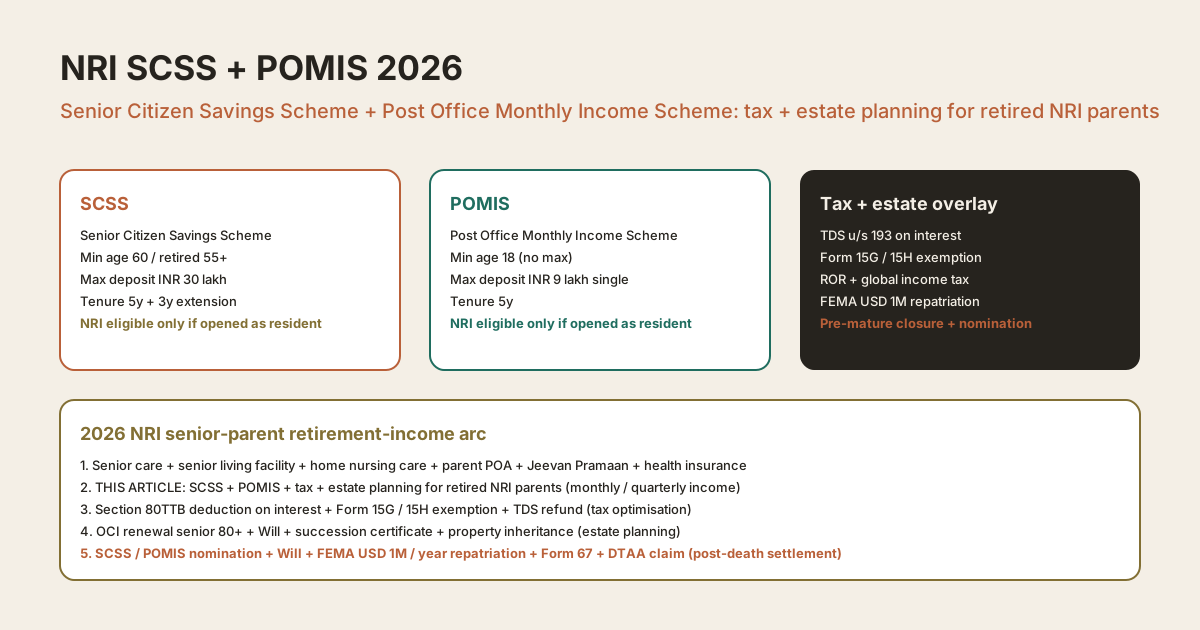
Why NRI parent SCSS + POMIS is the most under-served retirement-income + tax + estate planning pathway (and why 2026 changed it)
Every retired NRI parent with Indian retirement-income needs faces the choice between SCSS (Senior Citizen Savings Scheme) + POMIS (Post Office Monthly Income Scheme) + PPF (Public Provident Fund) + PMVVY (Pradhan Mantri Vaya Vandana Yojana) + bank FD (Fixed Deposit). Senior Citizen Savings Scheme Rules 2004 + India Post POMIS Rules + PPF Scheme + Income Tax Act 1961 Section 80TTB + Section 193 (TDS) + FEMA 1999 + RBI Master Direction specify that the SCSS is the highest-interest Government-backed retirement-income scheme (8.2% p.a. quarterly + Section 80C deduction + max INR 30 lakh + tenure 5y + 3y extension + age 60+ or retired 55+ with 5y retirement), the POMIS is the post-office-backed monthly-income scheme (7.4% p.a. monthly + no Section 80C deduction + max INR 9 lakh single / INR 15 lakh joint + tenure 5y + auto-extension + age 18+ no max), the PPF is the long-term tax-free scheme (7.1% p.a. compounded annually + Section 80C EEE + max INR 1.5 lakh / year + tenure 15y + age 18+ no max), and the PMVVY is the LIC-managed senior pension scheme (7.4% p.a. monthly + max INR 15 lakh + tenure 10y + age 60+ + closed March 2026). The 2026 simplified rules unified the NRI eligibility rules: (1) SCSS / POMIS / PPF must be opened as resident Indian before NRI status, (2) NRI parent can continue to hold the account + receive monthly / quarterly interest, (3) NRI parent can renew the account after maturity as resident, (4) special FEMA SCSS / POMIS repatriation rules apply (FEMA USD 1M / year limit + AD-1 bank + Form 15CB + CA certificate + Form A2 declaration).
The decision is not just about SCSS vs POMIS. It is also about the 5 distinct NRI retirement-income decisions (1. decide SCSS / POMIS / PPF / PMVVY / bank FD based on age + deposit + tenure + interest + TDS + repatriation + Section 80C; 2. decide NRI eligibility - SCSS / POMIS / PPF opened as resident Indian + parent must hold OCI + OCI-holder is NRI for FEMA purpose; 3. decide Section 80C deduction - SCSS + PPF + NSC qualify + POMIS + bank FD do not qualify; 4. decide Form 15G / 15H exemption - SCSS / POMIS interest may be exempt if total interest below basic exemption limit + Form 15G for resident below 60 + Form 15H for senior 60+; 5. decide pre-mature closure + nomination - SCSS + POMIS allow pre-mature closure with 1-2% penalty + nomination available), the 7-step application + monthly income + repatriation flow (T-3m age + residency + OCI eligibility check + T-1m SCSS / POMIS / PPF / PMVVY decision + T-0 SCSS / POMIS opening as resident Indian at bank / post office + T-0 to T+30d Form 15G / 15H at source + T+30d to T+5y monthly / quarterly interest credited to NRO account + T+5y maturity + renewal / auto-extension + T+5y to T+30y NRI repatriation), the document checklist (age proof + PAN + Aadhaar + OCI card + Indian address proof + nomination form + initial deposit cheque + Form 15G / 15H + bank / post office account opening form), the Form 15G / 15H TDS exemption (Form 15G for resident below 60 + Form 15H for senior 60+ + total interest below basic exemption limit + bank / post office accepts at source + TDS u/s 193 deducted at 10% if Form 15G / 15H not filed + TDS refund claim via ITR), the Section 80TTB deduction (up to INR 50,000 / year on interest income for senior 60+ parent + covers bank FD + SCSS + POMIS + savings account interest), the ROR tax status (global income taxed in India + senior parent ITR filing + Form 67 + DTAA claim for foreign tax credit + Form 67 must be filed with ITR), the FEMA USD 1M / year repatriation (AD-1 bank + Form 15CB + CA certificate + Form A2 declaration + 30-90 days for remittance to foreign account), and the worst-case scenarios (missed Form 15G / 15H + TDS deducted / missed Section 80TTB deduction / SCSS / POMIS opened as NRI (not allowed) / missed maturity renewal / missed FEMA USD 1M / year repatriation / missed nomination form / missed Will + succession certificate). The cleanest plan is to check age + residency + OCI eligibility (T-3m) + decide SCSS / POMIS / PPF / PMVVY (T-1m) + open SCSS / POMIS as resident Indian at bank / post office (T-0) + submit Form 15G / 15H at source (T-0 to T+30d) + receive monthly / quarterly interest in NRO account (T+30d to T+5y) + maturity + renewal (T+5y) + NRI repatriation at AD-1 bank (T+5y to T+30y).
The 2026 landscape has expanded the NRI parent SCSS + POMIS retirement-income pathway at every layer: more NRI parents are using the SCSS for highest-interest Government-backed retirement income (8.2% p.a. quarterly + Section 80C deduction) + more NRI parents are using the POMIS for post-office-backed monthly income (7.4% p.a. monthly + no Section 80C deduction) + more NRI parents are using the Form 15H for senior 60+ TDS exemption + more NRI parents are using the Section 80TTB deduction for senior parent interest income (up to INR 50,000 / year) + and the NRI parent SCSS + POMIS retirement-income pathway has become the most under-served and most-mistaken NRI retirement-income + tax + estate planning pathway. The order is fixed; the deliverables are not optional.
NRI parent SCSS + POMIS + PPF + PMVVY + bank FD: 5-scheme comparison and the retirement-income + tax + estate + FEMA + repatriation outcome each scheme triggers
Each scheme triggers a different retirement-income + tax + estate + FEMA + repatriation outcome. Confirm which scheme fits the NRI parent's age + deposit + tenure + interest + TDS + repatriation needs before opening the account.
| Scheme | Age + max deposit + tenure | Interest rate + payment frequency + Section 80C | NRI eligibility + tax + FEMA repatriation |
|---|---|---|---|
| SCSS (Senior Citizen Savings Scheme) | Age 60+ / retired 55+ with 5y retirement + max INR 30 lakh + tenure 5y + 3y extension | Interest 8.2% p.a. paid quarterly + Section 80C deduction available + Government of India backed | Opened as resident Indian + NRI parent can continue to hold + renewal as resident + FEMA USD 1M / year repatriation + AD-1 bank + Form 15CB + CA certificate + Form A2 |
| POMIS (Post Office Monthly Income Scheme) | Age 18+ (no max) + max INR 9 lakh single / INR 15 lakh joint + tenure 5y + auto-extension | Interest 7.4% p.a. paid monthly + no Section 80C deduction + India Post backed | Opened as resident Indian + NRI parent can continue to hold + renewal as resident + FEMA USD 1M / year repatriation + AD-1 bank + Form 15CB + CA certificate + Form A2 |
| PPF (Public Provident Fund) | Age 18+ (no max) + max INR 1.5 lakh / year + tenure 15y + partial withdrawal + loan | Interest 7.1% p.a. compounded annually + Section 80C EEE (tax-free on maturity) + Government of India backed | Opened as resident Indian + NRI parent can continue to hold + extension in blocks of 5y + FEMA USD 1M / year repatriation + AD-1 bank + Form 15CB + CA certificate + Form A2 |
| PMVVY (Pradhan Mantri Vaya Vandana Yojana) | Age 60+ + max INR 15 lakh + tenure 10y + pension monthly | Interest 7.4% p.a. paid monthly + no Section 80C deduction + LIC-managed | Closed March 2026 + existing PMVVY holders can continue + renewal as resident + FEMA USD 1M / year repatriation + AD-1 bank + Form 15CB + CA certificate + Form A2 |
| Bank FD (Fixed Deposit) for senior citizen | Age 60+ (senior citizen FD rate) + no max deposit + tenure 7d to 10y | Interest 7.5-8.0% p.a. for senior FD + interest paid at maturity / monthly / quarterly + no Section 80C deduction (for non-5y FD) + bank-backed | Opened as resident Indian + NRI parent can continue to hold + NRE / FCNR FD for NRI + FEMA USD 1M / year repatriation + AD-1 bank + Form 15CB + CA certificate + Form A2 |
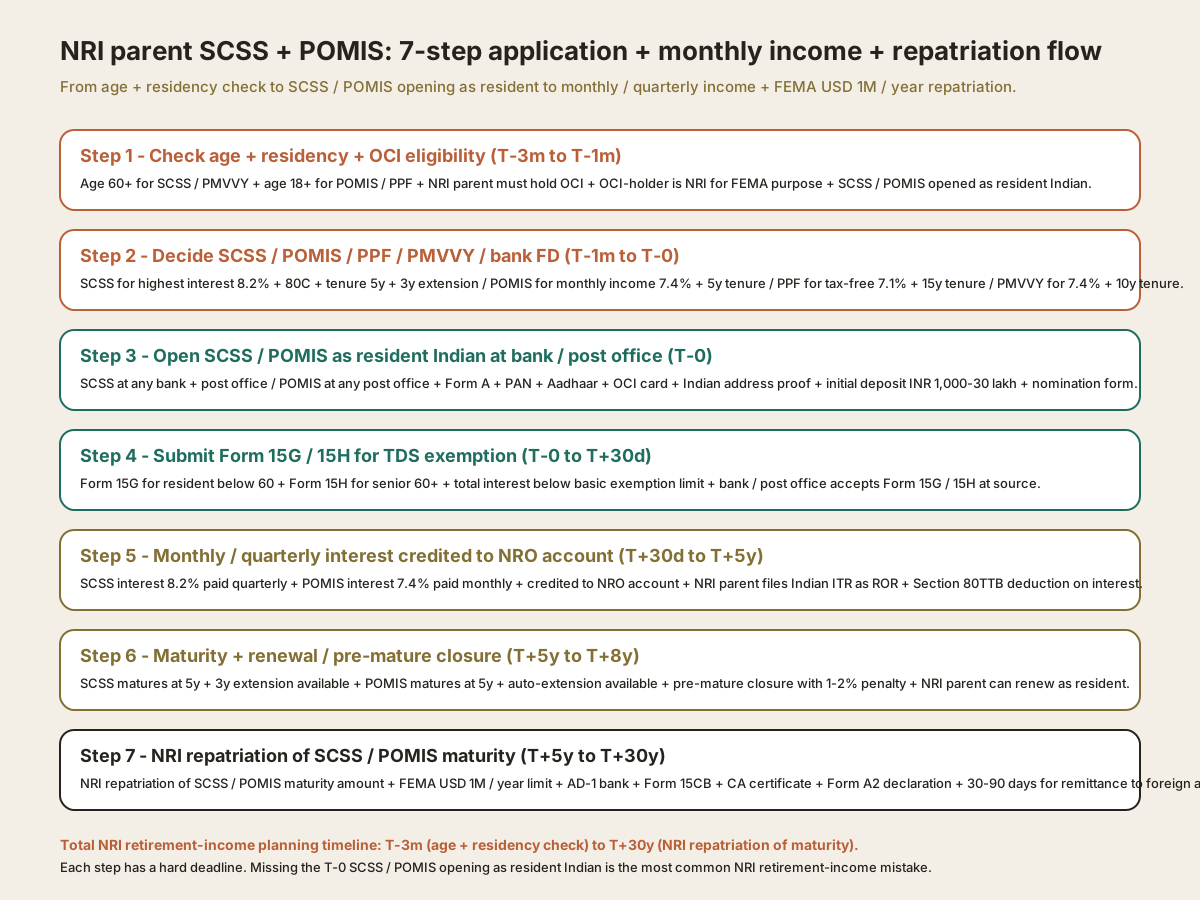
NRI parent SCSS + POMIS: 7-step application + monthly income + repatriation flow (T-3m to T+30y)
Each step has a deliverable and a deadline. The order is fixed; the deliverables are not optional.
Check age + residency + OCI eligibility (T-3m to T-1m)
The first step is to check the NRI parent's age + residency + OCI eligibility for SCSS / POMIS / PPF / PMVVY. The age requirement is: (1) SCSS: 60+ or retired 55+ with 5y retirement from employment, (2) POMIS: 18+ no max age, (3) PPF: 18+ no max age, (4) PMVVY: 60+ (closed March 2026 for new applications). The residency requirement is: SCSS / POMIS / PPF / PMVVY must be opened as resident Indian before NRI status + the NRI parent can continue to hold the account after becoming NRI. The OCI eligibility is: NRI parent must hold OCI card + OCI-holder is NRI for FEMA purpose + the OCI card is mandatory for FEMA repatriation of maturity. The cleanest plan is to verify the NRI parent's age + residency + OCI eligibility within T-3m + decide the SCSS / POMIS / PPF / PMVVY within T-1m + open the account within T-0.
Decide SCSS / POMIS / PPF / PMVVY / bank FD based on age + deposit + tenure + interest + TDS + repatriation (T-1m to T-0)
The second step is to decide between SCSS / POMIS / PPF / PMVVY / bank FD based on the 5-scheme comparison. The decision factors are: (1) age of NRI parent (60+ → SCSS / PMVVY / senior citizen FD / 55-59 retired → SCSS with retirement certificate / 18-54 → POMIS / PPF), (2) deposit amount (max INR 30 lakh → SCSS / max INR 9 lakh single → POMIS / max INR 1.5 lakh / year → PPF / max INR 15 lakh → PMVVY / no max → bank FD), (3) tenure (5y → SCSS / POMIS / 15y → PPF / 10y → PMVVY / 7d to 10y → bank FD), (4) interest rate (8.2% → SCSS / 7.4% → POMIS / PMVVY / 7.1% → PPF / 7.5-8.0% → senior citizen FD), (5) Section 80C deduction (SCSS / PPF qualify / POMIS / PMVVY / bank FD do not qualify), (6) payment frequency (quarterly → SCSS / monthly → POMIS / PMVVY / compounded annually → PPF / at maturity / monthly / quarterly → bank FD), (7) FEMA repatriation (all 5 schemes qualify for USD 1M / year + AD-1 bank + Form 15CB + CA certificate + Form A2). The cleanest plan is to assess the NRI parent's retirement-income needs + liquidity needs + tax bracket + estate planning needs + FEMA repatriation needs + decide the best scheme + open the account within T-0.
Open SCSS / POMIS / PPF / PMVVY as resident Indian at bank / post office (T-0)
The third step is to open SCSS / POMIS / PPF / PMVVY as resident Indian at the bank / post office. The application is via the bank / post office branch + the documents required are age proof (passport + birth certificate + Aadhaar / PAN) + PAN + Aadhaar + OCI card + Indian address proof + nomination form + initial deposit (INR 1,000 minimum + max as per scheme limit) + Form A (account opening form). The bank / post office accepts the application + verifies the documents + opens the account + issues the passbook + the nomination form is registered + the initial deposit is collected. The cleanest plan is to engage the bank / post office branch within T-0 + submit the application + documents + nomination form + initial deposit + open the account within T-0.
Submit Form 15G / 15H for TDS exemption at source (T-0 to T+30d)
The fourth step is to submit Form 15G / 15H for TDS exemption at source. The Form 15G is for resident below 60 + the Form 15H is for senior citizen 60+ + the total interest income must be below the basic exemption limit (INR 3 lakh for senior 60+ under new tax regime / INR 5 lakh for senior 60+ under old tax regime for FY 2026). The bank / post office accepts the Form 15G / 15H at source + the TDS u/s 193 is not deducted + the full interest is paid to the NRI parent's account. If the Form 15G / 15H is not filed, the TDS u/s 193 is deducted at 10% + the NRI parent must claim the TDS refund via ITR + Form 67 + DTAA claim. The cleanest plan is to submit the Form 15G / 15H at the bank / post office within T-0 + verify the TDS exemption + receive the full interest + keep the Form 15G / 15H receipt for at least 7 years (Indian tax retention period) + for at least 10 years (US / UK / Canadian / Australian tax retention period).
Receive monthly / quarterly interest in NRO account (T+30d to T+5y)
The fifth step is to receive the monthly / quarterly interest in the NRO account. The SCSS interest is 8.2% p.a. paid quarterly (INR 61,500 / quarter for INR 30 lakh deposit) + the POMIS interest is 7.4% p.a. paid monthly (INR 5,550 / month for INR 9 lakh deposit) + the PPF interest is 7.1% p.a. compounded annually + the PMVVY interest is 7.4% p.a. paid monthly. The interest is credited to the NRO account + the NRI parent files the Indian ITR as ROR + the Section 80TTB deduction is claimed (up to INR 50,000 / year on interest income for senior 60+ parent) + the Form 67 + DTAA claim is filed for foreign tax credit. The cleanest plan is to engage an Indian CA + FEMA specialist within T+30d + file the Indian ITR + claim the Section 80TTB deduction + file the Form 67 + DTAA claim + keep the ITR + Form 67 + DTAA claim for at least 7 years.
Maturity + renewal / auto-extension of SCSS / POMIS (T+5y)
The sixth step is the maturity + renewal / auto-extension of SCSS / POMIS. The SCSS matures at 5y + a 3y extension is available + the NRI parent can renew as resident Indian + the renewed SCSS continues to earn 8.2% p.a. quarterly + the Section 80C deduction continues. The POMIS matures at 5y + auto-extension is available + the NRI parent can renew as resident Indian + the renewed POMIS continues to earn 7.4% p.a. monthly. The PPF matures at 15y + extension in blocks of 5y is available + the NRI parent can extend as resident Indian. The PMVVY matures at 10y + the corpus is returned + no further interest. The cleanest plan is to engage the bank / post office within T+5y + apply for renewal / extension + continue to receive monthly / quarterly interest + claim the Section 80TTB deduction + file the Form 67 + DTAA claim.
NRI repatriation of SCSS / POMIS / PPF maturity at AD-1 bank (T+5y to T+30y)
The seventh step is the NRI repatriation of SCSS / POMIS / PPF maturity at the AD-1 bank. The FEMA USD 1M / year limit applies per financial year April-March + the repatriation is via the AD-1 bank + the documents required are maturity receipt + SCSS / POMIS / PPF passbook + PAN + Aadhaar + OCI card + foreign passport + Form 15CB + CA certificate + FEMA Form A2 declaration + AD-1 bank application + the processing time is 30-90 days. The Form 15CB is a CA certificate confirming the tax has been deducted / paid on the maturity + the CA certificate is mandatory for FEMA repatriation + the FEMA Form A2 declaration confirms the USD 1M / year limit is not exceeded. The cleanest plan is to engage an Indian CA + FEMA specialist within T+5y + file the Form 15CB + FEMA Form A2 + AD-1 bank application + obtain the NRI repatriation within T+30y + report the NRI repatriation on the US / UK / Canadian / Australian tax return + claim the Form 67 + DTAA for foreign tax credit + propagate the maturity receipt + repatriation receipt to the Will + succession certificate + legal heir certificate + property mutation stack.
Document checklist before the NRI parent SCSS / POMIS application is submitted
Most NRI parent SCSS / POMIS application failures are caused by missing or mismatched documents at the application stage. Confirm each item before submitting the application.
- NRI parent's age proof (passport + birth certificate + Aadhaar / PAN + 60+ age for SCSS / PMVVY + 55+ retired for SCSS with retirement certificate + 18+ for POMIS / PPF).
- NRI parent's residency proof (Aadhaar + Indian address proof + voter ID + driving licence + utility bill + rent agreement + as resident Indian before NRI status).
- NRI parent's PAN (mandatory for SCSS / POMIS / PPF / PMVVY / bank FD + TDS u/s 193 deduction + ITR filing + Form 15G / 15H submission).
- NRI parent's Aadhaar (mandatory for bank account + SCSS / POMIS / PPF / PMVVY + KYC + ITR filing + Form 15G / 15H).
- NRI parent's OCI card (mandatory for NRI status + FEMA USD 1M / year repatriation + AD-1 bank application + Form 15CB + CA certificate + Form A2 declaration).
- NRI parent's foreign passport (mandatory for KYC + FEMA repatriation + AD-1 bank application).
- NRI parent's Indian address proof (Aadhaar + utility bill + rent agreement + voter ID + driving licence + for SCSS / POMIS / PPF / PMVVY opening as resident Indian).
- NRI parent's retirement certificate (for SCSS age 55-59 retired + 5y retirement from employment + mandatory for SCSS opening below age 60).
- Initial deposit cheque (INR 1,000 minimum + max INR 30 lakh for SCSS / INR 9 lakh single for POMIS / INR 1.5 lakh / year for PPF / INR 15 lakh for PMVVY / no max for bank FD).
- Nomination form (Form DA-1 for SCSS / Form DA-2 for POMIS / Form DA-1 for PPF / Form DA-2 for PMVVY + nominee identity proof + nominee PAN + nominee Aadhaar).
- Form A (account opening form for SCSS / POMIS / PPF / PMVVY + with NRI parent's personal details + deposit amount + tenure + payment frequency + nomination).
- Form 15G / 15H (Form 15G for resident below 60 + Form 15H for senior 60+ + total interest below basic exemption limit + bank / post office accepts at source + TDS u/s 193 not deducted).
- ITR + Form 67 + DTAA claim (NRI parent files Indian ITR as ROR + Form 67 for foreign tax credit + DTAA claim + for SCSS / POMIS / PPF / PMVVY / bank FD interest income).
- Section 80TTB deduction (up to INR 50,000 / year on interest income for senior 60+ parent + covers bank FD + SCSS + POMIS + savings account interest + ITR filing).
- Section 80C deduction (SCSS deposit qualifies for Section 80C deduction up to INR 1.5 lakh / year + PPF deposit qualifies for Section 80C EEE + POMIS / PMVVY / bank FD do not qualify).
- NRO account (mandatory for NRI parent + SCSS / POMIS / PPF / PMVVY / bank FD interest credited to NRO account + NRI repatriation from NRO account + FEMA USD 1M / year limit).
- Form 15CB (CA certificate confirming tax deducted / paid on maturity + mandatory for FEMA repatriation + AD-1 bank application).
- CA certificate (mandatory for FEMA repatriation + confirms tax deducted / paid + for SCSS / POMIS / PPF / PMVVY / bank FD maturity).
- FEMA Form A2 declaration (confirms USD 1M / year limit not exceeded + per financial year April-March + AD-1 bank application).
- AD-1 bank application (maturity receipt + SCSS / POMIS / PPF / PMVVY passbook + PAN + Aadhaar + OCI card + foreign passport + Form 15CB + CA certificate + FEMA Form A2 + AD-1 bank application).
- Will + succession certificate + legal heir certificate + property mutation (post-maturity + for nominee claim + heir inheritance + FEMA USD 1M / year repatriation + estate planning).
NRI parent SCSS + POMIS decision flow
Community pattern: where NRI parent SCSS + POMIS actually breaks
Unable to embed reddit content. View on reddit
"The repeated pattern: NRI parents who open SCSS / POMIS as NRI (not as resident Indian), only to find that the bank / post office rejects the application + the NRI parent cannot open SCSS / POMIS / PPF as NRI + the NRI parent must open as resident Indian first + then continue to hold as NRI after becoming NRI. The fix is to open SCSS / POMIS / PPF as resident Indian first + then continue to hold as NRI + the NRI parent can renew as resident after maturity. The other repeated pattern: NRI parents who fail to submit Form 15G / 15H at source, only to find that the TDS u/s 193 is deducted at 10% + the NRI parent loses INR 31,260 / year on SCSS interest + the NRI parent must claim the TDS refund via ITR + Form 67 + DTAA claim. The fix is to submit Form 15G / 15H at the bank / post office within T-0 + verify the TDS exemption + receive the full interest + keep the Form 15G / 15H receipt for at least 7 years. The third repeated pattern: NRI parents who fail to claim Section 80TTB deduction on the interest income, only to find that the NRI parent loses INR 50,000 / year deduction + the NRI parent pays higher tax outgo + the NRI parent must file revised ITR to claim the deduction. The fix is to file the Indian ITR with Section 80TTB deduction within T+30d to T+5y + keep the ITR + Section 80TTB claim for at least 7 years. The fourth repeated pattern: NRI parents who fail to file FEMA Form 15CB + CA certificate + Form A2 for maturity repatriation, only to find that the NRI parent cannot repatriate the maturity + the FEMA violation triggers a penalty + the maturity remains in the NRO account + the NRI parent cannot access the maturity. The fix is to engage an Indian CA + FEMA specialist within T+5y + file the Form 15CB + FEMA Form A2 + AD-1 bank application + obtain the NRI repatriation within T+30y."
Read on reddit ->Need help with Move Planning?
Share your blocker in one line. Our experts will reply with practical next steps.
NRI parent SCSS + POMIS: the seven-layer stack
SCSS / POMIS opened as NRI is the most expensive NRI retirement-income mistake
The most common NRI parent SCSS + POMIS mistake is opening the account as NRI (not as resident Indian). SCSS / POMIS / PPF / PMVVY must be opened as resident Indian first + the NRI parent can continue to hold the account after becoming NRI + the NRI parent can renew as resident after maturity. If the NRI parent opens SCSS / POMIS / PPF as NRI, the bank / post office rejects the application + the NRI parent cannot open the account + the NRI parent loses the 8.2% / 7.4% / 7.1% interest rate + the NRI parent must re-open as resident Indian first + then continue to hold as NRI. The fix is to (a) verify the NRI parent's age + residency + OCI eligibility within T-3m + decide the SCSS / POMIS / PPF / PMVVY within T-1m + open the account as resident Indian at the bank / post office within T-0, (b) submit Form 15G / 15H at source within T-0 to T+30d + verify the TDS exemption + receive the full interest, (c) file the Indian ITR with Section 80TTB deduction within T+30d to T+5y + claim the Section 80TTB deduction up to INR 50,000 / year on interest income for senior 60+ parent, (d) at maturity + renew as resident Indian within T+5y + apply for SCSS 3y extension / POMIS auto-extension / PPF extension in blocks of 5y, (e) for NRI repatriation of maturity + engage an Indian CA + FEMA specialist within T+5y + file the Form 15CB + FEMA Form A2 + AD-1 bank application + obtain the NRI repatriation within T+30y, (f) propagate the maturity receipt + repatriation receipt to the Will + succession certificate + legal heir certificate + property mutation stack + nominee claim + heir inheritance, (g) report the NRI repatriation on the US / UK / Canadian / Australian tax return + claim the Form 67 + DTAA for foreign tax credit. The cost of opening SCSS / POMIS as NRI is the bank / post office rejection + the loss of the 8.2% / 7.4% / 7.1% interest rate + the cost of re-opening as resident Indian + the cost of the additional document request + the cost of the maturity renewal + the cost of the FEMA repatriation delays + the cost of the estate settlement delays. The cleanest plan is to open SCSS / POMIS / PPF as resident Indian first + continue to hold as NRI + renew as resident after maturity + repatriate via AD-1 bank + propagate to Will + succession certificate + nominee claim.
Animated decision map

Interactive checkpoint
Turn this guide into a decision file
0 of 4 checked
What is NRI parent SCSS + POMIS in 2026?
NRI parent SCSS + POMIS is a 7-step retirement-income + tax + estate + FEMA + repatriation pathway for retired NRI parents with Indian retirement-income needs. The 5 schemes are: (1) SCSS (Senior Citizen Savings Scheme) age 60+ or retired 55+ with 5y retirement + max INR 30 lakh + 8.2% p.a. quarterly + 5y + 3y extension + Section 80C deduction + Government of India backed, (2) POMIS (Post Office Monthly Income Scheme) age 18+ no max + max INR 9 lakh single / INR 15 lakh joint + 7.4% p.a. monthly + 5y + auto-extension + no Section 80C deduction + India Post backed, (3) PPF (Public Provident Fund) age 18+ no max + max INR 1.5 lakh / year + 7.1% p.a. compounded annually + 15y + Section 80C EEE + Government of India backed, (4) PMVVY (Pradhan Mantri Vaya Vandana Yojana) age 60+ + max INR 15 lakh + 7.4% p.a. monthly + 10y + LIC-managed + closed March 2026, (5) bank FD (Fixed Deposit) for senior citizen 60+ + no max + 7.5-8.0% p.a. + tenure 7d to 10y + bank-backed. The NRI eligibility rules are: SCSS / POMIS / PPF / PMVVY must be opened as resident Indian first + NRI parent can continue to hold + renewal as resident + special FEMA SCSS / POMIS repatriation rules apply (FEMA USD 1M / year limit + AD-1 bank + Form 15CB + CA certificate + Form A2 declaration). The cleanest plan is to check age + residency + OCI eligibility (T-3m) + decide SCSS / POMIS / PPF / PMVVY (T-1m) + open as resident Indian (T-0) + submit Form 15G / 15H (T-0 to T+30d) + receive monthly / quarterly interest (T+30d to T+5y) + maturity + renewal (T+5y) + NRI repatriation (T+5y to T+30y).
Can NRI parents open SCSS / POMIS / PPF?
NRI parents can hold SCSS / POMIS / PPF / PMVVY / bank FD but cannot open them as NRI. The SCSS / POMIS / PPF / PMVVY / bank FD must be opened as resident Indian first + the NRI parent can continue to hold the account after becoming NRI + the NRI parent can renew the account after maturity as resident. The NRI eligibility rules are: (1) the account must be opened as resident Indian before NRI status, (2) the NRI parent can continue to hold the account + receive monthly / quarterly interest, (3) the NRI parent can renew the account after maturity as resident, (4) special FEMA SCSS / POMIS repatriation rules apply for the maturity. The cleanest plan is to verify the NRI parent's age + residency + OCI eligibility within T-3m + decide the SCSS / POMIS / PPF / PMVVY within T-1m + open the account as resident Indian within T-0 + continue to hold as NRI after becoming NRI + renew as resident after maturity + repatriate via AD-1 bank + FEMA USD 1M / year limit + Form 15CB + CA certificate + Form A2 declaration.
What is the cost of NRI parent SCSS + POMIS in 2026?
The 2026 cost of NRI parent SCSS + POMIS is: (1) SCSS / POMIS / PPF / PMVVY account opening fee INR 100-500 + initial deposit INR 1,000 minimum + max INR 30 lakh for SCSS / INR 9 lakh for POMIS / INR 1.5 lakh / year for PPF / INR 15 lakh for PMVVY, (2) annual interest SCSS INR 2,46,000 (for INR 30 lakh deposit @ 8.2%) + POMIS INR 66,600 (for INR 9 lakh deposit @ 7.4%) + PPF INR 1,06,500 (for INR 1.5 lakh deposit @ 7.1% compounded) + PMVVY INR 1,11,000 (for INR 15 lakh deposit @ 7.4%), (3) TDS u/s 193 at 10% if Form 15G / 15H not filed (SCSS INR 24,600 / year + POMIS INR 6,660 / year + PMVVY INR 11,100 / year), (4) Form 15G / 15H submission fee INR 0-100, (5) Section 80TTB deduction up to INR 50,000 / year, (6) Section 80C deduction SCSS deposit up to INR 1.5 lakh / year + PPF deposit up to INR 1.5 lakh / year, (7) FEMA USD 1M / year repatriation fee at AD-1 bank INR 500-5,000 + Form 15CB + CA certificate fee INR 5,000-20,000 + FEMA Form A2 declaration fee INR 200-500, (8) Indian CA fee INR 10,000-50,000 for ITR + Form 67 + DTAA claim + Section 80TTB deduction claim + FEMA repatriation filing, (9) FEMA specialist fee INR 10,000-50,000, (10) cross-border tax lawyer fee INR 10,000-50,000. The total cost for NRI parent SCSS + POMIS is INR 30,000-2,00,000 / USD 360-2,400 over 5-10 years, with the bulk of the cost being the FEMA repatriation fee + Indian CA fee + FEMA specialist fee + cross-border tax lawyer consultation.
How long does NRI parent SCSS + POMIS take in 2026?
The 2026 processing time for NRI parent SCSS + POMIS is: (1) T-3m to T-1m for age + residency + OCI eligibility check, (2) T-1m to T-0 for SCSS / POMIS / PPF / PMVVY decision, (3) T-0 for SCSS / POMIS / PPF / PMVVY opening as resident Indian at bank / post office (1-2 hours), (4) T-0 to T+30d for Form 15G / 15H submission at source, (5) T+30d to T+5y for monthly / quarterly interest credited to NRO account + Indian ITR filing + Section 80TTB deduction claim + Form 67 + DTAA claim, (6) T+5y for maturity + renewal / auto-extension of SCSS / POMIS / PPF, (7) T+5y to T+30y for NRI repatriation of maturity at AD-1 bank (30-90 days for remittance to foreign account). The cleanest plan is to check age + residency + OCI eligibility (T-3m) + decide SCSS / POMIS / PPF / PMVVY (T-1m) + open as resident Indian (T-0) + submit Form 15G / 15H (T-0 to T+30d) + receive monthly / quarterly interest (T+30d to T+5y) + maturity + renewal (T+5y) + NRI repatriation (T+5y to T+30y). The propagation to Will + succession certificate + legal heir certificate + property mutation + nominee claim + heir inheritance should be completed within 90 days of the maturity.
What is the difference between SCSS and POMIS for NRI parents?
The difference between SCSS and POMIS for NRI parents is: (1) SCSS age 60+ or retired 55+ with 5y retirement + POMIS age 18+ no max, (2) SCSS max INR 30 lakh + POMIS max INR 9 lakh single / INR 15 lakh joint, (3) SCSS interest 8.2% p.a. quarterly + POMIS interest 7.4% p.a. monthly, (4) SCSS tenure 5y + 3y extension + POMIS tenure 5y + auto-extension, (5) SCSS Section 80C deduction available + POMIS no Section 80C deduction, (6) SCSS Government of India backed + POMIS India Post backed, (7) SCSS preferred for highest interest + Section 80C + senior parent 60+ / POMIS preferred for monthly income + 18+ no max + post office convenience, (8) both qualify for FEMA USD 1M / year repatriation + AD-1 bank + Form 15CB + CA certificate + Form A2 declaration, (9) both allow nomination + nominee claims maturity without succession certificate. The cleanest plan is to choose SCSS for the highest interest + Section 80C deduction + senior parent 60+ + max INR 30 lakh + tenure 5y + 3y extension + Government of India backed + choose POMIS for monthly income + 18+ no max + max INR 9 lakh single + tenure 5y + auto-extension + India Post backed.
What is the worst-case scenario if NRI parent SCSS + POMIS is mishandled?
Six things can go wrong: (1) SCSS / POMIS / PPF opened as NRI (not allowed) + the bank / post office rejects the application + the NRI parent cannot open the account + the NRI parent loses the 8.2% / 7.4% / 7.1% interest rate + must re-open as resident Indian first, (2) Form 15G / 15H not submitted at source + TDS u/s 193 deducted at 10% + NRI parent loses INR 31,260 / year on SCSS interest + must claim TDS refund via ITR + Form 67 + DTAA claim, (3) Section 80TTB deduction not claimed in ITR + NRI parent loses INR 50,000 / year deduction + higher tax outgo + must file revised ITR to claim the deduction, (4) maturity renewal missed + SCSS / POMIS / PPF not renewed as resident Indian + NRI parent loses the 8.2% / 7.4% / 7.1% interest rate + must re-open as new account, (5) FEMA USD 1M / year repatriation missed + Form 15CB + CA certificate + Form A2 not filed + NRI parent cannot repatriate the maturity + FEMA violation triggers a penalty INR 1-5 lakh + maturity remains in NRO account, (6) nomination form not submitted + nominee cannot claim maturity without succession certificate + Will + property mutation + estate is tied up in court for 2-10 years + heir ROR is delayed + FEMA USD 1M / year repatriation is delayed. Each of these is fixable + but the cost is INR 30,000-2,00,000 in additional fee + the cost of the bank / post office rejection + the cost of the TDS deducted + the cost of the Section 80TTB deduction missed + the cost of the maturity renewal missed + the cost of the FEMA repatriation missed + the cost of the nomination form missed + the stress of the SCSS / POMIS rejection. The cleanest plan is to open SCSS / POMIS / PPF as resident Indian first + submit Form 15G / 15H at source + file ITR with Section 80TTB deduction + renew as resident after maturity + repatriate via AD-1 bank + Form 15CB + CA certificate + Form A2 declaration + propagate to Will + succession certificate + nominee claim + heir inheritance.
The plan is only as good as the sequence.
Tax, banking, schools, shipping — they all have dependencies. A wrong order costs months and lakhs. Get it right.