NRI Home Loan Repayment After Returning to India: rupee-vs-dollar EMI, redesignation to resident, Section 24(b) + 80C, and the prepayment decision
A practical 2026 guide for NRIs and returning NRIs repaying an Indian home loan: rupee vs foreign-currency EMI, NRE / NRO / FCY account choice, redesignation to...
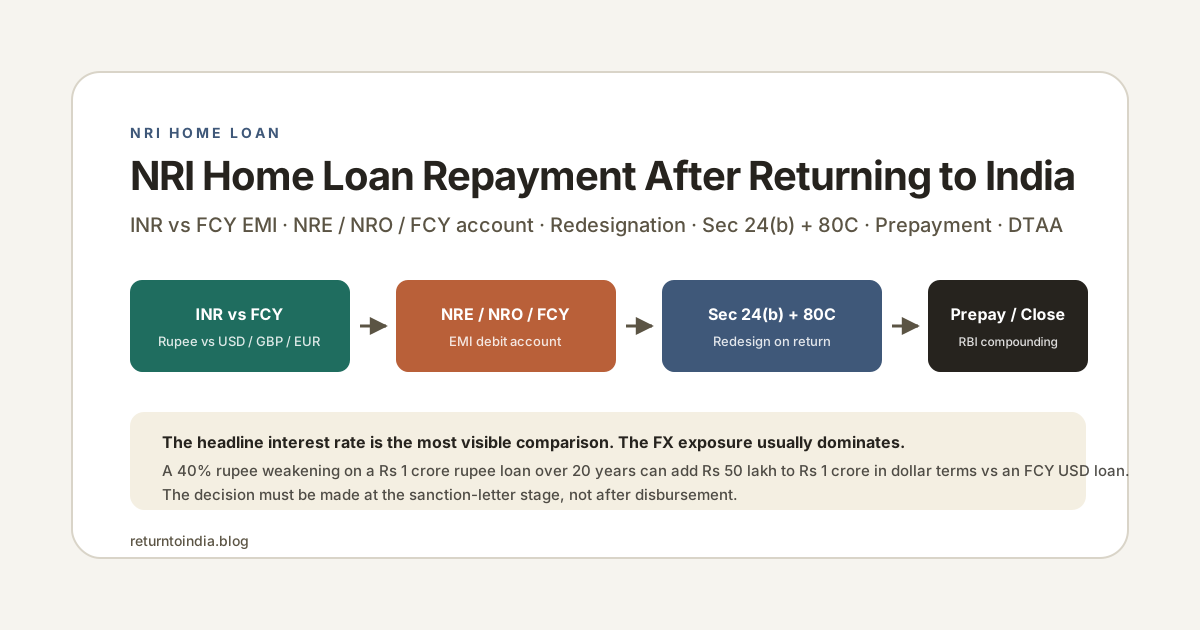
The 60-second version
Indian home loan repayment for an NRI is not just a debit instruction. The rupee-vs-dollar EMI decision, the account you pay from, the redesignation of the loan on return to India, and the Section 24(b) + 80C deduction eligibility are four separate decisions that compound over the loan tenure. Get the first one wrong and you carry 6% to 8% extra interest for the next 20 years. Get the second one wrong and you are paying a 30% to 50% FX premium every month. Get the third one wrong and you lose Rs 3.5 lakh per year in tax deductions. Get the fourth one wrong and you pay 4% to 6% prepayment penalty for a partial pre-payment that should have been penalty-free.
Why the rupee-vs-dollar EMI choice is the most expensive decision you did not know you were making
Most NRIs take an Indian home loan in rupees because that is the default. The bank's sanction letter, the rate, the EMI, the prepayment rules — all in INR. The NRI is then paid in USD, GBP, CAD, or AED, and the salary is converted to INR each month to pay the EMI through an FCNR or NRE account. On the surface, this is a simple rupee liability funded from a foreign-currency cash flow. In practice, it is a 20-year FX exposure that can cost 30% to 50% of the loan's principal in adverse-currency movements alone.
The alternative — a Foreign Currency Yen / Foreign Currency (FCY) home loan — is offered by a smaller set of Indian banks (mostly large public-sector and some private banks). The loan is sanctioned in USD (or sometimes GBP, EUR, JPY, or CAD), the EMI is debited in that foreign currency, and the principal outstanding is computed in the same currency. For a US-based NRI paid in USD, an FCY loan removes the FX exposure entirely. The catch: FCY loans are typically 0.25% to 1.0% higher in headline rate than rupee loans, the prepayment rules are tighter, and the tax deduction under Section 24(b) is still capped at Rs 2 lakh per AY — computed on the INR equivalent of the foreign-currency interest paid. The right choice depends on the borrower's currency of income, the loan tenure, and the expected rupee trajectory. Most borrowers who took rupee loans without thinking about it would have been better off with FCY. Most borrowers who took FCY loans without thinking about it would have been better off with rupee. The decision must be made deliberately, not by default.
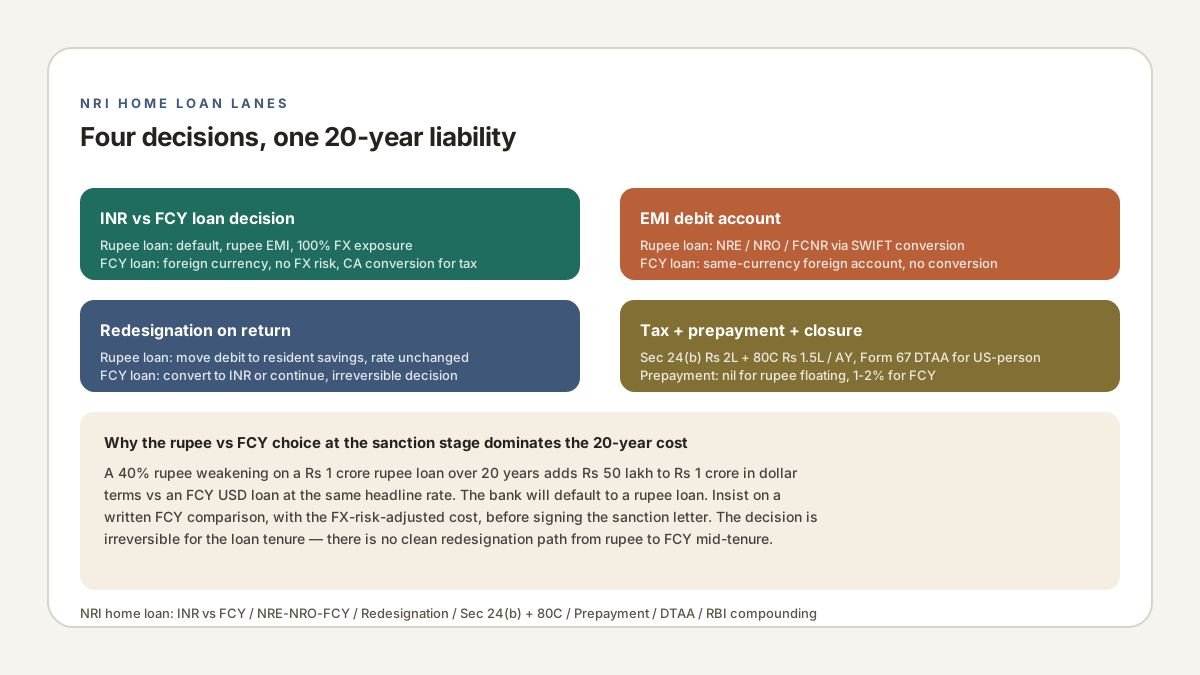
Rupee vs FCY home loan: what each path actually costs over 20 years
Rupee and FCY home loans differ on (a) interest rate, (b) FX exposure, (c) prepayment penalty, (d) Section 24(b) deduction treatment, and (e) redesignation cost on return to India.
| Dimension | Rupee home loan (default) | FCY home loan (USD / GBP / EUR) | Practical difference |
|---|---|---|---|
| Headline interest rate | 8.5% to 10.5% (floating, repo-linked benchmark) | SOFR + 3.0% to 4.5% for USD loans (typically 6.5% to 8.5% in 2026) | FCY is 0.25% to 1.0% cheaper in headline rate when the funding currency matches the borrower's salary currency. |
| EMI currency | INR (paid from NRE / NRO / FCNR via SWIFT conversion) | Foreign currency (paid from the same-currency foreign account; no INR conversion) | FCY removes the FX risk for a borrower whose income is in the same currency. Rupee loan leaves the borrower fully exposed to rupee depreciation. |
| Total cost over 20 years on a Rs 1 crore loan (illustrative) | Approx Rs 2.6 to 3.1 crore total (interest + principal), assuming 8.5% to 10.5% rate | Approx USD 280,000 to 360,000 total (interest + principal), assuming 6.5% to 8.5% rate and 20-year tenure | Cross-currency comparison: at INR 85 / USD, the FCY loan totals Rs 2.4 to 3.1 crore equivalent — a 10% to 30% difference depending on rate trajectory and rupee movement. |
| Section 24(b) deduction (interest) | Up to Rs 2 lakh per AY for self-occupied, full interest for let-out | Same Rs 2 lakh per AY cap, computed on the INR equivalent of the foreign-currency interest paid | For a US-based NRI, the deduction is recoverable but requires a CA certificate converting the FCY interest to INR at the RBI reference rate on each EMI date. |
| Section 80C deduction (principal) | Up to Rs 1.5 lakh per AY (within overall 80C cap), only after construction is complete | Same Rs 1.5 lakh cap, computed on the INR equivalent of the FCY principal | The deduction is symmetrical — the FCY loan does not gain or lose Section 80C eligibility vs rupee loan, but the INR conversion adds CA cost. |
| Prepayment penalty (floating rate) | Nil for individual borrowers on floating-rate loans (RBI 2014 directive, no penalty for floating-rate prepayment) | Often 1% to 2% on FCY loans even for floating-rate prepayment (bank-by-bank variation) | Floating-rate rupee loans are penalty-free for partial or full prepayment. FCY loans sometimes carry a penalty — check the loan agreement clause 12 / clause 14. |
| Foreclosure (full prepayment) cost | Nil for individual borrowers on floating rate | Often 1% to 3% on FCY loans (bank-by-bank variation) | Same as partial prepayment. The bank is required to disclose the foreclosure terms in the sanction letter; verify before signing. |
| Redesignation on return to India | Loan is already in INR — no redesignation needed, the EMI debit simply moves from NRE / NRO to a resident savings account | Loan can be redesignated as an INR loan (bank converts the outstanding principal at the prevailing rate) or continued as FCY loan | Most banks allow INR conversion on redesignation, but at a re-set interest rate. Get this in writing before you sign the original FCY sanction. |
| FX risk for the borrower | 100% rupee exposure — the EMI in INR is constant, but the dollar cost of paying it rises as the rupee weakens | 0% FX risk if income is in the same currency as the loan | A rupee weakening from 85 to 95 over 10 years on a Rs 1 crore loan = approx Rs 12 lakh extra in dollar terms. On a 20-year horizon, this can exceed Rs 50 lakh. |
Execution sequence: from sanctioned loan to redesignation on return to India
Plan the order. The EMI routing, the redesignation, the Section 24(b) + 80C claim, and the prepayment decision are not simultaneous — but they are interdependent, and an error in one is hard to fix after the loan has been running for a few years.
Decide rupee vs FCY at the sanction-letter stage (before signing)
Compare the rupee loan headline rate against the FCY loan rate in your income currency. Add the FX-risk-adjusted cost (estimate using the difference between the loan rate and your salary-currency inflation rate). Check the prepayment penalty clause, the redesignation clause, and the Section 24(b) treatment in writing. The bank relationship manager will usually steer toward the rupee loan (it's their default product); insist on a written FCY comparison before signing. For US-based NRIs, an FCY USD loan is usually 10% to 30% cheaper over 20 years than the equivalent rupee loan.
Set up the EMI debit from the right account (NRE / NRO / FCY / FCNR)
For a rupee loan, the EMI must be debited from an NRE or NRO account (most banks prefer NRE because the funds are clearly foreign-source). For an FCY loan, the EMI must be debited from a foreign-currency account — most US-based NRIs maintain a US checking or savings account with a USD remittance capability. Some Indian banks offer a foreign-currency FCY account in India that can hold USD directly; this is rare but worth asking. The EMI debit is automatic via standing instruction. If the account runs low, the bank will bounce the EMI, charge a penalty, and add it to the principal (RBI compounding rules apply).
Maintain the loan documentation for Section 24(b) + 80C claim
For Section 24(b) deduction on interest: the bank issues an annual interest certificate (Form 16B-equivalent for the loan, not for TDS) showing the total interest paid in the FY. For Section 80C deduction on principal: the bank issues a principal repayment certificate. Both are required for the ITR filing. For an FCY loan, a chartered accountant converts the foreign-currency interest / principal to INR at the RBI reference rate on each EMI date — the conversion must be done EMI-by-EMI, not at a single year-end rate. Keep all original bank statements and certificates for at least 8 years (the IT reassessment window).
On returning to India, redesignate the loan and the EMI debit
For a rupee loan: the loan is already in INR, no redesignation is needed. The EMI debit moves from NRE / NRO to a resident savings account. The bank may require a fresh KYC, a fresh address proof (Indian), a fresh PAN / Aadhaar linkage, and a fresh income proof (Indian salary, Form 16, or ITR). The interest rate is unchanged. Section 24(b) + 80C deductions can be claimed from the AY of return onwards. For an FCY loan: the bank may offer conversion to an INR loan (with a re-set interest rate) or continuation as an FCY loan with the EMI debited from a foreign-currency account that you still maintain abroad. The decision is irreversible for the loan tenure, so get a written comparison before signing the redesignation letter.
Decide on partial pre-payment vs full foreclosure
Floating-rate rupee loans are penalty-free for partial or full prepayment (RBI 2014 directive, in effect since 2014). Partial prepayment of Rs 5 lakh to Rs 10 lakh in years 3 to 7 of the loan can save 5% to 15% in total interest, depending on the rate. Foreclosure at the end of the tenure is the natural completion. For an FCY loan, partial prepayment may carry a 1% to 2% penalty. Read the sanction letter clause 12 / clause 14 before making any prepayment. Lump-sum prepayments from a US real estate sale, an inheritance, or a bonus are the most common trigger. The bank will not volunteer the optimal prepayment amount — ask for a written amortization with and without the prepayment.
File the ITR with Section 24(b) + 80C + Schedule FA (if applicable) and claim DTAA relief
On the Indian ITR for the AY of return, claim the Section 24(b) deduction for interest paid during the FY (up to Rs 2 lakh for self-occupied, full interest for let-out) and the Section 80C deduction for principal paid (up to Rs 1.5 lakh within the overall cap). If the loan was taken before return to India and the property is held in your name, the loan balance is not a foreign asset — no Schedule FA disclosure. If you are a US-person NRI taxed on worldwide income, claim DTAA relief via Form 67 for any mortgage interest that the IRS allows as a deduction on US Schedule A. The Indian 24(b) deduction and the US mortgage interest deduction are typically not the same number — they are independent.
Plan the final 12 to 24 months for a clean closure
In the final year, the bank issues a closure letter, a No-Objection Certificate, a final interest certificate, and updates the CIBIL / credit-bureau record. Do not miss the last EMI — a missed last EMI is reported as a delinquency and can affect the credit score for 7 years. After closure, remove the standing instruction, close the loan account in the bank's records, and retain the closure letter + final interest certificate for at least 8 years. If you sold the property before full closure, the loan must be closed at the same time as the sale (the bank disburses the loan closure amount from the sale proceeds).
Document checklist before the first EMI is paid
Most NRI home loan issues are caused by missing or mismatched documents at the EMI-debit stage. Confirm each item before the first debit.
- Loan sanction letter with explicit rupee vs FCY choice, interest rate, benchmark, and reset clause.
- Prepayment penalty clause (clause 12 / clause 14) — must say 'nil' for floating-rate rupee loans, must specify the FCY penalty if applicable.
- Redesignation clause — what happens to the loan on return to India, whether the bank will convert FCY to INR, and at what rate.
- Section 24(b) treatment for FCY loans — written confirmation that the bank will issue an annual interest certificate in foreign currency and that the chartered-accountant conversion to INR is accepted for the ITR.
- Section 80C treatment — written confirmation that the principal repayment certificate will be issued in foreign currency and that the INR conversion is accepted.
- Standing instruction setup on the correct NRE / NRO / FCY / FCNR account, with a buffer of at least 3 months' EMI in the account.
- Power of attorney (POA) document in favour of a representative in India if you are not personally present for the sanction, the disbursement, or the redesignation.
- PAN (mandatory for any loan above Rs 50,000 in most banks), Aadhaar (after return to India), and a recent Indian / overseas address proof.
- CIBIL / credit-bureau score check for the NRI and any co-borrower; a score below 750 will trigger rate loading or rejection.
- A written plan for the partial pre-payment trigger (e.g. after US real estate sale) and the redesignation trigger (e.g. on return to India).
- Insurance cover on the property (the bank usually requires this and bundles the premium into the EMI) and life cover on the borrower (optional but recommended for a 20-year loan).
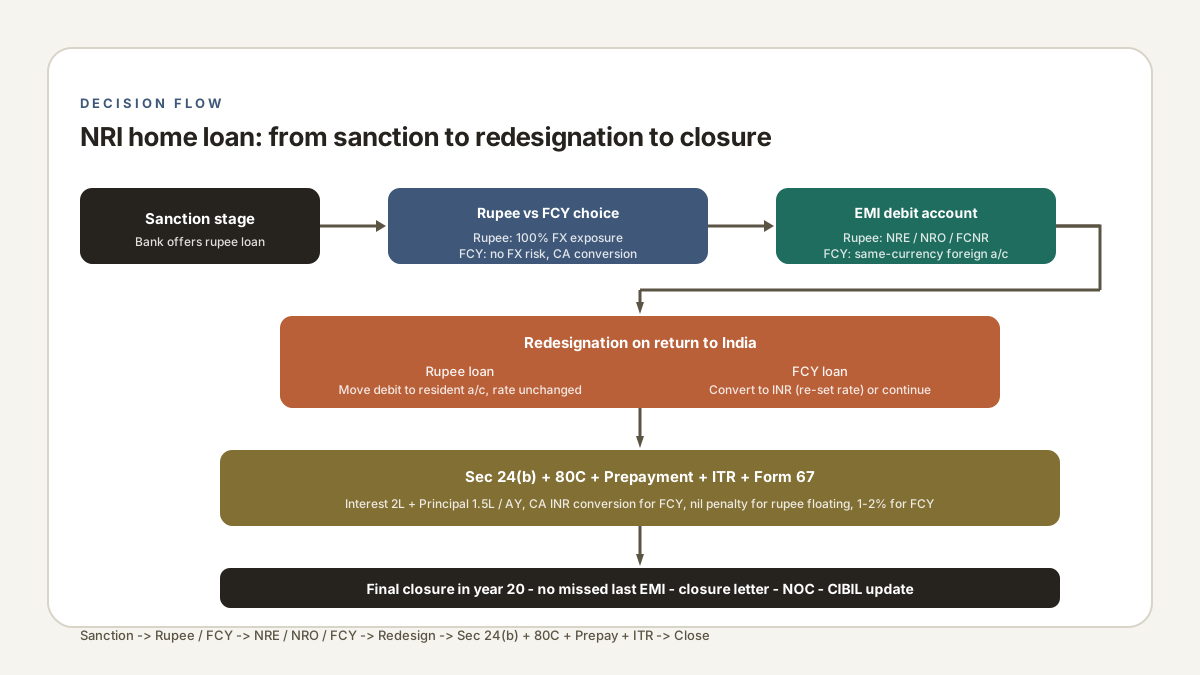
NRI home loan decision flow
Need help with Tax & Residency?
Share your blocker in one line. Our experts will reply with practical next steps.
NRI home loan -> redesignation -> closure: the five-layer stack
The prepayment penalty trap on FCY loans is the most common avoidable cost
Floating-rate rupee home loans to individual borrowers are penalty-free for partial or full prepayment under the RBI 2014 directive. This is well-known. What is less well-known: FCY home loans often carry a 1% to 2% prepayment penalty even on floating-rate loans, because the FCY loan is treated as a 'FCY asset' rather than a standard rupee home loan. On a USD 100,000 partial prepayment, a 2% penalty is USD 2,000 — wiped out by the interest saved only if the prepayment is made in years 3 to 7 of the loan. Before any prepayment, read the sanction letter clause 12 / clause 14, get a written prepayment quote from the bank, and compare the penalty to the interest saved using a fresh amortization schedule. Many banks will waive the penalty on negotiation, especially if you have a clean repayment history and a strong credit score.
Animated decision map

Community signal
What to watch in real discussions
Treat repeated complaints as risk signals rather than official advice. This page does not link to community search results.
Interactive checkpoint
Turn this guide into a decision file
0 of 4 checked
Should I take a rupee or FCY home loan as an NRI?
It depends on the currency of your income, the loan tenure, and the expected rupee trajectory. For US-based NRIs paid in USD, an FCY USD loan removes the FX exposure entirely and is typically 10% to 30% cheaper over 20 years, despite a 0.25% to 1.0% higher headline rate. For UAE-based NRIs paid in AED (pegged to USD), the same logic applies. For UK-based NRIs paid in GBP, an FCY GBP loan is the cleanest. For rupee-income NRIs (rare but possible — overseas Indian who is paid by an Indian company), a rupee loan is the natural choice. The decision must be made at the sanction-letter stage, not after disbursement. The bank will default to a rupee loan — insist on a written FCY comparison.
Can I claim Section 24(b) and Section 80C deductions on an FCY home loan?
Yes. The Section 24(b) deduction for interest is capped at Rs 2 lakh per AY for self-occupied property and the full interest for let-out property. The Section 80C deduction for principal is capped at Rs 1.5 lakh per AY within the overall 80C limit. For an FCY loan, the foreign-currency interest and principal are converted to INR by a chartered accountant at the RBI reference rate on each EMI date — the conversion is done EMI-by-EMI, not at a single year-end rate. The bank issues an annual interest certificate in foreign currency, and the CA adds the INR conversion. This is recoverable, but the CA cost (typically Rs 5,000 to Rs 15,000 per year) is the price of the cleanest execution.
What happens to my home loan when I return to India and become a resident?
For a rupee loan: the loan is already in INR, no redesignation is needed. The EMI debit moves from NRE / NRO to a resident savings account. The bank may require a fresh KYC, a fresh Indian address proof, a fresh PAN / Aadhaar linkage, and a fresh income proof. The interest rate is unchanged. Section 24(b) + 80C deductions can be claimed from the AY of return onwards. For an FCY loan: the bank may offer conversion to an INR loan (with a re-set interest rate, often at the prevailing floating benchmark plus the standard margin) or continuation as an FCY loan with the EMI debited from a foreign-currency account that you still maintain abroad. The decision is irreversible for the loan tenure. Most banks require the conversion within 6 to 12 months of becoming a resident. Get a written comparison before signing the redesignation letter.
Is there a prepayment penalty on a floating-rate home loan?
For floating-rate rupee home loans to individual borrowers: nil, under the RBI 2014 directive. The bank cannot charge a prepayment penalty. For fixed-rate rupee loans: typically 2% to 4% of the outstanding principal. For FCY home loans (floating or fixed): 1% to 2% is common, even for floating-rate loans, because the FCY loan is treated as a 'FCY asset'. The penalty is set in the sanction letter clause 12 / clause 14. Read it before signing. Many banks will waive the FCY penalty on negotiation, especially for borrowers with a clean repayment history and a strong credit score.
Do I need to disclose my Indian home loan in Schedule FA?
Schedule FA disclosure is for foreign assets held by an Indian resident. An Indian home loan is a liability, not an asset, so it is not disclosed in Schedule FA. The loan is disclosed in the Indian assets and liabilities schedule of the ITR (Schedule AL — Assets and Liabilities, mandatory if the total income exceeds Rs 50 lakh). For an FCY home loan, the foreign-currency outstanding is converted to INR at the RBI reference rate on the date of the ITR. If you have a foreign-currency mortgage (e.g. a US mortgage on a US property), that is also a foreign liability and is disclosed in Schedule FA with the country, the lender, the peak balance during the FY, and the interest paid during the FY.
What is the worst-case scenario if I take a rupee loan without thinking about FX?
Three things can go wrong: (1) the rupee weakens 30% to 50% over the 20-year loan tenure, and the dollar cost of paying the rupee EMI rises by the same amount — on a Rs 1 crore loan with a 50% rupee weakening, the cumulative extra cost in dollars is approx Rs 50 lakh to Rs 1 crore over 20 years. (2) The bank redesignates the loan on return to India at a higher rate than the original (the redesignation clause allows the bank to re-set the rate at the prevailing benchmark plus margin, which may be 0.5% to 1.5% higher than the original). (3) The FCY loan, if chosen at the start, would have saved the FX exposure entirely. Each of these is fixable only by taking the right loan at the start, not by amendment later. The cleanest plan is a written rupee vs FCY comparison, with the FX-risk-adjusted cost, before signing the sanction letter.
Your tax year is already running.
RNOR status, exit timing, and DTAA benefits all depend on decisions you make before you land. Don't guess.