Buying Property in India as an NRI: FEMA rules, payment routes, TDS sections, and the 2026 execution sequence
A practical 2026 guide for NRIs buying residential or commercial property in India: FEMA 1999 permissibility, NRE vs NRO funding, Liberalised Remittance Scheme (LRS)...
The 60-second version
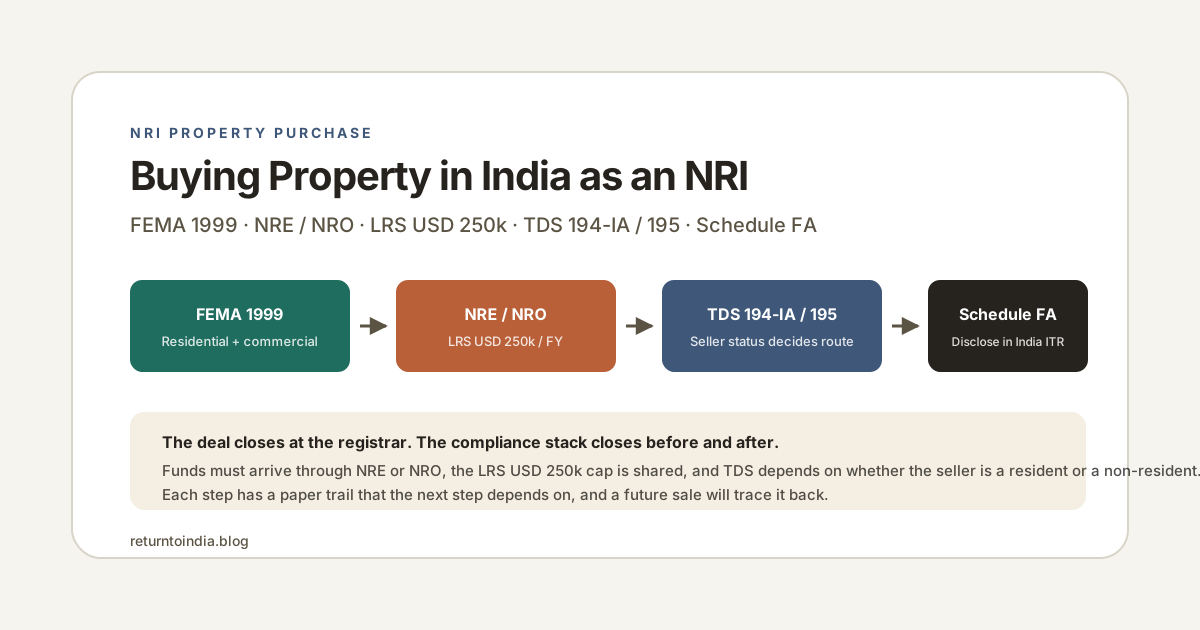
Most NRI property purchases in India do not fail on selection, due diligence, or registration — they fail on the money movement. NRI buyers can legally buy residential and commercial property in India under FEMA 1999, but the payment must come from an NRE or NRO account via a regulated banking channel, the TDS treatment depends on whether the seller is a resident or non-resident, and repatriation of sale proceeds later is capped and documented. The order is fixed, and each step has a deliverable.
Why NRI property purchase is a FEMA problem, not a real-estate problem
An NRI can buy most residential and commercial property in India under FEMA 1999. The permission is broad, but the mechanics of moving money in, deducting tax, registering the title, and later moving sale proceeds out are not. The property transaction looks like a real-estate deal on the surface, but the underlying machinery is foreign-exchange regulation plus Indian income-tax law plus RBI repatriation rules.
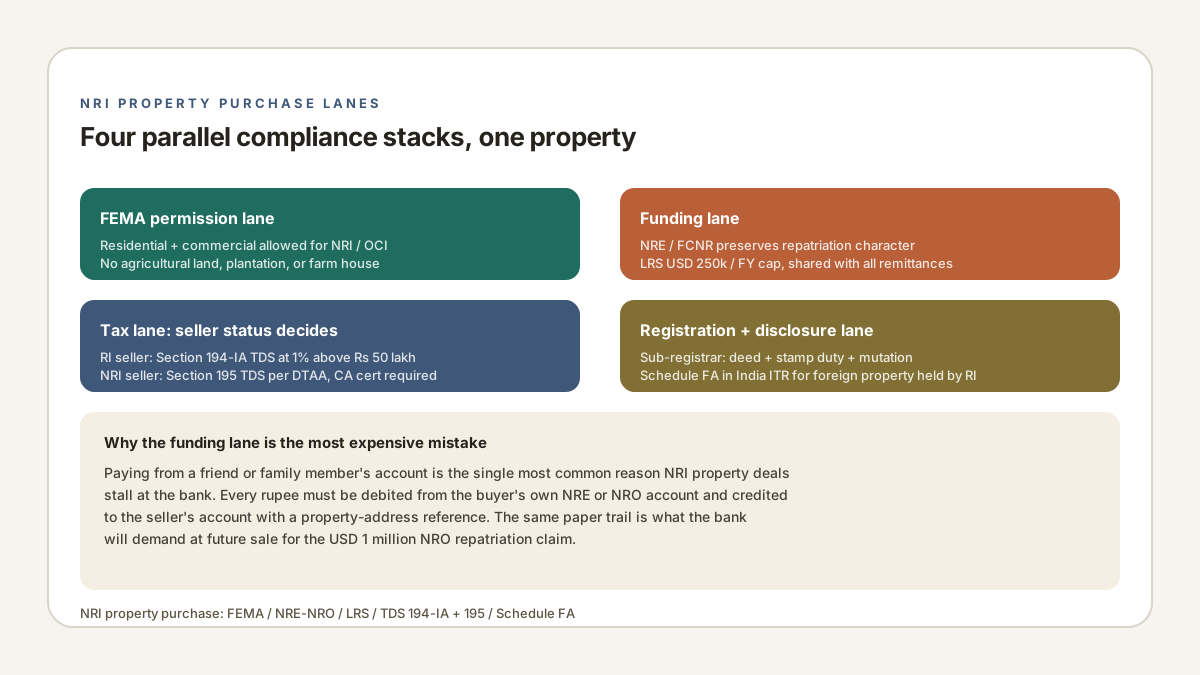
The four rules that bind almost every NRI purchase: (1) the funds must arrive in India through a regulated banking channel — NRE, NRO, FCNR, or a direct SWIFT to the seller — and the paper trail must be airtight; (2) the LRS cap of USD 250,000 per financial year governs how much you can remit from abroad for the purchase, and it is shared with education, travel, and other personal remittances; (3) TDS depends on the seller's status — Section 194-IA for a resident seller, Section 195 for a non-resident seller, with different rates, thresholds, and compliance; (4) agricultural land, plantation property, and farm houses cannot be bought by foreign persons at all, even as NRI. Most failed purchases are not stopped at the registrar; they are stopped at the bank, the tax officer, or the repatriation desk years later.
NRI vs PIO vs foreign citizen: who can buy what in India
FEMA 1999 distinguishes NRIs, PIOs, and foreign nationals. The property rights and the money-movement rules are different for each category.
| Property type | NRI / OCI | PIO (non-NRI) | Foreign citizen / non-OCI | Practical note |
|---|---|---|---|---|
| Residential property (flat, house, plot) | Yes — freely, no RBI approval | Yes — freely, no RBI approval | No — generally not permitted except under very narrow conditions | OCI is treated as NRI for property purchase; non-OCI foreign citizens face the strictest restrictions. |
| Commercial property (office, shop, warehouse) | Yes — freely, no RBI approval | Yes — freely, no RBI approval | Generally no — requires specific RBI approval under the FDI route | Commercial property has its own FDI rules; consult a CA for cross-border structures. |
| Agricultural land, plantation property, farm house | No — Section 6(3)(i) prohibition | No — same prohibition | No — same prohibition | Cannot be purchased, inherited through direct purchase, or gifted from another foreign person. |
| Joint purchase with a Resident Indian (RI) relative | Yes — common and useful for housing and loan eligibility | Yes | Generally no | Joint purchase with a resident relative can simplify home-loan eligibility and future repatriation. |
| Funding source: NRE / FCNR account | Yes — for purchase and for direct SWIFT remittance | Yes | No NRE/FCNR; must use NRO or direct remittance | NRE funding preserves the repatriation character of the funds; NRO does not. |
| LRS cap of USD 250,000 per FY for purchase funds | Applies per financial year, shared with other personal remittances | Applies if remitting from abroad for purchase | Applies | The cap is per FY per remitter, not per property; a high-value purchase requires multi-year planning. |
| Repatriation of sale proceeds later | Up to USD 1 million per FY from NRO, with conditions | Same — up to USD 1 million per FY | Different — proceeds may have to remain in India or route through specific channels | Repatriation is conditional on the original funding having come from an NRE/FCNR or remitted through proper banking. |
Execution sequence: from property shortlist to registered title
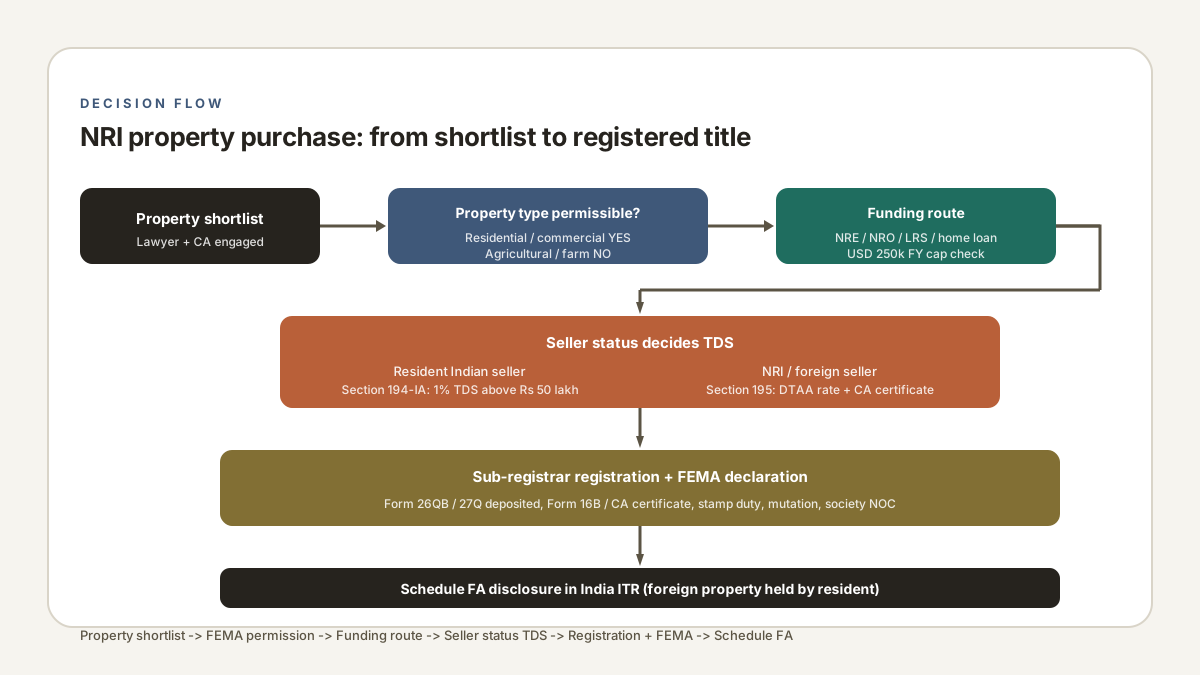
Plan the order. The FEMA, banking, and tax layers are not simultaneous — but they are interdependent, and an error in one is hard to fix after the next step has been taken.
Classify the property and the seller before any payment
Confirm the property is a permissible category under FEMA — residential or commercial, not agricultural / plantation / farm house. Confirm the seller's residential status: a Resident Indian seller triggers Section 194-IA TDS at 1% of the sale price above Rs 50 lakh; a Non-Resident seller triggers Section 195 TDS (rates depend on the DTAA, typically 12.5% to 31.2% on long-term capital gains) and requires a chartered-accountant certificate before remittance. The two TDS regimes are not interchangeable.
Decide the funding route: NRE, NRO, FCNR, or LRS remittance
If you are funding from foreign earnings parked in an NRE or FCNR account, you can transfer the rupee equivalent from NRE to the seller or to your NRO and then to the seller — both routes preserve the repatriation character. If you are remitting fresh funds from abroad, the remittance counts against the LRS cap of USD 250,000 per FY. Do not fund the purchase from a non-resident friend's account or a third-party wire — banks will reject the credit and the seller will lose the booking.
Engage a property lawyer and a chartered accountant before signing
A property lawyer verifies title, encumbrances, society NOC, and RERA registration; a chartered accountant verifies the TDS treatment, the LRS cap impact, and the repatriation plan for the future sale. Both are cheaper than fixing a title defect or a tax-default later. For high-value purchases (above Rs 1 crore), the lawyer fee is typically Rs 50,000 to Rs 2,00,000 and the CA fee for tax structuring is Rs 30,000 to Rs 1,00,000 — modest relative to the purchase price.
Sign the agreement and pay the token / earnest money from an NRE or NRO account
Every rupee paid during the transaction should be debited from your NRE or NRO account and credited to the seller's bank account, with a clear reference to the property address and agreement number. Do not pay the token in cash, in foreign currency, or from a third-party account. The bank will demand these receipts at the time of final payment and at the time of future sale for repatriation.
Apply for a home loan from an Indian bank if needed (NRI eligibility)
Most Indian public-sector and private banks offer NRI home loans against salary income from the country of residence, typically up to 80% of property value for properties above Rs 30 lakh. The loan is sanctioned and disbursed in rupees, repaid in rupees (or in foreign currency by some banks, where the rupee liability is converted to foreign currency at the prevailing rate). Interest rates are 8.5% to 10.5% for most lenders, comparable to resident rates. The bank will require the agreement copy, property documents, your passport, visa, employment letter, salary slips, and a power-of-attorney in India if you are not personally present.
Deduct and deposit TDS before or at the time of registration
For a Resident Indian seller, deduct 1% TDS under Section 194-IA on the sale price above Rs 50 lakh (no TDS below the threshold), and deposit it to the central government using Form 26QB within 30 days of the end of the month in which the payment is made. Issue Form 16B to the seller within 15 days of TDS deposit. For a Non-Resident seller, deduct Section 195 TDS at the applicable rate, obtain a CA certificate under Section 195(2)/(3) for the rate, deposit using Form 27Q, and file the CA certificate with the income-tax department. The bank at remittance time will also demand the CA certificate before allowing the SWIFT.
Register the property at the sub-registrar with the FEMA declaration
At registration, the sub-registrar's office will ask for your passport, visa, PAN (mandatory for purchase above Rs 10 lakh in many states), Aadhaar (if available; not mandatory for NRI), and a declaration that the funds have come through banking channels. The registration fee is 1% to 7% of the property value depending on the state. The stamp duty is 3% to 8% depending on the state and the buyer's gender (many states offer 1% to 2% lower stamp duty for women buyers). After registration, collect the registered sale deed, the encumbrance certificate, the society NOC, and the mutation entry.
Disclose the property in Schedule FA of the Indian ITR and plan for future sale
After the purchase, disclose the property in Schedule FA (Foreign Assets) of the Indian ITR for the year of purchase if you are an Indian resident, including the country, address, acquisition date, and acquisition value in INR. Failure to disclose a foreign property can attract a Rs 10 lakh penalty under Section 42 of the Black Money Act, 2015. Plan the future sale: if the property was funded from NRE/FCNR or LRS remittance, the original investment is repatriable on sale (subject to the USD 1 million per FY cap from NRO plus the original NRE/FCNR principal), and the capital-gains computation uses the rupee cost basis plus indexed upward.
Document checklist before the agreement is signed
Most NRI property purchases are disrupted by missing documents at the agreement stage. Confirm each item before paying earnest money.
- Title search report for at least 30 years from a property lawyer, including encumbrance certificate.
- RERA registration number and project details for under-construction properties (mandatory under RERA 2016 for projects registered after 2017).
- Society / apartment owners' association NOC and share certificate transfer process.
- Tax-paid receipts and TDS deposit challans for the seller (especially for properties recently transacted).
- Seller's PAN (mandatory for any property transaction above Rs 10 lakh) and Aadhaar (if seller is resident).
- Your PAN, passport, visa or OCI card, and a recent Indian address proof.
- Loan sanction letter and disbursement schedule if you are using an NRI home loan.
- Power-of-attorney (POA) document in favour of a representative in India if you will not be personally present at registration. The POA must be specific to the property, executed on stamp paper as required, and notarized / apostilled by the Indian consulate in the country of residence.
- NRE or NRO account statement showing sufficient balance for the purchase (the bank will ask).
- LRS utilisation certificate from your remitting bank for the FY of purchase, if applicable.
- A written agreement with the seller on TDS treatment — Section 194-IA (1% for RI seller) or Section 195 (rate per DTAA for NRI seller) — and who bears the TDS.
NRI property purchase decision flow
Need help with Tax & Residency?
Share your blocker in one line. Our experts will reply with practical next steps.
NRI property purchase -> registered title: the five-layer stack
The LRS USD 250,000 cap is shared across all personal remittances
The USD 250,000 Liberalised Remittance Scheme cap is a per-FY, per-remitter limit that is shared across all personal remittances: property purchase, education, travel, medical treatment, gifts, and maintenance of close relatives. A family that remits USD 200,000 for a child's US university fees and then USD 100,000 for a property purchase in the same FY will exceed the cap and the bank's SWIFT desk will reject the second remittance. The fix is to plan the FY in advance, split high-value purchases across two FYs, or fund the property from existing NRE/FCNR balances (which do not count against the LRS cap because the original remittance into NRE/FCNR already used the cap at the time of the original credit).
Animated decision map

Community signal
What to watch in real discussions
Treat repeated complaints as risk signals rather than official advice. This page does not link to community search results.
Interactive checkpoint
Turn this guide into a decision file
0 of 4 checked
Can an NRI buy any type of property in India?
No. FEMA 1999 prohibits NRIs (and all foreign persons) from purchasing agricultural land, plantation property, and farm houses. NRIs and OCIs can freely buy residential and commercial property, including through a power of attorney. Foreign citizens who are not OCI face the strictest restrictions and generally cannot buy property in India except under specific RBI approvals. Joint purchase with a Resident Indian relative is allowed and is the most common family structure.
Should I pay from an NRE or NRO account for the property?
Use NRE if the funds originated as foreign earnings — NRE preserves the repatriation character of the funds, and on a future sale the original investment (plus a cap) can be repatriated back to a foreign account more easily. Use NRO only if the funds were already in India (rental income, prior Indian investments) or if you have no NRE account. The choice at purchase determines your flexibility at sale. Most NRIs fund the down payment from NRE and the home-loan EMI from NRO (because the EMI is in rupees and the salary credit may be in NRO).
How is TDS handled when the NRI buys from a Resident Indian seller?
The buyer deducts TDS under Section 194-IA at 1% of the sale price above Rs 50 lakh (no TDS on the first Rs 50 lakh). For example, a property bought for Rs 1.2 crore attracts TDS on Rs 70 lakh = Rs 70,000. The TDS is deposited using Form 26QB within 30 days of the end of the month in which the payment is made, and Form 16B is issued to the seller within 15 days. The seller claims this TDS as credit in their Indian ITR. The buyer is treated as a deductor, not a taxpayer, in this scenario.
How is TDS handled when the NRI buys from another NRI or foreign seller?
The buyer deducts TDS under Section 195, which is the general TDS provision for payments to non-residents. The rate depends on whether the gain is short-term or long-term and on the India-side DTAA with the seller's country. For long-term capital gains (held > 24 months), the rate is typically 12.5% to 31.2% depending on DTAA, computed on the indexed gain. A chartered accountant's certificate under Section 195(2) or 195(3) determines the exact rate. The TDS is deposited using Form 27Q within 30 days, and the CA certificate is filed with the income-tax department. The bank at remittance time will also demand this certificate before allowing the SWIFT credit.
Do I need to disclose the Indian property in my ITR if I am an Indian resident?
Yes. Schedule FA (Foreign Assets) of the Indian ITR requires Indian residents to disclose foreign bank accounts, foreign financial interests, foreign equity / debt interests, and foreign immovable property. An Indian property that you bought while you were an NRI and still own after you became a resident must be disclosed if you became a resident and the property is held through a foreign structure. If the property is held directly in your name as an Indian resident, it is disclosed under the Indian assets schedule, not Schedule FA. The disclosure rules are complex; consult a chartered accountant if you have a cross-border ownership structure.
What is the worst-case scenario if I buy without planning the money route?
Three things can go wrong: (1) the bank rejects the credit because the funds came from a third-party account or an unauthorised channel, delaying or cancelling the registration. (2) The TDS is not deducted or is deducted at the wrong rate, leading to a tax demand on the buyer plus interest and penalty, and a separate demand on the seller for non-credit of TDS. (3) On future sale, the original investment is not repatriable because the funding paper trail is broken — the USD 1 million NRO cap cannot be claimed without evidence of the original NRE/FCNR credit or LRS remittance. Each of these is fixable, but the cost is Rs 5 lakh to Rs 50 lakh in additional tax + penalties, plus 2 to 3 years of audit and reassessment. The cleanest plan is a property lawyer + a chartered accountant, engaged as soon as the property is shortlisted, not at registration.
Your tax year is already running.
RNOR status, exit timing, and DTAA benefits all depend on decisions you make before you land. Don't guess.