NRI Direct Equity Investing in India: PIS permission letter, demat account, STT + Section 115E concession, and the redesignation on return to India
A practical 2026 guide for NRIs and returning NRIs investing in Indian listed equities directly: RBI Portfolio Investment Scheme (PIS) permission letter from an...
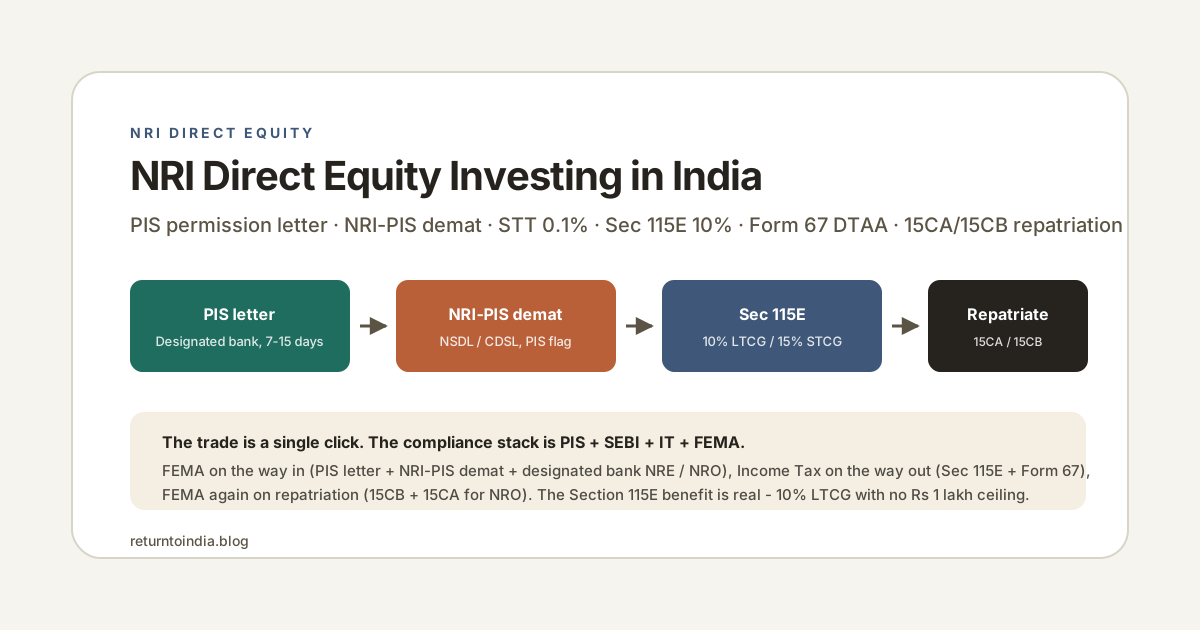
The 60-second version
Direct equity investing in India by an NRI is a different compliance stack from mutual fund investing. It requires a separate RBI Portfolio Investment Scheme (PIS) permission letter from an Indian bank, a separate NRI demat account, a separate NRI bank account for the trading, a Section 115E concessional tax rate (10% on long-term gains, 15% on short-term) versus the resident schedule, a STT (securities transaction tax) of 0.1% on the buy and sell, and a separate Form 15CA / 15CB for the repatriation of the sale proceeds. The order is fixed; the deliverables are not optional.
Why NRI direct equity is a separate compliance stack from mutual funds
Indian listed equities can be bought by an NRI in two distinct lanes: the mutual fund lane (non-PIS, covered in a separate article) and the direct equity lane (PIS - Portfolio Investment Scheme, RBI-regulated). The mutual fund lane is the default because it requires only the SEBI KYC + FATCA / CRS declaration and the bank mapping on the folio, with no separate bank permission. The direct equity lane is more complex because every equity purchase and sale must be cleared through a designated bank that has issued a PIS permission letter, the demat account must be flagged as 'NRI - PIS' rather than 'Resident', and the trade settlement is routed through the NRI's NRE or NRO account at the same designated bank. The two lanes cannot be mixed on the same demat account - an attempt to buy an equity directly without the PIS flag will be rejected by the depository, and an attempt to buy a mutual fund on a PIS-flagged demat account is over-engineered for the use case.
The direct equity lane has its own tax treatment under Section 115E of the Income Tax Act, which is more favourable than the resident schedule for most NRI taxpayers. Long-term capital gains (held > 12 months) on listed equity are taxed at 10% (vs 10% above Rs 1 lakh for resident under Section 112A), and short-term capital gains (held <= 12 months) are taxed at 15% (vs 15% for resident under Section 111A). The concessional rate under Section 115E is available only on income from 'foreign-currency assets' (assets acquired in foreign currency or from foreign-currency funds), which is the natural case for most NRI direct equity portfolios funded through NRE remittances. The catch: Section 115E must be claimed in the ITR for the AY of the sale, and the deduction under Section 206AA (30-50% higher TDS) still applies if PAN is not linked to Aadhaar. The cleanest plan is to obtain the PIS permission letter before the first trade, mirror the demat-account and bank-account setup, and complete the PAN-Aadhaar linkage before the first sale.

NRI direct equity vs mutual fund: investment lane, tax, and repatriation
FEMA + SEBI distinguish two investment lanes for NRIs (PIS for direct equity vs non-PIS for mutual funds), two bank-account mapping options (NRE vs NRO), and two capital-gains tax schedules (Section 115E concessional for NRI direct equity vs Section 111A / 112A resident schedule for mutual funds).
| Decision | Direct equity (PIS) | Mutual fund (non-PIS) | What clean execution looks like | What usually goes wrong |
|---|---|---|---|---|
| Investment lane (PIS vs non-PIS) | PIS - Portfolio Investment Scheme for listed equity / IPOs / ETFs (requires PIS permission letter from a designated bank + separate NRI demat account flagged as PIS) | Non-PIS - mutual funds (equity, debt, hybrid), no PIS permission required, fund-house KYC is enough | Use PIS only for direct listed equity. Use non-PIS for mutual funds. Most NRI investors use both lanes but on separate demat accounts. | Trying to route direct equity purchases through a non-PIS demat triggers a depository rejection. Trying to buy mutual funds on a PIS demat is over-engineered. |
| Bank-account setup | NRE or NRO account at the designated bank that issued the PIS permission letter. Trade settlement is debited from this account. | NRE or NRO account at any bank. SIP / lumpsum debit is from the mapped account on the folio. | Open the PIS bank account at the same designated bank that will issue the PIS permission letter. Trade settlement is smoother when the demat, bank, and broker are at the same institution. | Opening the PIS bank account at a different bank from the broker leads to settlement delays and failed trades. |
| Demat account | Separate NRI demat account flagged as 'NRI - PIS' at the depository participant (NSDL or CDSL). Resident demat cannot be used for direct equity. | NRI demat account (or no demat for non-equity funds). Most fund folios are statement-based, no demat needed. | Open the NRI-PIS demat at the same depository participant as the broker, with the same PAN, and the same NRE / NRO bank account mapped for settlement. | Mixing PIS and non-PIS holdings on the same demat triggers a depository flag and a forced reclassification. |
| Securities Transaction Tax (STT) | STT 0.1% on the buy and 0.1% on the sell for delivery-based equity; 0.025% on futures; 0.05% on options premium | STT 0.001% on equity mutual fund redemption (Section 98 STT) | STT is automatic - deducted by the exchange / depository on the transaction. STT paid is allowed as a deduction from the capital gain on sale. | Forgetting the STT adjustment in the capital-gains computation. The deduction is small (Rs 100 to Rs 1,000 per trade) but the cumulative effect is real. |
| Capital-gains tax (NRI schedule) | Section 115E: 10% LTCG (held > 12 months) on listed equity, 15% STCG (held <= 12 months). Available only on foreign-currency assets. | Section 111A: 15% STCG (held <= 12 months). Section 112A: 10% LTCG (held > 12 months) above Rs 1 lakh per FY. | Section 115E is more favourable than the resident schedule for most NRI taxpayers. The benefit is the 10% LTCG without the Rs 1 lakh exemption ceiling. | Claiming the resident schedule (Section 111A / 112A) instead of Section 115E. The NRI schedule is the default for foreign-currency assets - the resident schedule is the exception. |
| TDS on sale (Section 206AA) | No TDS by the buyer on listed equity sale (the exchange handles STT, not TDS). The NRI pays via self-assessment in the ITR. | No TDS by the fund house on equity-fund capital gains. The NRI pays via self-assessment in the ITR. | Section 206AA 30-50% higher TDS does not apply on equity-sale proceeds (no TDS on equity sales). It does apply on dividend income, interest income, and any other TDS-able payment. | Confusing TDS on equity-sale with TDS on dividend. They are different transactions. Dividend income from Indian companies is subject to 20% TDS under Section 196D for NRIs. |
| Repatriation of sale proceeds | Sale proceeds are credited to the NRI demat account and then to the NRE / NRO bank account. Repatriation to a foreign account requires Form 15CA + 15CB and is capped at USD 1 million per FY under LRS for NRO mapping. | Redemption proceeds are credited to the mapped NRE / NRO bank account. Repatriation is via Form 15CA + 15CB under USD 1 million per FY LRS cap for NRO mapping. | Match the demat and bank mapping to the source of the funds. Most NRI direct equity portfolios are funded from NRE remittances, so the proceeds can be repatriated freely from NRE. | Selling equity that was bought with NRO funds and trying to repatriate freely. The NRO funds are capped at USD 1m / FY LRS. |
| Redesignation to resident on return to India | PIS permission letter must be surrendered to the designated bank. The NRI demat account is redesignated as a resident demat. The NRE / NRO bank account is redesignated as a resident savings account. Section 115E benefit ends from the AY of return. | Mutual fund KYC is redesignated from NRI to resident. The folios continue to be held, but the tax treatment changes from Section 115E to the resident schedule. | Coordinate the redesignation with the designated bank, the depository participant, the broker, and the fund house. Each requires a fresh KYC and a fresh bank-account mapping. | Forgetting to surrender the PIS permission letter. The bank will continue to flag the demat as PIS, and any new buy orders will be rejected. |
Execution sequence: from foreign earnings to invested Indian listed equity
Plan the order. The PIS permission letter, the NRI demat account, the bank-account setup, the PAN-Aadhaar linkage, and the IT registration are not simultaneous — but they are interdependent, and an error in one is hard to fix after the demat is funded and the portfolio is held.
Open the NRE or NRO account at the bank that will issue the PIS permission letter
The PIS permission letter is issued by a 'designated bank' - a list of authorised banks maintained by the RBI for this purpose (most large public-sector and private banks are on the list). Open an NRE or NRO account at the chosen designated bank, with the foreign passport + OCI booklet + Indian address proof + PAN. The bank will issue a separate PIS permission letter, typically within 7-15 days of the account opening, with a unique PIS number that is mapped to the demat account. The PIS letter is the entry point - without it, no broker will accept the demat account for direct equity trading.
Complete SEBI KYC + FATCA / CRS declaration at the KRA level
Submit KYC documents (PAN, passport, visa or OCI card, Indian or overseas address proof, recent photograph, bank account proof) to a KYC Registration Agency (KRA) - CVL, NDML, Karvy, etc. Include the FATCA / CRS declaration: country of tax residence, TIN, and a statement on whether you are a US person. US-person NRIs cannot skip FATCA. Once KRA registration is done, your CKYC number mirrors across all SEBI-registered intermediaries (broker, depository participant, registrar).
Open the NRI-PIS demat account at the depository participant (NSDL or CDSL)
Open a separate demat account at the depository participant (NSDL or CDSL) - typically the brokerage arm of the same bank that issued the PIS letter. The demat must be flagged as 'NRI - PIS' rather than 'Resident'. The flag is set at the depository level and is irreversible without a fresh account opening. Map the same NRE or NRO account that was opened at the designated bank for trade settlement. Do not use a resident demat account for direct equity - the depository will reject the trade.
Link PAN with Aadhaar before the first trade (or first sale)
Complete the PAN-Aadhaar linkage via the e-filing portal with the Rs 1,000 fee (post-2024 regime). Without the linkage, the PAN is treated as inoperative under Section 139AA, and Section 206AA 30-50% higher TDS applies on any TDS-able payment (dividend, interest, etc.). For a US-person NRI, FATCA will also require the broker to report the account information to the IRS, and the absence of a TIN can trigger additional withholding.
Start trading through the broker on the PIS-flagged demat account
Open a trading account with a broker that supports NRI-PIS direct equity (most large discount and full-service brokers do). The trading account is linked to the NRI-PIS demat and the designated bank. The first trade should be small (Rs 10,000 to Rs 50,000) to confirm the full stack works: the broker accepts the demat, the bank clears the trade, the STT is deducted, the shares are credited to the demat, and the trade confirmation is received. Once the first trade is confirmed, the stack is operational.
Track holding period and STT paid for the capital-gains computation
For Section 115E LTCG (10%), the holding period is 12 months from the date of acquisition. STT paid on the buy and the sell is allowed as a deduction from the capital gain. The cost basis for an NRI funded from NRE is the rupee equivalent of the foreign-currency remittance on the date of the trade, converted at the RBI reference rate. The sale price is the rupee equivalent of the sale proceeds on the date of settlement, converted at the RBI reference rate. The chartered accountant computes the gain in INR, applies the appropriate DTAA treaty rate if any, and files Form 67 for the foreign tax credit.
On redemption or sale, compute Section 115E tax, file ITR, claim Form 67 DTAA relief
At sale, the broker does not deduct TDS on listed equity sale (STT is the only tax deducted at the exchange level). The NRI pays via self-assessment in the ITR for the AY of the sale. Apply Section 115E for foreign-currency assets: 10% LTCG (> 12 months) or 15% STCG (<= 12 months). Claim DTAA relief via Form 67 if the country of residence taxes the same gain (e.g. US-India DTAA - the IRS taxes the gain on a worldwide basis; the NRI can claim a US foreign tax credit for the Indian tax paid, capped at the US-tax attributable to the Indian gain). File the ITR for the AY of the sale by July 31 of the following year (or December 31 if a tax audit is required).
Repatriate the net proceeds via Form 15CA + 15CB (if NRO mapping)
If the sale proceeds are credited to an NRO account, repatriation to a foreign account is capped at USD 1 million per FY under the Liberalised Remittance Scheme. Each remittance requires Form 15CA (self-declaration by the remitter) and Form 15CB (chartered-accountant certificate confirming the India-tax treatment of the remittance). The chartered-accountant certificate determines whether the remittance is a capital-repatriation, a current-income remittance, or a gift, and the tax rate applied. Banks will reject the SWIFT if the 15CA / 15CB is missing or inconsistent with the LRS cap. NRE mapping does not require 15CA / 15CB for repatriation - the proceeds can be freely transferred back to a foreign account.
On returning to India, redesignate the demat and surrender the PIS permission letter
When you become an Indian resident, the PIS permission letter must be surrendered to the designated bank. The NRI demat account is redesignated as a resident demat (the PIS flag is removed). The NRE / NRO bank account is redesignated as a resident savings account. The broker is notified of the change. Section 115E benefit ends from the AY of return - the capital-gains tax on future sales is computed under the resident schedule (Section 111A / 112A). Schedule FA disclosure is required for the foreign equity holdings during the NRI period, with the country of the depository, the units, and the peak value in INR.
Document checklist before the first trade is placed
Most NRI direct equity investing failures are caused by missing or mismatched documents at the PIS letter or demat-opening stage. Confirm each item before the first trade.
- Foreign passport (all pages, including blank) - both the bio-page and the visa pages.
- OCI booklet (both sides) - required for the PIS permission letter and the demat account opening.
- PAN card - mandatory for any equity trade and for the PIS permission letter.
- Aadhaar letter or Aadhaar enrolment ID (the 14-digit number) - for the PAN-Aadhaar linkage under Section 139AA.
- PAN-Aadhaar linkage acknowledgement from the e-filing portal (post-Rs 1,000 fee payment) - without it, Section 206AA 30-50% higher TDS applies.
- Indian address proof (utility bill, rent agreement, society letter) - for the PIS letter and the demat KYC.
- NRE or NRO account statement at the designated bank that will issue the PIS letter - the bank will require this for the PIS letter issuance.
- Recent photograph (35mm x 35mm, white background, JPEG) and signature scan (JPEG or PNG) - for SEBI KYC and broker KYC.
- FATCA / CRS declaration - mandatory for all NRIs, especially US-person NRIs. Provide TIN for the country of tax residence (US TIN is the SSN or ITIN; UK TIN is the UTR; Canada TIN is the SIN).
- SEBI KYC Acknowledgement (KRA-registered) with CKYC number, or fresh KYC submission to the broker / depository participant.
- Power of attorney (POA) document in favour of a representative in India if you are not personally present for the PIS letter, demat opening, or first trade. The POA must be specific to the equity portfolio, executed on stamp paper, and notarized / apostilled by the Indian consulate in the country of residence.
- A written plan for the funding source (NRE remittance or fresh foreign remittance), the repatriation plan, and the redesignation trigger on return to India.
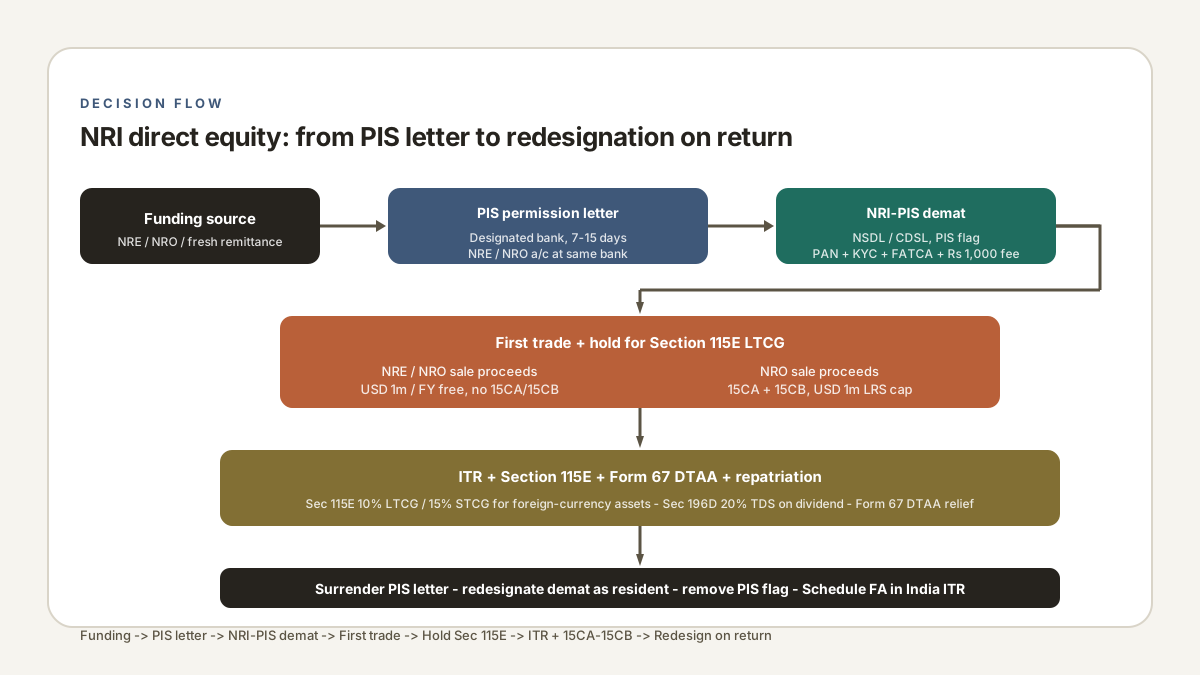
NRI direct equity investment decision flow
Need help with Tax & Residency?
Share your blocker in one line. Our experts will reply with practical next steps.
NRI direct equity -> redemption -> foreign account: the five-layer stack
Section 115E is the NRI concessional rate, but only for foreign-currency assets
Section 115E of the Income Tax Act, 1961, grants NRIs a concessional capital-gains tax rate: 10% on long-term capital gains (held > 12 months) from 'foreign-currency assets' and 15% on short-term capital gains. The benefit is available only on assets acquired in foreign currency or from foreign-currency funds - which is the natural case for most NRI direct equity portfolios funded through NRE remittances. The catch: the NRI must claim Section 115E in the ITR for the AY of the sale. If the ITR is filed under the resident schedule (Section 111A / 112A) by mistake, the higher tax applies, and the refund claim in the next AY takes 6-12 months to process. The other catch: Section 115E does not apply to dividend income from Indian companies, which is taxed at 20% under Section 196D for NRIs (vs 'nil' up to Rs 5,000 for resident under Section 115BBDA). The cleanest plan is to file the ITR with a CA-reviewed capital-gains computation, with Section 115E claimed for foreign-currency assets and Section 196D applied to dividend income.
Animated decision map

Community signal
What to watch in real discussions
Treat repeated complaints as risk signals rather than official advice. This page does not link to community search results.
Interactive checkpoint
Turn this guide into a decision file
0 of 4 checked
Do I need a separate PIS permission letter to invest in Indian listed equity?
Yes. The RBI Portfolio Investment Scheme (PIS) requires an NRI to obtain a PIS permission letter from a designated bank before any direct equity purchase. The letter is typically issued within 7-15 days of opening an NRE or NRO account at the designated bank, with a unique PIS number that is mapped to the demat account. Without the PIS letter, the broker will not accept the demat for direct equity trading, and any trade attempted through a non-PIS demat will be rejected by the depository. The PIS letter is the entry point for the direct equity lane and is separate from the SEBI KYC + FATCA / CRS declaration required for the mutual fund lane.
Can I use my existing resident demat account for direct equity as an NRI?
No. A resident demat account is flagged as 'Resident' at the depository level, and the depository will reject any equity purchase by a foreign person (NRI / OCI / PIO) on a resident demat. The NRI must open a separate NRI demat account flagged as 'NRI - PIS' at the depository participant (NSDL or CDSL). The flag is set at the depository level and is irreversible without a fresh account opening. The NRI-PIS demat is mapped to the NRE or NRO account at the designated bank for trade settlement, and the PIS permission letter from the designated bank is the prerequisite for the flag.
What is the capital-gains tax on NRI direct equity sales?
Under Section 115E of the Income Tax Act, 1961, NRI direct equity sales are taxed at 10% on long-term capital gains (held > 12 months) and 15% on short-term capital gains (held <= 12 months), provided the asset is a 'foreign-currency asset' (acquired in foreign currency or from foreign-currency funds). STT paid on the buy and the sell is allowed as a deduction from the capital gain. The cost basis is the rupee equivalent of the foreign-currency remittance on the date of the trade, converted at the RBI reference rate. The sale price is the rupee equivalent of the sale proceeds on the date of settlement, converted at the RBI reference rate. Section 206AA 30-50% higher TDS does not apply on equity-sale proceeds (no TDS on equity sales). The NRI must file the ITR for the AY of the sale and claim Section 115E - if the ITR is filed under the resident schedule (Section 111A / 112A) by mistake, the higher tax applies.
Do I need to disclose my Indian direct equity in Schedule FA?
Schedule FA disclosure is for foreign assets held by an Indian resident. If you held Indian listed equity while you were an NRI and the equity is still on the books at the time of becoming an Indian resident, the equity is an Indian asset, not a foreign asset - it is disclosed in the Indian assets schedule of the ITR (Schedule AL), not Schedule FA. If, however, you hold equity in a foreign-domiciled fund that invests in Indian stocks (e.g. a US-domiciled ETF that tracks the Nifty 50), that is a foreign asset and must be disclosed in Schedule FA with the country, the units, the peak value in INR during the FY, and the income derived. Failure to disclose foreign assets carries a Rs 10 lakh penalty under Section 42 of the Black Money Act, 2015, plus the tax + interest on the income.
Can I repatriate my direct equity sale proceeds to a foreign account?
Yes, but the route depends on the bank mapping. NRE mapping: free repatriation, no FEMA cap, no Form 15CA / 15CB required. NRO mapping: USD 1 million per FY cap under LRS, and each remittance requires Form 15CA + Form 15CB. The chartered-accountant certificate under Form 15CB confirms the India-tax treatment of the remittance and is filed with the income-tax department. Banks will reject the SWIFT if the 15CA / 15CB is missing, inconsistent, or if the LRS cap is exhausted. For a US-person NRI, the remittance may also attract US tax-reporting obligations on the foreign account, and the capital gain on the equity sale is taxed on a worldwide basis by the IRS (with a US foreign tax credit for the Indian tax paid via Form 67).
What is the worst-case scenario if I invest without the PIS permission letter?
Three things can go wrong: (1) the broker rejects the trade, the funds are debited from the bank account but the shares are not credited to the demat, and the NRI has to unwind the failed trade with a manual reconciliation at the bank. (2) The depository flags the NRI demat as 'Resident' and forces a reclassification, requiring a fresh NRI-PIS demat and a transfer of holdings. (3) On returning to India, the PIS permission letter is not surrendered to the designated bank, the demat continues to be flagged as PIS, and any new buy orders are rejected. Each of these is fixable, but the cost is Rs 50,000 to Rs 2,00,000 in failed trade unwind costs, demat reclassification costs, and CA fees, plus 2-3 years of audit and reassessment. The cleanest plan is a chartered-accountant-reviewed PIS setup, with the PIS letter issued before the first trade, the NRI-PIS demat opened at the same designated bank, and the PAN-Aadhaar linkage completed before the first sale.
Your tax year is already running.
RNOR status, exit timing, and DTAA benefits all depend on decisions you make before you land. Don't guess.