OCI Renewal 2026: e-OCI Fees, Photo, Portal Mistakes
OCI renewal fees, 35×35 photo, Missions portal flow, then download the e-OCI QR PDF — avoid the 5 delays that cost 6–12 months.
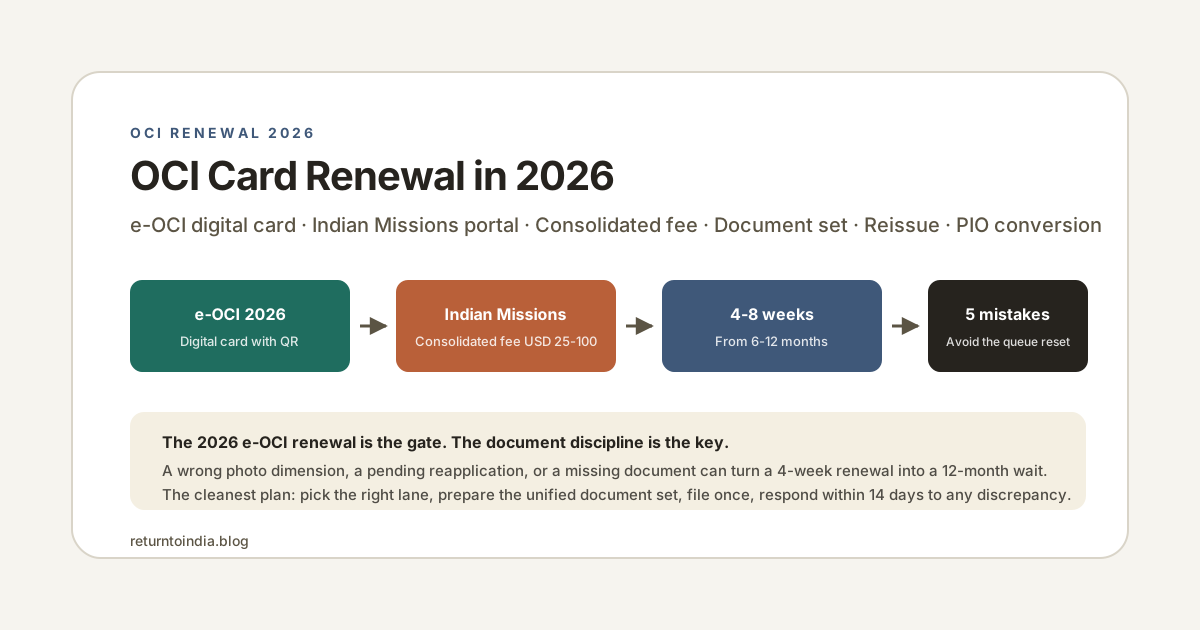
The 60-second version
I renewed OCI twice — once the slow way and once after the June 2026 e-OCI launch. The digital card cut my wait from months to weeks, but three rules still decide first-attempt success: correct 35×35mm photo, no duplicate application while one is pending, and downloading the QR PDF the day it issues. Start six months before expiry, not after.
Why OCI renewal is the gate every returning NRI must pass through (and why 2026 changed it)
Every overseas citizen of India (OCI) — whether they are a former Indian citizen who acquired foreign nationality, a Person of Indian Origin (PIO) cardholder, or the spouse or child of an OCI — must renew the OCI card or booklet periodically. The OCI card is the document that grants lifetime visa-on-arrival to India, exemption from FRRO / FRO registration for any stay under 180 days, and parity with NRIs for most economic activity (banking, property purchase, mutual fund investment, education). A lapsed, lost, or rejected OCI renewal can turn a 2-week India visit into a 6-month paperwork grind, and can leave the family stranded on a tourist visa with limited banking and property rights.
The 2026 changes are the most significant in a decade. On 30 June 2026, MHA launched the e-OCI digital card — a verifiable QR credential accepted at immigration alongside your physical booklet. I keep both until a bank or consulate tells me otherwise. The Indian Missions portal now uses one consolidated fee instead of the old four-fee stack, the application is fully online, and average processing dropped from 6–12 months to 4–8 weeks. A four-person family saves roughly USD 200–400. Start renewal at least six months before expiry, not after a pending application stalls you.
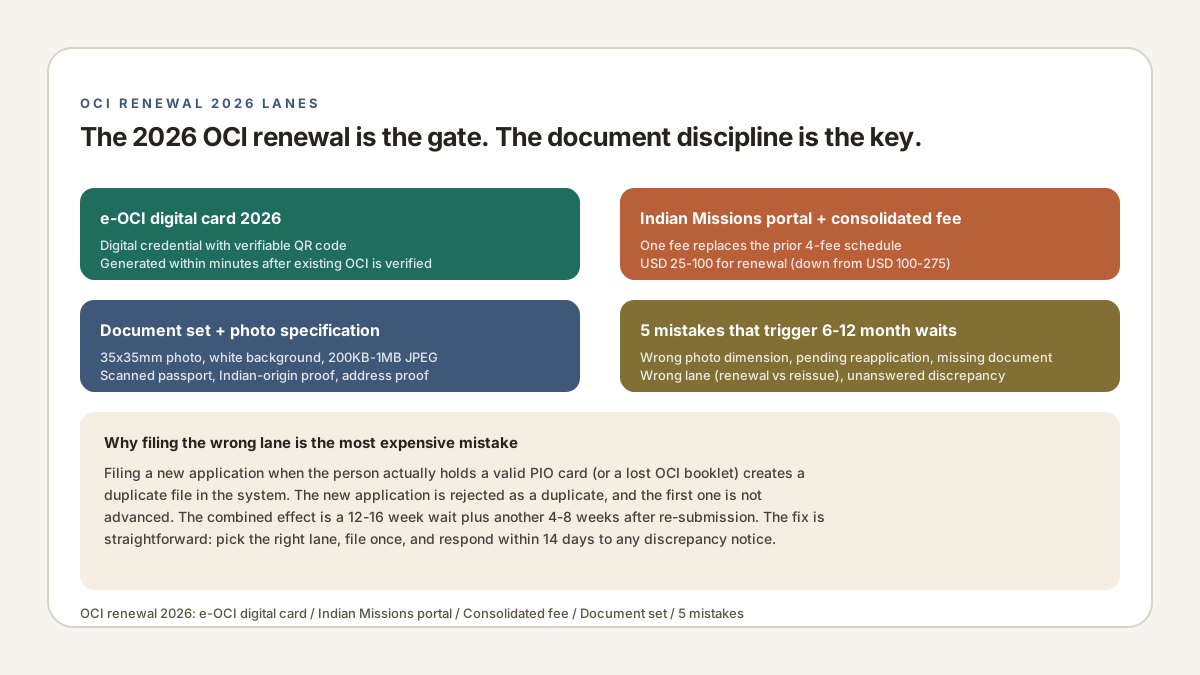
OCI renewal vs reissue vs new application: which lane you are actually in
OCI card services have four distinct lanes. Most confusion (and most rejections) come from picking the wrong lane.
| Service | When you use it | Fee (USD, 2026) | Average processing time | Common mistake |
|---|---|---|---|---|
| OCI renewal (lifetime validity card) | Current OCI booklet is about to expire (every 10 years for cards issued before 2021; lifetime for cards issued after 2021) | Approx USD 25 to USD 100 consolidated (down from USD 100 to USD 275 in the old system) | 4 to 8 weeks (down from 6 to 12 months) | Reapplying while a renewal is pending. Each new application starts the queue from zero. |
| OCI lost / damaged reissue | OCI booklet is lost, stolen, or physically damaged but the underlying registration is still valid | Approx USD 25 to USD 100 consolidated | 4 to 8 weeks | Filing a new OCI application instead of a reissue. The new application will be rejected as a duplicate. |
| OCI new application (PIO conversion + first-time OCI) | Eligible person (former Indian citizen, spouse of Indian / OCI, child of Indian / OCI) is applying for the first time | Approx USD 150 to USD 275 for first-time; PIO conversion is free or low-fee under the 2026 rules | 8 to 16 weeks | Filing as a new application when the person actually holds a valid PIO card. PIO conversion has its own lane. |
| e-OCI digital card (new in 2026) | OCI cardholder wants a digital credential with a verifiable QR code for use at immigration and for online verification (e.g. KYC with Indian banks, property registration) | Free for the digital card itself; the physical booklet renewal / reissue is a separate fee | Instant (digital card is generated within minutes after the existing OCI is verified) | Assuming the e-OCI replaces the physical booklet. It does not — the physical booklet is still required for some banking and property transactions in India. |
| OCI registration for minor child (under 18) | OCI application for a child under 18, including newborns (OCI applications are accepted from birth) | Same consolidated fee, plus simplified document set | 4 to 8 weeks | Filing the minor-child application with one parent only. Both parents (or surviving parent + declaration) must sign. |
| OCI surrender (renunciation) | OCI cardholder acquires Indian citizenship (the OCI is automatically cancelled on Indian passport application) or formally surrenders the OCI | Free (renunciation of OCI is free; Indian passport fees apply separately) | 2 to 4 weeks for the surrender acknowledgement | Continuing to use the OCI booklet after acquiring Indian citizenship. The OCI must be formally surrendered. |
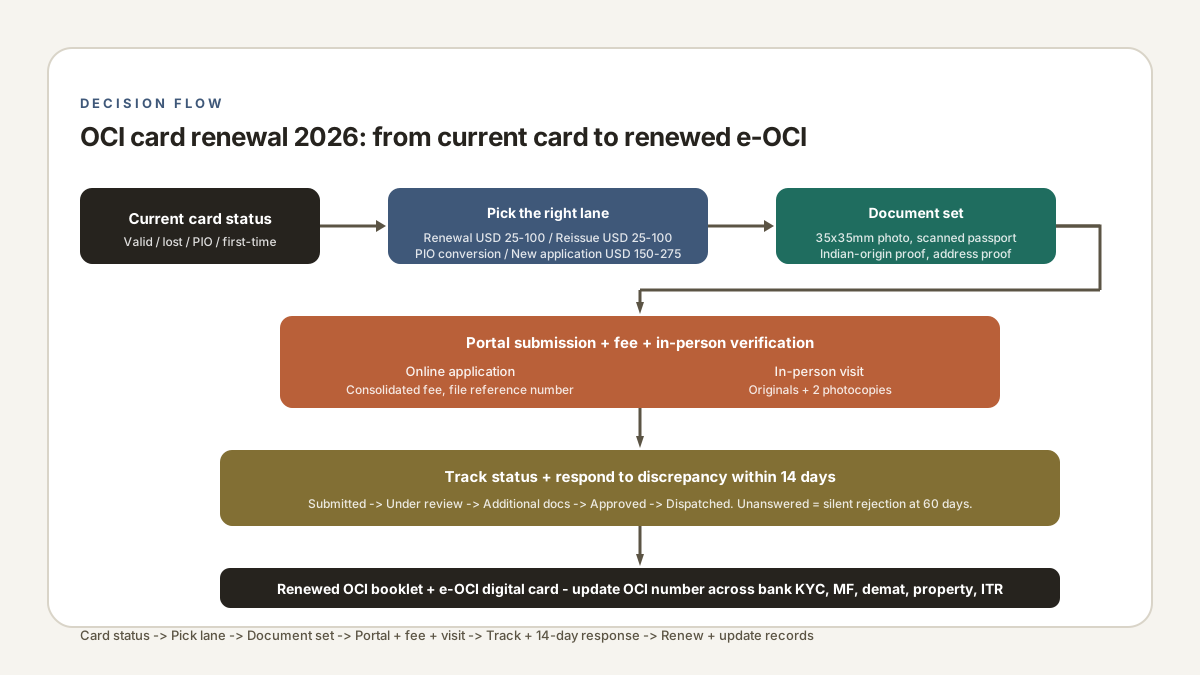
Execution sequence: from current OCI card to renewed e-OCI
Plan the order. The portal registration, the document upload, the fee payment, the in-person verification (if required), and the new card generation are not simultaneous — but they are interdependent, and an error in one is hard to fix after the application is submitted.
Confirm the current OCI booklet status and the renewal lane
Log into the Indian Missions portal (icrp.mea.gov.in or the relevant consulate / embassy portal for your jurisdiction). Check the current OCI booklet number, the date of issue, and the date of expiry. OCI cards issued before 2021 have a 10-year validity and must be renewed on expiry; cards issued after 2021 have lifetime validity and only need reissue for lost / damaged cases. Pick the lane accordingly: renewal for expiring cards, reissue for lost / damaged, PIO conversion for valid PIO cardholders, new application for first-time eligible persons.
Prepare the document set in the unified digital format
The Indian Missions portal now requires a unified document set across all lanes: (1) current OCI booklet or PIO card (scanned, both sides), (2) current foreign passport (scanned, all pages including blank), (3) Indian-origin proof (surrender certificate, Indian passport of parent / grandparent, or birth / marriage certificate linking to an Indian-citizen or OCI parent / grandparent), (4) recent photograph (35mm x 35mm, white background, JPEG, 200KB to 1MB, taken within the last 6 months), (5) signature or thumbprint scan (for minor children), (6) address proof of the current foreign residence (utility bill, bank statement, lease — last 3 months). The portal will reject scans that are not in the exact format specified. Rescanning to match the spec is the most common pre-submission fix.
Complete the online application and pay the consolidated fee
Fill the online application on the Indian Missions portal — every field is mandatory, and the auto-fill from previous applications can save 30 minutes. Upload the document set in the specified order. Pay the consolidated fee online (credit card, debit card, or net banking — fees in USD for US applicants, in the local currency for other jurisdictions). The portal will generate an acknowledgement receipt with a file reference number. Save the receipt — the consulate / embassy will reference this number in every status update.
Schedule and attend the in-person verification (if required)
Some consulates / embassies require an in-person appearance at the consulate for OCI renewal / reissue — to verify the original documents and capture biometrics. Some consulates allow a no-visit renewal if the applicant is in person already on file, has no change in personal details, and the OCI is not lost. The portal will tell you if a visit is required. If a visit is required, schedule the appointment online, bring the original documents + 2 photocopies, and attend at the scheduled time. A missed appointment resets the queue to the back.
Track the application status and respond to any discrepancy notice
The portal updates the application status in real time — submitted, under review, additional documents required, approved, dispatched. The most common status change is 'additional documents required', usually within 2 to 4 weeks of submission. The consulate / embassy will list the missing or unclear documents in the status update. Respond within 14 days by uploading the corrected document — the application will not progress without the response, and an unanswered discrepancy notice can lead to a silent rejection after 60 days.
Receive the renewed OCI booklet (or e-OCI digital card)
On approval, the OCI booklet is dispatched by the consulate / embassy (registered post or courier, depending on jurisdiction). The e-OCI digital card is generated within minutes after the existing OCI is verified — the digital card is downloadable from the portal as a PDF with a verifiable QR code, accepted at immigration alongside the physical booklet. Save the e-OCI PDF on the phone, and carry the physical booklet for any in-person verification in India (bank KYC, property registration, government office).
Update the new OCI number across all Indian records
If the OCI number changes (rare, but happens with reissue), update the new OCI number in: (1) Indian bank KYC (NRE / NRO / RFC / FCNR accounts), (2) Indian mutual fund folios, (3) Indian demat account, (4) Indian property records (encumbrance certificate, society records, sub-registrar), (5) Indian income-tax records (PAN, Aadhaar if linked, Form 10F, DTAA tax-residency certificate). The update is a paper-based exercise with each institution, but it is required for clean KYC and clean tax-residency proof.
Document checklist before the online application is submitted
Most OCI renewal rejections are caused by missing or mis-formatted documents at the upload stage. Confirm each item before submission.
- Current OCI booklet (scanned, front + back) — both sides, all pages including blank ones if it is a multi-page booklet.
- Current foreign passport (scanned, all pages) — bio-page, all visa pages, all stamp pages, and blank pages at the back.
- Indian-origin proof: surrender certificate, Indian passport of parent / grandparent, birth / marriage certificate linking to an Indian-citizen or OCI relative — depending on the eligibility basis.
- Recent photograph: 35mm x 35mm, white background, JPEG, 200KB to 1MB, taken within the last 6 months — no glasses, no hat, neutral expression. The portal is strict on the dimensions; a 2mm difference triggers a rejection.
- Signature scan (for adults) or thumbprint scan (for minor children under 5) — JPEG or PNG, 100KB to 500KB.
- Address proof of the current foreign residence: utility bill, bank statement, or lease — last 3 months, in the applicant's name.
- Marriage certificate (if the application is based on marriage to an Indian / OCI spouse) — apostilled or attested by the Indian mission in the country of issue.
- Birth certificate (for minor-child applications) — apostilled or attested, with both parents' names.
- Previous PIO card (if converting from PIO to OCI under the 2026 simplified rules) — both sides scanned.
- A working email address and phone number for the portal — the consulate / embassy communicates only through the portal and email; no SMS updates.
- Credit card or net-banking access for the consolidated fee payment — the portal accepts only online payment, no cash or cheque.
- An existing scan of the current OCI booklet's 'back side personal details' page — required for the e-OCI digital card generation.
OCI card renewal decision flow
OCI card renewal 2026: the five-layer stack
Need help with Move Planning?
Share your blocker in one line. Our experts will reply with practical next steps.
June 2026 e-OCI launch — what changed this week
MHA launched the Electronic OCI card on 30 June 2026. I wrote a short news brief on the launch date, QR verification at immigration, and what still requires your paper booklet. Read <a href="/news/e-oci-digital-card-launched-june-2026">e-OCI digital card launched June 2026</a> before you start a renewal application.
Do not reapply while a renewal is pending — the queue resets to zero
Each OCI renewal application carries a unique file reference number and enters a queue. Filing a second renewal while the first is pending creates a duplicate file in the system, and the consulate / embassy will reject the second one as a duplicate. The first one is not advanced by the second filing. The combined effect is that the applicant waits 12 to 16 weeks (the first application) plus another 4 to 8 weeks (the second application after re-submission), instead of the 4 to 8 weeks of the first application alone. The fix is straightforward: check the portal status, do not file again if the status is 'submitted' or 'under review', and contact the consulate / embassy by email with the file reference number if the status has not changed in 8 weeks. The same rule applies to PIO conversion applications.
Animated decision map

Community signal
What to watch in real discussions
Treat repeated complaints as risk signals rather than official advice. This page does not link to community search results.
Interactive checkpoint
Turn this guide into a decision file
0 of 4 checked
What changed in OCI renewal in 2026?
Three significant changes: (1) the e-OCI digital card was launched in early 2026 — a digital OCI credential with a verifiable QR code, accepted at immigration alongside the physical booklet, generated within minutes after the existing OCI is verified. (2) The Indian Missions portal flow was simplified — one consolidated fee replaces the prior 4-fee schedule (registration + visa + issuance + transmission), the application is fully online, the photo specification is unified, and the average processing time dropped from 6 to 12 months to 4 to 8 weeks. (3) The consolidated fee schedule was reduced — from USD 100 to USD 275 in the old system to USD 25 to USD 100 for renewal / reissue and USD 150 to USD 275 for first-time applications. The cost savings for a 4-person family are roughly USD 200 to USD 400.
How long is the OCI card valid, and when should I renew?
OCI cards issued before 2021 have a 10-year validity and must be renewed on expiry. The renewal can be filed up to 6 months before the expiry date. OCI cards issued after 2021 have lifetime validity and only need reissue for lost / damaged cases. The 10-year renewal cycle was abolished for new cards in 2021, but the millions of OCI cards issued before 2021 are still on the 10-year cycle. The Indian Missions portal will show the current card's expiry date and the eligibility for renewal vs reissue.
Do I need to visit the consulate / embassy in person for the renewal?
It depends on the consulate / embassy and the specific case. Some consulates / embassies require an in-person appearance to verify the original documents and capture biometrics — for first-time applications, PIO conversions, and lost-card reissues. Some consulates allow a no-visit renewal if the applicant is already in person on file, has no change in personal details, and the OCI is not lost. The portal will tell you if a visit is required when you complete the online application. A missed appointment resets the queue to the back, so schedule carefully and bring the original documents + 2 photocopies on the day.
Can I have both an OCI card and an Indian visa at the same time?
Yes. The OCI card grants lifetime visa-on-arrival to India for any visit under 180 days. For longer stays, an Indian visa can be obtained in addition. Indian visas for OCI cardholders are typically issued as 'OCI X' or 'OCI' visas and are free of charge at the consulate / embassy. The OCI card is not a substitute for an Indian passport — OCI cardholders must travel to India on their foreign passport, with the OCI booklet as the visa-on-arrival document. The OCI card also does not grant Indian citizenship, voting rights, or eligibility for an Indian passport. Acquiring an Indian passport (by renunciation of foreign citizenship) automatically cancels the OCI.
What happens to my OCI if I acquire Indian citizenship?
The OCI is automatically cancelled on the date the Indian passport is issued. The OCI booklet must be formally surrendered to the nearest Indian consulate / embassy — the surrender is free, and the consulate / embassy issues a surrender acknowledgement. Continuing to use the OCI booklet after acquiring Indian citizenship is illegal under the Citizenship Act, 1955, and can lead to cancellation of the Indian passport and prosecution for misrepresentation. The cleanest path: acquire Indian citizenship, surrender the OCI booklet, surrender the foreign passport (if required by the foreign country's law), and travel on the Indian passport.
What is the worst-case scenario if I file the renewal incorrectly?
Three things can go wrong: (1) the application is rejected for missing or mis-formatted documents, and the re-submission restarts the queue from zero — total wait 12 to 16 weeks instead of 4 to 8 weeks. (2) The application is filed in the wrong lane (renewal vs reissue vs new application), and the consulate / embassy takes 6 to 12 weeks to detect the error and request a re-filing — total wait 10 to 20 weeks. (3) The applicant files a second application while the first is pending, creating a duplicate file, and the second application is rejected as a duplicate while the first is silently stuck — total wait 16 to 24 weeks, and the only fix is to contact the consulate / embassy by email with the file reference number. Each of these is fixable, but the cost is 4 to 16 weeks of additional wait, plus USD 50 to USD 200 in re-filing fees. The cleanest plan is to pick the right lane, prepare the unified document set, and check the portal status before filing any new application.
The plan is only as good as the sequence.
Tax, banking, schools, shipping — they all have dependencies. A wrong order costs months and lakhs. Get it right.