Aadhaar, PAN, and Mobile KYC Redesignation for Returning NRIs in 2026: OCI / PIO eligibility, PAN-Aadhaar linkage, and bank KYC migration
A practical 2026 guide for returning NRIs redesignating their India-side identity and KYC stack: Aadhaar eligibility for OCI / PIO cardholders, PAN-Aadhaar linkage...
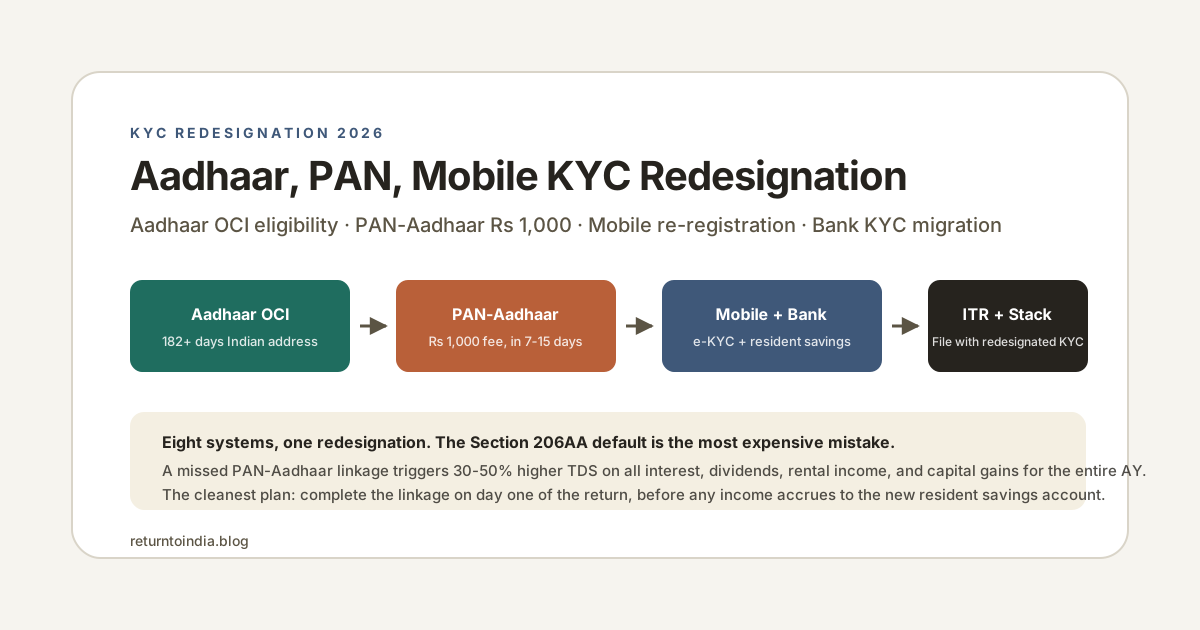
The 60-second version
Every returning NRI faces the same identity-and-KYC stack on landing: Aadhaar (or Aadhaar non-eligibility acknowledgement), PAN (mandatory above Rs 50,000 of Indian income), Indian mobile number (for bank OTP, ITR filing, mutual fund KYC), and Indian bank KYC (for redesignation from NRE / NRO to resident savings). Each of these has a different redesignation cost, a different document set, and a different failure mode. A missing PAN-Aadhaar linkage now costs Rs 1,000 in fee; a missed bank KYC redesignation costs 30% to 50% extra TDS on interest income. The order is fixed; the deliverables are not optional.
Why KYC redesignation is the gate every returning NRI must pass through (and why 2026 made it stricter)
Every returning NRI who has held an NRE / NRO / FCNR account, an Indian mutual fund folio, an Indian demat account, an Indian credit card, an Indian mobile number, an Indian property, or an Indian EPF / NPS / PPF account must redesignate their KYC from the foreign / NRI profile to the Indian resident profile on landing. The redesignation is not automatic — the bank, the fund house, the demat, the mobile operator, the property registrar, the income-tax department, and the EPFO / PFRDA each maintain their own KYC records, and each requires a fresh identity proof, address proof, photograph, signature, and (for some) biometrics before the redesignation clears. The redesignation touches 8 to 12 separate systems, and an error in any one of them creates a 30% to 50% higher TDS default, a frozen account, or a 1-year penalty under the Black Money Act.
The 2026 changes are the most significant in a decade. PAN-Aadhaar linkage became mandatory in 2017 with a Rs 1,000 fee, and the post-2024 regime makes the linkage a precondition for a valid PAN — without the linkage, the PAN is treated as 'inoperative', and the deductee (the NRI) faces 30% to 50% higher TDS under Section 206AA on all interest, dividends, rental income, and capital gains. OCI cardholders' Aadhaar eligibility was expanded in 2026, but the enrolment still requires an Indian address proof of at least 182 days, and the mobile number re-registration now requires a fresh e-KYC with the foreign passport + OCI booklet. The redesignation is not optional, but it is also not automatic. The cleanest plan is to start the KYC redesignation stack on day one of the return, not after the first bank statement arrives.
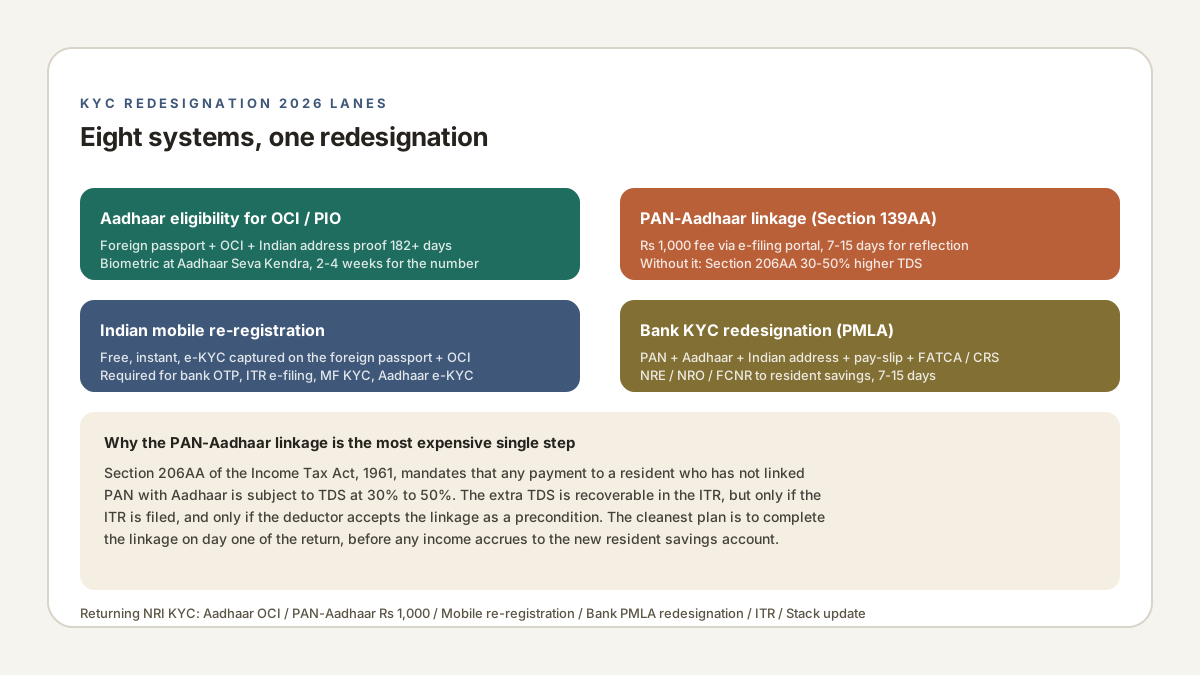
Aadhaar vs PAN vs mobile vs bank KYC: what each one actually requires
The four KYC components have different eligibility rules, different document sets, and different cost / time / penalty profiles.
| KYC component | Eligibility for returning NRI / OCI | Document set | Cost + time | Failure mode |
|---|---|---|---|---|
| Aadhaar (UID) | OCI / PIO cardholders are eligible for Aadhaar in 2026, subject to Indian address proof of 182+ days. Spouses and minor children of Indian / OCI cardholders are also eligible. Indian citizens who gave up citizenship for foreign naturalization are eligible for Aadhaar on return to India. | Foreign passport + OCI booklet + Indian address proof (utility bill, rent agreement, society letter) + biometric enrolment at an Aadhaar Seva Kendra | Free for the first enrolment; Rs 50 for biometric update; 2-4 weeks for the Aadhaar number; up to 90 days for the Aadhaar card to be printed and dispatched | Enrolment rejected for missing or invalid address proof; non-eligibility letter issued if OCI is not on the 2026 list; Aadhaar treated as inoperative if the address is not updated within 182 days of return. |
| PAN (Permanent Account Number) | Mandatory for any individual with Indian income above the basic exemption. PAN is issued on the basis of citizenship, not residency — an NRI / OCI / PIO can hold a PAN on the foreign passport. | PAN application on Form 49A (for Indian citizens) or Form 49AA (for foreign citizens) with foreign passport + OCI booklet + Indian address proof + 2 photographs | Rs 107 domestic + Rs 1,022 for foreign address dispatch; 15-30 days for the PAN card | TDS at 30% to 50% under Section 206AA if PAN is not linked to Aadhaar; PAN becomes 'inoperative' without Aadhaar linkage, leading to higher TDS, no ITR e-filing, and a 10,000 penalty for repeat non-linkage. |
| PAN-Aadhaar linkage (Section 139AA) | Mandatory for every individual who holds both PAN and Aadhaar, including OCI / PIO cardholders. Linkage is a precondition for a valid PAN, and the deductee (the NRI) faces 30% to 50% higher TDS without it. | PAN + Aadhaar (or Aadhaar enrolment ID) + payment of Rs 1,000 fee via the e-filing portal | Rs 1,000 fee (post-2024 regime; was Rs 500 to Rs 1,000 earlier); instant acknowledgement; 7-15 days for the linkage to reflect in the PAN database | PAN treated as inoperative without linkage; 30% to 50% higher TDS on all interest, dividends, rental income, capital gains; 10,000 penalty for repeat non-linkage; ITR e-filing blocked. |
| Indian mobile number re-registration | Foreign passport / OCI / PIO cardholders can re-register an Indian mobile number on the foreign passport + OCI booklet. The Indian mobile number is required for bank OTP, ITR filing, mutual fund KYC, Aadhaar e-KYC, and most Indian government portals. | Foreign passport + OCI booklet + Indian address proof + biometric (fingerprint / face) at the telecom operator's store or via e-KYC app | Free (re-registration is treated as a SIM update, not a new connection); instant re-registration; new SIM with the same number | SIM deactivated for failing to re-register within 90 days of return; bank OTP and ITR e-filing broken; mutual fund KYC redesignation blocked; Aadhaar e-KYC verification fails. |
| Indian bank KYC redesignation (NRE / NRO / FCNR to resident savings) | Mandatory under RBI Master Direction on KYC (PMLA-compliant). The bank must update the customer profile from NRI to resident, redesignate the account, and re-paper the KYC documents. | PAN + Aadhaar (or Aadhaar non-eligibility letter) + Indian address proof (utility bill, rent agreement, society letter) + photograph + signature + FATCA / CRS declaration + 2 recent pay-slips or ITR acknowledgement as income proof | Free (re-KYC is treated as a customer profile update); 7-15 days for the redesignation to clear; some banks require 2-4 weeks for the new account number to be activated | 30% to 50% higher TDS on interest income (Section 206AA if PAN-Aadhaar unlinked; Section 195 if not redesignated as resident); frozen account for failing to redesignate within 6 months of return; the old NRE / NRO accounts become inoperative for fresh credits. |
| Mutual fund + demat KYC redesignation | Mandatory under SEBI KYC Master Circular. The KYC must be redesignated from NRI / foreign passport to resident Indian, with a fresh CKYC, fresh FATCA / CRS, and fresh bank account mapping. | PAN + Aadhaar + Indian address proof + bank proof (the resident savings account) + FATCA / CRS declaration + photograph + signature | Free at the KRA level (CKYC); Rs 100 to Rs 500 per fund house for re-KYC; 7-15 days for the redesignation to clear | Folio frozen for fresh transactions; redemption proceeds credited to the old NRO account with USD 1m / FY LRS cap on repatriation; the redesignated folio cannot be operated until the new bank account is mapped. |
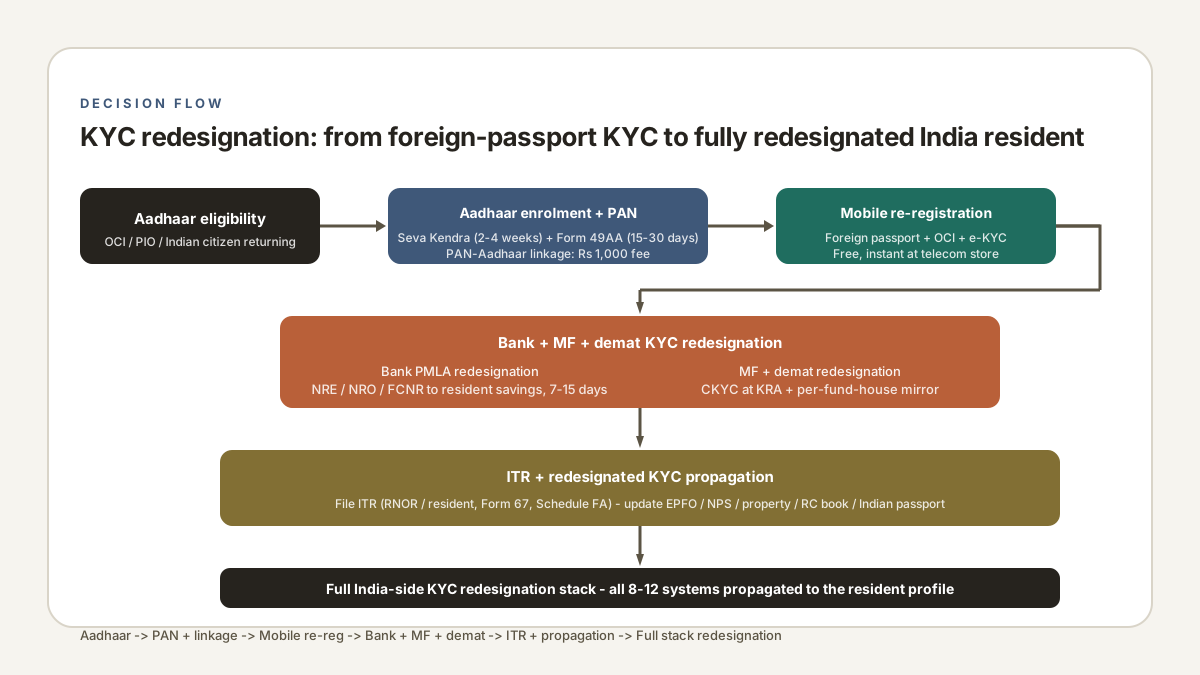
Execution sequence: from foreign-passport KYC to fully redesignated India resident
Plan the order. The PAN-Aadhaar linkage, the bank KYC redesignation, the mobile re-registration, and the ITR filing are not simultaneous — but they are interdependent, and an error in one is hard to fix after the redesignation has cleared in another.
Confirm the residential status and the Aadhaar eligibility on landing
On landing, confirm the residential status under Section 6 of the Income Tax Act (resident / RNOR / non-resident). For most returning NRIs, the year of return is RNOR, and the AY following the year of return is full resident. Confirm the Aadhaar eligibility: OCI / PIO cardholders are eligible in 2026, subject to Indian address proof of 182+ days; Indian citizens who gave up citizenship for foreign naturalization are eligible on return. Apply for Aadhaar at the nearest Aadhaar Seva Kendra with the foreign passport + OCI booklet + Indian address proof. The Aadhaar number is generated within 2-4 weeks; the Aadhaar card is dispatched within 90 days.
Link PAN with Aadhaar (or apply for PAN on the foreign passport)
If the PAN was issued earlier (on the Indian passport, before naturalization), link it with the new Aadhaar via the e-filing portal — pay the Rs 1,000 fee, get the instant acknowledgement, and wait 7-15 days for the linkage to reflect. If the PAN was never issued, apply via Form 49AA (for foreign citizens) with the foreign passport + OCI booklet + Indian address proof. The PAN is issued within 15-30 days. Without the PAN-Aadhaar linkage, the PAN is treated as inoperative, and 30% to 50% higher TDS applies under Section 206AA on all interest, dividends, rental income, and capital gains.
Re-register the Indian mobile number on the foreign passport + OCI booklet
Visit the telecom operator's store with the foreign passport + OCI booklet + Indian address proof. The SIM is re-registered (not replaced) on the new identity, the e-KYC is captured, and the same mobile number is activated under the new identity. The re-registration is free and instant. The Indian mobile number is required for bank OTP, ITR e-filing, mutual fund KYC, Aadhaar e-KYC, and most Indian government portals. Do not skip this step — a deactivated SIM blocks the rest of the redesignation stack.
Redesignate the bank KYC at every Indian bank (NRE / NRO / FCNR to resident savings)
Visit each Indian bank (or use the net-banking / mobile-app redesignation flow if available) with the PAN + Aadhaar + Indian address proof + photograph + signature + FATCA / CRS declaration + 2 recent pay-slips or ITR acknowledgement. The bank will redesignate the customer profile from NRI to resident, close the NRE / NRO / FCNR accounts (or convert them to resident accounts), and open a fresh resident savings account. The NRE / NRO balances are transferred to the new resident savings account at the prevailing rate. The redesignation is free, but it takes 7-15 days for the new account to be activated. Do not skip any bank — even a zero-balance dormant NRO account is reported to the RBI and the income-tax department, and an unredesignated dormant account can trigger a Section 142(1) income-tax notice.
Redesignate the mutual fund and demat KYC at every fund house and depository
Visit the KRA portal (CVL, NDML, Karvy, etc.) and update the CKYC profile to resident Indian, with the new PAN + Aadhaar + Indian address + bank proof. Then visit each mutual fund house (or use the fund house's online re-KYC) and mirror the redesignation. For the demat account, visit the depository participant (NSDL / CDSL) and update the KYC with the same documents. The redesignation is free at the KRA level, but each fund house may charge Rs 100 to Rs 500 for re-KYC. The folios cannot be operated (fresh purchases, redemptions, switch) until the redesignation clears.
File the ITR for the year of return with the redesignated KYC and the RNOR / resident schedule
On the ITR for the AY of return (typically the year of return + 1), file under the RNOR or resident schedule as applicable. Report worldwide income, claim DTAA relief via Form 67 for any tax paid in the country of residence, and disclose foreign assets in Schedule FA. The PAN-Aadhaar linkage is a precondition for e-filing — without the linkage, the ITR cannot be uploaded, and the assessment may be picked up for manual scrutiny. The bank KYC redesignation determines whether the bank can deduct TDS at the resident rate or the non-resident rate — without the redesignation, the bank will continue to deduct at the non-resident rate, leading to an excess TDS that can be claimed as a refund in the ITR (but only if the ITR is filed).
Update the redesignated KYC across the rest of the India-side stack
Update the redesignated PAN + Aadhaar + bank account + mobile number in: (1) EPFO portal (for EPF withdrawal, which we covered in a separate article), (2) NPS CRA (for NPS redesignation, which we covered in a separate article), (3) Indian property records (encumbrance certificate, society records, sub-registrar), (4) Indian motor vehicle records (RC book, driving licence), (5) Indian passport (if applying for resumption of Indian citizenship), (6) any Indian demat account, PPF account, or fixed deposit. The redesignation is a stack, and each system must be updated independently. The cost of a missed redesignation is a 30% to 50% higher TDS default + a 1-year penalty under the Black Money Act for undisclosed foreign assets.
Document checklist before the redesignation is started
Most KYC redesignation failures are caused by missing or mismatched documents at the bank / fund house / telecom visit. Confirm each item before starting the redesignation.
- Foreign passport (all pages, including blank) — both the bio-page and the visa pages.
- OCI booklet (both sides) — required for the Indian address proof and the bank / fund house KYC redesignation.
- Indian address proof of 182+ days: utility bill (electricity, water, gas) in the applicant's name, OR a registered rent agreement + a no-objection letter from the landlord.
- PAN card (existing, if any) or PAN application acknowledgement on Form 49AA.
- Aadhaar letter or Aadhaar enrolment ID (the 14-digit number issued at the Aadhaar Seva Kendra).
- PAN-Aadhaar linkage acknowledgement from the e-filing portal (post-Rs 1,000 fee payment).
- 2 recent pay-slips from an Indian employer, OR an Indian ITR acknowledgement for the previous AY, OR a chartered-accountant-certified income certificate for self-employed / business income.
- Recent photograph (35mm x 35mm, white background, JPEG / printed) and signature scan (JPEG or PNG).
- Indian mobile number re-registered on the foreign passport + OCI booklet (with e-KYC captured).
- FATCA / CRS declaration for the new India-resident status (most banks and fund houses have this as part of the redesignation form).
- Power of attorney (POA) document in favour of a representative in India if the applicant is not personally present for the redesignation visit. The POA must be specific to the KYC redesignation, executed on stamp paper, and notarized / apostilled by the Indian consulate in the country of residence.
- A list of every Indian bank, fund house, depository, EPFO / NPS office, property registrar, and motor vehicle office that holds the old NRI / foreign-passport KYC — the redesignation must be repeated at each one.
KYC redesignation decision flow
Need help with Move Planning?
Share your blocker in one line. Our experts will reply with practical next steps.
Returning NRI KYC redesignation: the five-layer stack
The Section 206AA 30% to 50% higher TDS default is the most expensive KYC mistake
Section 206AA of the Income Tax Act, 1961, mandates that any payment to a resident who has not linked PAN with Aadhaar (or has not furnished PAN to the deductor) is subject to TDS at 30% to 50%, depending on the nature of the payment. For a returning NRI who has not completed the PAN-Aadhaar linkage, this means: 30% TDS on bank interest (vs 10% for resident), 30% TDS on dividend income (vs nil for resident up to Rs 5,000), 30% TDS on rental income (vs 10% for resident with a 30% rebate), and 30% TDS on capital gains (vs 15% for STCG equity). The extra TDS is recoverable in the ITR, but only if the ITR is filed, and only if the deductor accepts the PAN-Aadhaar linkage as a precondition for the lower rate. The cleanest plan is to complete the PAN-Aadhaar linkage on day one of the return, before any income accrues to the new resident savings account.
Animated decision map

Community signal
What to watch in real discussions
Treat repeated complaints as risk signals rather than official advice. This page does not link to community search results.
Interactive checkpoint
Turn this guide into a decision file
0 of 4 checked
Can an OCI / PIO cardholder get an Aadhaar card in 2026?
Yes. The 2026 amendment to the Aadhaar Act allows OCI / PIO cardholders to enrol for Aadhaar, subject to Indian address proof of 182+ days. The enrolment requires the foreign passport + OCI booklet + Indian address proof (utility bill in the applicant's name, or registered rent agreement + landlord NOC) + biometric capture at an Aadhaar Seva Kendra. The Aadhaar number is generated within 2-4 weeks; the Aadhaar card is dispatched within 90 days. Minor children of OCI / PIO cardholders are also eligible. The Aadhaar is treated as a valid identity and address proof for all Indian KYC redesignation steps, including bank KYC, mutual fund KYC, demat KYC, and ITR filing.
What is the penalty for not linking PAN with Aadhaar in 2026?
The post-2024 regime is Rs 1,000 for the linkage fee (payable via the e-filing portal), with a deadline of 31 December of the AY. After the deadline, the PAN is treated as 'inoperative' under Section 139AA, and the deductee (the NRI) faces 30% to 50% higher TDS under Section 206AA on all interest, dividends, rental income, and capital gains. The ITR e-filing is blocked without the linkage, and the assessment may be picked up for manual scrutiny. A 10,000 penalty applies for repeat non-linkage. The cleanest plan is to complete the linkage on day one of the return, before any income accrues to the new resident savings account.
Do I need to apply for a new PAN on the foreign passport?
It depends on whether you already hold a PAN. If your PAN was issued earlier (on the Indian passport, before naturalization), the existing PAN is still valid for the new identity, but it must be linked with the new Aadhaar. If you never held a PAN, apply via Form 49AA (for foreign citizens) with the foreign passport + OCI booklet + Indian address proof + 2 photographs. The PAN is issued within 15-30 days. The PAN is the master identifier for all Indian tax and KYC systems, and a missing PAN leads to 30% higher TDS under Section 206AA, no ITR e-filing, and no bank interest above Rs 40,000 per FY (the basic interest TDS threshold).
How long does the bank KYC redesignation take?
For most public-sector and large private banks, the redesignation is initiated at the branch with the full document set, and the new resident savings account is activated within 7-15 days. Some banks require 2-4 weeks for the new account number to be issued and the old NRE / NRO account to be closed. The redesignation is free, but the deducer (the bank) will continue to treat the account as NRI until the new resident account is activated. During this transition period, the TDS rate is the non-resident rate (20% on interest for NRO, 30% under Section 206AA if PAN-Aadhaar unlinked), and the excess TDS is recoverable in the ITR. The cleanest plan is to submit the redesignation request on day one of the return and follow up at the branch every 5 days until the new account is activated.
Can I keep my old NRE / NRO account after returning to India?
No. Under FEMA 1999, an NRE / NRO / FCNR account is for non-resident Indians. Once you become an Indian resident, the NRE / FCNR account must be closed or converted to a resident account (the new resident savings account), and the balances are transferred at the prevailing rate. The NRO account can be redesignated as a resident ordinary account (not NRO-specific), and the balances continue to be parked. The interest rate changes from the NRE / NRO rate to the resident savings rate. The redesignation is mandatory under FEMA 1999 and the RBI KYC Master Direction, and an unredesignated NRE / NRO account is a FEMA violation that can trigger a penalty under the Black Money Act. The cleanest plan is to close the NRE / FCNR accounts and redesignate the NRO account on day one of the return, with the new resident savings account opened at the same time.
What is the worst-case scenario if I skip the KYC redesignation?
Three things can go wrong: (1) Section 206AA 30% to 50% higher TDS on all interest, dividends, rental income, and capital gains for the entire AY, recoverable only in the ITR and only if the ITR is filed. (2) The NRE / NRO account is frozen for failing to redesignate within 6 months of return, leading to a FEMA violation and a penalty under the Black Money Act. (3) The mutual fund and demat folios are frozen for fresh transactions, the redemption proceeds are stuck in the NRO account with the USD 1m / FY LRS cap on repatriation, and the redesignation cannot be completed without a fresh KYC visit to each fund house and depository. Each of these is fixable, but the cost is Rs 5 lakh to Rs 30 lakh in additional tax + penalties, plus 2 to 3 years of audit and reassessment. The cleanest plan is to start the KYC redesignation stack on day one of the return, complete the PAN-Aadhaar linkage first, redesignate the bank KYC second, and propagate the redesignation to the rest of the India-side stack over the next 30 to 60 days.
The plan is only as good as the sequence.
Tax, banking, schools, shipping — they all have dependencies. A wrong order costs months and lakhs. Get it right.