Selling US Real Estate After Returning to India: FIRPTA 15% withholding, Section 121 exclusion, DTAA relief, and NRO/NRE repatriation
Step-by-step US property sale guide for returning NRIs: FIRPTA 15% withholding mechanics, US federal + state + NIIT capital-gains tax, Section 121 primary-residence...
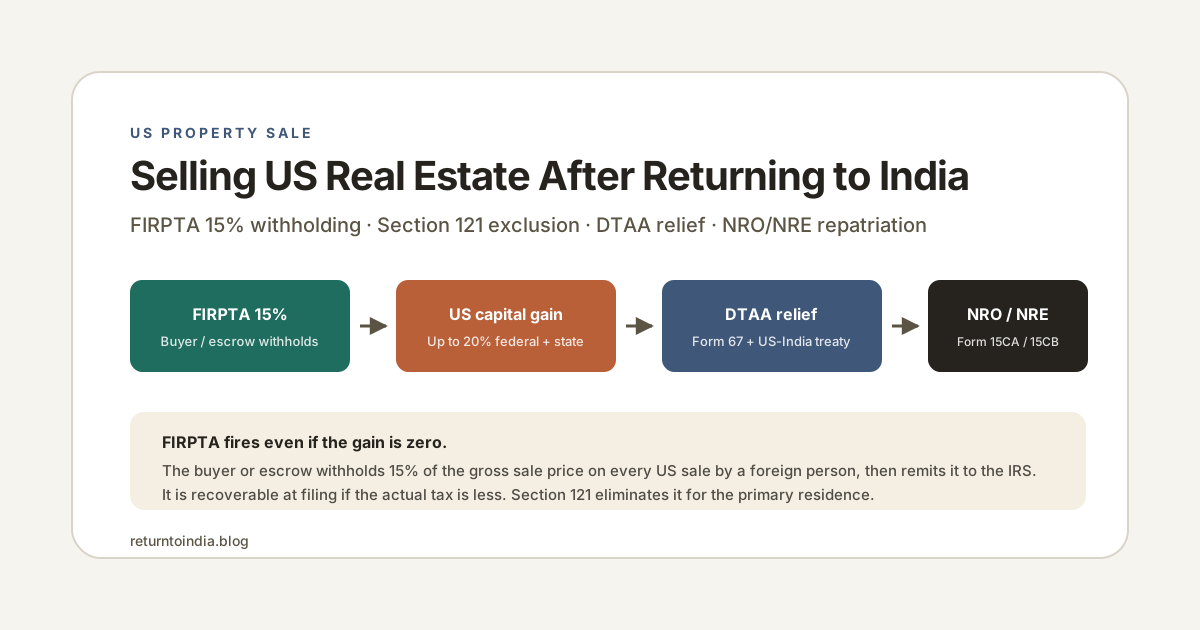
The 60-second version
Selling US real estate from India is a five-layer compliance stack: FIRPTA 15% at closing, US tax return to recover the withholding (or zero it out via Section 121), DTAA relief claimed on the Indian ITR via Form 67, India tax on worldwide income, and Form 15CA / 15CB to legally repatriate the proceeds. The order is fixed and each layer has a deliverable.
Why US real estate is the most expensive NRI asset to unwind
Selling a US property from India is the most compliance-heavy NRI asset disposal. The US Internal Revenue Code (FIRPTA, Sections 897 and 1445) requires the buyer or escrow agent to withhold 15% of the gross sale price on every disposition of a US real-property interest by a foreign person, then remit it to the IRS within 20 days of closing. The withholding fires on every sale, even if the actual tax is zero, even if the sale is a loss, and even if the seller has no US tax filing obligation. The mechanics are not the seller's call — the buyer or escrow holds the money and remits regardless.
The 15% is a prepayment of US tax, not a tax. It is recoverable (or partly recoverable) on the US income-tax return filed for the year of sale. For a primary residence, Section 121 excludes up to USD 500,000 of gain (married filing jointly) or USD 250,000 (single) if the owner has used the home as a principal residence for at least 2 of the last 5 years. For non-primary residences, the gain is taxed at US federal long-term capital-gains rates (0%, 15%, or 20% depending on income) plus state tax (0% to 13.3% depending on the state) plus the 3.8% Net Investment Income Tax (NIIT) for higher-income filers. The Indian side then taxes worldwide income, with DTAA relief via Form 67 to credit the US tax paid. Finally, repatriation requires Form 15CA + 15CB to legally move the net proceeds to an NRO or NRE account in India.
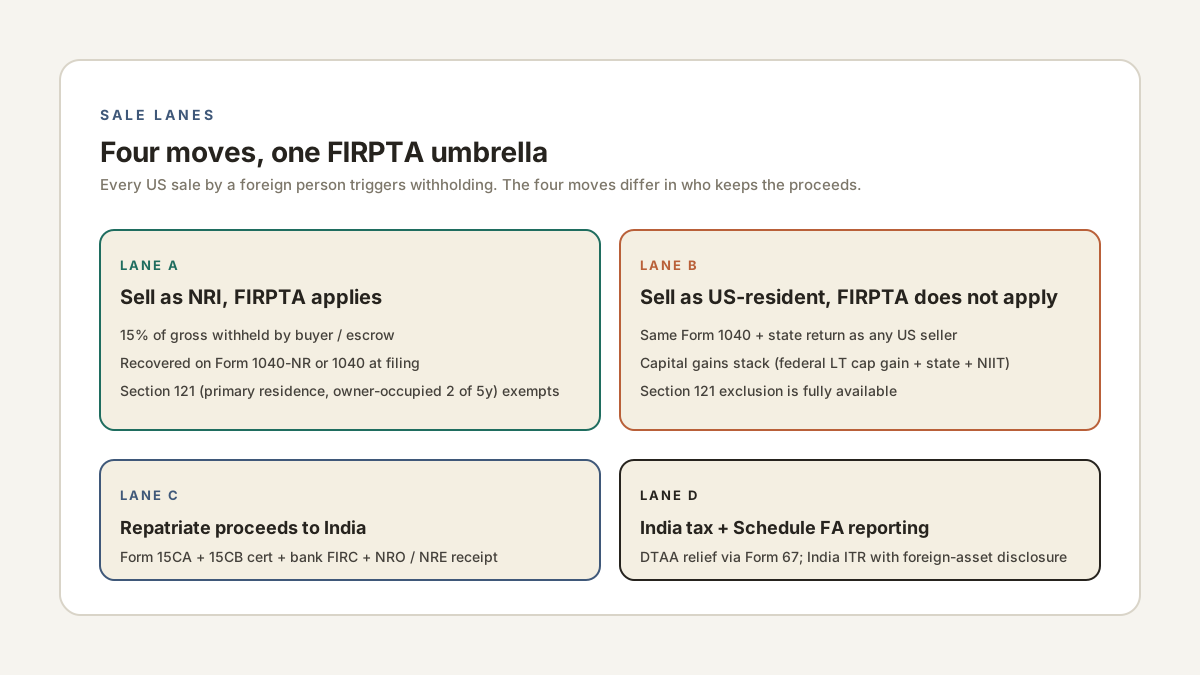
Sell as NRI vs sell as US-resident: who keeps the withholding
Whether FIRPTA fires depends on the seller's US tax-residency status on the date of closing. Most returning NRIs are NRIs at closing, so FIRPTA almost always applies — but the actual US tax owed is a separate calculation.
| Dimension | Sell as NRI (FIRPTA applies) | Sell as US-resident (no FIRPTA) | Practical difference |
|---|---|---|---|
| FIRPTA 15% withholding | Yes — buyer / escrow withholds 15% of gross and remits to IRS | No — buyer / escrow disburses 100% to seller at closing | FIRPTA is a prepayment, not a tax; recovered on the US return if actual tax is less |
| US income-tax return | Form 1040-NR (nonresident alien) or 1040 if RNOR / dual-status | Form 1040 (regular US resident return) | 1040-NR can only recover the FIRPTA, not claim most other deductions |
| Capital-gains tax rate (long-term) | Same graduated rates (0/15/20% federal) + state + 3.8% NIIT | Same graduated rates (0/15/20% federal) + state + 3.8% NIIT | Same statutory rate; the FIRPTA does not change the rate, only the cash flow |
| Section 121 primary-residence exclusion (up to USD 500k married / 250k single) | Available if owner-occupied 2 of last 5y and ownership test met | Available under the same test (most sellers qualify) | Section 121 also exempts from FIRPTA if seller certifies primary-residence status on Form 8288-B |
| Net Investment Income Tax (3.8%) | Applies if MAGI > USD 200k single / 250k joint | Applies under the same MAGI thresholds | Higher-income sellers owe the additional 3.8% on the gain |
| Depreciation recapture (rental property) | Section 1250 unrecaptured gain taxed at max 25% federal | Same 25% federal rate | Often the largest surprise for rental-property sellers |
| State income tax | State of property (e.g. CA 0% on cap gain, NY ~6.85%, HI 7.25%) | State of residence on the return (often the same state) | State-by-state variation is real; California has no state cap-gain tax |
| India side | Taxable in India as worldwide income; DTAA relief via Form 67 for US tax paid | Same — DTAA relief is unaffected by FIRPTA mechanics | Section 121 excludes gain from US tax; India DTAA typically grants the same exclusion |
Execution sequence: from listing to India bank credit
Plan the order. The US-side filings and the India-side filings are not simultaneous — but they are interdependent.
Decide the timing of the sale relative to the return to India
If you sell before establishing Indian residency, FIRPTA still applies (you are a non-US person at closing under the substantial-presence test), and you file Form 1040-NR for the year of sale. If you sell after establishing residency (green-card holder or US citizen), FIRPTA does not apply, and you file Form 1040. For most returning NRIs, the cleanest answer is to list the property 6 to 9 months before the planned move and close before or shortly after the move. This avoids the FICA / state-residency surprise of holding the property while you are technically a US resident in a high-tax state.
Engage a US real-estate agent and a cross-border CPA before listing
Cross-border CPAs cost USD 1,500 to USD 4,000 for the sale return and FIRPTA recovery, but they save multiples of that by (a) correctly applying Section 121, (b) running depreciation recapture math for rental properties, (c) coordinating with the India-side chartered accountant for Form 67, and (d) timing the FIRPTA-ID / ITIN application so the escrow does not withhold 15% when it does not need to. The IRS ITIN application (Form W-7) takes 7 to 11 weeks — start it as soon as the sale is under contract, not at closing.
Confirm Section 121 eligibility or plan the FIRPTA recovery
If the property is your primary residence and you have owned and used it as your principal residence for at least 2 of the last 5 years, file Form 8288-B with the IRS to apply for a withholding certificate. The IRS can reduce or eliminate the 15% withholding before closing, which preserves cash flow. The IRS typically responds in 30 to 90 days. If Section 121 is unavailable (rental property, second home, mixed-use), the 15% is recoverable on the 1040-NR or 1040 only to the extent the actual tax owed is less.
Run the 1040-NR (or 1040) for the year of sale
Report the sale on Form 8949 + Schedule D, claim Section 121 if eligible, claim FIRPTA as estimated tax paid on Form 1040-NR (line 14) or 1040 (line 33). For nonresident sellers, the only deductions available are the cost basis, selling expenses, and Section 121 — the standard deduction and most personal credits are not available on 1040-NR. If the FIRPTA exceeds the actual tax, the difference is refunded (typically 6 to 12 weeks after filing). The 1040-NR due date is June 15 if all US-source wages are reported, otherwise April 15. Extensions are available.
File the Indian ITR for the assessment year of the sale
If you sold the property after becoming an Indian resident, the gain is part of worldwide income and taxable in India under Section 45 (capital gains). Compute the gain in INR using the RBI reference rate on the date of receipt of funds (or the date of sale if earlier, per Rule 115). The tax rate is 20% with indexation for long-term (held > 24 months) property, computed under Section 48. Claim DTAA relief via Form 67 — the US tax paid (federal + state + NIIT, including any FIRPTA that became additional US tax, but not the FIRPTA that was refunded) is creditable against the India tax, capped at the India-tax attributable to the foreign income.
Repatriate the net proceeds via Form 15CA + 15CB
Form 15CA is a self-declaration by the remitter; Form 15CB is a chartered-accountant certificate confirming the India-tax treatment of the remittance. For a US-property sale, the typical flow is: seller's US bank -> SWIFT to seller's NRO account in India -> Form 15CB certifies the amount is a capital-gains remittance -> Form 15CA submitted to the bank -> bank credits the NRO. The USD 1 million per FY cap on NRO repatriation (under FEMA 1999) does not normally bind for a single property sale. Do not send the proceeds to an NRE account — NRE is for foreign-source current-income, and a US property sale is a capital repatriation that belongs in NRO.
Before you list the US property
Cross-border property sales are unforgiving of timing errors. Confirm each item before going to market.
- You have a clear answer to the 2-of-5-year ownership-and-use test for Section 121 (or a written plan if you do not qualify).
- You have identified whether the property has been rented out for any period (depreciation recapture applies if so).
- You have applied for an ITIN (Form W-7) if you do not already have an SSN — 7 to 11 week processing.
- You have engaged a cross-border CPA for the US return and a chartered accountant in India for the ITR and Form 67.
- You have a written estimate of the FIRPTA recoverable vs. forfeited under each scenario (Section 121 full, partial, none).
- You have planned the India bank setup: an NRO account that accepts the wire from the US escrow, ideally in a bank that supports SWIFT credit in USD.
- You have scheduled the US return filing date and the India ITR filing date (typically the next assessment year by July 31).
- You have a written plan for state-tax implications: state of property vs. state of residence on the return.
- If the property is jointly held, the other owner has agreed on the split and the FIRPTA / Section 121 treatment.
- If the property is held in an LLC, you have decided whether to sell the LLC interest (different FIRPTA treatment) or the property directly.
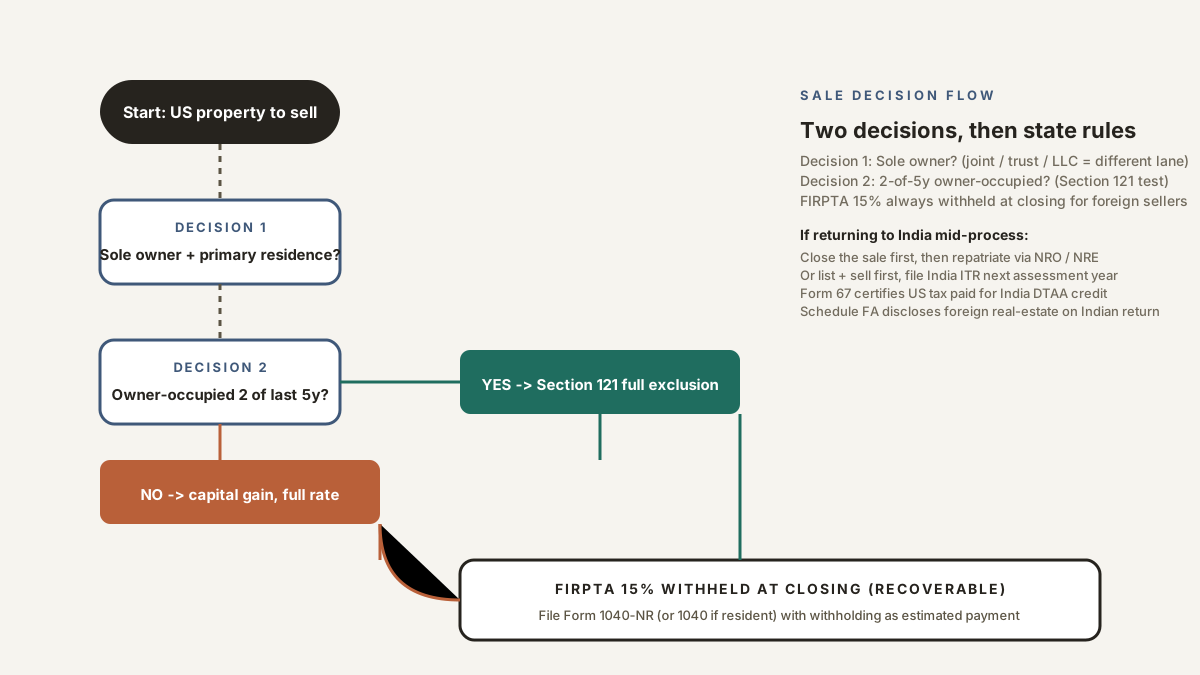
US property sale decision flow
Need help with Tax & Residency?
Share your blocker in one line. Our experts will reply with practical next steps.
US property sale -> India bank credit: the five-layer stack
Section 121 is the only realistic way to zero out a US property tax bill
Most US-property sales by returning NRIs produce a non-zero US tax bill only because the seller did not meet Section 121's 2-of-5-year ownership-and-use test. The test is strict: 2 full years of ownership in the 5-year period ending on the sale date, AND 2 full years of primary-residence use in the same 5-year period. Partial-year owner-occupied use does not count, even if you lived there for 23 months. The exclusion is USD 250,000 (single) / USD 500,000 (married filing jointly) per seller, so a married couple selling jointly can shield up to USD 500,000 of gain. The same exclusion exempts the sale from FIRPTA withholding if Form 8288-B is filed before closing. If you are within 2 years of meeting the test, waiting is often cheaper than paying the FIRPTA bridge cost.
Animated decision map

Community signal
What to watch in real discussions
Treat repeated complaints as risk signals rather than official advice. This page does not link to community search results.
Interactive checkpoint
Turn this guide into a decision file
0 of 4 checked
Does FIRPTA apply if I am a US green-card holder at closing?
No. FIRPTA defines a foreign person as someone who is not a US citizen, not a US green-card holder, and does not pass the substantial-presence test (183 days weighted average over 3 years). If you are a green-card holder or a US citizen on the date of closing, the buyer is not required to withhold, and you file a regular Form 1040 with the state return. Most returning NRIs renounce or abandon green-card status before returning, so FIRPTA applies at closing. Check the substantial-presence calculation carefully — even one extra day of physical presence in the US can change the result.
Can I get the FIRPTA withholding reduced before closing?
Yes, by filing Form 8288-B with the IRS and asking for a withholding certificate. The IRS can reduce or eliminate the 15% withholding if you can demonstrate that the actual tax owed is less than 15% of the gross sale price. The most common case is the Section 121 primary-residence exclusion: a seller eligible for the full USD 250k / 500k exclusion and whose entire gain is shielded can apply to have the withholding reduced to zero. Form 8288-B is filed as soon as the sale is under contract; the IRS typically responds in 30 to 90 days. If the response arrives after closing, the buyer must still withhold, but the certificate retroactively adjusts the amount and the excess is refunded on the return.
How is the India capital-gains tax computed on a US property sale?
If the property is held > 24 months (long-term), India taxes 20% with indexation on the capital gain, computed under Section 48. The sale price is converted to INR using the RBI reference rate on the date of receipt of funds (or the date of agreement if earlier, per Rule 115). The cost basis is the original purchase price converted at the RBI rate on the date of acquisition, plus indexed upward using the Cost Inflation Index (CII) published each year by the CBDT. Selling expenses (broker commission, legal fees, FIRPTA consulting) are deductible. If the property is held <= 24 months (short-term), India taxes the gain at the slab rate. Claim DTAA relief via Form 67 — the US tax paid (federal + state + NIIT, not including the FIRPTA that was refunded) is creditable against the India tax, capped at the India-tax attributable to the foreign income.
Do I need to disclose a US property in Schedule FA after I become an Indian resident?
Yes. Schedule FA (Foreign Assets) of the Indian ITR requires Indian residents to disclose foreign bank accounts, foreign financial interests, foreign equity / debt interests, and foreign immovable property. A US property that you own (or that you sold during the year) must be disclosed in Schedule FA, including the address, country, acquisition date, acquisition value in INR, and any peak balance during the year. Failure to disclose foreign assets can trigger a Rs 10 lakh penalty under Section 42 of the Black Money (Undisclosed Foreign Income and Assets) Act, 2015, plus the tax + interest on the income. The disclosure is required even if the property is jointly held with a non-resident spouse, and even if the property is held in an LLC.
Can I send the US sale proceeds to an NRE account?
Strictly, no. NRE accounts are for parking foreign-source current income (salary, interest, dividends, rental income from a foreign tenant). A US property sale is a one-time capital repatriation that belongs in NRO, not NRE. Banks may accept the SWIFT credit into an NRE if the source is misrepresented, but this is a FEMA violation and can be flagged on subsequent audits. The correct flow is: US bank -> SWIFT to NRO -> Form 15CA + 15CB -> NRO credit. NRO funds can be transferred to NRE only to the extent of USD 1 million per FY under the Liberalised Remittance Scheme, and only after the source is documented. For most sellers, leaving the funds in NRO and using them for India expenses (housing, children's education, Indian investments) is the simplest plan.
What is the worst-case scenario if I sell without planning?
Three things can go wrong: (1) the buyer withholds 15% of the gross, and the seller has not filed Form 8288-B and does not file a US return, so the FIRPTA is forfeited to the US Treasury. (2) The seller files a 1040-NR but does not file Form 67 with the India ITR, so the India tax is computed on the full gain without DTAA relief, leading to double taxation. (3) The seller fails to disclose the US property in Schedule FA, triggering a Rs 10 lakh penalty under the Black Money Act and potential criminal prosecution for willful non-disclosure. Each of these is fixable, but the cost is Rs 5 lakh to Rs 30 lakh in additional tax + penalties, plus 2 to 3 years of audit and reassessment. The cleanest plan is a cross-border CPA + India CA, engaged as soon as the sale is under contract, not at closing.
Your tax year is already running.
RNOR status, exit timing, and DTAA benefits all depend on decisions you make before you land. Don't guess.