Moving Back to India from Australia: Super + Tax Guide
Australia-to-India relocation: tax residency exit, superannuation, DASP, Age Pension abroad rules, banking, and landing checklist.

The 60-second version
The Australia-to-India move usually turns on a small set of systems rather than one emotional decision: when you stop being an Australian tax resident, whether your super stays preserved or falls into the DASP lane, what Age Pension rules may still matter later, and how much India-side cash flow you really need before you touch long-horizon assets.
Why the Australia return needs its own operating model
Searchers moving back to India from Australia usually are not asking for a generic relocation pep talk. They are trying to settle a small number of operating questions that can become expensive if mixed together: when Australian tax residency changes, whether super is preserved or claimable only in the temporary-resident DASP lane, whether an Age Pension assumption still survives a move, and how much liquidity India actually needs before long-horizon money is touched.
That is why the strongest Australia-to-India plan is built around sequence rather than emotion. Separate the Australian tax exit, the super decision, the identity-and-login continuity work, and the India landing runway. Once those are settled, the move usually becomes much calmer than it felt at the start.
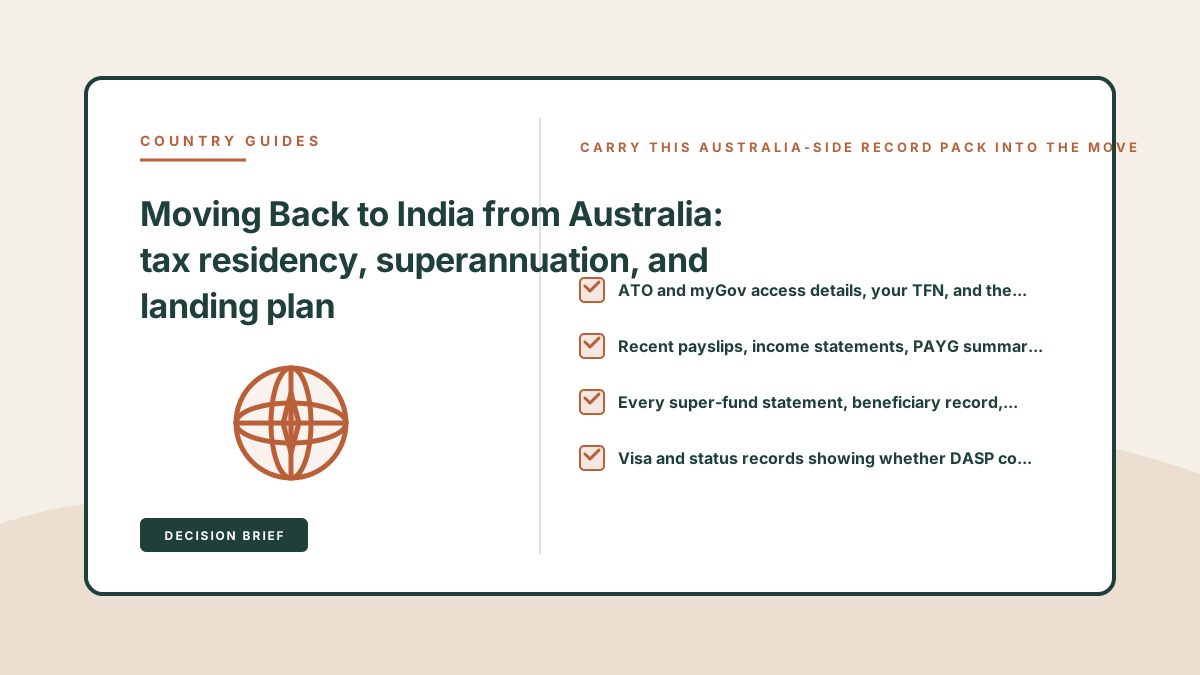
DASP (Departing Australia Superannuation Payment) Eligibility
The six Australia-specific checkpoints worth locking before you plan around them
| Checkpoint | Question to settle | Why it matters |
|---|---|---|
| Australian tax residency date | Will the ATO still treat you as an Australian resident for tax purposes after the move, or do you become a foreign resident part-way through the year? | Residency drives filing treatment, tax-free-threshold access, and what the move year looks like on the Australian side. |
| Superannuation lane | Is your money simply preserved inside super until a normal condition of release is met, or are you actually in the separate DASP lane for eligible temporary residents? | People often confuse preserved super with money that becomes cashable just because the move is happening. |
| DASP eligibility | Were you in Australia on an eligible temporary visa, has that visa ceased, have you left Australia, and are you neither an Australian or New Zealand citizen nor an Australian permanent resident? | ATO guidance makes DASP eligibility narrow. If you are outside that lane, your super decision is a preservation problem, not a departure-payment problem. |
| Age Pension and agreement assumptions | If Age Pension could matter later, do you understand the outside-Australia rules and whether the Australia-India social security arrangement may still affect your case? | A casual pension assumption can distort the family?s long-horizon planning. |
| ATO, myGov, bank, and phone continuity | Which logins, numbers, and contact details must keep working after you land in India? | Access problems become much harder to solve once you have already left Australia. |
| First India landing model | Is your first city a final commitment or a temporary operating base while housing and schools settle? | That answer changes cash needs, shipment size, school urgency, and how aggressively you simplify the Australia side. |
Key steps before you leave Australia
The goal is to protect optionality first and only trigger an irreversible action when the rule lane is clear.
Work out the Australian tax-residency fact pattern before you lock the move date
ATO guidance separates immigration or visa status from tax residency. If you become a foreign resident after leaving, the move year can carry a different tax-free-threshold calculation than a full-year resident return.
Separate preserved super from DASP before you build your India cash plan
ATO guidance says DASP applies to eligible temporary residents only after they have left Australia and their visa has ceased. If you are not in that lane, super usually stays governed by preservation-age and retirement-access rules.
Download the record pack while Australian access is still easy
Keep ATO, myGov, super-fund, bank, and employer records available offline and make sure the phone-number or recovery path still works once you are outside Australia.
Build the India runway separately from long-horizon retirement money
The first months in India should usually be funded by landing liquidity, not by forcing a rushed super decision that was never designed for short-term move expenses.
Carry this Australia-side record pack into the move
These are the details people most regret not organizing before local access disappears.
- ATO and myGov access details, your TFN, and the identity or recovery path that will still work from India.
- Recent payslips, income statements, PAYG summaries, and prior-year tax returns for the move year file.
- Every super-fund statement, beneficiary record, insurance option inside the fund, and the exact provider contact channels.
- Visa and status records showing whether DASP could ever apply to your case or whether the super remains preserved.
- Australian bank, brokerage, and credit-card records plus the phone-number continuity plan that protects OTPs and login recovery.
- School, medical, and shipment records if children or a family move are part of the same departure window.
- Your India-side account and first-90-day cash-flow plan so the landing does not depend on improvising cross-border transfers under fatigue.
What should be settled before departure and what can wait until after landing
| Decision | Before departure | After landing | Reason |
|---|---|---|---|
| Australian tax-residency analysis | Yes | Review only | The move-year filing logic is easier to shape before the date is already gone. |
| DASP eligibility check | Yes | Claim can happen later if eligible | You want the rule lane clear before you rely on that money for the move. |
| Preserved-super strategy | Yes | Execution may continue | Preserved super is a long-horizon decision and should not be guessed at under relocation stress. |
| ATO and bank-access continuity | Yes | Testing continues | Login failure is easier to prevent than to fix remotely. |
| Permanent housing and school commitment | Not always | Usually yes | Many families do better with a temporary India operating base first. |
Need help with Country Guides?
Share your blocker in one line. Our experts will reply with practical next steps.
The expensive Australia mistake
Do not assume all super becomes departure liquidity. ATO guidance makes DASP a specific temporary-resident pathway, while standard super access still depends on preservation-age and release conditions. If you confuse those lanes, the whole India cash plan gets built on the wrong money.
Use the first 60 days in India to stabilize access and simplify later
Test every Australian institution that still matters
Log in from India, verify statement delivery, confirm OTP behavior, and make sure the contact details each institution holds are still usable.
Keep super and pension assumptions separate from India day-to-day spending
Treat long-horizon retirement money as a planning asset, not as routine operating cash for rent, school fees, or the first relocation purchases.
Only then decide what should stay open, what should be simplified, and what India truly needs
Once the landing is stable, review which Australian relationships still serve a purpose and which ones can be consolidated without harming access or future optionality.
Animated decision map

Interactive checkpoint
Turn this guide into a decision file
0 of 4 checked
Can I claim DASP after moving back to India from Australia?
Only if you fit the ATO's temporary-resident rules. In general, DASP is for people who accumulated super on an eligible temporary visa, have left Australia, have no active Australian visa, and are not Australian or New Zealand citizens or Australian permanent residents.
Do I lose my superannuation when I move to India?
No. Moving to India does not by itself wipe out preserved super. For many returnees, the real question is when normal access conditions are met, not whether the balance disappears.
Do I still need to lodge an Australian tax return after leaving?
Often yes. The ATO says people returning to their home country will usually still need to lodge an Australian tax return after 30 June, and permanent leavers may in some situations lodge early on paper.
Can Age Pension continue if I later live in India?
Possibly, but the outside-Australia rules matter. Services Australia says some people can keep Age Pension abroad, but payment rate and continuity can change, especially if the pension started only after a recent return to Australia. Check the India agreement and your own facts before building a retirement budget around it.
Your country's rules are the starting point, not the finish line.
Tax exits, pension continuity, banking notifications — the India side has its own rules too. Get both sides clear.