The 60-second version
DICGC aggregates eligible deposits in the same right and capacity at one bank. Check the Rs 5 lakh principal-and-interest limit before adding an RD.
Fast answer: an RD does not get a separate insurance limit
A recurring deposit at an insured Indian bank is covered by DICGC, but your RD, fixed deposits, savings and current accounts held at the same bank in the same right and capacity are aggregated. The maximum cover is Rs 5 lakh for principal and interest together, not Rs 5 lakh for each account or branch. Check the bank and ownership grouping before treating a new RD as a separately protected pot.
This is an insurance-exposure guide, not an RD rate comparison or an account-opening eligibility decision. Returning residents should settle account designation and bank KYC separately. An NRE, NRO or resident label should not be used as a shortcut for determining a separate insurance capacity. Ask the bank to confirm how its recorded ownership and your combined deposits are treated.
What is grouped together?
| Arrangement | Insurance question | Practical check |
|---|---|---|
| RD plus FD plus savings at one bank | Same right and capacity balances aggregate | Include principal and interest |
| Accounts at different branches of one bank | Branches do not create separate limits | Use the bank legal identity |
| Deposits at separate insured banks | Limit applies separately per bank | Confirm each bank is insured |
| Joint or representative ownership | Different right/capacity rules may apply | Use actual names, order and capacity |
| Mutual funds, stocks or NBFC deposits | Not DICGC-insured bank deposits | Do not include them as covered assets |
A clearly hypothetical household example
Hypothetical only: suppose one person has Rs 2 lakh in savings, Rs 2 lakh in an FD and Rs 1.5 lakh in an RD at the same insured bank, all in the same right and capacity. These balances total Rs 5.5 lakh before any additional interest. The maximum DICGC cover for that grouping is Rs 5 lakh, leaving at least Rs 50,000 beyond the limit. This is an aggregation illustration, not a claim calculation for an actual customer.
Opening the RD at another branch of that same bank does not change the aggregation. A separate insured bank would have its own per-bank limit, subject to the same ownership and scheme rules. Compare the legal banking entity, not just a branch address, app brand, deposit product or relationship-manager team. Remember that interest can take a balance beyond the cap even when principal starts below it.
Joint accounts and representative capacities need a real review
DICGC explains that accounts held in the same capacity and right are grouped. Its examples distinguish an individual’s own holdings from certain accounts held as a guardian, partner, director, trustee or joint holder. It also explains that a sole proprietor’s business deposit and individual deposit are aggregated. A business-sounding account name does not automatically provide an independent limit.
For joint accounts, DICGC discusses combinations and ordering of names. Do not casually rearrange account names to chase cover: ownership, access, succession and the bank’s actual records all matter. Make a list of each account’s legal holders, name order and capacity, then ask the bank to explain the grouping. Nomination does not by itself change the depositor’s ownership grouping.
Verify the institution and the product, not just the word deposit
The DICGC guide includes savings, fixed, current and recurring deposits within covered deposit types, subject to specified exclusions. It separately lists NBFC deposits, mutual funds, stocks and bonds, ETFs and cryptocurrencies as not covered. A product sold in a bank branch is not necessarily a deposit of that insured bank. Read the issuer and product documents before adding it to your insured total.
The guide tells depositors who are unsure about registration to make a specific enquiry with branch officials. Retain written confirmation and consult the DICGC site. Do not assume an overseas branch deposit is covered just because the banking group also operates in India; the guide excludes amounts due on deposits received outside India.
Need help with Banking?
Share your blocker in one line. Our experts will reply with practical next steps.
Insurance is not instant access to emergency cash
Insurance protection does not mean an RD can be withdrawn without product penalties, or that all money becomes immediately available if a bank faces restrictions. DICGC describes different claim channels for liquidation, reconstruction and banks placed under withdrawal-restricting directions. Relevant records and claim processes still matter. Do not build a household emergency plan on an unconditional payout promise.
The FAQ also explains set-off of dues before insurance is determined. If you have a loan or another amount owed to the same bank, the eventual admissible amount may require netting. Keep statements, deposit receipts, identification and contact details current. Review exposure when an FD matures into savings, interest accrues, a bank merger occurs or another family account changes ownership.
Your next steps
Inventory accounts
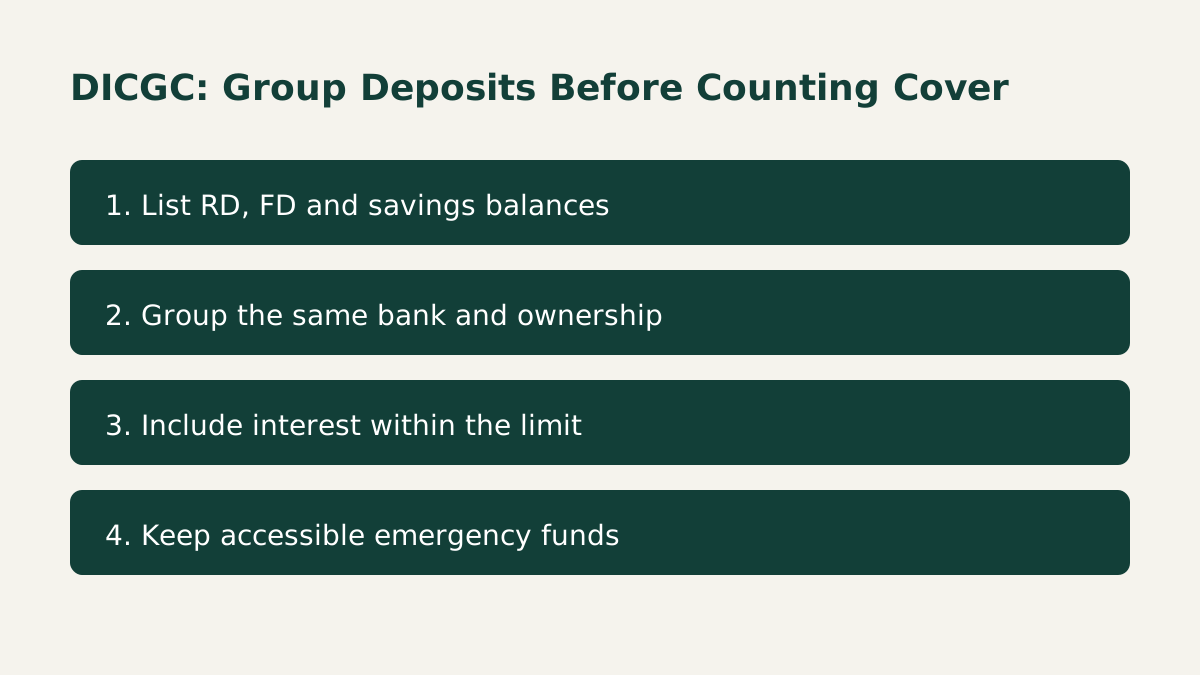
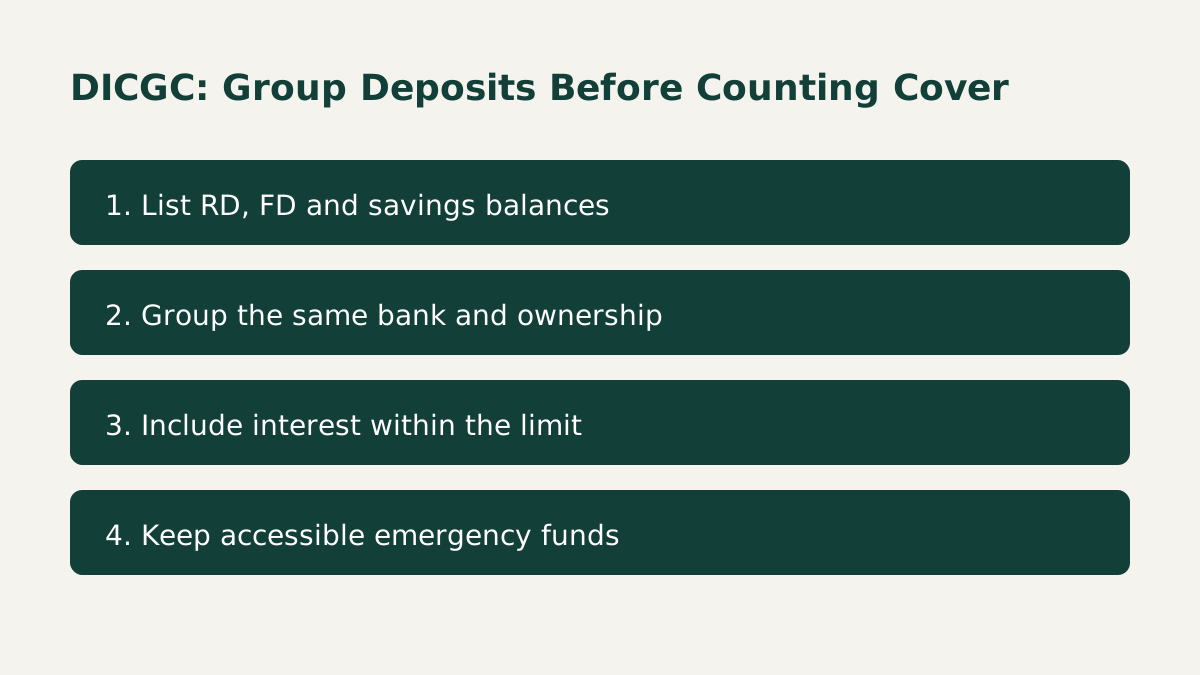
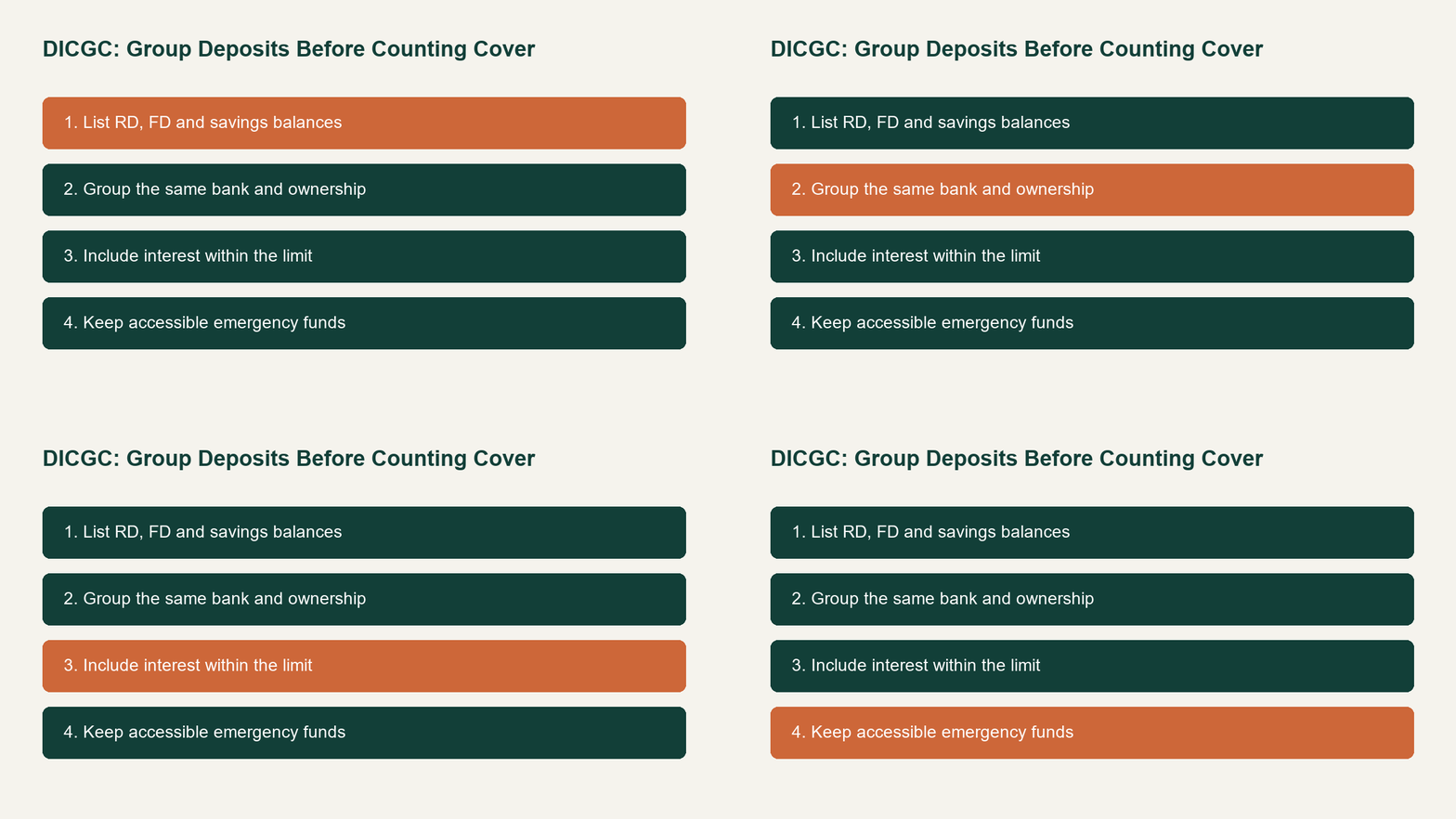
List RD, FD, savings and current balances including interest.
Group ownership
Match bank legal identity, holders, order and right/capacity.
Check coverage
Confirm insured bank and eligible product; exclude investments.
Review liquidity
Keep accessible emergency funds and maintain current claim records.
Before you finish
- List RD, FD, savings and current balances including interest.
- Match bank legal identity, holders, order and right/capacity.
- Confirm insured bank and eligible product; exclude investments.
- Keep accessible emergency funds and maintain current claim records.
Need help with Banking?
Share your blocker in one line. Our experts will reply with practical next steps.
The decision at a glance
Keep the decisions in the right order
Do not treat this checklist as approval
This AI-written guide explains the decision process. The relevant institution must confirm your facts and application. It does not guarantee eligibility, tax treatment or an outcome.
Need help with Banking?
Share your blocker in one line. Our experts will reply with practical next steps.
Animated decision map
Community signal
What to watch in real discussions
Treat repeated complaints as risk signals rather than official advice. This page does not link to community search results.
Interactive checkpoint
Turn this guide into a decision file
0 of 4 checked
Are recurring deposits covered by DICGC?
Yes, eligible recurring deposits at insured banks are among the covered deposit types, subject to the scheme rules.
Do my RD and FD each receive Rs 5 lakh cover?
Not when they are at the same bank in the same right and capacity. Their balances aggregate with other eligible deposits.
Do different branches create separate cover?
No. Deposits at branches of the same bank are aggregated for the relevant ownership grouping.
Is interest included in the limit?
Yes. The Rs 5 lakh maximum includes principal and interest together.
Are deposits in different insured banks separate?
DICGC says the coverage limit applies separately to deposits in each bank.
Does this cover a mutual fund bought through my bank?
No. The DICGC guide lists mutual funds among products not covered by deposit insurance.
Your NRE account redesignation has a deadline.
Banks don't remind you. You need the right account stack before salary, rent, and EMIs start moving. Get the exact sequence.