The 60-second version
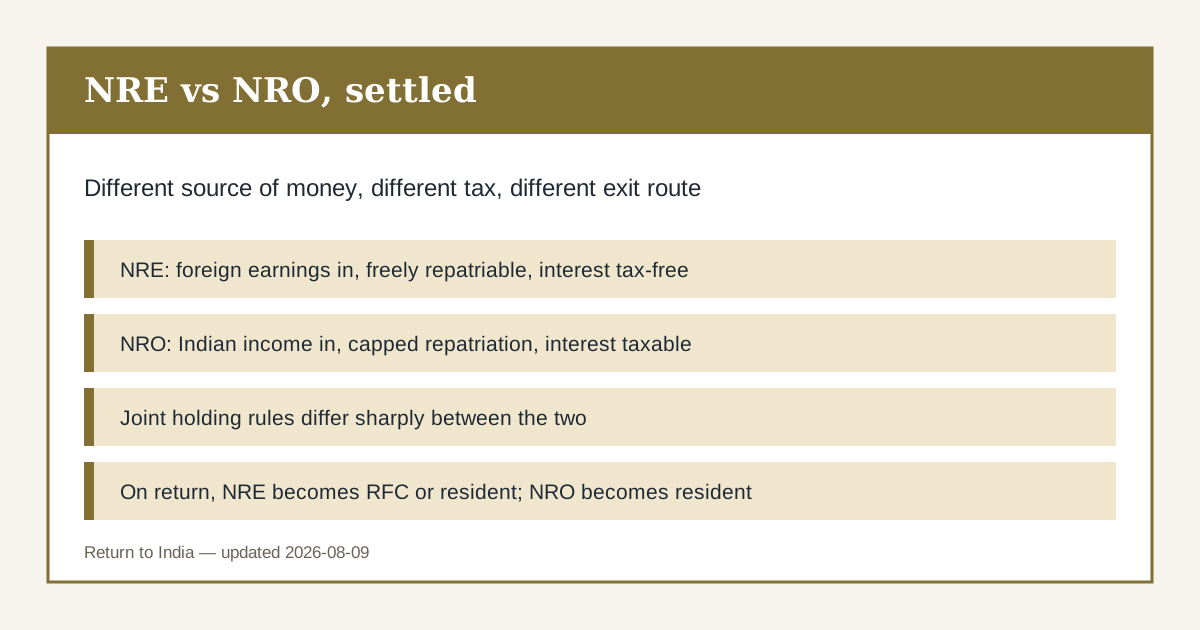
NRE holds repatriable foreign earnings with tax-free interest; NRO holds Indian-sourced income with taxable interest and a USD 1 million per financial year repatriation cap. On permanent return, neither survives — both convert, but they convert into different things.
Fast answer: the difference is where the money came from
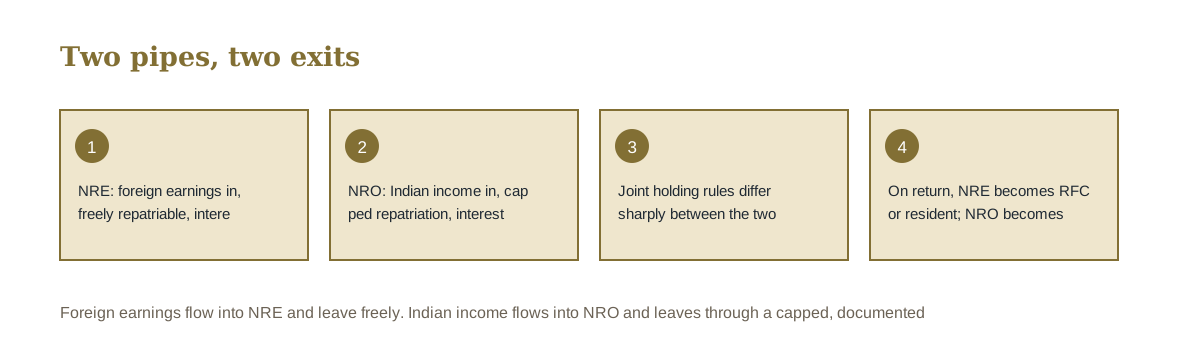
Every other difference between NRE and NRO follows from one thing — the origin of the money. NRE, the Non-Resident External account, is designed to receive earnings from outside India. Because that money was never Indian income, the rupee balance is freely repatriable and the interest is exempt from Indian income tax while you are a non-resident.
NRO, the Non-Resident Ordinary account, is designed to receive income that arises in India: rent from a flat you own, dividends from Indian shares, a pension, a maturing Indian deposit, proceeds from selling Indian property. That money is Indian income, so interest is taxable, tax is deducted at source, and taking the balance out of the country runs through a documented repatriation route capped at USD 1 million per financial year.
The practical mistake is routing money into the wrong pipe. Indian rent credited to an NRE account, or a salary transfer from abroad parked in an NRO account, creates a mismatch that is painful to unwind years later when you want to repatriate. Get the routing right at the start and the exit is straightforward.
NRE versus NRO on every dimension that matters
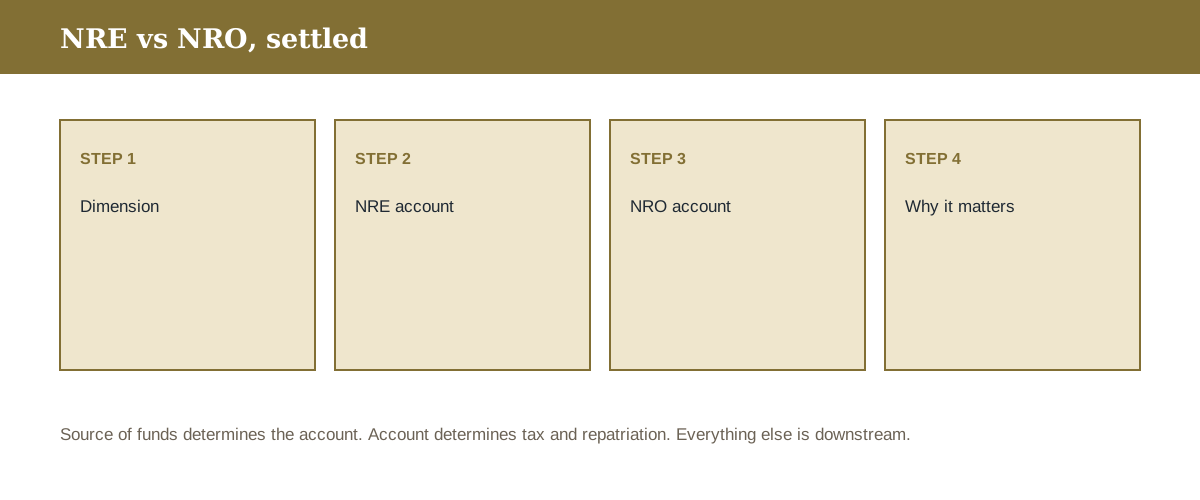
This is the comparison to bookmark. The last row is the one almost nobody plans for until the week they land.
| Dimension | NRE account | NRO account | Why it matters |
|---|---|---|---|
| What you can credit | Earnings from outside India, remitted in foreign currency and converted to rupees | Income arising in India — rent, dividends, pension, maturity proceeds, sale proceeds | Crediting the wrong source into the wrong account is the root of most repatriation refusals |
| Interest taxability in India | Exempt from Indian income tax while you hold non-resident status | Taxable, with tax deducted at source at the applicable non-resident rate | Drives which account you should keep surplus balances in before you return |
| Repatriation of the balance | Freely repatriable — principal and interest | Permitted up to USD 1 million per financial year, subject to documentation | The cap is per financial year and applies across all your NRO balances taken together |
| Paperwork to send money out | Minimal — standard bank remittance instructions | Form 15CA plus a chartered accountant's Form 15CB, with the tax position evidenced | The 15CA/15CB pair is where most NRO repatriations stall |
| Joint holding | May be held jointly with another non-resident; with a resident close relative on a former-or-survivor basis | May be held jointly with residents and with non-residents | The joint-holding rules are asymmetric and are a frequent source of branch confusion |
| Currency risk | Rupee account — converting at remittance means you carry rupee exposure | Rupee account — same exposure | FCNR(B) exists precisely to hold foreign currency without conversion |
| What happens on permanent return | Typically redesignated to a resident account, or the balance moved into an RFC account | Typically redesignated to an ordinary resident account | Both must be dealt with; leaving them open in non-resident form is a FEMA problem |
The redesignation sequence when you move back
Do this in order and in one branch visit if possible. Doing it piecemeal is how people end up with a frozen account and a KYC mismatch.
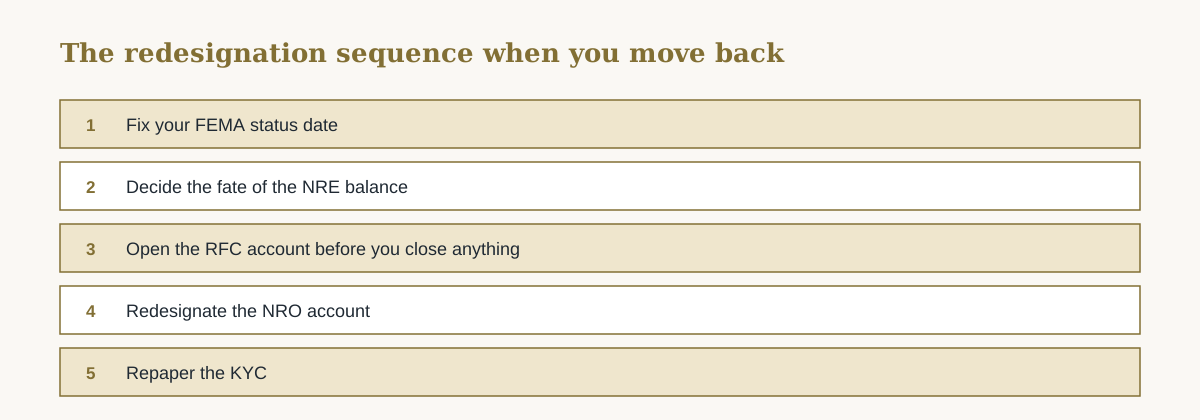
Fix your FEMA status date
Decide and record the date you became a person resident in India — normally the date you returned for an uncertain period for employment, business or vocation. Every subsequent instruction is dated from there.
Decide the fate of the NRE balance
Two broad routes: redesignate to a resident rupee account, or move the balance into a Resident Foreign Currency account if you want to keep holding foreign currency without converting to rupees.
Open the RFC account before you close anything
An RFC account lets a returning resident hold foreign currency in India. Open it first, so foreign-currency balances have somewhere to land instead of being force-converted.
Redesignate the NRO account
The NRO converts to an ordinary resident account. Any pending repatriation you intended to make under the USD 1 million route should be considered before the conversion, not after.
Repaper the KYC
New address proof, updated contact details, PAN linkage, and the Indian mobile number that will receive one-time passwords. Do this on the same day as redesignation so the records do not disagree.
Fix every downstream mandate
Mutual fund folios, demat accounts, insurance premium mandates, standing instructions and dividend credit accounts all point at the old account type. Update each one, or payments will bounce.
Archive the evidence
Save the redesignation request, the bank's acknowledgement, the closing statements of the NRE and NRO accounts, and the opening statement of the resident and RFC accounts.
Account audit before you land
Run this three months before the move, while you can still call your Indian bank as a non-resident.
- A written list of every NRE, NRO and FCNR(B) account and deposit, with balances and maturity dates.
- Confirmation of what has been credited to each account over the last two years, by source.
- Any Indian income sitting in an NRE account identified and flagged for correction.
- Any foreign remittance sitting in an NRO account identified, because it may be repatriable outside the cap.
- A decision on whether an RFC account is needed, taken before the return date.
- Fixed deposits checked for premature-closure penalties triggered by redesignation.
- Joint holders informed, because their operating rights change on redesignation.
- Nominations reviewed and refreshed on each account.
- Standing instructions, SIPs and insurance mandates mapped to the accounts they debit.
- The USD 1 million per financial year repatriation headroom checked before the status change.
Two pipes, two exits
Need help with Banking?
Share your blocker in one line. Our experts will reply with practical next steps.
Community signal: the wrong-pipe problem is extremely common
Unable to embed reddit content. View on reddit
"The recurring thread is someone discovering that Indian rent was credited to an NRE account for years, and now the repatriation trail does not support the claim."
Read on reddit ->Institutional signal: banks explain the accounts, not the transition
"Bank explainers cover NRE and NRO as products. What they rarely cover is the redesignation sequence on permanent return, which is where returnees actually get stuck."
Read on youtube ->NRE and NRO decision diagram
Need help with Banking?
Share your blocker in one line. Our experts will reply with practical next steps.
Do not leave NRE or NRO accounts running after you return
Continuing to hold accounts in non-resident form after you have become a person resident in India under FEMA is a compliance breach, not an administrative oversight. Redesignate promptly and keep the bank's acknowledgement.
The one-sentence answer
NRE holds foreign earnings with tax-free interest and free repatriation, NRO holds Indian income with taxable interest and a USD 1 million per financial year repatriation cap — and on permanent return both must be redesignated, with an RFC account opened first if you want to keep holding foreign currency.
Animated decision map

Need help with Banking?
Share your blocker in one line. Our experts will reply with practical next steps.
Interactive checkpoint
Turn this guide into a decision file
0 of 4 checked
What is the main difference between an NRE and an NRO account?
The source of the money. NRE receives earnings from outside India and is freely repatriable with interest exempt from Indian tax while you are non-resident. NRO receives income arising in India, its interest is taxable with tax deducted at source, and repatriation is capped at USD 1 million per financial year.
Which account should I use for rent from my flat in India?
An NRO account. Rent is income arising in India and belongs in the NRO pipe. Crediting it to an NRE account creates a mismatch that complicates repatriation later.
Is NRE interest really tax free?
Interest on an NRE account is exempt from Indian income tax while you hold non-resident status. The exemption is tied to your status, so it does not survive your becoming a resident, and it says nothing about tax in your country of residence.
Can I hold an NRE or NRO account jointly with a resident Indian?
The rules differ. An NRO account may generally be held jointly with residents and non-residents. An NRE account may be held jointly with another non-resident, and with a resident close relative on a former-or-survivor basis. Confirm the current position in the RBI Master Direction and with your bank.
What is the USD 1 million repatriation limit?
Balances in NRO accounts may generally be remitted abroad up to USD 1 million per financial year, subject to documentation including Form 15CA and a chartered accountant's Form 15CB. The limit applies across your NRO balances taken together, not per account.
What happens to my NRE account when I move back to India?
It does not continue as an NRE account. On becoming a person resident in India, the account is generally redesignated as a resident account, or the balance is transferred to a Resident Foreign Currency account if you want to keep holding foreign currency.
Should I close my NRE account before returning?
Not necessarily close — redesignate. Closing early can trigger premature-withdrawal penalties on linked deposits and can strand standing instructions. Plan the conversion, including whether to open an RFC account, before the return date.
Can I keep foreign currency in India after returning?
A Resident Foreign Currency account is designed for exactly that. It lets a returning resident hold eligible foreign currency in India without converting to rupees at the moment of return.
Do I need Form 15CA and 15CB for NRE repatriation too?
NRE repatriation is generally straightforward because the funds originated abroad and the interest is exempt. The Form 15CA and Form 15CB documentation pair is characteristically associated with NRO repatriation, where Indian tax has to be evidenced.
Your NRE account redesignation has a deadline.
Banks don't remind you. You need the right account stack before salary, rent, and EMIs start moving. Get the exact sequence.