Raising an Autistic Child: India or the USA?
A structured comparison for families weighing a return to India with an autistic or neurodivergent child — therapy access, school inclusion, legal entitlements,...
The 60-second version
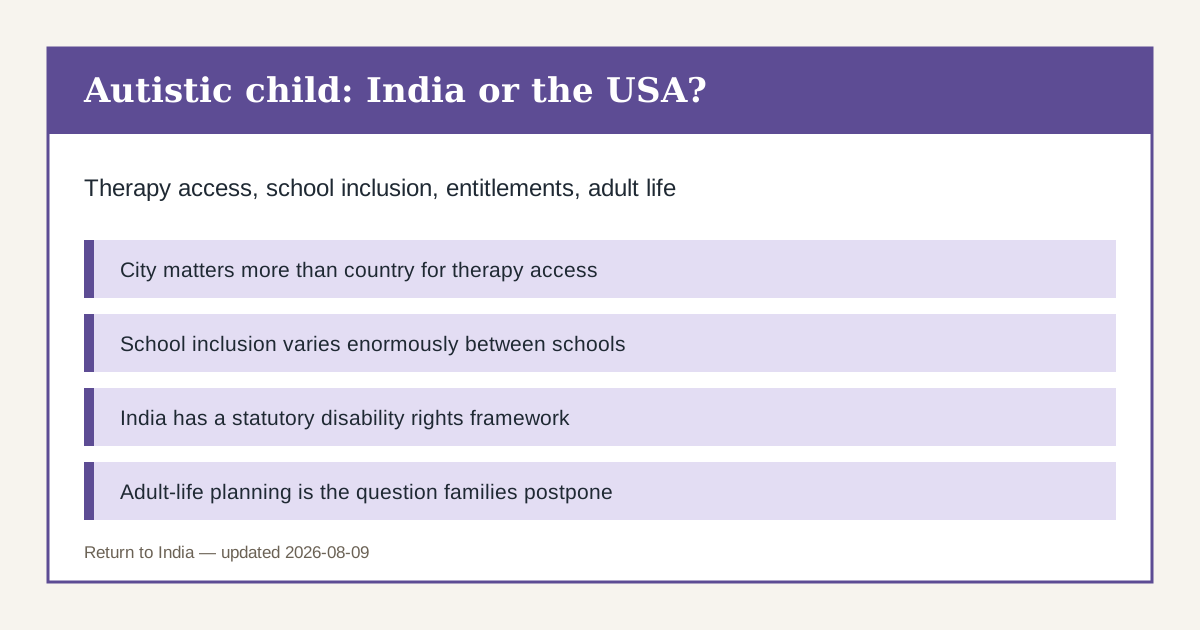
For a family with an autistic child, the return decision hinges on four things: whether comparable therapy exists in the specific Indian city, whether a school will genuinely include the child, what the legal entitlement framework provides, and what adult life looks like in each country.
Fast answer: this is a city and school decision, not a country decision
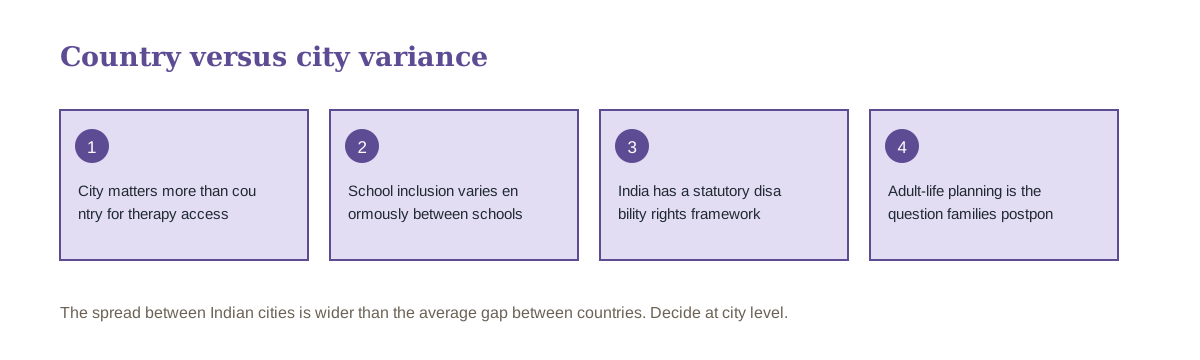
Framing this as 'India versus the USA' produces an unanswerable question, because the variance within India is far larger than any average difference between the two countries. Therapy availability, trained professionals, inclusive schools and adult services are concentrated in specific cities and, within those cities, in specific institutions. A family moving to one Indian city may find comparable provision to what they had; a family moving to another may find very little.
So the decision has to be made at the level of the actual destination. Which named therapists, with what training and what availability. Which specific schools have admitted and retained children with similar profiles, and what they actually provide rather than what their prospectus claims. What the waiting lists look like. Whether the therapy intensity your child currently receives can be sustained, and at what cost.
Two things do genuinely differ at the country level and should be weighed. India has a statutory rights framework for persons with disabilities, together with a certification and identification system that unlocks entitlements — but the practical experience of exercising those rights varies substantially. And the extended family support that many returning families are moving toward is a real, material resource in day-to-day caregiving that no service system replicates.
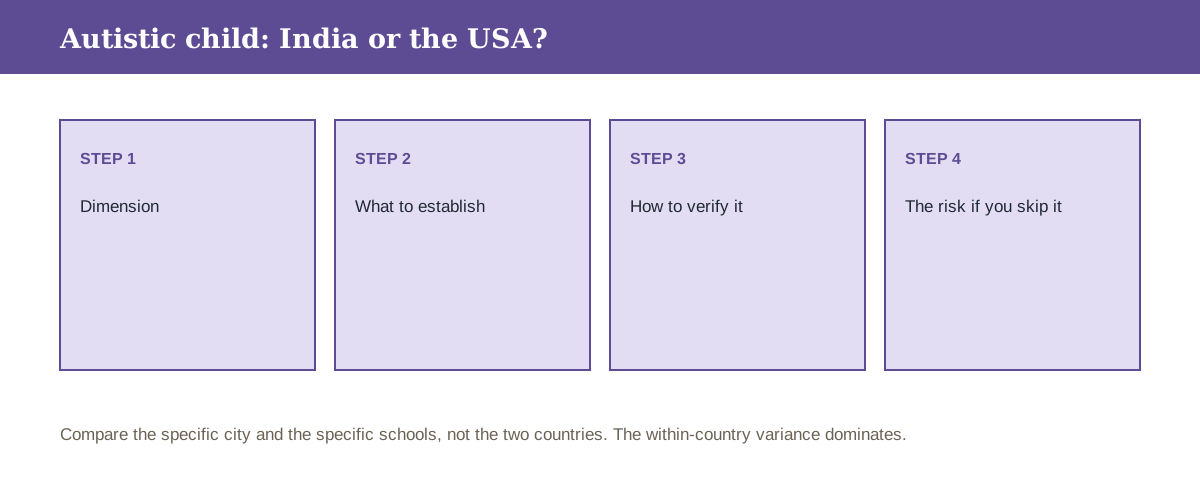
The four dimensions to compare
Fill this in for your actual destination city, not for India in general. Anything you cannot fill in is a research task, not a leap of faith.
| Dimension | What to establish | How to verify it | The risk if you skip it |
|---|---|---|---|
| Therapy access | Named providers, their training and registration, availability and waiting list | Contact providers directly; check professional registration; ask about current capacity | Arriving to find a twelve-month waiting list for the therapy your child relies on |
| Therapy intensity and continuity | Whether current hours per week can be sustained, and at what cost | Get written schedules and fees from named providers | A sharp reduction in intervention intensity at the worst possible moment |
| School inclusion | Schools that have actually admitted and retained similar children | Speak to parents of enrolled children, not only to admissions staff | Admission granted, then support quietly withdrawn after a term |
| Support staffing in school | Shadow teacher or aide policy, who employs and trains them, and the cost | Ask in writing; ask who supervises the aide | A shadow teacher arrangement the family must source, fund and manage alone |
| Legal entitlements | Disability certification, identification, and what each unlocks | The statutory framework and the official certification portal | Missing entitlements simply because certification was never obtained |
| Healthcare and insurance | Cover for therapies and associated conditions | Confirm in writing with named insurers before relying on it | Discovering exclusions after the move, when switching is difficult |
| Family and community support | Who is actually nearby, and what they can realistically do | An honest conversation, not an assumption | Building the plan on help that was never explicitly agreed |
| Adult-life planning | Vocational options, supported living, guardianship and financial provision | Research the specific options in the destination city | A plan that works for a child and fails for an adult |
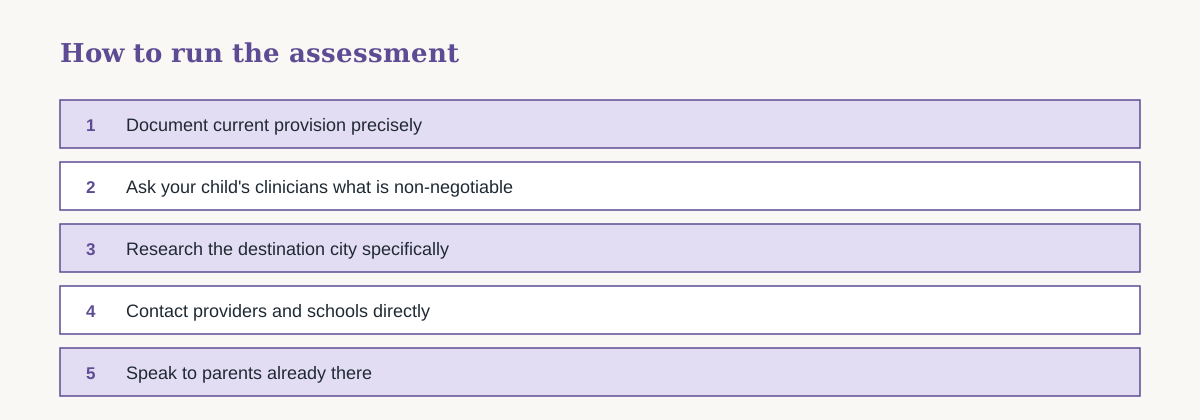
How to run the assessment
Budget several months. A decision of this weight should not be made from search results.
Document current provision precisely
Therapy types, hours per week, providers, school support arrangements, medications, and what has demonstrably worked. This is the benchmark against which any alternative is measured.
Ask your child's clinicians what is non-negotiable
Which elements of the current programme must be preserved, and which are flexible. Their view of what a disruption would cost is a central input, not an afterthought.
Research the destination city specifically
Named providers, named schools, registered professionals, parent networks and support organisations in that city. National-level information is not decision-grade.
Contact providers and schools directly
Ask about current capacity, waiting lists, fees, and experience with children of a similar profile. Ask schools how many similar children they currently have enrolled and how long those children have stayed.
Speak to parents already there
Parent networks give you the operating reality rather than the prospectus. This is consistently the most valuable research step and the one families most often skip.
Understand the entitlement framework
The statutory rights framework, the disability certification process and the identification system, and what each entitlement practically provides in your destination state.
Visit before deciding, with the child if possible
Meet the therapists, see the school, observe a session. Nothing in the research substitutes for this, and a child's own response to the environment is genuine information.
Plan for adulthood, not only for schooling
Vocational pathways, supported living options, guardianship arrangements and long-term financial provision. The school years end, and the plan needs to extend past them.
Decision file for a family with a neurodivergent child
This is the file that makes the decision defensible to yourselves in five years, whichever way it goes.
- Current therapy programme documented — type, hours, provider, outcomes.
- Current school support arrangements documented in detail.
- Written input from current clinicians on what must be preserved.
- Named therapy providers identified in the destination city.
- Professional registration verified for each named provider.
- Current capacity and waiting lists confirmed with each provider.
- Therapy costs obtained in writing for the intended intensity.
- Named schools identified with experience of similar profiles.
- Number of similar children currently enrolled asked for, and retention over time.
- Shadow teacher or aide policy confirmed, including who employs, trains and supervises.
- Conversations held with at least three parents already in that city.
- Disability certification and identification process understood for your state.
- Health insurance cover for therapies confirmed in writing before relying on it.
- Family support commitments discussed explicitly, not assumed.
- A visit completed, with the child where possible.
- Adult-life planning researched — vocational, supported living, guardianship, finances.
- A written reversal plan, including what it would cost and what must be preserved.
Country versus city variance
Need help with Schools & Family?
Share your blocker in one line. Our experts will reply with practical next steps.
Community signal: parent networks are the real information source
Unable to embed reddit content. View on reddit
"Families consistently report that parents already in the destination city gave them more usable information than any institutional source."
Read on reddit ->Community signal: school inclusion is uneven
"Admission and genuine inclusion are different things. The question that matters is how many similar children are currently enrolled and how long they have stayed."
Read on quora ->Special-needs relocation decision diagram
Need help with Schools & Family?
Share your blocker in one line. Our experts will reply with practical next steps.
Do not disrupt an effective programme without a confirmed replacement
Where a child is responding well to an established intervention, interrupting it without a confirmed, scheduled, funded replacement in the destination city carries real developmental risk. Secure the replacement in writing — named provider, start date, hours per week — before the move rather than after.
The one-sentence answer
Whether India or the USA is better for an autistic child depends on the specific destination city and the specific schools and therapists in it, so benchmark the current programme, verify named providers and schools directly, talk to parents already there, understand the statutory entitlement framework, visit before deciding, and secure a confirmed replacement programme before disrupting one that is working.
Animated decision map

Need help with Schools & Family?
Share your blocker in one line. Our experts will reply with practical next steps.
Interactive checkpoint
Turn this guide into a decision file
0 of 4 checked
Is India or the USA better for raising an autistic child?
The question cannot be answered at country level, because variation between Indian cities is far larger than any average difference between the two countries. Compare your specific destination city, its named therapy providers and its specific schools.
Is therapy available in India for autism?
Yes, with availability and quality concentrated in particular cities and institutions. Verify named providers, check professional registration, and confirm current capacity and waiting lists rather than relying on general availability claims.
Will an Indian school include my child?
Inclusion varies enormously between schools. The useful questions are how many children with similar profiles are currently enrolled, how long they have stayed, and what specific support the school provides rather than what its prospectus states.
What is a shadow teacher and who pays for one?
It is a one-to-one support aide accompanying a child in class. Arrangements differ substantially — some schools employ and supervise them, others expect the family to source, fund and manage the aide. Confirm the policy in writing before admission.
What legal rights does my child have in India?
The Rights of Persons with Disabilities Act 2016 establishes a statutory framework covering education, accessibility and non-discrimination. Practical access to entitlements generally requires disability certification and the associated identification, so start that process early.
How do I get a disability certificate in India?
Through the prescribed medical assessment process, with the unique disability identification issued through the official portal. The certification is what unlocks many entitlements, so treat it as an early task rather than a later one.
Will Indian health insurance cover therapies?
Coverage for developmental therapies varies considerably between policies and insurers. Confirm the position in writing with named insurers before the move, since switching cover after arrival is much harder.
How do I evaluate schools from abroad?
Contact schools directly with specific questions, then speak to parents of children already enrolled. Parent networks give the operating reality that admissions conversations do not, and a visit before deciding is worth more than any amount of remote research.
What about adult life and long-term planning?
Research vocational pathways, supported living options, guardianship arrangements and long-term financial provision in the destination city. A plan built only around schooling leaves the hardest transition unaddressed.
School admissions close fast — and some only take students in April.
Curriculum, timing, and location all need to be decided before you choose a neighborhood. Get clarity now.