Challenges NRIs Face Returning to India, and What Helps
The friction points returnees consistently report: paperwork density, the identity gap, spouse career disruption, children's schooling, healthcare navigation,...
The 60-second version
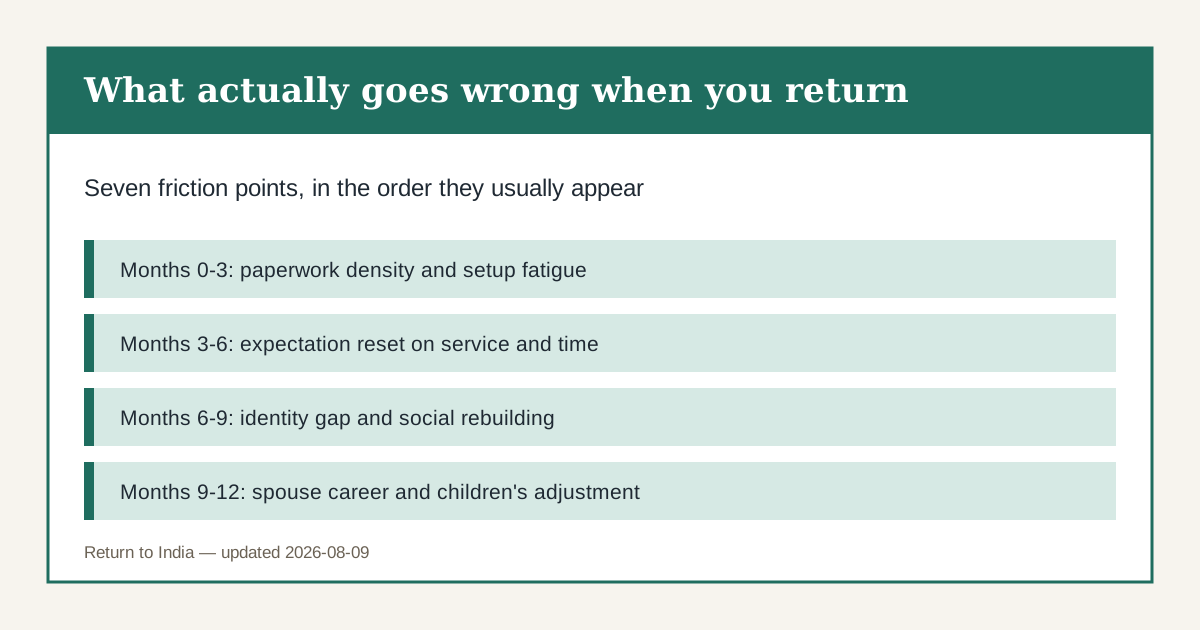
The hard parts of returning to India are rarely the ones people prepare for. Logistics get solved. What catches returnees is the identity gap, the spouse's career interruption, the density of one-time paperwork and the expectation reset on service and time.
Fast answer: the logistics get solved; the adjustment is what surprises people
Ask people who moved back what was hard and almost nobody says shipping. Containers arrive. Bank accounts get redesignated. Schools admit children. Furniture is bought. The operational side of a return is demanding but bounded, and it is largely finished within six months.
What people describe instead is a set of adjustments with no completion date. The sense of being read as an outsider in a place you consider home. A spouse whose career took the larger hit and whose network is entirely elsewhere. Children negotiating an unfamiliar academic and social system. An expectation reset on service quality, punctuality and how things get done. And a quiet, cumulative frustration with processes that assume you have been present in the system all along.
The countermeasures are not dramatic. They are mostly about sequencing — front-loading the paperwork so it stops consuming attention, protecting the spouse's professional continuity deliberately rather than incidentally, building social connection on purpose rather than assuming it will regenerate, and setting a review point far enough out that a bad third month does not get mistaken for a verdict.
The seven challenges and what actually works
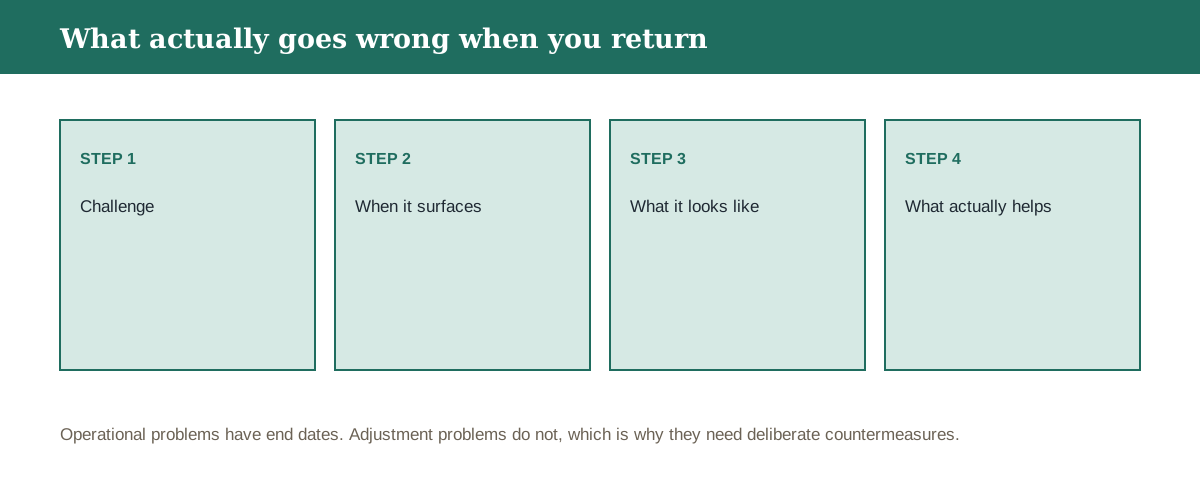
Ordered by when they typically surface. The countermeasure column is what returnees consistently report as effective.
| Challenge | When it surfaces | What it looks like | What actually helps |
|---|---|---|---|
| Paperwork density | Months 0-3 | Bank redesignation, KYC, PAN and Aadhaar linkage, address updates, utilities, school admissions — all at once | Treat it as one ninety-day sprint with a written checklist rather than as background admin |
| Expectation reset | Months 2-6 | Frustration with timelines, service quality and processes that assume prior presence | Budget time deliberately, use a local fixer for repeated tasks, and stop benchmarking against the old country |
| Identity gap | Months 4-9 | Being treated as an outsider in your own city; references and humour landing differently | Accept it as a phase with a duration, and invest in a small number of deep local relationships |
| Spouse career disruption | Months 3-12 | One partner's career restarts from a cold network while the other's continues | Plan the trailing spouse's professional path before the move, with a named target and a start date |
| Children's adjustment | Months 1-12 | Curriculum gaps, social integration, and a different academic pace and pressure | Choose the curriculum for continuity where possible, and give the transition year explicit slack |
| Healthcare navigation | Months 0-6, then on first need | Finding a physician you trust and understanding how the system actually works | Establish a named physician and hospital before you need one, not during the first emergency |
| Money movement learning curve | Months 0-6 | Repatriation documentation, residency-linked tax rules and record-keeping demands | Set the account structure and record discipline in month one, before the first large transaction |
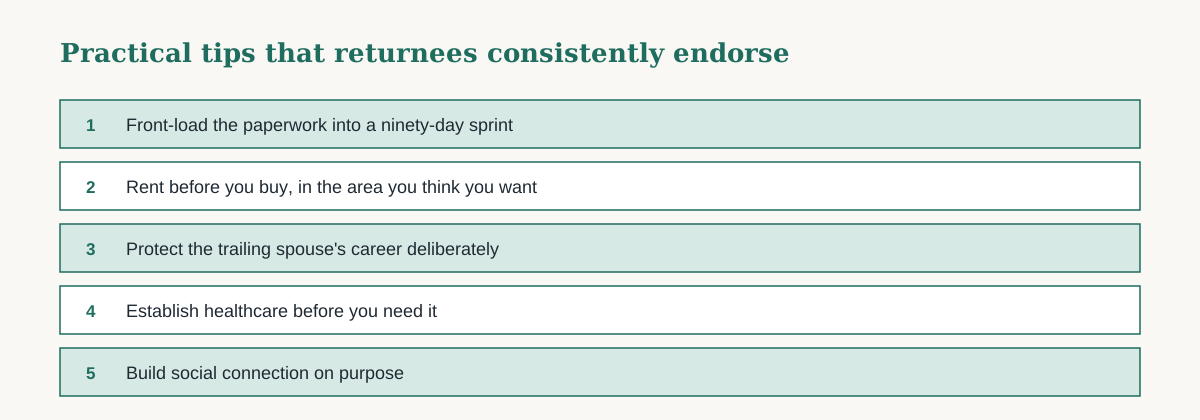
Practical tips that returnees consistently endorse
These come up repeatedly in return accounts. They are unglamorous and they work.
Front-load the paperwork into a ninety-day sprint
List every one-time task — bank redesignation, KYC, PAN and Aadhaar, address updates, utilities, school admission, vehicle, insurance — and finish them in a defined block instead of letting them trickle through the first year.
Rent before you buy, in the area you think you want
Twelve months of renting in the target neighbourhood reveals commute, noise, water reliability, power, neighbours and school access in a way no visit can. Buying in month two is the most common expensive mistake.
Protect the trailing spouse's career deliberately
Name the target role, the timeline and the network-building plan before the move. A career restart that is planned looks entirely different from one that is improvised in month eight.
Establish healthcare before you need it
A named physician, a named hospital, an insurance policy that will actually accept you, and a written emergency protocol. Doing this during a first crisis is how people end up in the wrong hospital.
Build social connection on purpose
Old friendships have moved on and proximity alone does not rebuild them. Join something structured — a sport, a class, a professional group, a neighbourhood association — within the first three months.
Set the money architecture in month one
Account structure, record-keeping discipline, residency status computation and repatriation route. Establishing this before the first large transaction avoids reconstructing records under pressure later.
Give it twelve months before you judge it
Agree written success criteria in advance and review at twelve months. Months three to six are the hardest stretch for most families and are a poor sample for a permanent conclusion.
First-year survival checklist
Tick these off in order. The ones people skip are numbers three, five and eleven.
- A written list of every one-time setup task, with a target completion date.
- Bank redesignation and KYC completed within the first month.
- PAN, Aadhaar where applicable and Indian mobile number linked consistently everywhere.
- A rental agreement rather than a purchase for the first twelve months.
- Named physician and hospital identified, with travel time tested in real traffic.
- Health insurance confirmed as issued, not merely quoted.
- School admission secured with the transition year's academic gaps identified.
- Trailing spouse's professional plan written, with a target and a start date.
- One structured social commitment started within three months.
- Account structure and record-keeping discipline established before the first large transaction.
- Residential status computed and RNOR years diarised.
- Written twelve-month review criteria agreed with your partner.
- A reversal plan documented, including cost and what must be preserved.
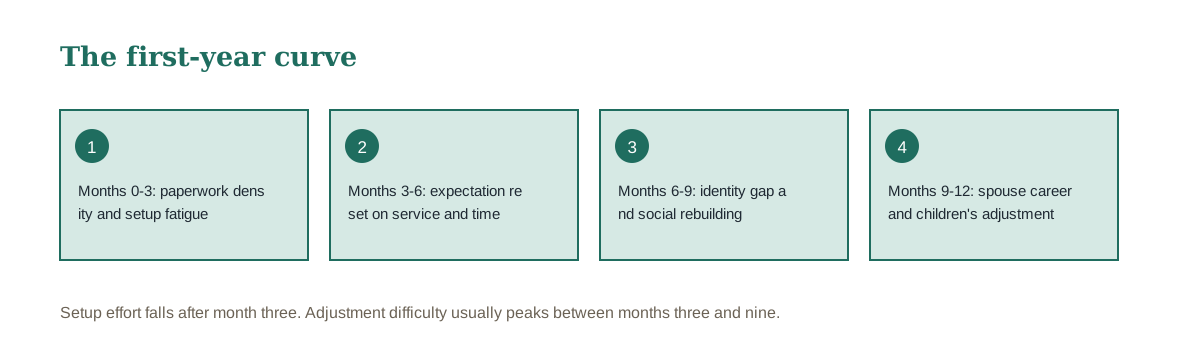
The first-year curve
Need help with Move Planning?
Share your blocker in one line. Our experts will reply with practical next steps.
Community signal: months three to six are the hardest
Unable to embed reddit content. View on reddit
"Return accounts consistently identify months three to six as the low point, after the novelty fades and before the new routines are established."
Read on reddit ->Community signal: the trailing spouse takes the larger hit
Unable to embed reddit content. View on reddit
"The partner whose job did not drive the move consistently reports the harder adjustment, which is why their professional plan needs to be explicit before the move rather than after."
Read on reddit ->First-year challenge timeline
Need help with Move Planning?
Share your blocker in one line. Our experts will reply with practical next steps.
Do not evaluate the move in month four
Months three to six are the statistically hardest stretch for most returning families — setup fatigue has accumulated, novelty has worn off, and new routines have not yet formed. Judging the decision in that window produces conclusions that most families later say were wrong.
The one-sentence answer
The hard parts of returning are the adjustment ones, not the logistical ones — so front-load the paperwork into a ninety-day sprint, rent before buying, plan the trailing spouse's career explicitly, fix healthcare before you need it, build social connection deliberately, and review the decision at twelve months rather than at four.
Animated decision map
Need help with Move Planning?
Share your blocker in one line. Our experts will reply with practical next steps.
Interactive checkpoint
Turn this guide into a decision file
0 of 4 checked
What is the hardest part of returning to India?
Most returnees say the adjustment rather than the logistics. Shipping, banking and school admission get finished. The identity gap, the trailing spouse's career restart and the expectation reset on service and time have no completion date.
When is the hardest period after moving back?
Typically months three to six. Setup fatigue has accumulated, the novelty has worn off, and new routines have not yet formed. It is a poor window in which to evaluate the decision.
Should I buy a house immediately after returning?
Usually not. Renting for twelve months in the target neighbourhood reveals commute, water reliability, power, noise, neighbours and school access in ways no visit can. Buying in the first few months is a frequently reported regret.
How do I handle my spouse's career disruption?
Plan it before the move. Name the target role, the timeline and the network-building approach, and treat it as a primary planning item rather than something to sort out after landing. The trailing partner consistently reports the harder adjustment.
How do children adjust to Indian schools?
Better with continuity of curriculum where possible, and with explicit academic slack in the transition year. Expect gaps in specific subjects and a different pace and pressure, and plan support rather than assuming a smooth switch.
What is reverse culture shock?
The disorientation of returning to a place you consider home and finding that both you and it have changed. It typically surfaces around months four to nine and eases as new routines and relationships form.
How do I rebuild a social circle after years abroad?
Deliberately. Old friendships have moved on and proximity alone does not restore them. Joining something structured within the first three months — a sport, a class, a professional group — is what returnees consistently report as effective.
What paperwork should I finish first?
Bank redesignation and KYC, PAN and Aadhaar linkage, an Indian mobile number, a consistent address across all records, health insurance and school admission. Treating these as one defined sprint works far better than handling them piecemeal.
How long before I know whether the move worked?
Give it twelve months against criteria written down in advance. Anything shorter is dominated by transition friction, and anything much longer risks passing the point where reversal remains practical.
The plan is only as good as the sequence.
Tax, banking, schools, shipping — they all have dependencies. A wrong order costs months and lakhs. Get it right.