Removals to India: International Moving, Customs Duty and Door-to-Door Shipping Guide 2026
Planning removals to India? This guide covers full-service international moving companies, Transfer of Residence customs duty exemption, packing and shipping options...
The 60-second version
International removals to India typically involve a door-to-door moving service that handles packing, customs, shipping, and delivery. Returning Indians can claim Transfer of Residence (TR) customs duty exemption on used personal and household effects. This page explains the end-to-end removals process, documentation requirements, and cost factors.
Fast answer: what 'removals to India' covers and what it costs
International removals to India means a door-to-door moving service that packs your household goods abroad, ships them by sea or air freight, handles Indian customs clearance, and delivers them to your new address in India. Full-service removals typically cost between £ 2,000 and £ 8,000 (or $ 3,000–$ 12,000) for a standard three-bedroom household, depending on the origin country, volume, and shipping mode.
Returning NRIs and OCI holders who have lived abroad for at least two years are entitled to Transfer of Residence (TR) customs duty exemption on used personal and household effects under the Baggage Rules, 2016 (amended) read with the CBIC Transfer of Residence guidelines. This means most of your used furniture, clothing, books, kitchen appliances, and personal electronics enter India duty-free.
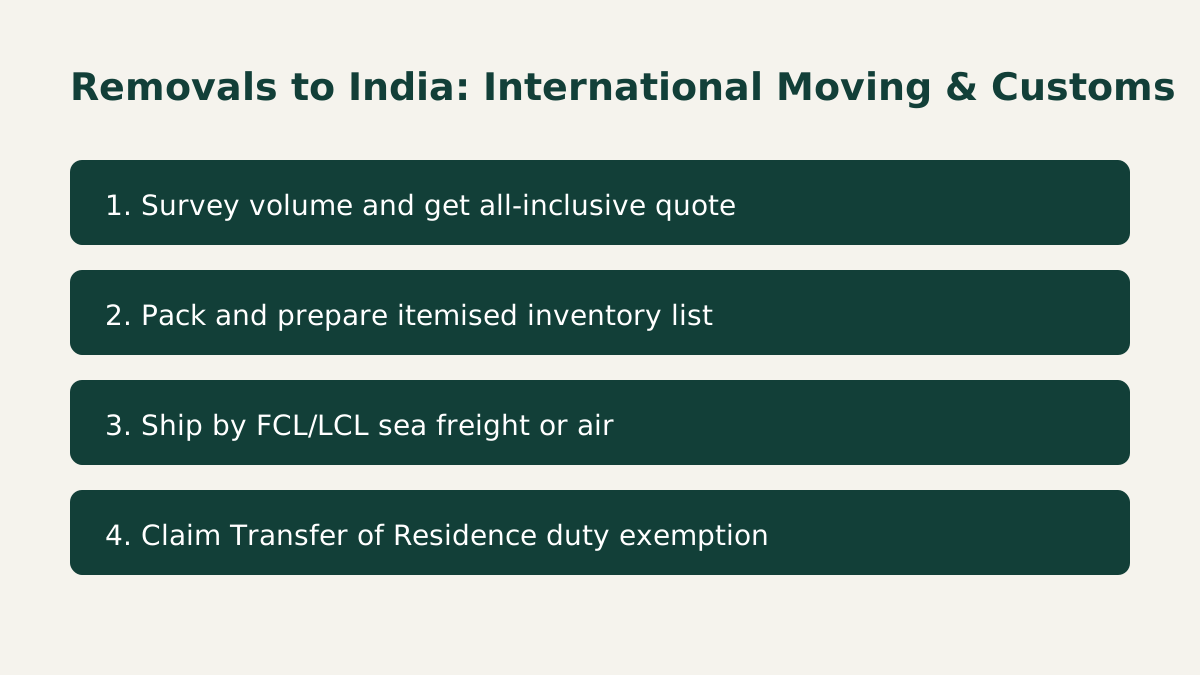
The process has four main stages: pre-move survey and quotation, packing and export clearance at origin, sea or air transit, and Indian customs clearance with last-mile delivery. Each stage has specific documentation requirements that this guide walks through.
End-to-end removals process: origin to Indian doorstep
A typical international removal to India follows these stages.
Pre-move survey and quotation
A removal company surveys your household (in person or by video call) to estimate the volume in cubic feet or cubic metres. They quote for packing materials, export customs paperwork at origin, ocean or air freight, Indian customs clearance, and last-mile delivery. Ask for an all-inclusive quote that covers both origin and destination charges.
Packing and inventory
Professional packers wrap furniture, box dishes and fragile items, and create a detailed packing list — item by item, box by box. This inventory becomes your customs declaration. Mark items as 'used personal effects' on the list. New items and restricted goods (alcohol, firearms, drones, certain electronics) must be declared separately.
Export clearance and loading
The removal company handles any export customs paperwork at the origin country. For FCL (Full Container Load) shipments, a 20-foot or 40-foot container is loaded at your door. For LCL (Less than Container Load), your goods are collected, taken to a warehouse, and consolidated with other shipments.
Sea or air transit
Sea freight to India takes 4–8 weeks from Europe or the USA, and 2–4 weeks from the Middle East or Southeast Asia. Air freight takes 5–10 days but costs 4–6 times more per cubic metre. Most household removals go by sea due to cost.
Indian customs clearance
Your goods arrive at an Indian port (typically Nhava Sheva/JNPT near Mumbai, Chennai, or Mundra). The destination agent files a Bill of Entry and presents your Transfer of Residence documents to customs. Inspection may be physical or based on the declared inventory. Duty-free clearance applies to used personal and household effects for eligible returning residents.
Last-mile delivery and unpacking
After customs release, the goods are transported by road to your home. Full-service removals include unpacking, furniture reassembly, and removal of packing debris. Confirm the condition of items against your inventory and file any transit insurance claims within the policy window (usually 14–30 days).
Shipping modes compared: FCL, LCL and air freight
Choose your shipping mode based on volume, budget, and urgency.
| Factor | FCL (Full Container) | LCL (Shared Container) | Air Freight |
|---|---|---|---|
| Best for | 3+ bedroom household | Studio to 2-bedroom or partial move | Urgent essentials or small shipments |
| Volume | 20-ft (1,170 cu ft) or 40-ft (2,390 cu ft) | Any volume; charged per cu ft or cu metre | Charged per kg (volumetric or actual) |
| Indicative cost from UK | £ 3,000–£ 6,000 | £ 1,500–£ 3,500 | £ 4–£ 8 per kg |
| Indicative cost from USA | $ 4,000–$ 9,000 | $ 2,000–$ 5,000 | $ 5–$ 10 per kg |
| Transit time | 4–8 weeks | 5–10 weeks (warehouse consolidation adds time) | 5–10 days |
| Security | Sealed container; only your goods | Shared space; slight co-loading risk | Tracked pallets |
| Customs clearance | Single Bill of Entry | Single Bill of Entry | Through air cargo complex |
Transfer of Residence customs documents checklist
Returning Indians (citizens and OCI holders) claiming TR duty exemption need these documents at the Indian port.
- Valid passport with immigration stamps showing departure and return dates
- OCI card (if applicable) with valid U-visa stamp
- Proof of residence abroad for at least two years (visa, residence permit, utility bills, or employment letter)
- Detailed packing list matching the Bill of Lading or Air Waybill — item descriptions, quantity, and approximate value
- Bill of Lading (sea) or Air Waybill (air) — original or telex release
- TR declaration form filled and signed (available from your customs broker)
- Self-declaration that goods are personal effects, used for at least one year, and not for resale
- PAN card copy
- Aadhaar card copy with Indian address
- Two passport-size photographs
- Transit insurance policy document (not required by customs, but needed for claims)
- Separate declaration for any new or restricted items with applicable duty paid or waived
Items that are not duty-free under Transfer of Residence
TR duty exemption covers used personal and household effects only. New items purchased specifically for import, commercial quantities, alcohol above the personal allowance (2 litres), firearms, drones, satellite phones, and certain electronics may attract customs duty at applicable rates. Vehicles have a separate and much higher duty structure. Always declare new items honestly — misdeclaration can result in confiscation and penalty.
How to choose an international removal company for India
Look for removal companies that are members of FIDI (Fédération Internationale des Déménageurs Internationaux) or BAR (British Association of Removers) Overseas Group — these memberships require quality audits and insurance standards. Ask whether the company has its own office or a vetted partner in India for destination clearance.
Get at least three written quotes based on a physical or video survey, not just a phone estimate. Compare on an all-inclusive basis: packing, loading, freight, customs brokerage, destination port charges, delivery, and unpacking. The cheapest quote that excludes destination charges will end up more expensive.
Check the transit insurance policy carefully. 'Total loss only' cover is inadequate; you want 'all-risk' marine transit insurance that covers breakage, scratching, water damage, and theft. The standard market rate is approximately 3 %–5 % of the declared value of goods.
Confirm the timeline in writing: pack date, estimated sailing date, estimated arrival, and delivery window. Sea freight delays of one to two weeks are common; build a buffer into your planning.
Need help with Move Planning?
Share your blocker in one line. Our experts will reply with practical next steps.
Typical cost breakdown for removals to India
The total cost of an international removal to India can be broken into five components: (1) packing and loading at origin — 15 %–20 % of total; (2) origin port charges and export formalities — 5 %–10 %; (3) ocean freight — 40 %–50 %; (4) Indian port charges, customs brokerage, and duty (if any) — 15 %–20 %; and (5) last-mile delivery and unpacking — 5 %–10 %.
Destination charges in India are a frequent source of surprise. These include Container Freight Station (CFS) charges, terminal handling, customs examination fees, and transportation from the port to your home. Ask your removal company for an itemised estimate of destination charges before you commit.
For a standard 20-foot container from the UK to Mumbai, expect a total all-inclusive cost of approximately £ 3,500–£ 5,500. From the eastern USA to Mumbai, $ 5,000–$ 8,000 is a reasonable range. Costs from the Middle East are lower — AED 8,000–AED 15,000 for a 20-foot container from Dubai to Mumbai.
Planning visual

Animated decision map

Decision workflow map
Community signal
What to watch in real discussions
Treat repeated complaints as risk signals rather than official advice. This page does not link to community search results.
Interactive checkpoint
Turn this guide into a decision file
0 of 4 checked
How long does an international removal to India take?
Sea freight transit from the UK or USA to India takes 4–8 weeks. Add 1–2 weeks for packing at origin and 1–2 weeks for customs clearance and delivery in India. Total end-to-end is typically 7–12 weeks for sea shipments.
Do returning NRIs pay customs duty on household goods?
Returning Indian citizens and OCI holders who have lived abroad for at least two years can claim Transfer of Residence customs duty exemption on used personal and household effects. New items, commercial quantities, and restricted goods are not exempt.
What is the cheapest way to ship household goods to India?
LCL (Less than Container Load) sea freight is the cheapest for small volumes. For a full household, a 20-foot FCL container offers the best value per cubic foot. Air freight is 4–6 times more expensive and is only recommended for urgent essentials.
Can OCI holders claim Transfer of Residence in India?
Yes, OCI cardholders who are returning to settle in India can claim TR exemption, provided they have lived abroad for at least two years and the goods are used personal effects. The OCI card and valid U-visa stamp must be presented at customs.
What items cannot be shipped to India duty-free?
New items purchased for import, alcohol above 2 litres, firearms, drones, satellite phones, gold and silver beyond personal jewellery limits, and vehicles attract customs duty. Commercial quantities of any goods are also not eligible for TR exemption.
Should I get transit insurance for removals to India?
Yes. All-risk marine transit insurance typically costs 3 %–5 % of declared value and covers breakage, water damage, theft, and total loss. Without it, any damage in transit is at your cost. File claims within the policy window, usually 14–30 days after delivery.
What are destination charges in India and how much do they cost?
Destination charges include Container Freight Station handling, terminal handling, customs examination, ground rent, and transportation to your home. These typically add 15 %–20 % to the total cost. Always ask for an itemised destination charge estimate before booking.
The plan is only as good as the sequence.
Tax, banking, schools, shipping — they all have dependencies. A wrong order costs months and lakhs. Get it right.