Nri Parent Joint Property Nri Sibling Co Owner Partition Deed...
A practical 2026 guide for NRI parents on joint property + NRI sibling co-owner + partition deed + family settlement + Section 54 / 54F + FEMA USD 1M / year +...
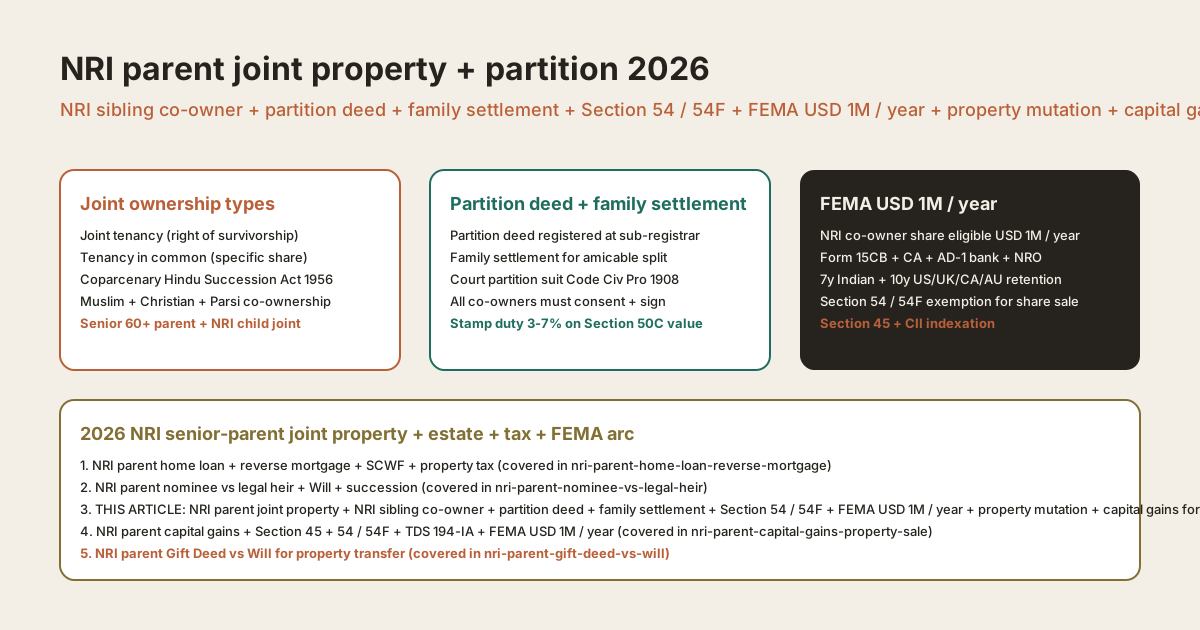
Why NRI parent joint property + NRI sibling co-owner + partition deed + family settlement + Section 54 / 54F + FEMA USD 1M / year + property mutation + capital gains is the most consequential senior 60+ joint property + tax + FEMA decision (and why 2026 changed it)
Every NRI senior parent with Indian residence + Indian joint property + NRI sibling co-owner + NRI co-owner share + inherited property + senior 60+ parent estate needs faces the under-served challenge of joint ownership type + partition deed + family settlement + Section 54 / 54F + FEMA USD 1M / year + property mutation + capital gains + co-owner consent + stamp duty + sub-registrar + ITR + Schedule CG + Schedule FA + Form 67 + TRC + DTAA. Indian property law + Indian Registration Act 1908 + Indian Stamp Act 1899 + Hindu Succession Act 1956 + Muslim Personal Law Sharia + Christian Indian Succession Act 1925 + Parsi Indian Succession Act 1925 + Income Tax Act 1961 Section 45 + 48 + 54 + 54F + 111A + 112 + 112A + 194-IA + 206C(1G) + FEMA 1999 + RBI Master Direction + Code Civ Pro 1908 Order XX Rule 18 + Finance Act 2024 specify that the joint ownership type is via joint tenancy (right of survivorship) vs tenancy in common (specific share) vs coparcenary Hindu Succession Act 1956 (Class I heirs + daughter equal coparcener) vs Muslim + Christian + Parsi co-ownership + Indian default is tenancy in common + senior 60+ parent + NRI child typically tenancy in common with specific share, the partition deed + family settlement is via partition deed registered at sub-registrar + stamp duty 3-7% on Section 50C market value + 2 witnesses + co-owner consent + family settlement for amicable split + court partition suit Code Civ Pro 1908 Order XX Rule 18 for contested partition, the Section 45 + 54 / 54F for share sale is via STCG 20% Section 111A + LTCG 12.5% Section 112A + LTCG 20% Section 112 + Finance Act 2024 + CII 2001 base + CII 2026 376 for indexation + Section 54 (1 residential house reinvestment) + Section 54F (any asset class 5y lock-in) + CGAS Capital Gains Account Scheme deposit + Form 10-CCB + 1-time INR 2 crore cap, the FEMA USD 1M / year for NRI co-owner share is via NRI / PIO / OCI eligible + Form 15CB + CA certificate + AD-1 bank + NRO account + repatriation proof FIRC + bank statement 7y Indian + 10y US/UK/CA/AU + combined across all properties + all sources of capital gains + TCS 5% Section 206C(1G) above INR 50L, and the Aadhaar + PAN + bank + MF + demat + OCI propagation is via partition deed + family settlement + co-owner consent + property mutation + Section 45 + 54 / 54F + CGAS + FEMA USD 1M / year + ITR + Form 67 + DTAA + Schedule FA + Schedule CG + Section 80C + 80TTB + 80D + 80DDB + Form 10-I to Aadhaar + PAN + bank + MF + demat + OCI + senior citizen ID card within 90 days. The 2026 simplified rules cut the average partition deed + family settlement processing time from 6-12 months to 1-3 months, expanded the Section 54F 1-time INR 2 crore cap for NRI co-owner share + senior 60+ parent estate, and unified the joint ownership + partition + tax + FEMA + property mutation pathway for NRI senior-parent estate.
The decision is not just about joint ownership type. It is also about the 5 distinct NRI senior-parent joint property + partition + tax + FEMA decisions (1. decide joint ownership type - joint tenancy (right of survivorship) vs tenancy in common (specific share) vs coparcenary Hindu Succession Act 1956 (Class I heirs + daughter equal coparcener) vs Muslim + Christian + Parsi co-ownership; 2. decide partition deed vs family settlement vs court partition - partition deed registered at sub-registrar (3-7% stamp duty on Section 50C value) for amicable split; family settlement for NRI co-owner disputes; court partition suit Code Civ Pro 1908 Order XX Rule 18 for contested partition; 3. decide Section 45 + 54 / 54F for share sale - STCG 20% Section 111A (within 24m) + LTCG 12.5% Section 112A (listed equity / equity MF) + LTCG 20% Section 112 (property / unlisted / debt MF) + CII 2001 base + CII 2026 376 for indexation + Section 54 (1 residential house reinvestment) + Section 54F (any asset class 5y lock-in) for NRI co-owner share; 4. decide FEMA USD 1M / year - NRI co-owner share eligible + Form 15CB + CA + AD-1 bank + NRO account + 7y Indian + 10y US/UK/CA/AU + combined across all properties + all sources of capital gains; 5. decide property mutation + co-owner consent - all co-owners must consent + sign partition deed + family settlement; property mutation at sub-registrar 90-270 days with succession certificate + legal heir + co-owner consent + Aadhaar + PAN + KYC + Section 80TTB + 80C + 80D + 80DDB claim), the 7-step joint property + partition + tax + FEMA flow (T-3m to T+0 co-owner consent + T-1m to T+30d partition deed drafting + family settlement amicable + T+30d to T+90d partition deed registration at sub-registrar + T+90d to T+180d property mutation + T+post-partition Section 45 + 54 / 54F + CGAS + T+post-partition FEMA USD 1M / year + T+90d Aadhaar + PAN + bank + MF + demat + OCI propagation), the document checklist (partition deed + family settlement + co-owner consent + co-owner Aadhaar + PAN + co-owner KYC + property documents + succession certificate + legal heir + property mutation + CA certificate + Form 15CB + AD-1 bank + repatriation proof + CII indexation table + ITR-2 / ITR-3 + Schedule CG + Form 67 + TRC + DTAA + Section 80C + 80TTB + 80D + 80DDB + Form 10-I + CGAS deposit receipt + Section 54 / 54F declaration + Form 10-CCB), the joint ownership type pathway (joint tenancy + tenancy in common + coparcenary + Indian default tenancy in common + senior 60+ parent + NRI child typically tenancy in common with specific share), the partition deed + family settlement pathway (partition deed + family settlement + co-owner consent + stamp duty 3-7% + sub-registrar + 2 witnesses), the Section 45 + 54 / 54F for share sale pathway (STCG 20% + LTCG 12.5% / 20% + CII indexation + Section 54 + Section 54F + CGAS + 1-time INR 2 crore cap), the FEMA USD 1M / year pathway (NRI / PIO / OCI + Form 15CB + CA + AD-1 bank + NRO + 7y + 10y + TCS 5% Section 206C(1G)), and the Aadhaar + PAN + bank + MF + demat + OCI propagation (within 90 days + senior citizen ID card + partition deed + family settlement + co-owner consent + property mutation + Section 45 + 54 / 54F + CGAS + FEMA USD 1M / year + ITR + Form 67 + DTAA + Schedule FA + Schedule CG).
The 2026 landscape has expanded the NRI parent joint property + NRI sibling co-owner + partition deed + family settlement + Section 54 / 54F + FEMA USD 1M / year + property mutation + capital gains pathway at every layer: more NRI senior parents are using the joint ownership type pathway (tenancy in common + specific share + coparcenary + senior 60+ parent + NRI child) + more NRI senior parents are using the partition deed + family settlement pathway (partition deed + family settlement + co-owner consent + stamp duty 3-7% + sub-registrar) + more NRI senior parents are using the Section 45 + 54 / 54F for share sale (STCG 20% + LTCG 12.5% / 20% + CII 2001 base + CII 2026 376 + Section 54 + Section 54F + CGAS + Form 10-CCB + 1-time INR 2 crore cap) + more NRI senior parents are using the FEMA USD 1M / year pathway (NRI / PIO / OCI + Form 15CB + CA + AD-1 bank + NRO + 7y + 10y + TCS 5% Section 206C(1G)) + more NRI senior parents are using the property mutation + co-owner consent pathway (succession certificate + legal heir + co-owner consent + Aadhaar + PAN + KYC + Section 80TTB + 80C + 80D + 80DDB) + more NRI senior parents are using the Aadhaar + PAN + bank + MF + demat + OCI propagation (within 90 days + senior citizen ID card + 7y + 10y) + and the NRI parent joint property + NRI sibling co-owner + partition deed + family settlement + Section 54 / 54F + FEMA USD 1M / year + property mutation + capital gains pathway has become the most consequential and most-mistaken NRI senior-parent joint property + tax + FEMA pathway. The order is fixed; the deliverables are not optional.
NRI parent joint property + partition overview
The 6 most common NRI parent joint property + partition mistakes cost INR 5-15 lakh + FEMA USD 1M / year window
Mistake 1: Senior 60+ parent + NRI co-owner do not obtain partition deed + family settlement before sale - sale is voidable + buyer can rescind + NRI co-owner loses FEMA USD 1M / year window + co-owner share unclear. Mistake 2: Senior 60+ parent + NRI co-owner do not claim Section 54 / 54F exemption for share sale - pays INR 5-15 lakh extra LTCG tax. Mistake 3: Senior 60+ parent + NRI co-owner do not deposit in CGAS Capital Gains Account Scheme if no immediate purchase - loses Section 54 / 54F exemption. Mistake 4: NRI co-owner does not pay advance tax 4 instalments - pays Section 234B + 234C interest for default. Mistake 5: NRI co-owner does not obtain Form 15CB + CA certificate + AD-1 bank + NRO account for FEMA USD 1M / year repatriation - co-owner share proceeds locked in India. Mistake 6: Senior 60+ parent + NRI co-owner do not file ITR + Form 67 + DTAA + Schedule FA + Schedule CG within AY+1 - capital gains tax penalty + DTAA benefit forfeited + FEMA USD 1M / year window missed.
NRI parent joint property + NRI sibling co-owner + partition deed + family settlement + Section 54 / 54F + FEMA USD 1M / year: 5-ownership + tax + FEMA matrix and the joint property + partition + tax + FEMA outcome each pathway triggers
Each pathway triggers a different joint property + partition + tax + FEMA outcome. Confirm which pathway fits the NRI senior-parent joint ownership + partition + co-owner consent + stamp duty + sub-registrar + ITR + Schedule CG + Schedule FA + Form 67 + TRC + DTAA + FEMA USD 1M / year needs before starting the joint property + partition + tax + FEMA flow.
| Pathway | Eligibility + tax + FEMA | Documentation + cost | Best for |
|---|---|---|---|
| Joint ownership type (joint tenancy / tenancy in common / coparcenary) | Joint tenancy: right of survivorship (last to die inherits) + Tenancy in common: specific share + Coparcenary: Hindu Succession Act 1956 Class I heirs + daughter equal coparcener | Sale deed + co-owner consent + Aadhaar + PAN + KYC + property documents + succession certificate + legal heir + co-owner succession certificate | Senior 60+ parent + NRI child joint property (typical tenancy in common with specific share) |
| Partition deed + family settlement | Partition deed registered at sub-registrar + stamp duty 3-7% on Section 50C market value + 2 witnesses + co-owner consent + family settlement for amicable split + court partition suit Code Civ Pro 1908 Order XX Rule 18 for contested partition | Partition deed + co-owner consent + stamp duty 3-7% + registration fee INR 1,000-5,000 + sub-registrar + 2 witnesses + co-owner Aadhaar + PAN + co-owner NRI status proof (passport + visa + NRI certificate) | Senior 60+ parent + NRI co-owner + sibling co-owners amicable split OR court partition for contested |
| Section 45 + 54 / 54F for share sale | STCG 20% Section 111A (within 24m) + LTCG 12.5% Section 112A (listed equity / equity MF) + LTCG 20% Section 112 (property / unlisted / debt MF) + Finance Act 2024 + CII 2001 base + CII 2026 376 + Section 54 (1 residential house reinvestment) + Section 54F (any asset class 5y lock-in) + CGAS + 1-time INR 2 crore cap + Form 10-CCB | Sale deed + stamp duty 3-7% + TDS 194-IA 1% above INR 50L + advance tax 4 instalments + Section 234B + 234C + ITR-2 / ITR-3 + Schedule CG + Form 67 + TRC + DTAA + 8-year carry forward per Section 90(4) | NRI co-owner share sale + reinvestment in 1 residential house (Section 54) or any asset class (Section 54F) |
| Property mutation at sub-registrar | Partition deed + family settlement + co-owner consent + co-owner succession certificate + legal heir + Aadhaar + PAN + KYC + mutation fee INR 5,000-50,000 + 90-180 days processing + Section 80TTB + 80C + 80D + 80DDB claim | Partition deed + family settlement + co-owner consent + co-owner Aadhaar + PAN + KYC + property documents + co-owner NRI status proof (passport + visa + NRI certificate) + senior citizen ID card | Senior 60+ parent + NRI co-owner + sibling co-owners property mutation at sub-registrar |
| FEMA USD 1M / year for NRI co-owner share | NRI / PIO / OCI eligible + Form 15CB + CA certificate + AD-1 bank + NRO account + repatriation proof FIRC + bank statement 7y Indian + 10y US/UK/CA/AU + combined across all properties + all sources of capital gains + TCS 5% Section 206C(1G) above INR 50L | Partition deed + family settlement + co-owner consent + co-owner Aadhaar + PAN + KYC + co-owner NRI status proof + property documents + Form 15CB + CA + AD-1 bank + NRO account + FIRC + bank statement 7y Indian + 10y US/UK/CA/AU | NRI co-owner share repatriation to foreign account within 12 months of share sale |
NRI parent joint property + partition: 5 ownership + tax + FEMA matrix
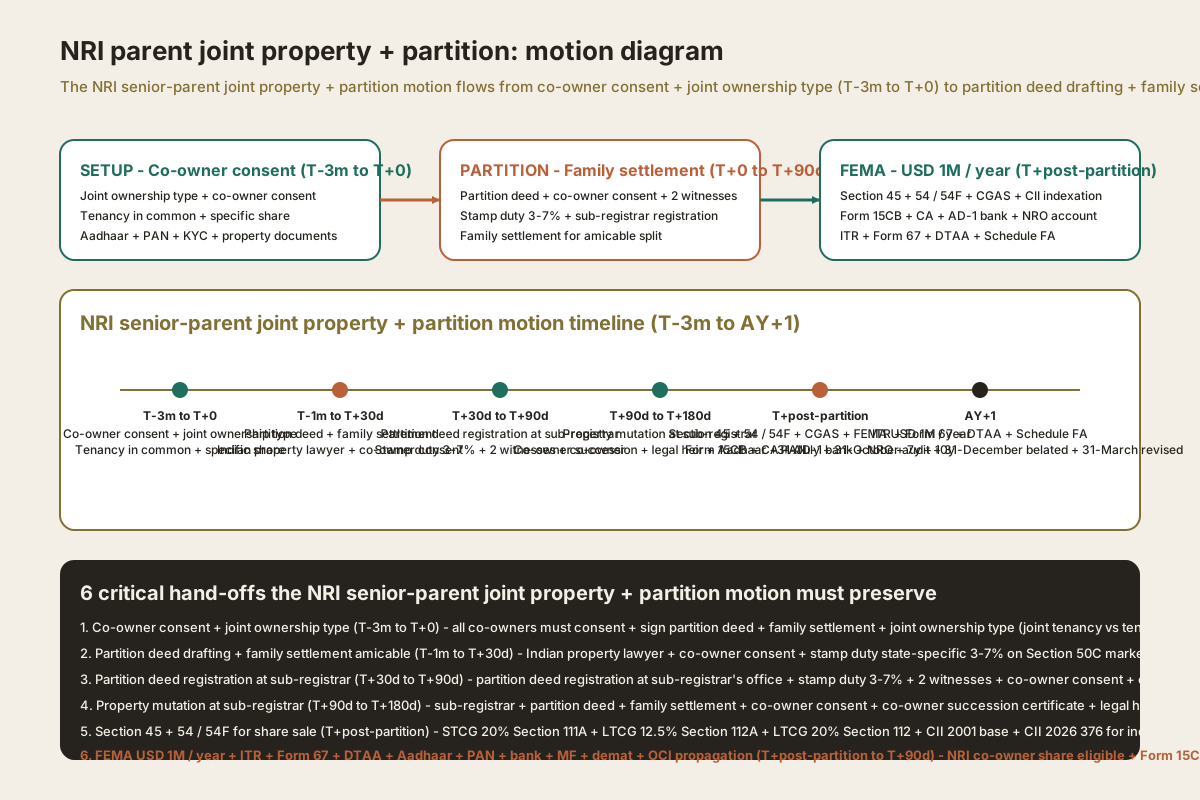
Joint ownership type vs partition deed vs FEMA USD 1M / year - the central choice for NRI senior-parent joint property + tax + FEMA
The first and most consequential decision the NRI senior-parent household makes is whether to use a joint ownership type pathway or a partition deed pathway or a FEMA USD 1M / year repatriation pathway. Each one serves a different senior 60+ parent joint property + NRI co-owner + partition + tax + FEMA need and triggers a different joint property + partition + tax + FEMA + property mutation + co-owner consent + stamp duty + sub-registrar + ITR + Schedule CG + Schedule FA + Form 67 + TRC + DTAA outcome. Pick the wrong one and the NRI co-owner pays INR 5-15 lakh extra tax, or loses the FEMA USD 1M / year window, or pays Section 234B + 234C interest for default + penalty for non-filing of ITR + Schedule CG + Schedule FA + Form 67 + TRC + DTAA claim.
Joint ownership type is the legal foundation. Indian property law recognizes 4 joint ownership types: (1) Joint tenancy (right of survivorship - last to die inherits the entire property automatically). This is rare in India but common in the US/UK. (2) Tenancy in common (specific share - each co-owner owns a specific undivided share, e.g., 50% + 50% or 1/3 + 1/3 + 1/3). This is the Indian default for joint property acquired by 2 or more persons. (3) Coparcenary under Hindu Succession Act 1956 (Class I heirs include spouse + sons + daughters + mother + father + son's daughter + son's son, with daughter equal coparcener after 2005 amendment). This applies to Hindu joint family ancestral property. (4) Muslim + Christian + Parsi co-ownership (specific share per personal law). For senior 60+ parent + NRI child joint property, tenancy in common with specific share is the most common. The catch: joint tenancy right of survivorship can override the Will, so senior 60+ parent + NRI child should explicitly specify tenancy in common with specific share in the sale deed + partition deed + family settlement.
Partition deed + family settlement is the amicable split mechanism. When 2 or more co-owners want to split the joint property, they can execute a partition deed (registered at sub-registrar) or a family settlement (for amicable split among family members). The partition deed requires: (1) all co-owners to consent + sign, (2) stamp duty state-specific 3-7% on Section 50C market value (Karnataka 5% + Maharashtra 3% + Delhi 4% + Tamil Nadu 7% + UP 5% + Gujarat 4.9% + West Bengal 6% + Kerala 8%), (3) 2 witnesses, (4) registration at sub-registrar's office (registration fee INR 1,000-5,000), (5) property mutation at sub-registrar (mutation fee INR 5,000-50,000 + 90-180 days processing). The family settlement requires: (1) all co-owners to consent + sign, (2) family settlement deed (not necessarily registered but recommended), (3) co-owner Aadhaar + PAN + KYC + property documents, (4) stamp duty state-specific. For contested partition, court partition suit under Code Civ Pro 1908 Order XX Rule 18 is required (court fee INR 5,000-50,000 + lawyer fee INR 50,000-3,00,000 + 1-3 years processing).
Section 45 + 54 / 54F for share sale is the tax trigger + relief. When the NRI co-owner sells their share of the joint property, capital gains under Section 45 apply. STCG 20% Section 111A applies if the share was acquired within 24 months (Finance Act 2024 raised from 15% to 20%). LTCG 12.5% Section 112A applies for listed equity + equity-oriented mutual fund share (Finance Act 2024 raised from 10% to 12.5%). LTCG 20% Section 112 applies for property share + unlisted shares + debt MF + business + jewellery share with indexation benefit Section 48 (CII 2001 base + CII 2026 376 for indexation). The NRI co-owner can claim Section 54 exemption if the LTCG from share sale is reinvested in 1 residential house (purchase 2y before / 2y after / construct 3y after) or Section 54F exemption if invested in any asset class (5y lock-in). The exemption is limited to INR 2 crore of capital gains (1-time cap per lifetime per asset class). If no immediate reinvestment, deposit the LTCG amount in CGAS Capital Gains Account Scheme at an authorized bank within the due date of ITR filing. The catch: the Section 54 / 54F exemption is for the share sale only, not the entire joint property. The NRI co-owner must claim the exemption on their specific share.
FEMA USD 1M / year for NRI co-owner share is the post-tax repatriation trigger. After the NRI co-owner pays the capital gains tax (Section 111A + 112A + 112 + Section 54 / 54F exemption), the NRI co-owner can repatriate the share sale proceeds (after TDS 194-IA + capital gains tax + Section 54 / 54F) under FEMA USD 1M / year. The USD 1M / year limit is combined across all properties + all sources of capital gains + rent + interest + business + salary + all foreign currency remittances. The repatriation requires Form 15CB (CA certificate confirming the tax has been paid / deducted on the share sale) + AD-1 bank (State Bank of India + HDFC + ICICI + Axis + etc.) + NRO account + repatriation proof (FIRC + bank statement) for 7 years (Indian) + 10 years (US/UK/CA/AU). If the NRI co-owner remits the share sale proceeds abroad, TCS 5% Section 206C(1G) applies above INR 50 lakh. The catch: the NRI co-owner must apply for FEMA USD 1M / year within 12 months of the share sale to avoid the FEMA USD 1M / year window being missed.
The trade-off: joint ownership type is the legal foundation (tenancy in common + specific share is the Indian default), partition deed + family settlement is the amicable split mechanism (partition deed + stamp duty 3-7% + sub-registrar + family settlement), Section 45 + 54 / 54F is the tax trigger + relief (STCG 20% + LTCG 12.5% / 20% + Section 54 + Section 54F + CGAS + 1-time INR 2 crore cap), FEMA USD 1M / year is the post-tax repatriation (USD 1M / year combined across all properties + all sources of capital gains). For most NRI senior-parent joint property + NRI co-owner + partition + tax + FEMA scenarios, the right answer is: obtain co-owner consent (T-3m to T+0) + partition deed drafting + family settlement amicable (T-1m to T+30d) + partition deed registration at sub-registrar (T+30d to T+90d) + property mutation (T+90d to T+180d) + Section 45 + 54 / 54F + CGAS deposit (T+post-partition) + FEMA USD 1M / year repatriation (T+post-partition) + ITR + Form 67 + DTAA + Schedule FA (AY+1) + Aadhaar + PAN + bank + MF + demat + OCI propagation (T+90d).
Need help with Move Planning?
Share your blocker in one line. Our experts will reply with practical next steps.
Tenancy in common is the Indian default for NRI senior-parent joint property - the most-misunderstood rule in joint property + tax + FEMA
Indian property law defaults to tenancy in common for joint property acquired by 2 or more persons, not joint tenancy. This means each co-owner owns a specific undivided share (e.g., 50% + 50% or 1/3 + 1/3 + 1/3) and can sell, gift, or bequeath their share independently. The right of survivorship (which is the hallmark of joint tenancy) does NOT apply in India. The Supreme Court of India in the 2008 judgment (Kumar Hari vs State of Jharkhand) and the 2014 judgment (Narayanamma vs Govindappa) clarified that Indian property law does not recognize joint tenancy right of survivorship unless explicitly stated in the sale deed. For senior 60+ parent + NRI child joint property, this means: (a) specify tenancy in common with specific share in the sale deed (50% senior 60+ parent + 50% NRI child, or 1/3 each for 3 co-owners), (b) avoid joint tenancy right of survivorship unless explicitly desired, (c) draft a Will that explicitly names the heirs for the specific share (otherwise intestate succession applies per Indian Succession Act 1925 + Hindu Succession Act 1956 + Muslim Sharia + Christian 1925 + Parsi 1925), (d) obtain partition deed + family settlement for amicable split, (e) property mutation at sub-registrar with succession certificate + legal heir + co-owner consent + Aadhaar + PAN + KYC. The fix is to (a) verify the joint ownership type in the sale deed + partition deed + family settlement, (b) specify tenancy in common with specific share, (c) draft a Will for each co-owner's specific share, (d) obtain partition deed + family settlement + co-owner consent + stamp duty 3-7% + sub-registrar + 2 witnesses, (e) property mutation at sub-registrar with co-owner consent + Aadhaar + PAN + KYC + Section 80TTB + 80C + 80D + 80DDB claim + FEMA USD 1M / year for NRI co-owner share.
Joint ownership type vs partition deed vs FEMA USD 1M / year - NRI senior-parent joint property + tax + FEMA decision matrix
| Parameter | Joint ownership type | Partition deed + family settlement | FEMA USD 1M / year |
|---|---|---|---|
| Trigger | Sale of joint property by 2 or more co-owners to NRI child heir + senior 60+ parent + sibling co-owners | Amicable split (partition deed + family settlement) OR contested split (court partition suit Code Civ Pro 1908 Order XX Rule 18) | Post-tax repatriation of NRI co-owner share proceeds to NRI / PIO / OCI foreign account |
| Tax rate | N/A (joint ownership type does not trigger tax) | Stamp duty state-specific 3-7% on Section 50C market value + registration fee INR 1,000-5,000 | No additional tax, but TCS 5% Section 206C(1G) above INR 50L if remitted abroad |
| Documentation | Sale deed + co-owner consent + Aadhaar + PAN + KYC + property documents + succession certificate + legal heir + co-owner succession certificate | Partition deed + family settlement + co-owner consent + 2 witnesses + stamp duty 3-7% + sub-registrar + co-owner Aadhaar + PAN + KYC + co-owner NRI status proof (passport + visa + NRI certificate) | Partition deed + family settlement + co-owner consent + co-owner Aadhaar + PAN + KYC + co-owner NRI status proof + property documents + CA certificate + Form 15CB + AD-1 bank + NRO account + FIRC + bank statement 7y Indian + 10y US/UK/CA/AU |
| Cost | N/A (joint ownership type does not trigger cost) | Stamp duty 3-7% + registration fee INR 1,000-5,000 + court fee INR 5,000-50,000 (if contested) + lawyer fee INR 50,000-3,00,000 (if contested) | TCS 5% Section 206C(1G) above INR 50L + Form 15CB CA certificate fee INR 5,000-25,000 + AD-1 bank remittance fee INR 500-5,000 |
| Time window | N/A (joint ownership type is the legal foundation) | Partition deed + family settlement: 1-3 months (amicable) + 1-3 years (court partition) | 12 months from share sale (FEMA USD 1M / year window) |
| Best for | Senior 60+ parent + NRI child joint property (typical tenancy in common with specific share) + coparcenary Hindu Succession Act 1956 for ancestral property + Muslim + Christian + Parsi co-ownership | Senior 60+ parent + NRI co-owner + sibling co-owners amicable split + court partition for contested | NRI / PIO / OCI co-owner remitting share sale proceeds to foreign account |
| Risk | Joint tenancy right of survivorship overrides Will + intestate succession applies per Indian Succession Act 1925 + Hindu Succession Act 1956 | Missed co-owner consent + stamp duty 3-7% penalty + sub-registrar rejection + court partition delay 1-3 years | Missed 12-month FEMA USD 1M / year window + share sale proceeds locked in India + TCS 5% Section 206C(1G) |
7-step NRI parent joint property + NRI sibling co-owner + partition deed + family settlement + Section 54 / 54F + FEMA USD 1M / year joint property + tax + FEMA flow
Each step has a hard deadline. Missing the T-3m co-owner consent is the most common NRI senior-parent joint property + partition mistake.
Step 1 - Setup co-owner consent + joint ownership type (T-3m to T+0)
All co-owners must consent + sign partition deed + family settlement. Joint ownership type: joint tenancy (right of survivorship) vs tenancy in common (specific share) vs coparcenary Hindu Succession Act 1956 (Class I heirs + daughter equal coparcener) vs Muslim + Christian + Parsi co-ownership. Indian default is tenancy in common with specific share. Senior 60+ parent + NRI child typically tenancy in common with specific share. Aadhaar + PAN + co-owner consent + property documents + KYC. Indian property lawyer + co-owner NRI status proof (passport + visa + NRI certificate). Senior citizen ID card + Section 80TTB + 80C + 80D + 80DDB + Form 10-I claim + ITR + Form 67 + DTAA + advance tax + propagation.
Step 2 - Partition deed drafting + family settlement amicable (T-1m to T+30d)
Indian property lawyer + co-owner consent + stamp duty state-specific 3-7% on Section 50C market value. Family settlement for amicable split among NRI co-owner + senior 60+ parent + sibling co-owners. Court partition suit Code Civ Pro 1908 Order XX Rule 18 for contested partition. All co-owners must sign + 2 witnesses + registration at sub-registrar. Co-owner Aadhaar + PAN + KYC + property documents + co-owner NRI status proof (passport + visa + NRI certificate).
Step 3 - Partition deed registration at sub-registrar (T+30d to T+90d)
Partition deed registration at sub-registrar's office + stamp duty 3-7% on Section 50C market value + 2 witnesses + co-owner consent + co-owner Aadhaar + PAN + property documents + registration fee INR 1,000-5,000 + co-owner NRI status proof (passport + visa + NRI certificate) + Form 15CB + CA certificate + AD-1 bank + NRO account + stamp duty + state-specific stamp duty. Section 80TTB + 80C + 80D + 80DDB + Form 10-I claim + ITR + Form 67 + TRC + DTAA + advance tax + self-assessment tax + refund.
Step 4 - Property mutation at sub-registrar (T+90d to T+180d)
Property mutation at sub-registrar with partition deed + family settlement + co-owner consent + co-owner succession certificate + legal heir + Aadhaar + PAN + KYC. Mutation fee INR 5,000-50,000 + 90-180 days processing. Senior 60+ parent + NRI co-owner + sibling co-owners each get separate mutation entry. Section 80TTB + 80C + 80D + 80DDB + Form 10-I claim for ITR + Form 67 + TRC + DTAA + advance tax + self-assessment tax + refund + Section 234F late filing fee INR 1,000-5,000 if missed 31-July deadline + Section 234B + 234C interest for advance tax default.
Step 5 - Section 45 + 54 / 54F for share sale + CGAS deposit (T+post-partition)
Section 45 capital gains: STCG 20% Section 111A (within 24m) + LTCG 12.5% Section 112A (listed equity / equity MF) + LTCG 20% Section 112 (property / unlisted / debt MF) + CII 2001 base + CII 2026 376 for indexation. Section 54: LTCG exempt if reinvested in 1 residential house (purchase 2y before / 2y after / construct 3y after) + Section 54F: LTCG exempt if invested in any asset class (5y lock-in) + CGAS Capital Gains Account Scheme deposit if no immediate purchase (authorized bank) + ITR-2 / ITR-3 claim within ITR filing + Form 10-CCB + Section 54F declaration + 1-time INR 2 crore cap + 5y lock-in for Section 54F.
Step 6 - FEMA USD 1M / year repatriation (T+post-partition)
NRI co-owner share eligible for FEMA USD 1M / year + NRI status proof (passport + visa + NRI certificate) + partition deed + family settlement + co-owner consent + co-owner Aadhaar + PAN + property documents + Form 15CB + CA certificate + AD-1 bank (State Bank of India + HDFC + ICICI + Axis + etc.) + NRO account + repatriation proof (FIRC + bank statement) for 7 years (Indian) + 10 years (US/UK/CA/AU). USD 1M / year combined across all properties + all sources of capital gains + rent + interest. TCS 5% Section 206C(1G) above INR 50L if remitted abroad + Section 195 TDS for NRI remittance.
Step 7 - Aadhaar + PAN + bank + MF + demat + OCI propagation (T+90d)
Propagate partition deed + family settlement + co-owner consent + property mutation + Section 45 + 54 / 54F + CGAS + FEMA USD 1M / year + ITR + Form 67 + DTAA + Schedule FA + Schedule CG + Section 80C + 80TTB + 80D + 80DDB + Form 10-I to Aadhaar + PAN + bank + MF + demat + OCI + senior citizen ID card within 90 days. Update Aadhaar + PAN + bank + MF + demat with partition deed + co-owner share + FEMA USD 1M / year. Update OCI with property partition + FEMA USD 1M / year. Keep all documents for 7 years (Indian) + 10 years (US/UK/CA/AU).
NRI parent joint property + partition: 7-step partition + tax + FEMA flow
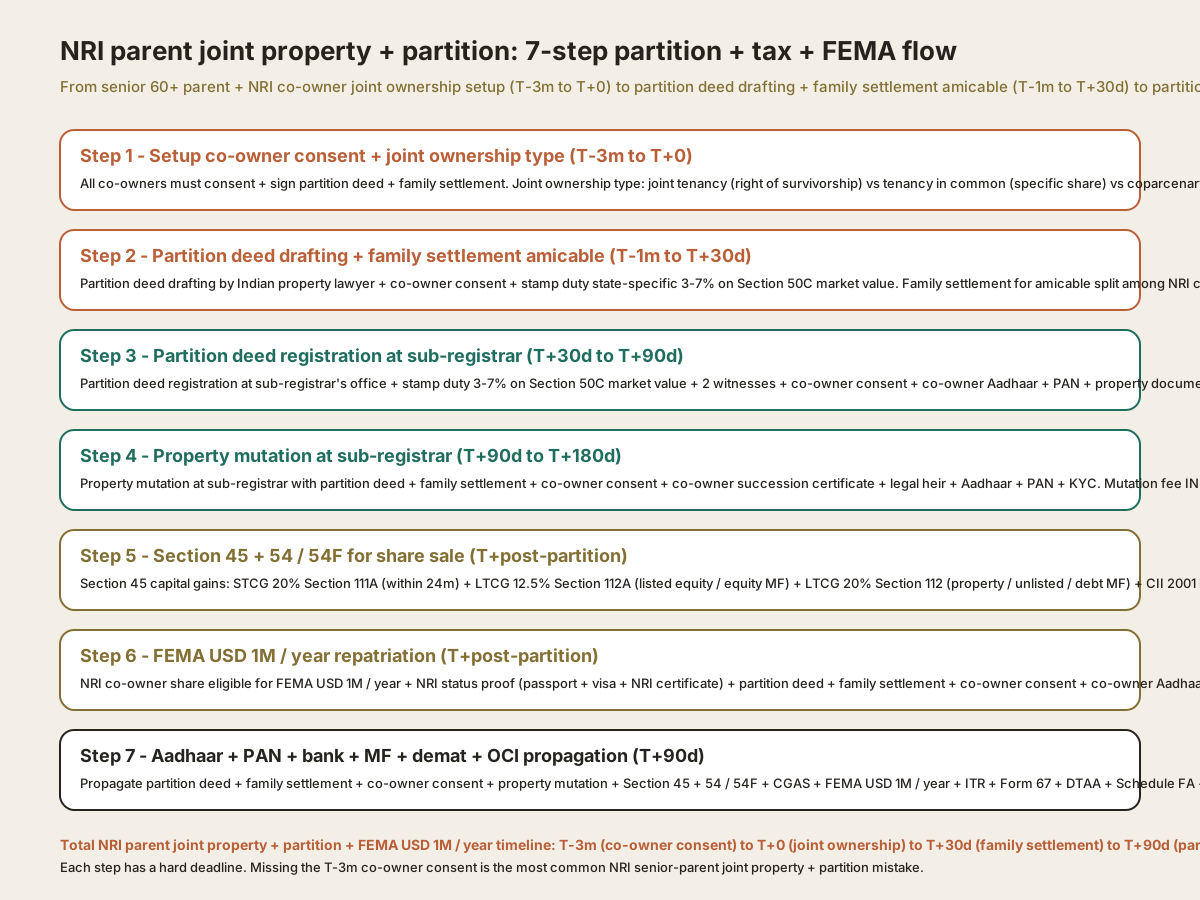
NRI parent joint property + partition motion diagram
Need help with Move Planning?
Share your blocker in one line. Our experts will reply with practical next steps.
NRI parent joint property + partition: 7-year senior 60+ survival matrix
NRI parent joint property + NRI sibling co-owner + partition deed + family settlement + Section 54 / 54F + FEMA USD 1M / year document checklist
- Co-owner consent + joint ownership type (T-3m to T+0): All co-owners must consent + sign partition deed + family settlement. Joint ownership type: joint tenancy (right of survivorship) vs tenancy in common (specific share) vs coparcenary Hindu Succession Act 1956 (Class I heirs + daughter equal coparcener) vs Muslim + Christian + Parsi co-ownership. Indian default is tenancy in common with specific share. Senior 60+ parent + NRI child typically tenancy in common with specific share. Aadhaar + PAN + co-owner consent + property documents + KYC. Indian property lawyer + co-owner NRI status proof (passport + visa + NRI certificate).
- Partition deed drafting + family settlement amicable (T-1m to T+30d): Indian property lawyer + co-owner consent + stamp duty state-specific 3-7% on Section 50C market value. Family settlement for amicable split among NRI co-owner + senior 60+ parent + sibling co-owners. Court partition suit Code Civ Pro 1908 Order XX Rule 18 for contested partition. All co-owners must sign + 2 witnesses + registration at sub-registrar. Co-owner Aadhaar + PAN + KYC + property documents + co-owner NRI status proof (passport + visa + NRI certificate).
- Partition deed registration at sub-registrar (T+30d to T+90d): Partition deed registration at sub-registrar's office + stamp duty 3-7% on Section 50C market value + 2 witnesses + co-owner consent + co-owner Aadhaar + PAN + property documents + registration fee INR 1,000-5,000 + co-owner NRI status proof (passport + visa + NRI certificate) + Form 15CB + CA certificate + AD-1 bank + NRO account + stamp duty + state-specific stamp duty.
- Property mutation at sub-registrar (T+90d to T+180d): Property mutation at sub-registrar with partition deed + family settlement + co-owner consent + co-owner succession certificate + legal heir + Aadhaar + PAN + KYC. Mutation fee INR 5,000-50,000 + 90-180 days processing. Senior 60+ parent + NRI co-owner + sibling co-owners each get separate mutation entry. Section 80TTB + 80C + 80D + 80DDB + Form 10-I claim for ITR + Form 67 + TRC + DTAA + advance tax + self-assessment tax + refund.
- Section 45 + 54 / 54F for share sale + CGAS deposit (T+post-partition): Section 45 capital gains: STCG 20% Section 111A (within 24m) + LTCG 12.5% Section 112A (listed equity / equity MF) + LTCG 20% Section 112 (property / unlisted / debt MF) + CII 2001 base + CII 2026 376 for indexation. Section 54: LTCG exempt if reinvested in 1 residential house (purchase 2y before / 2y after / construct 3y after) + Section 54F: LTCG exempt if invested in any asset class (5y lock-in) + CGAS Capital Gains Account Scheme deposit if no immediate purchase (authorized bank) + ITR-2 / ITR-3 claim within ITR filing + Form 10-CCB + Section 54F declaration + 1-time INR 2 crore cap + 5y lock-in for Section 54F.
- FEMA USD 1M / year repatriation (T+post-partition): NRI co-owner share eligible for FEMA USD 1M / year + NRI status proof (passport + visa + NRI certificate) + partition deed + family settlement + co-owner consent + co-owner Aadhaar + PAN + property documents + Form 15CB + CA certificate + AD-1 bank (State Bank of India + HDFC + ICICI + Axis + etc.) + NRO account + repatriation proof (FIRC + bank statement) for 7 years (Indian) + 10 years (US/UK/CA/AU). USD 1M / year combined across all properties + all sources of capital gains + rent + interest. TCS 5% Section 206C(1G) above INR 50L if remitted abroad + Section 195 TDS for NRI remittance.
- Aadhaar + PAN + bank + MF + demat + OCI propagation (T+90d): Aadhaar + PAN + bank + MF + demat + OCI + senior citizen ID card propagation within 90 days. Update Aadhaar + PAN + bank + MF + demat with partition deed + family settlement + co-owner consent + property mutation + Section 45 + 54 / 54F + CGAS + FEMA USD 1M / year. Update OCI with property partition + co-owner share + FEMA USD 1M / year. Keep all documents for 7 years (Indian) + 10 years (US/UK/CA/AU).
The 6 NRI parent joint property + partition decision points - and the cost of getting each one wrong
Six decisions in the NRI parent joint property + NRI sibling co-owner + partition deed + family settlement + Section 54 / 54F + FEMA USD 1M / year + property mutation + capital gains arc have outsized financial impact. Each is a place where the wrong call costs the NRI co-owner INR 5-15 lakh over 1-2 years - and where the right call preserves the FEMA USD 1M / year repatriation window + Section 54 / 54F exemption + ITR + Schedule CG + Schedule FA + Form 67 + TRC + DTAA claim.
Decision 1: Joint ownership type. Pick tenancy in common with specific share for senior 60+ parent + NRI child joint property. Pick coparcenary Hindu Succession Act 1956 for Hindu joint family ancestral property. Pick Muslim + Christian + Parsi co-ownership per personal law. Avoid joint tenancy right of survivorship unless explicitly desired. Wrong pick: senior 60+ parent + NRI child use joint tenancy, the last to die inherits the entire property, overriding the Will + creating intestate succession per Indian Succession Act 1925 + Hindu Succession Act 1956.
Decision 2: Partition deed vs family settlement vs court partition. Pick partition deed for amicable split (1-3 months + stamp duty 3-7% + sub-registrar). Pick family settlement for NRI co-owner disputes. Pick court partition suit Code Civ Pro 1908 Order XX Rule 18 for contested partition (1-3 years + court fee INR 5,000-50,000 + lawyer fee INR 50,000-3,00,000). Wrong pick: senior 60+ parent + NRI co-owner do not obtain partition deed before sale, sale is voidable + buyer can rescind + NRI co-owner loses FEMA USD 1M / year window + co-owner share unclear.
Decision 3: Section 54 / 54F for share sale. Pick Section 54 if the NRI co-owner wants to reinvest in 1 residential house within 2y / 3y. Pick Section 54F if the NRI co-owner wants to invest in any asset class within 2y / 3y. Pick CGAS Capital Gains Account Scheme deposit if no immediate reinvestment. Wrong pick: NRI co-owner does not claim Section 54 / 54F exemption, pays INR 5-15 lakh extra LTCG tax. Or NRI co-owner claims Section 54F but sells the new property within 5y, pays proportional reversal of the exemption.
Decision 4: TDS 194-IA + advance tax. Pay advance tax 4 instalments 15-Jun + 15-Sep + 15-Dec + 15-Mar (15% + 45% + 75% + 100% of estimated capital gains tax for AY of share sale). Ensure buyer deducts TDS 1% Section 194-IA above INR 50 lakh and remits to IT department. Wrong pick: NRI co-owner does not pay advance tax 4 instalments, pays Section 234B (1% per month) + 234C (1% per month for default in 4 instalments) interest for default.
Decision 5: FEMA USD 1M / year timing. Apply for FEMA USD 1M / year repatriation within 12 months of the share sale. Wrong pick: NRI co-owner does not apply for FEMA USD 1M / year within 12 months, share sale proceeds locked in India + must re-apply via RBI + additional documentation + delay 6-12 months. Or NRI co-owner remits more than USD 1M / year combined across all properties + all sources of capital gains + rent + interest, must obtain RBI approval + LRS Liberized Remittance Scheme compliance.
Decision 6: Property mutation + co-owner consent. All co-owners must consent + sign partition deed + family settlement. Property mutation at sub-registrar 90-180 days with succession certificate + legal heir + co-owner consent + Aadhaar + PAN + KYC. Wrong pick: senior 60+ parent + NRI co-owner do not obtain co-owner consent, partition deed is voidable + sub-registrar rejection + property mutation delayed 6-12 months + co-owner share unclear + FEMA USD 1M / year window missed.
Join the conversation
Unable to embed reddit content. View on reddit
"Have you navigated joint property + NRI sibling co-owner + partition deed + family settlement + Section 54 / 54F + FEMA USD 1M / year + property mutation + capital gains for your senior 60+ parent estate in India? Share your Indian property lawyer + co-owner consent + stamp duty + sub-registrar + 2 witnesses + property mutation + Section 45 + 54 / 54F + CGAS + FEMA USD 1M / year + Form 15CB + AD-1 bank + DTAA + Schedule FA experience in the comments. Your story could help another NRI child avoid the INR 5-15 lakh + FEMA USD 1M / year window mistakes I see every week."
Read on reddit ->Need help with Move Planning?
Share your blocker in one line. Our experts will reply with practical next steps.
Animated decision map

Interactive checkpoint
Turn this guide into a decision file
0 of 4 checked
What is the default joint ownership type for senior 60+ parent + NRI child in India 2026?
The default joint ownership type for senior 60+ parent + NRI child in India 2026 is tenancy in common with specific share (e.g., 50% senior 60+ parent + 50% NRI child, or 1/3 each for 3 co-owners). Indian property law does NOT recognize joint tenancy right of survivorship by default, unless explicitly stated in the sale deed. The Supreme Court of India in the 2008 judgment (Kumar Hari vs State of Jharkhand) and the 2014 judgment (Narayanamma vs Govindappa) clarified that Indian property law defaults to tenancy in common. The right of survivorship (which is the hallmark of joint tenancy) does NOT apply in India. For senior 60+ parent + NRI child joint property, this means: (a) specify tenancy in common with specific share in the sale deed, (b) avoid joint tenancy right of survivorship unless explicitly desired, (c) draft a Will that explicitly names the heirs for the specific share, (d) obtain partition deed + family settlement for amicable split, (e) property mutation at sub-registrar with succession certificate + legal heir + co-owner consent + Aadhaar + PAN + KYC. For Hindu joint family ancestral property, coparcenary under Hindu Succession Act 1956 applies (Class I heirs include spouse + sons + daughters + mother + father + son's daughter + son's son, with daughter equal coparcener after 2005 amendment).
How much stamp duty do I pay for partition deed + family settlement for senior 60+ parent + NRI co-owner in India 2026?
The stamp duty for partition deed + family settlement for senior 60+ parent + NRI co-owner in India 2026 is state-specific, ranging from 3-7% of the Section 50C market value of the property share. The Section 50C market value is the circle rate / guidance value determined by the state government, which is usually higher than the sale consideration. The state-specific stamp duty rates are: Karnataka 5% + Maharashtra 3% + Delhi 4% + Tamil Nadu 7% + UP 5% + Gujarat 4.9% + West Bengal 6% + Kerala 8% + Rajasthan 5% + Punjab 6% + Haryana 5% + Bihar 6% + Jharkhand 5% + Odisha 5% + Assam 6% + Goa 4% + Himachal Pradesh 5% + Uttarakhand 5% + Chhattisgarh 5% + Madhya Pradesh 5% + Andhra Pradesh 5% + Telangana 5%. The registration fee is INR 1,000-5,000 (state-specific, typically 1% of market value or fixed fee). The mutation fee is INR 5,000-50,000 (state-specific, typically 0.5-1% of market value). For a INR 1 crore property share in Mumbai, the stamp duty would be INR 3 lakh (3%) + registration fee INR 30,000 (0.3%) = INR 3.3 lakh. For a INR 1 crore property share in Chennai, the stamp duty would be INR 7 lakh (7%) + registration fee INR 1 lakh (1%) = INR 8 lakh. The NRI co-owner must also pay capital gains tax (Section 45 + 54 / 54F) on the share sale + TDS 194-IA 1% above INR 50L + advance tax 4 instalments + FEMA USD 1M / year + TCS 5% Section 206C(1G) above INR 50L if remitted abroad.
Can I as NRI co-owner claim Section 54 / 54F exemption on share sale of joint property inherited from senior 60+ parent?
Yes, you can claim Section 54 / 54F exemption on share sale of joint property inherited from senior 60+ parent as NRI co-owner, subject to the following conditions: (1) Section 54: LTCG from share sale is exempt if reinvested in 1 residential house (purchase 2y before / 2y after / construct 3y after). The 1-time INR 2 crore cap applies per lifetime per asset class. (2) Section 54F: LTCG from share sale is exempt if invested in any asset class (residential house + commercial property + equity + bonds + MF + gold + any financial asset) within 2y / 3y. The 5y lock-in applies - if the new asset is sold within 5y, the Section 54F exemption is proportionally reversed. The 1-time INR 2 crore cap applies per lifetime per asset class. (3) If no immediate reinvestment, deposit the LTCG amount in a Capital Gains Account Scheme (CGAS) at an authorized bank (SBI + PNB + BOB + etc.) within the due date of ITR filing for AY of share sale. The CGAS deposit preserves the Section 54 / 54F exemption for 2y (purchase) or 3y (construct) from the date of share sale. (4) File ITR-2 / ITR-3 for AY of share sale with Schedule CG (capital gains) + Form 10-CCB (CGAS deposit declaration) + Section 54 / 54F declaration within the due date. (5) Maintain documentation of the new property / asset purchase + CGAS deposit receipt + Form 10-CCB for 7 years (Indian) + 10 years (US/UK/CA/AU). The NRI co-owner must also obtain partition deed + family settlement + co-owner consent + property mutation + FEMA USD 1M / year repatriation within 12 months of share sale.
What is the FEMA USD 1M / year limit for NRI co-owner share of joint property in India 2026?
The FEMA USD 1M / year limit for NRI co-owner share of joint property in India 2026 is USD 1M / year per financial year (April-March) and is combined across all properties + all sources of capital gains + rent + interest + business + salary + all foreign currency remittances. The USD 1M / year limit applies to NRI / PIO / OCI for proceeds from the sale of joint property share in India where the NRI co-owner inherited the share from a resident Indian relative (including senior 60+ parent) or purchased the share using INR funds from an NRO account. The repatriation requires: (1) Form 15CB (CA certificate confirming the tax has been paid / deducted on the share sale), (2) AD-1 bank (State Bank of India + HDFC + ICICI + Axis + etc.), (3) NRO account, (4) repatriation proof (FIRC + bank statement) for 7 years (Indian) + 10 years (US/UK/CA/AU). (5) If the NRI co-owner remits the share sale proceeds abroad, TCS 5% Section 206C(1G) applies above INR 50 lakh (Finance Act 2020) + Section 195 TDS for NRI remittance. The NRI co-owner must apply for FEMA USD 1M / year within 12 months of the share sale to avoid the FEMA USD 1M / year window being missed. If the joint property was purchased by the senior 60+ parent using foreign exchange received as NRI (i.e., through an FCNR / NRE / RFC account), the repatriation is limited to the original foreign exchange received, not the share value.
What is the cost basis + indexation for inherited joint property share from senior 60+ parent for NRI co-owner?
The cost basis + indexation for inherited joint property share from senior 60+ parent for NRI co-owner is: (1) Cost = testator's original purchase cost (not fair market value at date of death). This is the Indian tax law treatment per Income Tax Act 1961 Section 55(2)(b). (2) Indexation = CII (Cost Inflation Index) 2001 base 100, applied to AY of share sale. For example, if the senior 60+ parent purchased the joint property in 2001 for INR 50 lakh and the NRI co-owner's share is 50% (INR 25 lakh), and the NRI co-owner sells in AY 2026-27, the indexed cost = INR 25 lakh * (CII 2026-27 / CII 2001-02) = INR 25 lakh * (376 / 100) = INR 94 lakh. (3) If the joint property was purchased before 2001, the NRI co-owner can use the fair market value as on 1 April 2001 as the cost basis (Section 55(2)(b) proviso). (4) The capital gain on share = Share sale price - Indexed cost - selling expenses (brokerage + legal + valuation + repair + improvement) - co-owner share of joint property value. (5) The capital gain on share is taxable as LTCG 20% Section 112 with indexation benefit (if sold after 24 months of acquisition by the senior 60+ parent) or STCG 20% Section 111A (if sold within 24 months of acquisition by the senior 60+ parent). (6) The NRI co-owner can claim Section 54 / 54F exemption on the share sale only, not the entire joint property. The exemption is limited to the NRI co-owner's specific share. (7) The NRI co-owner must maintain documentation of the senior 60+ parent's original purchase cost + improvement cost + CII table for AY of share sale + partition deed + family settlement + co-owner consent for 7 years (Indian) + 10 years (US/UK/CA/AU) for any future IT scrutiny.
Can I claim DTAA benefit for capital gains on joint property share sale as NRI co-owner?
Yes, you can claim DTAA benefit for capital gains on joint property share sale as NRI co-owner if you are a tax resident of a country with which India has a DTAA (US / UK / CA / AU / most countries). The DTAA typically allows the NRI co-owner to claim credit for capital gains tax paid in India against the capital gains tax liability in the country of residence. For US: India-US DTAA Article 13 (capital gains) typically allows the US to tax the capital gain (since the property is in India, India has primary taxation right, and the US provides foreign tax credit). For UK: India-UK DTAA Article 13 (capital gains) similar treatment. For CA: India-Canada DTAA Article 13. For AU: India-Australia DTAA Article 13. The NRI co-owner must: (1) Obtain a Tax Residency Certificate (TRC) from the US / UK / CA / AU tax authority (IRS Form 6166 for US, HMRC certificate for UK, CRA certificate for CA, ATO certificate for AU). (2) File Form 67 (Indian IT form for DTAA foreign tax credit) along with ITR-2 / ITR-3 for AY of share sale. Form 67 must be filed by the due date of ITR filing. (3) Claim credit for Indian capital gains tax paid against US / UK / CA / AU capital gains tax liability per Form 1040 Schedule 3 (US) / SA108 (UK) / T1 (CA) / annual return (AU). (4) Maintain documentation of TRC + Form 67 + ITR + Schedule CG + capital gains report for 7 years (Indian) + 10 years (US/UK/CA/AU) for any future IT scrutiny. (5) The 8-year carry forward per Section 90(4) applies if the foreign tax credit exceeds the Indian tax liability in any AY. (6) The DTAA benefit applies to the NRI co-owner's specific share only, not the entire joint property sale.
The plan is only as good as the sequence.
Tax, banking, schools, shipping — they all have dependencies. A wrong order costs months and lakhs. Get it right.