Oci Cancellation After Death of Senior Cardholder India 2026...
A practical 2026 guide for the family of a deceased senior OCI cardholder on what happens to the OCI on death, how to intimate the Indian consulate + FRRO + Aadhaar...
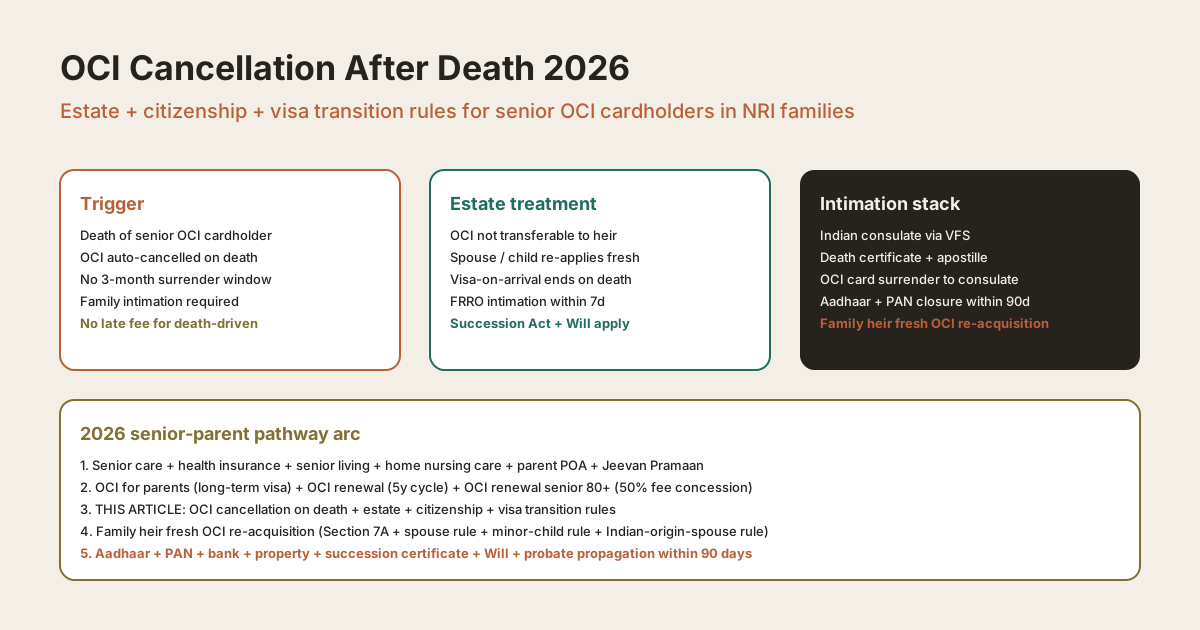
Why OCI cancellation after death is the most under-served estate + visa + citizenship pathway (and why 2026 changed it)
Every senior OCI cardholder family faces the question of what happens to the OCI on death, how to intimate the Indian consulate + FRRO + Aadhaar + PAN + bank + mutual fund + demat + property, and how to handle the estate + visa + citizenship transition. MEA OCI Cardholder rules 2026 + Bureau of Immigration + Indian Succession Act 1925 + Citizenship Act 1955 specify that the OCI is auto-cancelled on the date of death of the cardholder (no 3-month surrender window applies + no late fee USD 25-5,000 is levied + the family must intimate the Indian consulate + FRRO within 7 days + surrender the OCI card within 30 days + deactivate Aadhaar + close PAN + close bank + transmit mutual fund + demat + mutate property within 90 days), the spouse OCI cardholder (independent application) retains the OCI status (no cascade), the minor child OCI cardholder (linked to the deceased parent) faces a risk review (may continue if renewed independently + at-18 conversion within 1-year grace), the NRI / PIO heir (no OCI) inherits the estate + Indian property + bank balance + mutual fund + demat under Indian Succession Act 1925 + must apply for fresh OCI separately under Section 7A, and the Indian citizen heir (naturalised) inherits under Indian Succession Act 1925 + no OCI eligibility + global income tax ROR from day 1. The 2026 simplified rules cut the average family intimation processing time from 6-12 months to 30-60 days at the Indian consulate, and unified the family intimation + OCI card surrender + succession certificate + fresh OCI re-acquisition process across all 5 distinct family member roles.
The decision is not just about the OCI cancellation. It is also about the 5 distinct family member roles (deceased senior OCI cardholder + spouse OCI cardholder + minor child OCI cardholder + NRI / PIO heir + Indian citizen heir), the 7-step family intimation flow (T+0 to T+270d), the document checklist (death certificate + apostille + English translation + 5-10 originals for Indian + foreign records + OCI card scan + heir identity proof + intimation letter + succession certificate / probate + Will + nomination forms), the consulate intimation (T+7d to T+30d + via Indian Missions portal or VFS Global in person + death certificate + OCI card scan + heir identity proof + intimation letter), the FRRO intimation (T+7d to T+14d + if the deceased was in India on OCI at time of death + exit-entry permit for transporting mortal remains / ashes), the OCI card surrender (T+7 to T+30d + physical OCI card mailed or surrendered at consulate + cancellation stamp + surrender certificate + same OCI number retained in records), the Aadhaar + PAN + bank + mutual fund + demat closure (T+30 to T+90d + Aadhaar deactivation + PAN closure + bank account closure / nominee claim + mutual fund transmission + demat transmission + property mutation), the succession certificate + probate of Will + legal heir certificate (T+30 to T+180d + succession certificate from district court + probate of Will if Will exists + legal heir certificate from tehsildar / district court), the family heir fresh OCI re-acquisition (T+90 to T+180d + Section 7A application + USD 275 + USD 25-100 fee + VFS Global appointment + Indian consulate submission + 60-90 days processing + NEW OCI number issued), the estate settlement + property mutation (T+180 to T+270d + heir OCI approval + property mutation + estate fully settled), and the worst-case scenarios (missed T+7d consulate intimation + OCI card misuse by family + bank account frozen for KYC mismatch + succession certificate denied + heir OCI rejected for missing documents). The cleanest plan is to obtain the death certificate + apostille within T+14d + intimate the Indian consulate + FRRO within T+7d + surrender the OCI card within T+30d + deactivate Aadhaar + close PAN + close bank + transmit mutual fund + demat + mutate property within T+90d + obtain succession certificate / probate of Will within T+180d + apply for fresh OCI for the eligible heir within T+90 to T+180d + complete the estate settlement + property mutation within T+270d.
The 2026 landscape has expanded the OCI cancellation after death pathway at every layer: more NRI families are using the Indian Missions portal for consulate intimation + more NRI families are using the FRRO online portal for FRRO intimation + more NRI families are obtaining the succession certificate from the district court + more NRI families are applying for fresh OCI for the eligible heir under Section 7A + and the OCI cancellation after death pathway has become the most under-served and most-mistaken estate + visa + citizenship transition pathway. The order is fixed; the deliverables are not optional.
OCI cancellation after death: 5 distinct family member roles and the estate + visa + citizenship treatment each one receives
Each family member role has a different OCI status, a different estate treatment, and a different visa + citizenship + tax outcome. Confirm which role applies to each family member before starting the intimation flow.
| Family member role | OCI status on death | Estate treatment | Visa + citizenship + tax outcome |
|---|---|---|---|
| Deceased senior OCI cardholder | OCI auto-cancelled on date of death + no 3-month surrender window + no late fee USD 25-5,000 | Estate transmitted under Indian Succession Act 1925 + spouse + children + parents + siblings as legal heirs | OCI ends + lifetime visa-on-arrival ends + tax status ROR ends (no further filing) + Section 80C / 80D / 80DDB / 80TTB claim ends |
| Spouse OCI cardholder (independent application) | Spouse OCI remains valid + no cascade + independent status | Inherits share of estate under Indian Succession Act 1925 + Hindu Succession Act 1956 for Hindu spouses | Lifetime visa-on-arrival preserved + tax status ROR preserved + Section 80C / 80D / 80DDB / 80TTB claim preserved + separate renewal cycle |
| Minor child OCI cardholder (linked to deceased parent) | Risk review triggered + may continue if renewed independently + at-18 conversion within 1-year grace | Inherits share of estate under Indian Succession Act 1925 + guardian manages until 18 | May continue OCI with renewal + at-18 conversion within 1-year grace + lifetime visa-on-arrival preserved if renewed |
| NRI / PIO heir (no OCI) | No OCI status transferred from deceased + inherits estate | Inherits Indian property + bank balance + mutual fund + demat + Indian-resident status for estate purposes | Fresh OCI application eligible under Section 7A + USD 275 + USD 25-100 + 60-90 days + NEW OCI number issued |
| Indian citizen heir (naturalised) | No OCI eligibility + inherits estate as Indian citizen | Inherits under Indian Succession Act 1925 + no special OCI estate treatment | No OCI status + global income tax ROR from day 1 + Indian tax-resident + Form 67 not applicable |
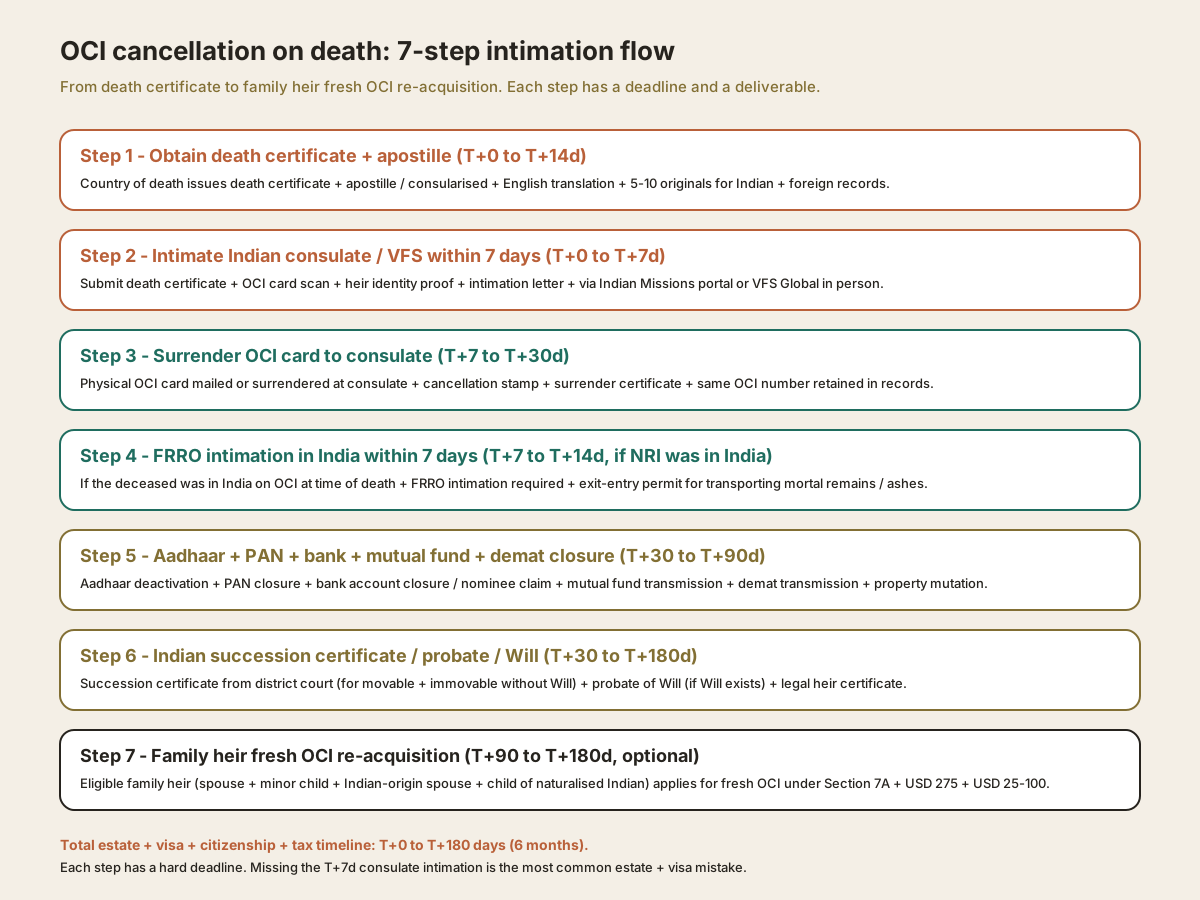
OCI cancellation after death: 7-step family intimation flow (T+0 to T+270d)
Each step has a deadline and a deliverable. The order is fixed; the deliverables are not optional.
Obtain death certificate + apostille + consularisation + English translation (T+0 to T+14d)
The first step is to obtain the death certificate from the country of death + apostille / consularisation + English translation + 5-10 originals for Indian + foreign records. The death certificate is the master document for the entire 7-step intimation flow + it must be apostilled / consularised in the country of death + translated to English if in a foreign language + the apostille / consularisation must be from the competent authority (state department / foreign ministry / apostille convention member). The 5-10 originals are needed for: (1) Indian consulate intimation, (2) FRRO intimation (if in India), (3) Aadhaar deactivation, (4) PAN closure, (5) bank account closure / nominee claim, (6) mutual fund transmission, (7) demat transmission, (8) property mutation, (9) succession certificate, (10) probate of Will. The cleanest plan is to obtain 10-15 originals + apostille each one separately + keep a master copy in a fireproof safe + scan all at 300 DPI in PDF format for digital records.
Intimate Indian consulate + VFS Global within 7 days + surrender OCI card within 30 days (T+0 to T+30d)
The second step is to intimate the Indian consulate + VFS Global within 7 days + surrender the OCI card within 30 days. The consulate intimation is via the Indian Missions portal or VFS Global in person + the documents required are death certificate + apostille + English translation + OCI card scan + heir identity proof + intimation letter + the consulate issues an intimation receipt + the OCI is marked cancelled in the MEA records. The OCI card surrender is physical mailing or in-person surrender at the consulate + the documents required are the intimation receipt + OCI card + heir identity proof + the consulate stamps the OCI card as cancelled + issues a surrender certificate + the same OCI number is retained in the MEA records (the OCI card is cancelled but the OCI number is preserved for audit + records + history purposes). The cleanest plan is to intimate the consulate within 7 days + surrender the OCI card within 30 days + obtain both the intimation receipt and the surrender certificate + keep both for at least 7 years (Indian tax retention period) + for at least 10 years (US / UK / Canadian / Australian tax retention period).
Intimate FRRO within 7 days if the deceased was in India on OCI at time of death (T+0 to T+14d)
The third step is to intimate the FRRO within 7 days if the deceased was in India on OCI at the time of death. The FRRO intimation is via the FRRO online portal or in person at the local FRRO office + the documents required are death certificate + apostille + English translation + OCI card surrender certificate + heir identity proof + intimation letter + the FRRO marks the OCI as cancelled in the Bureau of Immigration records + issues an exit-entry permit for transporting mortal remains / ashes out of India. The exit-entry permit is required for the repatriation of the mortal remains / ashes to the country of residence + the documents required are the FRRO intimation receipt + death certificate + embalming certificate + coffin / urn details + airline acceptance + consular assistance from the destination country. The cleanest plan is to engage a funeral repatriation specialist within 24-48 hours of the death + coordinate with the FRRO + the airline + the destination country's consulate + the local hospital + the crematorium / burial ground.
Deactivate Aadhaar + close PAN + close bank account / claim nominee + transmit mutual fund + transmit demat (T+30 to T+90d)
The fourth step is to deactivate Aadhaar + close PAN + close bank account / claim nominee + transmit mutual fund + transmit demat within 90 days. The Aadhaar deactivation is via the UIDAI portal or Aadhaar Seva Kendra + the documents required are death certificate + heir identity proof + Aadhaar of the heir + the Aadhaar is deactivated in the UIDAI records. The PAN closure is via the Income Tax Department portal or UTI / NSDL + the documents required are death certificate + heir identity proof + PAN card + the PAN is marked as 'deceased' in the Income Tax records + the final ITR is filed by the legal heir. The bank account closure / nominee claim is at the NRE / NRO / FCNR account branch + the documents required are death certificate + heir identity proof + nomination form + bank passbook + KYC documents + the bank account is closed or transmitted to the nominee / legal heir. The mutual fund transmission is via the AMC portal or email to the AMC + the documents required are death certificate + heir identity proof + nomination form + KYC documents + the mutual fund folio is transmitted to the nominee / legal heir. The demat transmission is via the depository participant (CDSL / NSDL) + the documents required are death certificate + heir identity proof + nomination form + KYC documents + the demat account is transmitted to the nominee / legal heir. The cleanest plan is to engage a probate + succession specialist within 30 days + coordinate with the bank + AMC + depository participant + ensure all transmissions are completed within 90 days.
Obtain succession certificate from district court + probate of Will + legal heir certificate (T+30 to T+180d)
The fifth step is to obtain succession certificate from district court + probate of Will + legal heir certificate within 180 days. The succession certificate is from the district court under Section 372 of the Indian Succession Act 1925 + the documents required are death certificate + legal heir affidavit + heir identity proof + property list + bank + mutual fund + demat list + the succession certificate enables the heirs to inherit the movable + immovable property of the deceased. The probate of Will is from the district court under Section 276 of the Indian Succession Act 1925 + the documents required are the original Will + 2 witnesses + death certificate + heir identity proof + the probate grants the executor the authority to administer the estate per the Will. The legal heir certificate is from the tehsildar / district court + the documents required are death certificate + legal heir affidavit + heir identity proof + ration card / Aadhaar of the family + the legal heir certificate establishes the legal heirs of the deceased for government + bank + property purposes. The cleanest plan is to engage a probate + succession lawyer within 30 days + file the succession certificate petition + probate of Will petition + legal heir certificate application + attend the court hearings + obtain the certificates within 180 days.
Family heir fresh OCI re-acquisition under Section 7A (T+90 to T+180d, optional)
The sixth step is the family heir fresh OCI re-acquisition under Section 7A (optional + only for eligible family members). The eligibility for fresh OCI re-acquisition is: (1) the family heir must be eligible under Section 7A (spouse of Indian citizen / spouse of OCI cardholder / minor child of Indian citizen / minor child of OCI cardholder / person of Indian origin up to 4th generation / child of naturalised Indian citizen under Section 7A post-naturalisation), (2) the family heir must not hold any other citizenship that disqualifies them (Pakistan / Bangladesh are disqualified under Section 7A), (3) the family heir must hold a valid foreign passport with 6+ months validity and 2+ blank pages, (4) the family heir must submit the application via the Indian Missions portal or VFS Global + the documents required are death certificate + apostille + OCI surrender certificate of the deceased + heir identity proof + foreign passport + 35x35mm photograph + fee USD 275 + USD 25-100 + the processing time is 60-90 days + the outcome is a NEW OCI number (the old OCI number is not transferred + a new OCI number is issued). The cleanest plan is to engage an OCI specialist within 90 days + confirm the family heir eligibility + pre-stage the documents + submit the fresh OCI application + obtain the NEW OCI number within 180 days.
Heir OCI approval + estate settlement + property mutation (T+180 to T+270d)
The seventh step is the heir OCI approval + estate settlement + property mutation within 270 days. The heir OCI approval is from the Indian consulate + the documents required are the fresh OCI application + supporting documents + the heir OCI is approved + the NEW OCI number is issued + the lifetime visa-on-arrival + tax status ROR + Section 80C / 80D / 80DDB / 80TTB claim are restored for the heir. The estate settlement is the distribution of the estate per the succession certificate / probate of Will + the documents required are the succession certificate / probate + legal heir certificate + the estate is distributed to the heirs as per the Will or per the Indian Succession Act 1925. The property mutation is the update of the property records at the sub-registrar's office + the documents required are the succession certificate / probate + legal heir certificate + property documents + the property is mutated in the name of the heir. The cleanest plan is to complete the estate settlement + property mutation within 270 days + propagate the heir OCI details to Aadhaar + PAN + bank + mutual fund + demat + property within 90 days of the heir OCI approval.
Document checklist before the OCI cancellation after death intimation is submitted
Most OCI cancellation after death intimation failures are caused by missing or mismatched documents at the intimation stage. Confirm each item before submitting the intimation.
- Death certificate (issued by the country of death + with the deceased's full name + date of birth + date of death + cause of death + signature of the issuing authority).
- Apostille / consularisation of the death certificate (from the competent authority in the country of death + apostille convention member or consular attestation).
- English translation of the death certificate (if in a foreign language + by a certified translator + notarised).
- 5-10 originals of the death certificate + apostille + English translation (for Indian consulate + FRRO + Aadhaar + PAN + bank + mutual fund + demat + property + succession certificate + probate of Will).
- OCI card scan + physical OCI card (the OCI booklet + bio page + even if damaged beyond readability + a photocopy of the bio page for reference).
- Foreign passport of the deceased (with the date of birth + the OCI number + the date of death + 6+ months validity at the time of death).
- Heir identity proof (Aadhaar + PAN + passport + driving licence of the heir + with the relationship to the deceased established).
- Intimation letter to the Indian consulate (with the deceased's full name + OCI number + date of death + heir identity + request for OCI cancellation + OCI card surrender).
- Indian Missions portal account (created with the heir's email + phone + with the intimation application completed in full + the death certificate + apostille + English translation uploaded).
- VFS Global appointment booking (for in-person OCI card surrender at the consulate + only if postal mail is not feasible).
- FRRO intimation documents (death certificate + apostille + OCI surrender certificate + heir identity proof + intimation letter + if the deceased was in India on OCI at time of death).
- Aadhaar deactivation documents (death certificate + heir identity proof + Aadhaar of the heir + Aadhaar deactivation form).
- PAN closure documents (death certificate + heir identity proof + PAN card + PAN closure form + final ITR filing by the legal heir).
- Bank account closure / nominee claim documents (death certificate + heir identity proof + nomination form + bank passbook + KYC documents + bank account closure form).
- Mutual fund transmission documents (death certificate + heir identity proof + nomination form + KYC documents + mutual fund transmission form).
- Demat transmission documents (death certificate + heir identity proof + nomination form + KYC documents + demat transmission form).
- Property mutation documents (death certificate + heir identity proof + succession certificate / probate + property documents + property mutation form).
- Succession certificate petition (death certificate + legal heir affidavit + heir identity proof + property list + bank + mutual fund + demat list).
- Probate of Will petition (original Will + 2 witnesses + death certificate + heir identity proof + executor appointment).
- Legal heir certificate application (death certificate + legal heir affidavit + heir identity proof + ration card / Aadhaar of the family).
- Fresh OCI application for eligible heir (death certificate + apostille + OCI surrender certificate of the deceased + heir identity proof + foreign passport + 35x35mm photograph + fee USD 275 + USD 25-100).
OCI cancellation after death decision flow
Community pattern: where OCI cancellation after death actually breaks
Unable to embed reddit content. View on reddit
"The repeated pattern: families of deceased senior OCI cardholders who fail to intimate the Indian consulate within 7 days of the death, only to find at the consulate that the OCI is auto-cancelled in the MEA records but the family intimation was not recorded + the OCI card is still in the family's possession + the OCI card cannot be used by any family member for any purpose. The fix is to intimate the consulate within 7 days + surrender the OCI card within 30 days + obtain both the intimation receipt and the surrender certificate + keep both for at least 7 years. The other repeated pattern: families of deceased senior OCI cardholders who fail to deactivate Aadhaar + close PAN + close bank account + transmit mutual fund + demat within 90 days, only to find that the bank account is frozen for KYC mismatch + the mutual fund folio is frozen for KYC mismatch + the property records are inconsistent + the Indian tax filing is rejected for PAN-Aadhaar mismatch. The fix is to engage a probate + succession specialist within 30 days + coordinate with the bank + AMC + depository participant + ensure all transmissions are completed within 90 days. The third repeated pattern: families of deceased senior OCI cardholders who fail to obtain the succession certificate / probate of Will / legal heir certificate within 180 days, only to find that the estate cannot be transmitted to the heirs legally + the property mutation is denied + the bank account is not closed + the mutual fund is not transmitted + the demat is not transmitted. The fix is to engage a probate + succession lawyer within 30 days + file the succession certificate petition + probate of Will petition + legal heir certificate application + attend the court hearings + obtain the certificates within 180 days."
Read on reddit ->Need help with Move Planning?
Share your blocker in one line. Our experts will reply with practical next steps.
OCI cancellation after death: the seven-layer stack
Missed T+7d consulate intimation is the most expensive OCI cancellation after death mistake
The most common OCI cancellation after death mistake is missing the T+7d Indian consulate intimation. MEA OCI Cardholder rules 2026 specify that the family must intimate the Indian consulate within 7 days of the death of the OCI cardholder + surrender the OCI card within 30 days + obtain both the intimation receipt and the surrender certificate. If the consulate intimation is missed beyond 7 days, the OCI card remains in the family's possession + the OCI is auto-cancelled in the MEA records but the family intimation is not recorded + the OCI card cannot be used by any family member for any purpose + the family may face additional documentation requirements at the consulate to prove the death + the OCI surrender may be processed with a delay of 2-8 weeks + the bank account + mutual fund + demat + property transmissions may be delayed. The fix is to (a) intimate the Indian consulate within 7 days of the death + via the Indian Missions portal or VFS Global in person + (b) surrender the OCI card within 30 days + physical mailing or in-person surrender at the consulate + (c) obtain both the intimation receipt and the surrender certificate + keep both for at least 7 years (Indian tax retention period) + for at least 10 years (US / UK / Canadian / Australian tax retention period), (d) engage a probate + succession specialist within 30 days + coordinate with the bank + AMC + depository participant + sub-registrar's office + ensure all transmissions are completed within 90 days, (e) engage a probate + succession lawyer within 30 days + file the succession certificate petition + probate of Will petition + legal heir certificate application + attend the court hearings + obtain the certificates within 180 days, (f) engage an OCI specialist within 90 days + confirm the family heir eligibility + pre-stage the documents + submit the fresh OCI application + obtain the NEW OCI number within 180 days, (g) complete the estate settlement + property mutation within 270 days + propagate the heir OCI details to Aadhaar + PAN + bank + mutual fund + demat + property within 90 days of the heir OCI approval. The cost of missing the T+7d consulate intimation is USD 25-5,000 in late fees + the cost of the additional document request + the cost of the OCI card misuse risk for the family + the cost of the bank + mutual fund + demat + property transmission delays + the cost of the succession certificate delays + the cost of the estate settlement delays. The cleanest plan is to intimate the Indian consulate within 7 days of the death + surrender the OCI card within 30 days + engage the probate + succession specialist within 30 days + obtain the succession certificate within 180 days + apply for fresh OCI for the eligible heir within 90 to 180 days + complete the estate settlement + property mutation within 270 days.
Animated decision map

Interactive checkpoint
Turn this guide into a decision file
0 of 4 checked
What happens to OCI on death of senior cardholder in 2026?
The OCI is auto-cancelled on the date of death of the senior cardholder under MEA OCI Cardholder rules 2026 + Bureau of Immigration + Citizenship Act 1955. No 3-month surrender window applies (unlike the naturalisation surrender pathway). No late fee USD 25-5,000 is levied. The family must intimate the Indian consulate + FRRO within 7 days + surrender the OCI card within 30 days + obtain both the intimation receipt and the surrender certificate. The same OCI number is retained in the MEA records for audit + records + history purposes (the OCI card is cancelled but the OCI number is preserved). The lifetime visa-on-arrival + tax status ROR + Section 80C / 80D / 80DDB / 80TTB claim for the deceased end on the date of death. The spouse OCI (independent application) is unaffected. The minor child OCI (linked to the deceased parent) faces a risk review. The NRI / PIO heir inherits the estate + must apply for fresh OCI separately. The Indian citizen heir inherits under Indian Succession Act 1925 + no OCI eligibility.
Who must intimate the Indian consulate after death of senior OCI cardholder?
The legal heir (spouse + adult child + parent + sibling + executor of Will) of the deceased senior OCI cardholder must intimate the Indian consulate + FRRO within 7 days of the death. The documents required are death certificate + apostille / consularisation + English translation + OCI card scan + heir identity proof + intimation letter. The intimation is via the Indian Missions portal or VFS Global in person. The consulate issues an intimation receipt + the OCI is marked cancelled in the MEA records. The OCI card is surrendered to the consulate within 30 days (physical mailing or in-person surrender) + the consulate stamps the OCI card as cancelled + issues a surrender certificate + the same OCI number is retained in the MEA records. The cost of consulate intimation is USD 0 (no fee for death-driven intimation) + the cost of OCI card surrender is USD 0 (no fee for death-driven surrender). The processing time is 14-30 days at the Indian consulate.
What is the cost of OCI cancellation after death in 2026?
The 2026 cost of OCI cancellation after death is: (1) USD 0 for the consulate intimation (no fee for death-driven intimation), (2) USD 0 for the OCI card surrender (no fee for death-driven surrender), (3) USD 0 for the FRRO intimation (no fee for death-driven intimation), (4) USD 0 for the Aadhaar deactivation (no fee for death-driven deactivation), (5) USD 0 for the PAN closure (no fee for death-driven closure), (6) USD 0 for the bank account closure / nominee claim (no fee for death-driven closure), (7) USD 0 for the mutual fund transmission (no fee for death-driven transmission), (8) USD 0 for the demat transmission (no fee for death-driven transmission), (9) USD 50-200 for the death certificate + apostille + English translation, (10) USD 500-2,000 for the succession certificate from district court, (11) USD 500-3,000 for the probate of Will from district court, (12) USD 50-200 for the legal heir certificate, (13) USD 275 + USD 25-100 for the family heir fresh OCI re-acquisition, (14) USD 100-300 for the funeral repatriation specialist, (15) USD 200-500 for the probate + succession lawyer. The total cost for the OCI cancellation after death is USD 1,700-6,300 / Rs 1.4-5.3 lakh over 6-12 months, with the bulk of the cost being the succession certificate + probate of Will + legal heir certificate + probate + succession lawyer + funeral repatriation specialist.
How long does OCI cancellation after death take in 2026?
The 2026 processing time for OCI cancellation after death is 14-30 days at the Indian consulate for the intimation + 7-30 days for the OCI card surrender + 14-30 days at the FRRO for the intimation + 30-90 days for the Aadhaar deactivation + PAN closure + bank account closure / nominee claim + mutual fund transmission + demat transmission + property mutation + 30-180 days for the succession certificate from district court + 30-180 days for the probate of Will from district court + 30-180 days for the legal heir certificate + 60-90 days for the family heir fresh OCI re-acquisition + 60-180 days for the estate settlement + property mutation. The cleanest plan is to obtain the death certificate + apostille within T+14d + intimate the Indian consulate + FRRO within T+7d + surrender the OCI card within T+30d + deactivate Aadhaar + close PAN + close bank + transmit mutual fund + demat + mutate property within T+90d + obtain succession certificate / probate of Will within T+180d + apply for fresh OCI for the eligible heir within T+90 to T+180d + complete the estate settlement + property mutation within T+270d.
What is the difference between OCI cancellation after death and standard OCI surrender?
The difference between OCI cancellation after death and standard OCI surrender is: (1) trigger: OCI cancellation after death is triggered by the death of the cardholder + standard OCI surrender is triggered by the naturalisation of the cardholder under Section 7D Citizenship Act 1955, (2) timeline: OCI cancellation after death is auto-cancelled on the date of death + no surrender window applies + standard OCI surrender has a 3-month surrender window + late fee USD 25-5,000, (3) fee: OCI cancellation after death has no fee for consulate intimation + OCI card surrender + standard OCI surrender has USD 25-5,000 late fee, (4) document: OCI cancellation after death requires death certificate + apostille + English translation + standard OCI surrender requires surrender certificate + renunciation certificate + foreign citizenship certificate, (5) estate: OCI cancellation after death triggers estate transmission under Indian Succession Act 1925 + standard OCI surrender does not trigger estate transmission (the cardholder is alive), (6) heir: OCI cancellation after death may trigger family heir fresh OCI re-acquisition under Section 7A + standard OCI surrender may trigger re-acquisition under Section 7A after renunciation + 2y wait. The cleanest plan is to confirm the trigger (death vs naturalisation) + follow the appropriate intimation / surrender flow + engage a probate + succession specialist for the death pathway.
What is the worst-case scenario if OCI cancellation after death is mishandled?
Six things can go wrong: (1) the T+7d consulate intimation is missed + the OCI card remains in the family's possession + the family may face additional documentation requirements + the OCI surrender may be delayed 2-8 weeks + the bank + mutual fund + demat + property transmissions may be delayed, (2) the OCI card is misused by a family member for any purpose + the family may face legal consequences + the OCI surrender may be denied + the new OCI application for the heir may be rejected, (3) the Aadhaar + PAN + bank + mutual fund + demat transmissions are missed beyond 90 days + the bank account is frozen for KYC mismatch + the mutual fund folio is frozen for KYC mismatch + the property records are inconsistent + the Indian tax filing is rejected for PAN-Aadhaar mismatch, (4) the succession certificate / probate of Will is missed beyond 180 days + the estate cannot be transmitted to the heirs legally + the property mutation is denied + the bank account is not closed + the mutual fund is not transmitted + the demat is not transmitted, (5) the family heir fresh OCI application is rejected for missing documents + the family heir loses lifetime visa-on-arrival + tax status ROR + Section 80C / 80D / 80DDB / 80TTB claim + the family heir must re-apply with additional documents + the processing time extends 2-8 weeks, (6) the estate settlement is not completed within 270 days + the property mutation is delayed + the bank account is not closed + the mutual fund is not transmitted + the demat is not transmitted + the heir OCI is not propagated to Aadhaar + PAN + bank + mutual fund + demat + property within 90 days of the heir OCI approval. Each of these is fixable + but the cost is USD 25-5,000 in late fees + the cost of the additional document request + the cost of the OCI card misuse risk for the family + the cost of the bank + mutual fund + demat + property transmission delays + the cost of the succession certificate delays + the cost of the estate settlement delays. The cleanest plan is to intimate the Indian consulate within 7 days + surrender the OCI card within 30 days + engage the probate + succession specialist within 30 days + obtain the succession certificate within 180 days + apply for fresh OCI for the eligible heir within 90 to 180 days + complete the estate settlement + property mutation within 270 days.
The plan is only as good as the sequence.
Tax, banking, schools, shipping — they all have dependencies. A wrong order costs months and lakhs. Get it right.