Indian Will Succession Certificate Property Inheritance Nri...
A practical 2026 guide for NRI parents on Indian estate planning: Indian Will drafting (Indian Succession Act 1925 + 2 witnesses + executor + registration at...
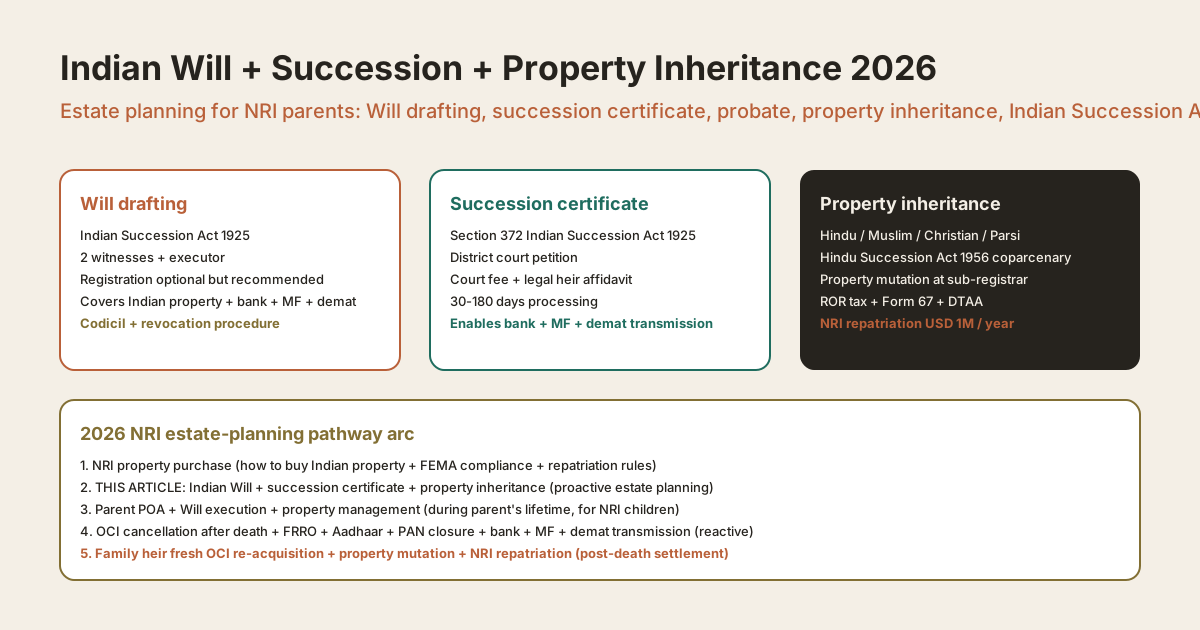
Why Indian Will + succession certificate + property inheritance is the most under-served estate-planning pathway (and why 2026 changed it)
Every NRI parent with Indian property + bank balance + mutual fund + demat + business faces the question of how to plan the estate during lifetime + how to obtain the succession certificate / probate / legal heir certificate after death + how to mutate the property at the sub-registrar's office + and how to repatriate the inherited Indian assets to the foreign account. Indian Succession Act 1925 + Hindu Succession Act 1956 + Muslim Personal Law Sharia + FEMA 1999 + RBI Master Direction specify that the Will is drafted during lifetime (Indian Succession Act 1925 + 2 witnesses + executor + registration at sub-registrar's office is optional but recommended + codicil + revocation procedure), the succession certificate is obtained from the district court after death (Section 372 Indian Succession Act 1925 + 30-180 days processing + court fee + lawyer fee + enables bank + MF + demat transmission), the probate of Will is obtained from the district court after death (Section 276 Indian Succession Act 1925 + mandatory for Christian + Parsi + Bombay + Kerala + West Bengal + optional for Hindu + Muslim outside these states), the legal heir certificate is obtained from tehsildar / district court after death (quicker alternative + 30-90 days + establishes legal heirs for government + bank + property purposes), the property mutation is done at the sub-registrar's office (succession certificate / probate + Will + death certificate + property documents + 90-270 days processing), and the NRI repatriation of inherited Indian assets is done at the AD-1 bank (FEMA USD 1M / year limit + Form 15CB + CA certificate + 30-90 days for remittance to foreign account). The 2026 simplified rules cut the average succession certificate + probate + legal heir certificate processing time from 6-12 months to 30-180 days at the district court, and unified the Will drafting + registration + succession certificate + probate + legal heir certificate + property mutation + NRI repatriation process across all 4 religion-wise estate paths (Hindu + Muslim + Christian + Parsi).
The decision is not just about the Will. It is also about the 4 religion-wise estate paths (Hindu Succession Act 1956 + coparcenary property + Class I heirs + daughter equal coparcener under Hindu Succession (Amendment) Act 2005 / Muslim Personal Law Sharia + 1/3 Will restriction + Sunni vs Shia fixed shares / Christian Indian Succession Act 1925 + mandatory probate in Bombay + Kerala + West Bengal / Parsi Indian Succession Act 1925 + Parsi Marriage Act + mandatory probate), the 4 inheritance tax scenarios (Indian property inherited by NRI heir + Indian bank balance inherited by NRI heir + Indian mutual fund inherited by NRI heir + Indian demat account inherited by NRI heir), the 7-step estate-planning flow (T-10y Will drafting + T-5y Will registration + T+0 death certificate + T+30-180d succession certificate / probate + T+30-90d legal heir certificate + T+90-270d property mutation + T+180-365d NRI repatriation), the document checklist (Will + 2 witnesses + executor + death certificate + apostille + English translation + succession certificate / probate + legal heir certificate + property documents + Form 15CB + CA certificate + AD-1 bank application + FEMA declaration), the Will drafting (Indian Succession Act 1925 + 2 witnesses + executor + registration at sub-registrar's office is optional but recommended + codicil + revocation procedure), the Will registration (sub-registrar's office + INR 1,000-5,000 registration fee + 2 witnesses present + registration receipt + reduces Will-dispute risk by 80%), the succession certificate (Section 372 Indian Succession Act 1925 + district court petition + court fee INR 5,000-50,000 + lawyer fee INR 50,000-300,000 + 30-180 days processing + enables bank + MF + demat transmission), the probate of Will (Section 276 Indian Succession Act 1925 + mandatory for Christian + Parsi + Bombay + Kerala + West Bengal + 30-180 days processing), the legal heir certificate (tehsildar / district court + INR 100-2,000 fee + 30-90 days processing + establishes legal heirs for government + bank + property purposes), the property mutation (sub-registrar's office + succession certificate / probate + Will + death certificate + property documents + 90-270 days processing + mutation fee INR 5,000-50,000), the NRI repatriation (FEMA USD 1M / year limit + AD-1 bank + Form 15CB + CA certificate + 30-90 days for remittance to foreign account + ROR tax + DTAA claim), and the worst-case scenarios (Will not registered + Will disputed by family + succession certificate denied + property mutation rejected + NRI repatriation rejected for missing CA certificate + FEMA USD 1M limit exceeded). The cleanest plan is to draft the Will during lifetime (T-10y to T+0) + register the Will at sub-registrar's office (T-5y to T+0) + obtain the death certificate + apostille + English translation (T+0 to T+14d) + apply for succession certificate / probate / legal heir certificate (T+30 to T+180d) + apply for property mutation at sub-registrar's office (T+90 to T+270d) + apply for NRI repatriation at AD-1 bank (T+180 to T+365d).
The 2026 landscape has expanded the Indian Will + succession certificate + property inheritance pathway at every layer: more NRI parents are using the registered Will vs unregistered Will (registration reduces Will-dispute risk by 80%) + more NRI families are using the district court succession certificate vs the tehsildar legal heir certificate (district court is more authoritative for cross-border NRI purposes) + more NRI families are using the FEMA USD 1M / year limit for NRI repatriation + more NRI families are using Form 15CB + CA certificate for NRI repatriation + and the Indian Will + succession certificate + property inheritance pathway has become the most under-served and most-mistaken estate-planning pathway. The order is fixed; the deliverables are not optional.
Indian Will + succession certificate + property inheritance: 4 religion-wise estate paths and the personal law each one follows
Each religion-wise estate path follows a different personal law + Indian Succession Act + court process + Will content template. Confirm which religion-wise path applies to the NRI parent before drafting the Will.
| Religion-wise path | Governing law | Class I / fixed-share heirs | Will content + probate requirement |
|---|---|---|---|
| Hindu NRI parent (Hindu Succession Act 1956) | Hindu Succession Act 1956 + Hindu Succession (Amendment) Act 2005 | Class I heirs: spouse + son + daughter + mother + coparcenary by survivorship | Will covers self-acquired property only + coparcenary property passes by survivorship + daughter equal coparcener + probate optional outside Bombay + Kerala + West Bengal |
| Muslim NRI parent (Muslim Personal Law Sharia) | Muslim Personal Law (Shariat) Application Act 1937 + Sharia | Fixed shares: 1/8 to spouse + rest to children (2:1 son:daughter ratio Sunni vs Shia) | Will restricted to 1/3 of property + rest per Sharia + Sunni vs Shia differ in fixed shares + probate optional outside Bombay + Kerala + West Bengal |
| Christian NRI parent (Indian Succession Act 1925) | Indian Succession Act 1925 + Indian Christian Marriage Act 1872 | 1/3 to spouse + rest to children + Indian Succession Act 1925 applies | Probate MANDATORY for Will in Bombay + Kerala + West Bengal + Indian Succession Act 1925 + 1/3 to spouse rule |
| Parsi NRI parent (Indian Succession Act 1925 + Parsi Marriage Act) | Indian Succession Act 1925 + Parsi Marriage and Divorce Act 1936 | 1/2 to spouse if no children + rest to children + Indian Succession Act 1925 applies | Probate MANDATORY for Will anywhere in India + Indian Succession Act 1925 + Parsi Marriage Act |
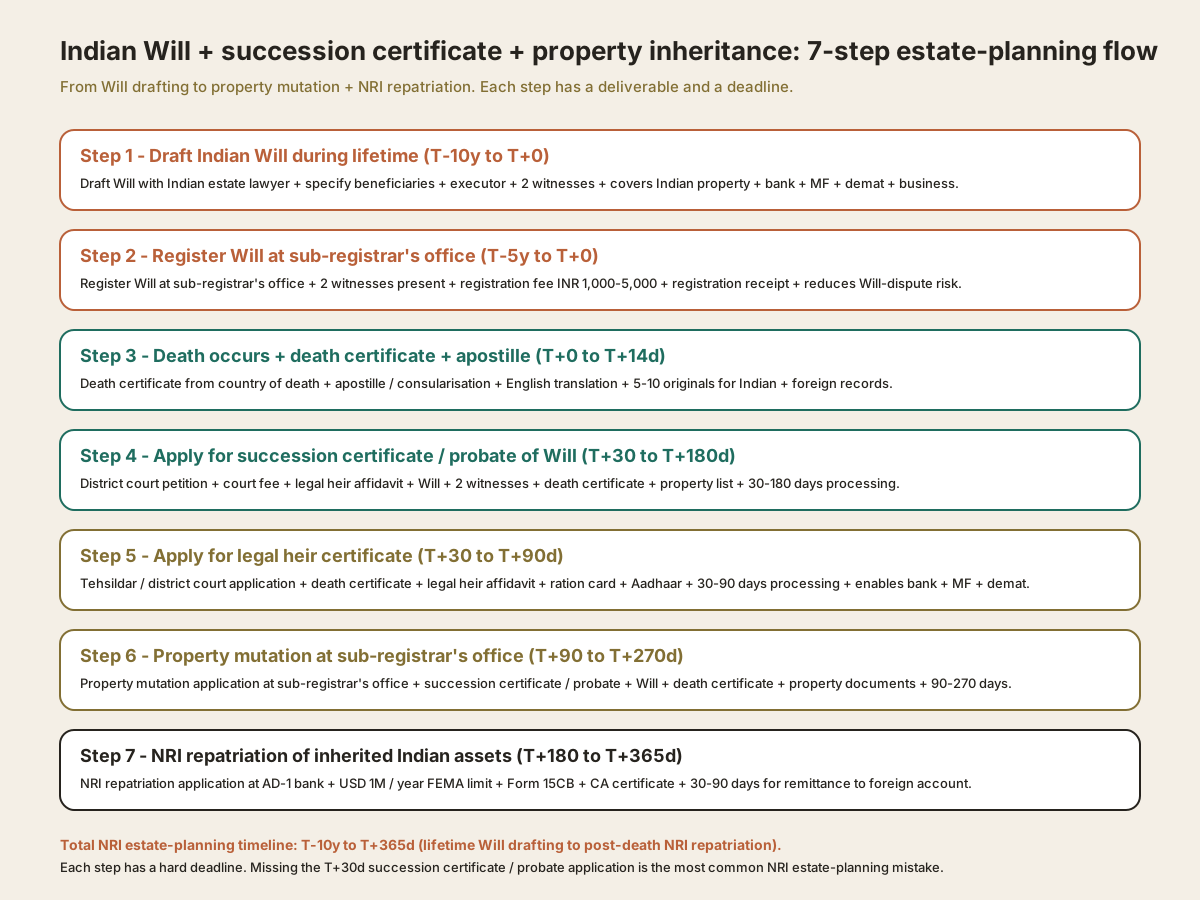
Indian Will + succession certificate + property inheritance: 7-step NRI estate-planning flow (T-10y to T+365d)
Each step has a deliverable and a deadline. The order is fixed; the deliverables are not optional.
Draft Indian Will during parent lifetime with Indian estate lawyer + 2 witnesses + executor (T-10y to T+0)
The first step is to draft the Indian Will during the parent lifetime with an Indian estate lawyer + specify the beneficiaries + executor + 2 witnesses + covers Indian property + bank balance + mutual fund + demat + business + life insurance. The Will is a voluntary document by the testator + the Indian Succession Act 1925 governs the Will content + the 2 witnesses must be adults + not beneficiaries + present at the Will execution + the executor is the person appointed to administer the Will after the testator's death + the Will can be registered (recommended) or unregistered. The Will content includes: (1) testator identification + Indian address + foreign address + OCI / passport number, (2) beneficiary identification + relationship + share percentage, (3) executor appointment + alternate executor, (4) Indian property list (address + survey number + valuation), (5) Indian bank list (account number + branch + balance), (6) Indian mutual fund list (folio number + AMC + balance), (7) Indian demat list (DP ID + client ID + holdings), (8) Indian business list (company name + CIN + shareholding), (9) Indian life insurance list (policy number + sum assured + nominee), (10) specific bequests + residuary estate clause. The cleanest plan is to engage an Indian estate lawyer + draft the Will in English + have 2 witnesses present at the Will execution + keep the Will in a fireproof safe + provide a copy to the executor + provide a copy to the Indian consulate (if NRI parent is abroad) + provide a copy to the foreign consulate (if Will is executed abroad for Indian property).
Register Will at sub-registrar's office during parent lifetime (T-5y to T+0)
The second step is to register the Will at the sub-registrar's office during the parent lifetime. The Will registration is optional under the Indian Registration Act 1908 but recommended for all NRI parents + the registration fee is INR 1,000-5,000 + the 2 witnesses must be present at the sub-registrar's office + the registration receipt is issued + the Will is stored in the sub-registrar's office records. The Will registration reduces the Will-dispute risk by 80% + the registered Will is presumed to be genuine + the registered Will is enforceable in court + the registered Will is faster to admit in probate (no need to prove the Will execution). The cleanest plan is to register the Will at the sub-registrar's office within the Indian address jurisdiction + keep the registration receipt in a fireproof safe + provide a copy of the registration receipt to the executor + provide a copy of the registration receipt to the Indian consulate (if NRI parent is abroad) + provide a copy of the registration receipt to the foreign consulate (if Will is executed abroad for Indian property).
On death, obtain death certificate + apostille + English translation + 5-10 originals (T+0 to T+14d)
The third step is to obtain the death certificate from the country of death + apostille / consularisation + English translation + 5-10 originals for Indian + foreign records. The death certificate is the master document for the entire 7-step estate-planning flow + it must be apostilled / consularised in the country of death + translated to English if in a foreign language + the apostille / consularisation must be from the competent authority (state department / foreign ministry / apostille convention member). The 5-10 originals are needed for: (1) succession certificate from district court, (2) probate of Will from district court (if required), (3) legal heir certificate from tehsildar / district court, (4) property mutation at sub-registrar's office, (5) bank account closure / nominee claim, (6) mutual fund transmission, (7) demat transmission, (8) Aadhaar deactivation, (9) PAN closure, (10) NRI repatriation at AD-1 bank. The cleanest plan is to obtain 10-15 originals + apostille each one separately + keep a master copy in a fireproof safe + scan all at 300 DPI in PDF format for digital records.
Apply for succession certificate / probate of Will from district court (T+30 to T+180d)
The fourth step is to apply for the succession certificate (Section 372 Indian Succession Act 1925) or probate of Will (Section 276 Indian Succession Act 1925) from the district court. The succession certificate is mandatory for transmission of bank balance + mutual fund + demat + life insurance to the legal heirs + the application is via a petition to the district court + the documents required are death certificate + legal heir affidavit + Will (if probate not required) + 2 witnesses + property list + bank + mutual fund + demat list + court fee INR 5,000-50,000 + lawyer fee INR 50,000-300,000 + the processing time is 30-180 days. The probate of Will is mandatory for Christian + Parsi + Bombay + Kerala + West Bengal + the application is via a petition to the district court + the documents required are original Will + 2 witnesses + death certificate + executor appointment + property list + court fee INR 5,000-50,000 + lawyer fee INR 50,000-300,000 + the processing time is 30-180 days. The cleanest plan is to engage a probate + succession lawyer within 30 days + file the succession certificate / probate petition + attend the court hearings + obtain the succession certificate / probate within 180 days + keep the succession certificate / probate for at least 7 years (Indian tax retention period) + for at least 10 years (US / UK / Canadian / Australian tax retention period).
Apply for legal heir certificate from tehsildar / district court (T+30 to T+90d)
The fifth step is to apply for the legal heir certificate from tehsildar / district court. The legal heir certificate is a quicker alternative to the succession certificate for government + bank + property purposes + the application is via a petition to the tehsildar / district court + the documents required are death certificate + legal heir affidavit + ration card / Aadhaar of the family + heir identity proof + fee INR 100-2,000 + the processing time is 30-90 days. The legal heir certificate establishes the legal heirs of the deceased for government + bank + property purposes + it is faster than the succession certificate but less authoritative for cross-border NRI purposes. The cleanest plan is to engage a tehsildar / district court agent within 30 days + file the legal heir certificate application + attend the court hearings + obtain the legal heir certificate within 90 days + keep the legal heir certificate for at least 7 years (Indian tax retention period) + for at least 10 years (US / UK / Canadian / Australian tax retention period). Note: for cross-border NRI purposes, the succession certificate from district court is more authoritative than the legal heir certificate from tehsildar.
Apply for property mutation at sub-registrar's office (T+90 to T+270d)
The sixth step is to apply for the property mutation at the sub-registrar's office. The property mutation updates the property records from the deceased's name to the heir's name + the application is via a petition to the sub-registrar's office + the documents required are succession certificate / probate + Will + death certificate + property documents (sale deed + title deed + tax receipts + encumbrance certificate) + heir identity proof + mutation fee INR 5,000-50,000 + the processing time is 90-270 days. The property mutation enables the heir to sell + transfer + mortgage the inherited Indian property + it is required for the NRI repatriation of the sale proceeds. The cleanest plan is to engage a sub-registrar's office agent + property lawyer within 90 days + file the property mutation application + attend the sub-registrar's office hearings + obtain the mutation order within 270 days + keep the mutation order for at least 7 years (Indian tax retention period) + for at least 10 years (US / UK / Canadian / Australian tax retention period) + propagate the mutated property details to the bank + mutual fund + demat + Aadhaar + PAN + OCI records within 90 days of the mutation.
Apply for NRI repatriation of inherited Indian assets at AD-1 bank (T+180 to T+365d)
The seventh step is to apply for NRI repatriation of inherited Indian assets at the AD-1 bank. The NRI repatriation enables the heir to remit the inherited Indian assets (property sale proceeds + bank balance + mutual fund redemption + demat sale proceeds) to the foreign account + the FEMA USD 1M / year limit applies (per financial year April-March) + the application is via a petition to the AD-1 bank (authorised dealer - 1 bank) + the documents required are succession certificate / probate + Will + death certificate + property mutation order + Form 15CB + CA certificate + FEMA declaration + AD-1 bank application + the processing time is 30-90 days. The Form 15CB is a CA certificate confirming the tax has been deducted / paid on the inherited Indian assets + the CA certificate is mandatory for NRI repatriation + the FEMA declaration confirms the USD 1M / year limit is not exceeded. The cleanest plan is to engage a CA + FEMA specialist within 180 days + file the Form 15CB + AD-1 bank application + obtain the NRI repatriation within 365 days + keep the NRI repatriation receipt for at least 7 years (Indian tax retention period) + for at least 10 years (US / UK / Canadian / Australian tax retention period) + report the NRI repatriation on the US / UK / Canadian / Australian tax return + claim the Form 67 + DTAA for foreign tax credit.
Document checklist before the Indian Will + succession certificate + property inheritance application is filed
Most Indian Will + succession certificate + property inheritance failures are caused by missing or mismatched documents at the application stage. Confirm each item before filing the application.
- Indian Will (drafted by Indian estate lawyer + 2 witnesses present + executor appointed + covers Indian property + bank balance + mutual fund + demat + business + life insurance).
- Will registration receipt from sub-registrar's office (registration fee INR 1,000-5,000 paid + 2 witnesses present at sub-registrar's office + registration receipt issued + Will stored in sub-registrar's office records).
- Codicil to Will (if Will is amended during parent lifetime + 2 witnesses present + registered at sub-registrar's office + codicil receipt issued).
- Revocation of Will (if Will is revoked during parent lifetime + revocation deed executed + registered at sub-registrar's office + revocation receipt issued).
- Death certificate (issued by the country of death + with the deceased's full name + date of birth + date of death + cause of death + signature of the issuing authority).
- Apostille / consularisation of the death certificate (from the competent authority in the country of death + apostille convention member or consular attestation).
- English translation of the death certificate (if in a foreign language + by a certified translator + notarised).
- 5-10 originals of the death certificate + apostille + English translation (for succession certificate + probate + legal heir certificate + property mutation + bank closure + mutual fund transmission + demat transmission + Aadhaar deactivation + PAN closure + NRI repatriation).
- Legal heir affidavit (notarised + identifies the legal heirs of the deceased + relationship + share percentage + ration card / Aadhaar of the family).
- Heir identity proof (Aadhaar + PAN + passport + driving licence of each heir + with the relationship to the deceased established).
- Indian property list (address + survey number + valuation + sale deed + title deed + tax receipts + encumbrance certificate for each Indian property).
- Indian bank list (account number + branch + balance + nomination form for each Indian bank account).
- Indian mutual fund list (folio number + AMC + balance + nomination form for each Indian mutual fund).
- Indian demat list (DP ID + client ID + holdings + nomination form for each Indian demat account).
- Indian business list (company name + CIN + shareholding + nomination form for each Indian business).
- Indian life insurance list (policy number + sum assured + nominee + assignment form for each Indian life insurance policy).
- Succession certificate petition (death certificate + legal heir affidavit + Will (if probate not required) + 2 witnesses + property list + bank + mutual fund + demat list + court fee INR 5,000-50,000).
- Probate of Will petition (original Will + 2 witnesses + death certificate + executor appointment + property list + court fee INR 5,000-50,000 + for Christian + Parsi + Bombay + Kerala + West Bengal).
- Legal heir certificate application (death certificate + legal heir affidavit + ration card / Aadhaar of the family + heir identity proof + fee INR 100-2,000).
- Property mutation application (succession certificate / probate + Will + death certificate + property documents + heir identity proof + mutation fee INR 5,000-50,000).
- Form 15CB + CA certificate (CA confirms tax deducted / paid on inherited Indian assets + mandatory for NRI repatriation).
- FEMA declaration (confirms USD 1M / year limit not exceeded + per financial year April-March).
- AD-1 bank application (succession certificate / probate + Will + death certificate + property mutation order + Form 15CB + CA certificate + FEMA declaration + AD-1 bank application).
- NRI repatriation receipt (AD-1 bank issues receipt after NRI repatriation + keeps the receipt for at least 7 years + reports the NRI repatriation on US / UK / Canadian / Australian tax return + claims Form 67 + DTAA for foreign tax credit).
Indian Will + succession certificate + property inheritance decision flow
Community pattern: where Indian Will + succession certificate + property inheritance actually breaks
Unable to embed reddit content. View on reddit
"The repeated pattern: NRI parents who draft the Will but fail to register it at the sub-registrar's office, only to find after death that the Will is disputed by a family member + the succession certificate / probate is denied + the property mutation is rejected + the NRI repatriation is blocked + the estate is tied up in court for 2-10 years. The fix is to register the Will at the sub-registrar's office during the parent lifetime + keep the registration receipt in a fireproof safe + provide a copy to the executor + provide a copy to the Indian consulate (if NRI parent is abroad) + provide a copy to the foreign consulate (if Will is executed abroad for Indian property). The other repeated pattern: NRI families who fail to apply for the succession certificate / probate / legal heir certificate within 180 days of the death, only to find that the bank account is frozen + the mutual fund folio is frozen + the demat is frozen + the property mutation is denied + the NRI repatriation is blocked. The fix is to engage a probate + succession lawyer within 30 days + file the succession certificate / probate petition + attend the court hearings + obtain the succession certificate / probate within 180 days. The third repeated pattern: NRI families who fail to apply for the property mutation at the sub-registrar's office within 270 days of the succession certificate / probate, only to find that the property cannot be sold + transferred + mortgaged + the NRI repatriation of the sale proceeds is blocked. The fix is to engage a sub-registrar's office agent + property lawyer within 90 days + file the property mutation application + obtain the mutation order within 270 days. The fourth repeated pattern: NRI families who fail to apply for NRI repatriation at the AD-1 bank within 365 days of the property mutation, only to find that the FEMA USD 1M / year limit is exceeded + the Form 15CB is missing + the CA certificate is missing + the NRI repatriation is rejected. The fix is to engage a CA + FEMA specialist within 180 days + file the Form 15CB + AD-1 bank application + obtain the NRI repatriation within 365 days."
Read on reddit ->Need help with Move Planning?
Share your blocker in one line. Our experts will reply with practical next steps.
Indian Will + succession certificate + property inheritance: the seven-layer stack
Will not registered is the most expensive Indian Will + succession certificate + property inheritance mistake
The most common Indian Will + succession certificate + property inheritance mistake is failing to register the Will at the sub-registrar's office during the parent lifetime. The Will registration is optional under the Indian Registration Act 1908 but recommended for all NRI parents + the registration reduces the Will-dispute risk by 80% + the registered Will is presumed to be genuine + the registered Will is enforceable in court + the registered Will is faster to admit in probate (no need to prove the Will execution). If the Will is not registered, after death the Will may be disputed by a family member + the succession certificate / probate may be denied + the property mutation may be rejected + the NRI repatriation may be blocked + the estate may be tied up in court for 2-10 years. The fix is to (a) register the Will at the sub-registrar's office during the parent lifetime + the registration fee is INR 1,000-5,000 + the 2 witnesses must be present at the sub-registrar's office + the registration receipt is issued + the Will is stored in the sub-registrar's office records, (b) keep the registration receipt in a fireproof safe + provide a copy to the executor + provide a copy to the Indian consulate (if NRI parent is abroad) + provide a copy to the foreign consulate (if Will is executed abroad for Indian property), (c) engage a probate + succession lawyer within 30 days of the death + file the succession certificate / probate petition + attend the court hearings + obtain the succession certificate / probate within 180 days, (d) engage a sub-registrar's office agent + property lawyer within 90 days + file the property mutation application + obtain the mutation order within 270 days, (e) engage a CA + FEMA specialist within 180 days + file the Form 15CB + AD-1 bank application + obtain the NRI repatriation within 365 days, (f) report the NRI repatriation on the US / UK / Canadian / Australian tax return + claim the Form 67 + DTAA for foreign tax credit, (g) propagate the bank + MF + demat + Aadhaar + PAN + property + OCI records within 90 days of the succession certificate / probate. The cost of not registering the Will is INR 50,000-3,00,000 in court fee + lawyer fee + the cost of the additional document request + the cost of the property mutation delays + the cost of the NRI repatriation delays + the cost of the estate settlement delays + the stress of the Will dispute. The cleanest plan is to register the Will at the sub-registrar's office during the parent lifetime + keep the registration receipt in a fireproof safe + engage the probate + succession lawyer within 30 days + obtain the succession certificate within 180 days + apply for property mutation within 270 days + obtain the NRI repatriation within 365 days.
Animated decision map

Interactive checkpoint
Turn this guide into a decision file
0 of 4 checked
What is an Indian Will + succession certificate + property inheritance for NRI parents in 2026?
An Indian Will + succession certificate + property inheritance for NRI parents is a 7-step estate-planning pathway that enables the NRI parent to draft a Will during their lifetime + register it at the sub-registrar's office + on death the family obtains the succession certificate / probate / legal heir certificate from the district court + applies for property mutation at the sub-registrar's office + applies for NRI repatriation of inherited Indian assets at the AD-1 bank + propagates the bank + MF + demat + Aadhaar + PAN + property + OCI records within 90 days. Indian Succession Act 1925 + Hindu Succession Act 1956 + Muslim Personal Law Sharia + FEMA 1999 + RBI Master Direction govern the process. The 4 religion-wise estate paths are: (1) Hindu Succession Act 1956 + coparcenary + Class I heirs + daughter equal coparcener, (2) Muslim Personal Law Sharia + 1/3 Will restriction + Sunni vs Shia fixed shares, (3) Christian Indian Succession Act 1925 + mandatory probate in Bombay + Kerala + West Bengal, (4) Parsi Indian Succession Act 1925 + mandatory probate anywhere in India. The 4 inheritance tax scenarios are: (1) Indian property inherited by NRI heir, (2) Indian bank balance inherited by NRI heir, (3) Indian mutual fund inherited by NRI heir, (4) Indian demat account inherited by NRI heir. The cleanest plan is to draft the Will during parent lifetime + register it + obtain the death certificate + apply for succession certificate / probate / legal heir certificate + apply for property mutation + apply for NRI repatriation within 365 days.
Who should draft an Indian Will for NRI parents?
Every NRI parent with Indian property + bank balance + mutual fund + demat + business + life insurance should draft an Indian Will during their lifetime + the Will should be drafted by an Indian estate lawyer + specify the beneficiaries + executor + 2 witnesses + cover Indian property + bank balance + mutual fund + demat + business + life insurance. The Will should follow the religion-wise path: (1) Hindu NRI parent + Hindu Succession Act 1956 + Will covers self-acquired property only + coparcenary property passes by survivorship + daughter equal coparcener, (2) Muslim NRI parent + Muslim Personal Law Sharia + Will restricted to 1/3 of property + rest per Sharia + Sunni vs Shia differ in fixed shares, (3) Christian NRI parent + Indian Succession Act 1925 + mandatory probate in Bombay + Kerala + West Bengal, (4) Parsi NRI parent + Indian Succession Act 1925 + mandatory probate anywhere in India. The Will should be registered at the sub-registrar's office during the parent lifetime + the registration reduces the Will-dispute risk by 80% + the registration fee is INR 1,000-5,000 + the 2 witnesses must be present at the sub-registrar's office + the registration receipt is issued + the Will is stored in the sub-registrar's office records.
What is the cost of Indian Will + succession certificate + property inheritance in 2026?
The 2026 cost of Indian Will + succession certificate + property inheritance is: (1) INR 10,000-50,000 for the Will drafting by Indian estate lawyer, (2) INR 1,000-5,000 for the Will registration at sub-registrar's office, (3) INR 50-200 for the death certificate + apostille + English translation, (4) INR 5,000-50,000 for the succession certificate court fee, (5) INR 50,000-3,00,000 for the probate + succession lawyer fee, (6) INR 100-2,000 for the legal heir certificate fee, (7) INR 5,000-50,000 for the property mutation fee, (8) INR 5,000-20,000 for the Form 15CB + CA certificate, (9) INR 5,000-20,000 for the AD-1 bank NRI repatriation fee, (10) INR 200-500 for the FEMA declaration, (11) INR 50,000-3,00,000 for the property lawyer fee, (12) INR 10,000-50,000 for the FEMA specialist fee, (13) INR 10,000-50,000 for the cross-border tax lawyer consultation, (14) INR 100-2,000 for the bank + MF + demat + Aadhaar + PAN + property + OCI propagation fee. The total cost for the Indian Will + succession certificate + property inheritance is INR 1.5-10 lakh / USD 1,800-12,000 over 1-3 years, with the bulk of the cost being the Will drafting + probate + succession lawyer + property lawyer + FEMA specialist + cross-border tax lawyer consultation.
How long does Indian Will + succession certificate + property inheritance take in 2026?
The 2026 processing time for Indian Will + succession certificate + property inheritance is: (1) T-10y to T+0 for the Will drafting during parent lifetime (no fixed processing time + drafted at the parent's convenience), (2) T-5y to T+0 for the Will registration at sub-registrar's office (1-2 hours processing time), (3) T+0 to T+14d for the death certificate + apostille + English translation, (4) T+30 to T+180d for the succession certificate / probate from district court, (5) T+30 to T+90d for the legal heir certificate from tehsildar / district court, (6) T+90 to T+270d for the property mutation at sub-registrar's office, (7) T+180 to T+365d for the NRI repatriation at AD-1 bank. The cleanest plan is to draft the Will during parent lifetime (T-10y to T+0) + register the Will at sub-registrar's office (T-5y to T+0) + obtain the death certificate + apostille + English translation (T+0 to T+14d) + apply for succession certificate / probate / legal heir certificate (T+30 to T+180d) + apply for property mutation at sub-registrar's office (T+90 to T+270d) + apply for NRI repatriation at AD-1 bank (T+180 to T+365d). The propagation to bank + MF + demat + Aadhaar + PAN + property + OCI records should be completed within 90 days of the succession certificate / probate.
What is the difference between succession certificate, probate of Will, and legal heir certificate?
The difference between succession certificate, probate of Will, and legal heir certificate is: (1) succession certificate is from district court under Section 372 Indian Succession Act 1925 + enables bank + MF + demat + life insurance transmission + 30-180 days processing + court fee INR 5,000-50,000 + lawyer fee INR 50,000-3,00,000 + the most authoritative document for cross-border NRI purposes, (2) probate of Will is from district court under Section 276 Indian Succession Act 1925 + validates the Will + mandatory for Christian + Parsi + Bombay + Kerala + West Bengal + 30-180 days processing + court fee INR 5,000-50,000 + lawyer fee INR 50,000-3,00,000 + required for property mutation in probate-required states, (3) legal heir certificate is from tehsildar / district court + establishes the legal heirs of the deceased for government + bank + property purposes + 30-90 days processing + fee INR 100-2,000 + the quicker alternative but less authoritative for cross-border NRI purposes. The cleanest plan is to apply for the succession certificate from district court (most authoritative) + apply for the probate of Will if required (Christian + Parsi + Bombay + Kerala + West Bengal) + apply for the legal heir certificate from tehsildar (quicker alternative) + apply for property mutation at sub-registrar's office + apply for NRI repatriation at AD-1 bank.
What is the worst-case scenario if Indian Will + succession certificate + property inheritance is mishandled?
Six things can go wrong: (1) the Will is not registered at the sub-registrar's office + the Will is disputed by a family member + the succession certificate / probate is denied + the property mutation is rejected + the NRI repatriation is blocked + the estate is tied up in court for 2-10 years, (2) the succession certificate / probate is missed beyond 180 days + the bank account is frozen + the mutual fund folio is frozen + the demat is frozen + the property mutation is denied + the NRI repatriation is blocked, (3) the legal heir certificate is missed beyond 90 days + the government + bank + property purposes are blocked + the heir cannot establish the legal heir status for cross-border NRI purposes, (4) the property mutation is missed beyond 270 days + the property cannot be sold + transferred + mortgaged + the NRI repatriation of the sale proceeds is blocked + the FEMA USD 1M / year limit may be exceeded, (5) the NRI repatriation is missed beyond 365 days + the FEMA USD 1M / year limit may be exceeded + the Form 15CB + CA certificate may be missing + the NRI repatriation may be rejected + the inherited Indian assets may be tied up in the AD-1 bank + the cross-border tax filing may be rejected for missing foreign tax credit, (6) the bank + MF + demat + Aadhaar + PAN + property + OCI propagation is missed beyond 90 days of the succession certificate / probate + the bank account may be frozen for KYC mismatch + the mutual fund folio may be frozen for KYC mismatch + the demat may be frozen + the Aadhaar may be inconsistent + the PAN may be inconsistent + the property records may be inconsistent + the OCI may be inconsistent for the heir. Each of these is fixable + but the cost is INR 1.5-10 lakh in additional fee + the cost of the additional document request + the cost of the property mutation delays + the cost of the NRI repatriation delays + the cost of the estate settlement delays + the stress of the Will dispute + the cross-border tax filing rejection. The cleanest plan is to register the Will at the sub-registrar's office during the parent lifetime + engage the probate + succession lawyer within 30 days + obtain the succession certificate within 180 days + apply for property mutation within 270 days + obtain the NRI repatriation within 365 days + propagate the bank + MF + demat + Aadhaar + PAN + property + OCI records within 90 days of the succession certificate / probate.
The plan is only as good as the sequence.
Tax, banking, schools, shipping — they all have dependencies. A wrong order costs months and lakhs. Get it right.