NRI Power of Attorney for Parents in India

Prepare parent-care authority for India: POA, bank mandate, nominee, hospital consent, health records, care manager, and emergency payments.
Updated 12 Jun 2026|14 min read
Official consulate walkthrough for Power of Attorney attestation. Use it as a process check, then confirm the exact document requirements for your Indian mission and receiving institution. Watch source
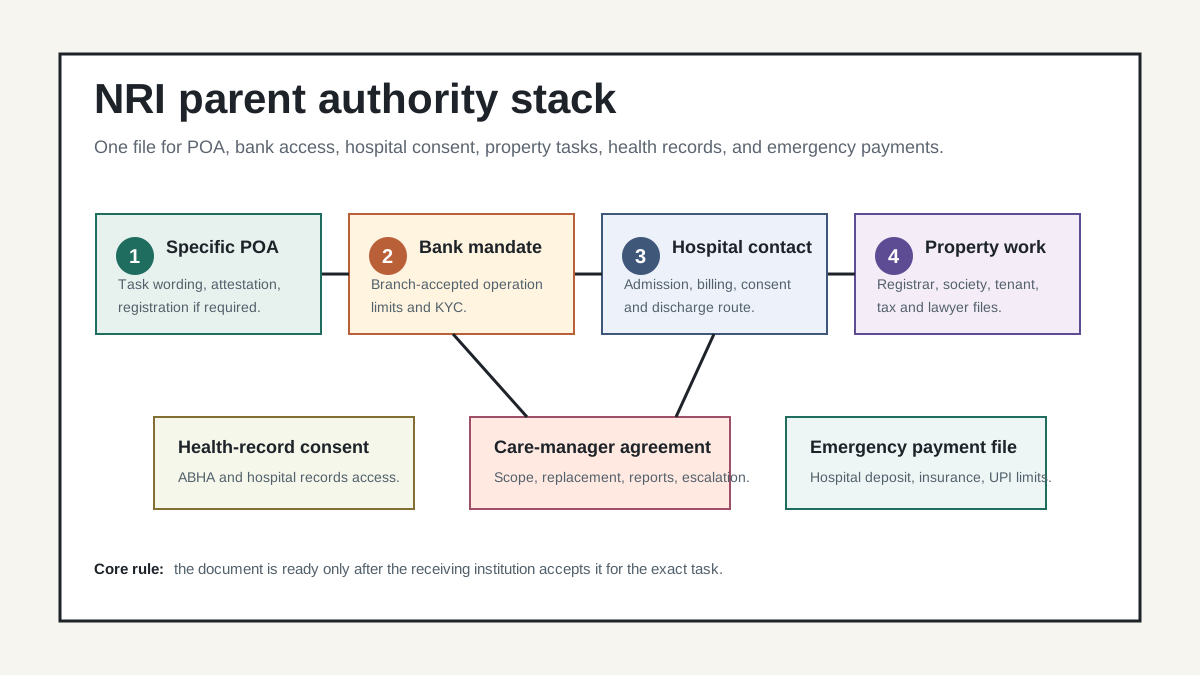
Flat authority stack for NRI parents in India showing Power of Attorney, bank mandate, hospital consent, health records, property work, care manager, and emergency payment lanes.

The real parent-care risk is not distance. It is missing authority.

Many NRI families prepare money, hospitals, attendants, and insurance, but leave authority vague. Then the emergency arrives: the parent is admitted, the bank wants the account holder or authorised signatory, the property office needs a registered or authenticated POA, the insurer asks who can coordinate documents, and the overseas child has only WhatsApp screenshots.

The fix is not one universal document. A Power of Attorney can authorise a person to act for specific legal, bank, or property work, but it does not automatically replace every hospital consent process, bank mandate, nominee record, digital-health consent, or senior-care contract. The useful model is an authority stack: one file that names who can act, for which task, under which proof, and with which limits.

Build the stack while the parent is healthy, mentally capable, and available to sign. If you wait until hospitalization, cognitive decline, travel disruption, or a property deadline, the family may discover too late that the right authority needed to be executed, attested, registered, bank-accepted, or institution-specific before the emergency.

NRI parent authority stack showing POA, bank mandate, nominee, hospital contact, ABHA consent, care manager, and emergency payment file.
Do not ask, 'Do we have a POA?' Ask, 'Which exact person can do which exact task tomorrow?'

POA, bank mandate, nominee, hospital consent, and care manager are not the same thing

This is where most families make the mistake. Each authority lane solves a different problem and fails in a different way.

Authority laneWhat it can solveWhat it does not solveProof to keep
Specific Power of AttorneyLets a trusted person act for defined legal, property, bank, or administrative tasks, subject to wording, execution, attestation, registration, and institution acceptance.It is not a blank cheque for every hospital, bank, demat, insurer, or property office. A generic POA can fail when the task needs specific wording.Signed POA, witness details, notarisation or consular attestation if executed abroad, registration record where required, ID/address proof of executor and attorney holder.
Bank operating mandate or authorised signatoryAllows a bank-recognised person to operate or assist with specific account actions under bank rules.Does not make the person a nominee, owner, legal heir, medical decision-maker, or property agent.Bank mandate form, accepted branch acknowledgement, KYC of mandate holder, operation limits, cheque/debit/online access rules.
Nominee recordHelps the institution know who can receive/claim after the account holder's death, subject to law and institutional rules.Does not authorise day-to-day operation during the parent's lifetime and does not settle all inheritance disputes by itself.Nomination acknowledgement for bank, demat, insurance, pension, deposits, lockers, and mutual funds.
Hospital consent contactGives the hospital a named person for admission paperwork, billing coordination, consent workflows, and emergency updates under hospital policy.Does not replace a legally valid POA or medical decision framework where the hospital asks for formal authority.Hospital registration form, consent contact, emergency contact, medical file, insurance card, policy TPA details, discharge authority note.
ABHA / health-record consentControls consent-based sharing of digital health records inside the ABDM health information exchange model.Does not by itself let a child sign surgery consent, operate bank money, or sell property.ABHA number, linked mobile, consent artefact or app access proof, list of hospitals and doctors using the record.
Care-manager agreementLets a paid professional coordinate appointments, attendants, medicine refills, transport, reporting, and escalation.Does not give legal, banking, or property authority unless separately executed and accepted.Service contract, scope, replacement rule, reporting format, emergency escalation protocol, payment terms.
Emergency payment filePrevents delay during admission, diagnostics, pharmacy, ambulance, attendant salary, or travel.Does not give legal authority. It only makes payment execution faster.Insurance policy, PMJAY card if applicable, credit/debit access, UPI limits, hospital deposit plan, reimbursement folder, local cash owner.
A POA is one layer. Parent-care execution needs the full stack.

Nine-step sequence to build the authority stack before a crisis

Do these in order while the parent is healthy enough to understand, sign, and visit the required office if needed.

Step 1

List the actions someone may need to take

Separate bank operation, pension follow-up, hospital admission, insurance claim, property registration, society paperwork, demat or mutual-fund work, care-manager coordination, and emergency payments. Each action may need different wording or a different institutional form.

Step 2

Choose the attorney holder by trust and location

The person should be reachable in India, able to visit banks or hospitals, financially clean, and trusted by all key family members. If siblings are involved, decide whether one person acts, two people act jointly, or each person handles a defined lane.

Step 3

Draft specific POA wording instead of a vague all-purpose form

Use a lawyer or institution-specific draft for property, bank, court, demat, society, pension, or hospital-adjacent administrative tasks. A line that sounds broad may still be rejected if it does not name the exact act required.

Step 4

Execute and attest correctly if the parent or child is abroad

If the document is signed outside India, check Indian mission, notary, apostille, witness, photograph, passport, and local jurisdiction requirements. Consulate pages often specify exact documents and appointment steps.

Step 5

Register where the task requires registration

Property registration and some high-value immovable-property actions can require a registered or properly authenticated POA. Do not assume a notarised document abroad will be accepted by every sub-registrar or society office.

Step 6

Get bank acceptance before the emergency

Take the POA or mandate to the bank branch or relationship office and obtain written acknowledgement of what the attorney or mandate holder can and cannot do. RBI guidance also treats old, sick, or incapacitated account operation as a bank-process issue, not a family assumption.

Step 7

Build the hospital and health-record file

Keep the parent medical summary, prescriptions, allergies, insurance, preferred hospital, ABHA status, emergency contact, and hospital consent contact together. Ask the hospital what it accepts for admission, consent, updates, billing, and discharge.

Step 8

Align nominee and legal-heir records

Update nominations for bank accounts, deposits, insurance, demat, mutual funds, lockers, and pension where applicable. Nominee is not the same as owner or attorney holder, but a missing nominee creates avoidable friction later.

Step 9

Rehearse the emergency call flow

Run a dry drill: who goes to the hospital, who pays the deposit, who shows ID, who calls the doctor, who sends insurance documents, who checks the bank limit, and who updates siblings. Fix missing authority before it is real.

Animated authority workflow moving from action list to POA wording, consular attestation, registration, bank acceptance, hospital file, nominee records, and emergency drill.
The stack only works when the institution has accepted it before the emergency.

Emergency authority file for NRI parents

Keep one printed file at home and one digital folder shared with the named family owner. Review it every six months.

  • Parent identity: Aadhaar/PAN/passport/OCI where applicable, address proof, mobile number, blood group, emergency contacts.
  • Signed specific POA documents with witnesses, attestation, registration record where required, and attorney-holder KYC.
  • Bank mandate or accepted POA acknowledgement for each important bank, deposit, locker, pension, or investment account.
  • Nominee acknowledgements for bank accounts, deposits, insurance, demat, mutual funds, pension, and lockers.
  • Hospital packet: medical summary, allergies, prescriptions, insurance, PMJAY card if applicable, preferred hospital, doctor numbers, admission history.
  • ABHA or health-record access details, linked mobile owner, and consent workflow notes if the parent uses ABDM-linked health records.
  • Property packet: title copy, tax receipts, society contact, tenant file, lawyer contact, and exact POA accepted for registration or society work.
  • Care-manager or home-care contract, worker verification file, replacement rule, daily reporting format, and escalation threshold.
  • Emergency money plan: UPI/card limits, hospital deposit route, insurer TPA number, local cash owner, reimbursement folder.
  • Revocation and misuse control: who can revoke, when to review, where originals are stored, and who is notified if trust changes.

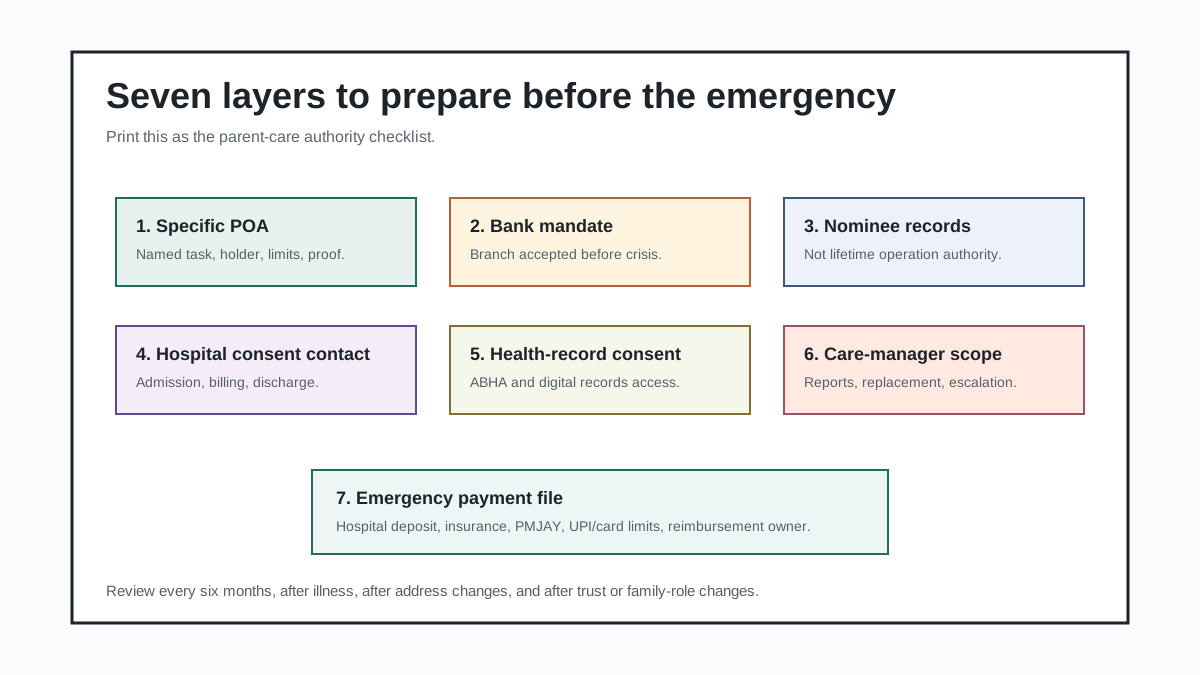
Authority-stack infographic

Infographic showing seven authority layers for NRI parents: specific POA, bank mandate, nominee, hospital consent contact, ABHA consent, care-manager agreement, and emergency payment file.
A complete authority stack is deliberately boring: every person, task, proof, and limit is named before it is needed.

Need help with Move Planning?

Share your blocker in one line. Our experts will reply with practical next steps.

Community signal: bank access fails when authority is informal

Community threads are intent signals, not legal advice. Use them to spot the failure mode.
r
reddit
r/LegalAdviceIndia community

"The repeated pattern is practical: the family can explain the emergency, but the bank still needs an accepted operating route. Verbal family consensus does not move money when the account holder cannot act."

Read on reddit ->

Official video signal: execution abroad has its own checklist

Use the video as a process checkpoint, then follow the Indian mission that serves your jurisdiction.
y
youtube
Consulate General of India, Atlanta

"The practical lesson from consulate POA workflows is that signing abroad is an evidence process: applicant identity, witness, notary or consular attestation, photograph, passport, address proof, and document wording all matter."

Read on youtube ->

Professional pattern: care coordination needs written authority

Use practitioner posts as operating-pattern signals, then verify with the bank, lawyer, and official authority.
l
linkedin
LinkedIn NRI POA discussion

"Loan and property workflows show the same principle that parent-care families need: the POA holder should be authorised for specific acts, and the receiving institution should know exactly what it will accept."

Read on linkedin ->

Social explainer pattern: POA content must match the task

Search links are nofollow references and should be used only as audience-language signals.
i
instagram
Instagram public search pattern

"Short explainers often make POA sound like one document. In practice, task wording, attestation, registration, and institution acceptance decide whether it works."

Read on instagram ->

Need help with Move Planning?

Share your blocker in one line. Our experts will reply with practical next steps.

Question pattern: families ask after the crisis starts

Use Q&A patterns to understand search language, then verify with official and professional advice.
q
quora
Public Q&A pattern

"The late-stage question is usually, 'Can I do this for my parent now?' The better pre-crisis question is, 'Which document does this institution accept for this exact task?'"

Read on quora ->

Decision flow: which authority solves which task

Decision flow for NRI parent authority: define task, choose document, execute or attest, register if needed, get institution acceptance, and rehearse emergency use.
The receiving institution is the real test. If the bank, hospital, society, or sub-registrar will not accept it, the document is not ready.

Authority operating map

Task list -> trusted holder -> specific POA wording -> execution and attestation -> registration if required -> bank / hospital / property-office acceptance -> nominee and health-record alignment -> emergency payment file -> six-month review and revocation control
A family authority system is only complete when it has a task, a person, a proof, a limit, and an institution that has accepted it.

Need help with Move Planning?

Share your blocker in one line. Our experts will reply with practical next steps.

Do not use a generic POA download for parent-care emergencies

A generic downloaded POA can be worse than no plan because it creates false confidence. Property, banking, demat, pension, hospital, and senior-care tasks can need different wording, attestation, registration, or institution-specific forms. Use this guide as an operating map, then get the document drafted and accepted for the exact task before relying on it.

Interactive checkpoint

Turn this guide into a decision file

0 of 4 checked

Do NRIs need a Power of Attorney to manage parents in India?

Not for every task, but often for important legal, banking, property, or administrative actions. Some tasks may instead need a bank mandate, nominee update, hospital consent contact, care-manager agreement, or health-record consent. The right question is which institution must accept which document for which task.

Can a Power of Attorney let me operate my parent's bank account?

Only if the bank accepts the authority for the specific operation under its process. Banks can have their own mandate, KYC, limits, and old/sick/incapacitated account procedures. Get branch or relationship-office acceptance in writing before an emergency.

Is nominee the same as Power of Attorney?

No. A nominee record usually helps with claims after death and institutional processing. A POA or bank mandate is about acting during the account holder's lifetime. Families should keep both updated because they solve different problems.

Can a POA signed abroad be used in India?

It can be, but execution matters. Check the relevant Indian embassy or consulate, notary, apostille, witness, photograph, passport, address proof, and registration requirements. Then confirm the receiving bank, property office, society, or registrar will accept that exact document.

Can a child give hospital consent for an elderly parent in India?

Hospital consent is institution-specific and situation-specific. Keep the child or local family owner listed as emergency and consent contact, but ask the preferred hospital what it needs for admission, billing, treatment consent, discharge, and records. A POA may help with administration but does not replace medical ethics, patient capacity, or hospital policy.

What is the first document to prepare for NRI parent emergencies?

Start with a task list, not a document. List bank, hospital, property, pension, insurance, care-manager, and payment tasks. Then prepare the specific POA, mandate, nominee, consent, and emergency payment file for those tasks. A vague all-purpose form should not be the starting point.

Expert Consultation — Free to Inquire

The plan is only as good as the sequence.

Tax, banking, schools, shipping — they all have dependencies. A wrong order costs months and lakhs. Get it right.

Or learn more first
See how we help
Expert replies within 24-48 business hours
Your specific situation — not generic advice
100% free to ask — no sales pitch
Largest NRI community on the internet