The 60-second version
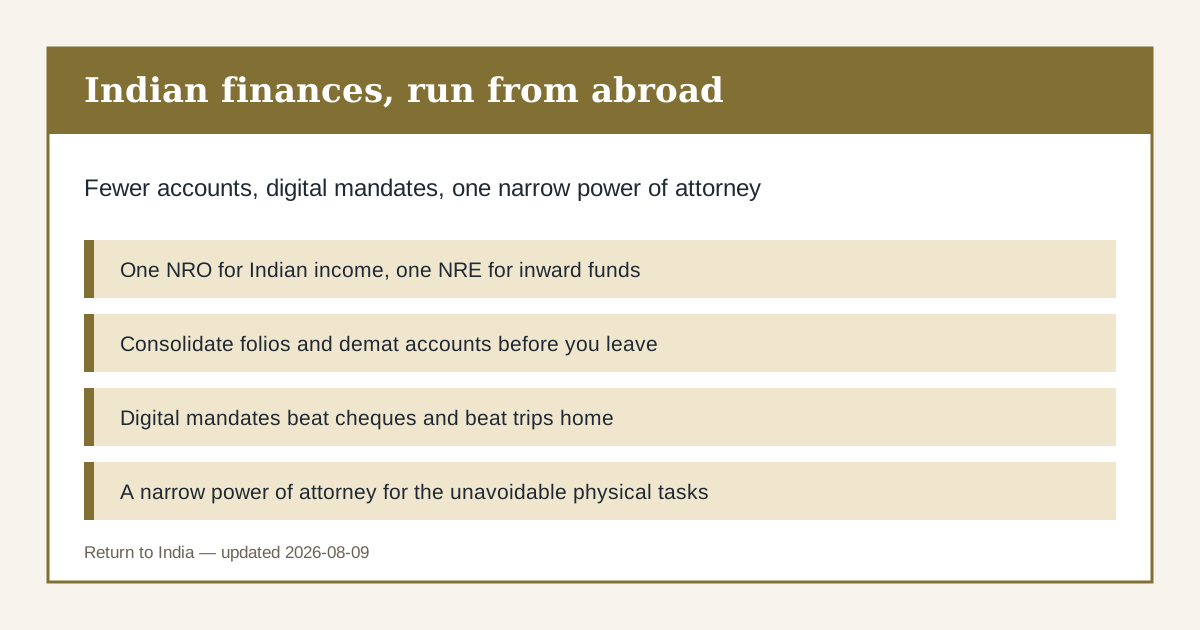
The affordable way to manage Indian finances from abroad is to reduce the number of moving parts: one NRO account for Indian income, one NRE account for inward funds, consolidated mutual fund and demat holdings, digital mandates instead of cheques, and a narrowly scoped power of attorney for the physical tasks.
Fast answer: cost is a function of complexity, not of fees
People asking for the cheapest way to manage Indian finances from abroad usually think the answer is a bank with lower charges. It rarely is. The real cost is complexity: six accounts across four banks, folios scattered across three fund houses, a demat account nobody has logged into for two years, an insurance premium debiting a closed account, and a property that generates rent into an account with a KYC block on it.
Every one of those is a recurring tax on your attention that eventually converts into a real cost — a lapsed policy, a dormant account reactivation fee, unclaimed dividends, tax deducted at source you never reclaimed, a rent cheque that could not be deposited, or a flight home to sign something in person.
So the cheap setup is the simple one. Consolidate to the minimum viable stack, move everything possible to digital mandates that do not need a physical signature, put a narrowly scoped power of attorney in place for the things that genuinely require a body in India, and run one honest annual review. That structure costs less to maintain than any fee comparison will save you.
Where the money actually leaks
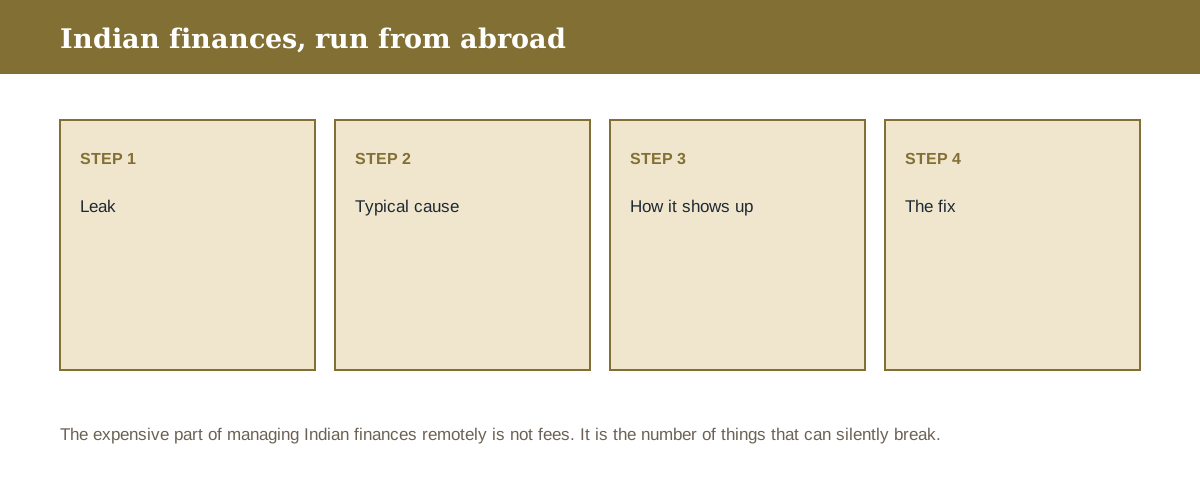
These are the recurring costs of a fragmented remote setup. Most are invisible until you total them for a year.
| Leak | Typical cause | How it shows up | The fix |
|---|---|---|---|
| Dormant account charges and reactivation | Accounts nobody transacts on for years | Fees, then a full KYC re-verification to reopen access | Close what you do not need; keep one active account per purpose |
| Tax deducted at source never reclaimed | NRO interest and rent with no return filed | Refund left with the tax department year after year | File the Indian return even when income is small |
| Unclaimed dividends and matured deposits | Old folios and stale bank mandates | Amounts drifting toward the unclaimed-assets regime | Consolidate folios and refresh bank mandates once |
| Lapsed insurance | Premium debiting a closed or blocked account | Policy lapse discovered at claim time | Point every premium at the single active account |
| Currency conversion spread | Frequent small remittances | A percentage lost on every transfer | Fewer, larger transfers; compare the all-in rate, not the advertised fee |
| Emergency travel to sign documents | No power of attorney, wet signature required | The single largest cost of the whole setup | A narrowly scoped, properly executed power of attorney |
| Blocked transactions from KYC mismatch | Different addresses across bank, demat and fund records | Frozen redemption at the worst moment | One address, updated everywhere on the same day |
Building the low-maintenance remote setup
This is a one-time cleanup followed by an annual review. The cleanup is the hard part.
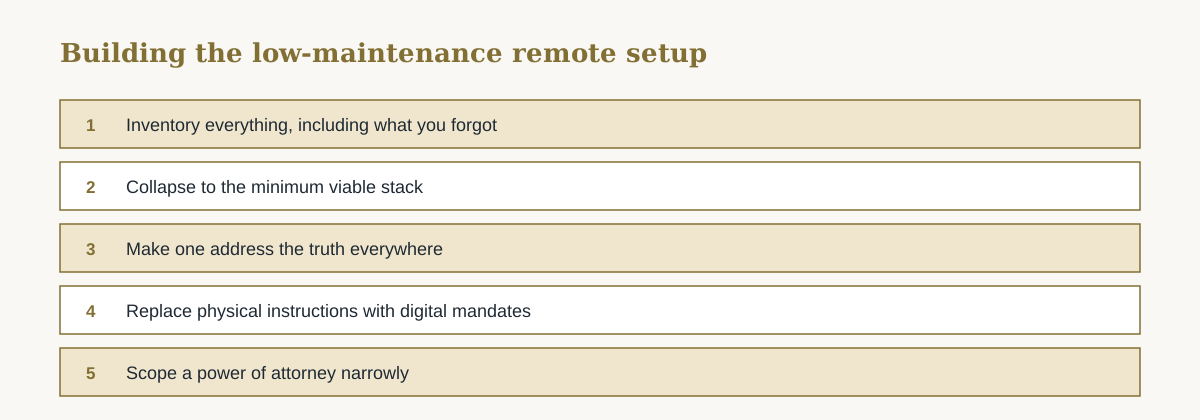
Inventory everything, including what you forgot
Bank accounts, deposits, mutual fund folios, demat accounts, insurance policies, property, loans, provident fund balances and any small-savings scheme. Old employer-linked accounts are the usual discovery.
Collapse to the minimum viable stack
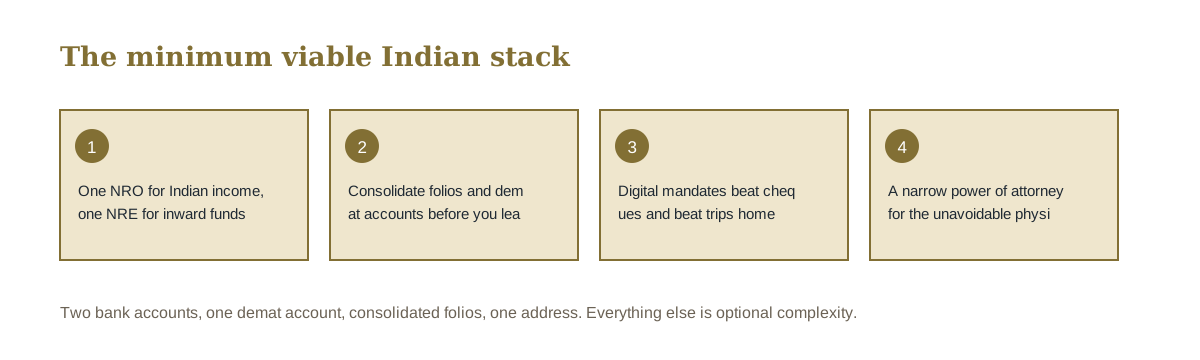
One NRO account for Indian income, one NRE account for inward funds, one demat account, and consolidated fund holdings. Close the rest properly rather than letting them go dormant.
Make one address the truth everywhere
Pick the address you will actually use for the next few years and update it on bank, demat, fund, insurance and tax records on the same day. Mismatched addresses are the leading cause of blocked transactions.
Replace physical instructions with digital mandates
Standing instructions for premiums, systematic investment plans and loan instalments. Every cheque you eliminate is one fewer reason to need someone physically present.
Scope a power of attorney narrowly
Grant only what is genuinely needed — typically permitted local payments and specified operational tasks. Avoid a broad general power of attorney, and record its scope and expiry clearly.
Fix the tax rhythm
Know your filing obligation, keep interest and rent certificates, reconcile against the annual information statement, and file even when the income is modest so tax deducted at source can be reclaimed.
Run one annual review, on a fixed date
Balances, nominations, mandates, address, KYC validity, insurance status, unclaimed amounts, and whether the power of attorney is still appropriate. One calendar entry prevents most of the leaks above.
Annual remote-management review
One sitting, once a year. Put it in the calendar on a date you will not move.
- Every Indian account listed with its current balance and last transaction date.
- Dormant accounts identified and either reactivated or closed.
- Address identical across bank, demat, mutual fund, insurance and tax records.
- KYC validity confirmed; re-verification started before it lapses.
- Nominations current on every account, folio, deposit and policy.
- Every insurance premium confirmed as debiting an active account.
- Mutual fund folios consolidated where possible, with bank mandates refreshed.
- Unclaimed dividends and matured deposits searched for and claimed.
- Tax deducted at source reconciled against the annual information statement.
- Indian return filed, including where the only purpose is reclaiming deducted tax.
- Power of attorney reviewed for scope, validity and continued suitability.
- One documented plan for what happens if you cannot travel to India for two years.
The minimum viable Indian stack
Need help with Banking?
Share your blocker in one line. Our experts will reply with practical next steps.
Community signal: dormancy is the silent killer
Unable to embed reddit content. View on reddit
"The most repeated remote-management failure is an account going dormant and then requiring in-person re-verification to unlock."
Read on reddit ->Search signal: the real question is 'without flying back'
"People asking about cost are usually asking how to avoid a trip to India for a signature. That is a power-of-attorney and mandate problem, not a fee problem."
Read on quora ->Remote management structure diagram
Need help with Banking?
Share your blocker in one line. Our experts will reply with practical next steps.
Avoid a broad general power of attorney
A wide, open-ended power of attorney over Indian assets is convenient and dangerous. Scope it to specific tasks, name a defined validity period, keep a copy, and revoke it formally when it is no longer needed rather than letting it sit indefinitely.
The one-sentence answer
The cheapest way to run Indian finances from abroad is to reduce moving parts — one NRO account, one NRE account, one demat account, consolidated folios, one address everywhere, digital mandates instead of signatures, and a narrowly scoped power of attorney reviewed once a year.
Animated decision map

Need help with Banking?
Share your blocker in one line. Our experts will reply with practical next steps.
Interactive checkpoint
Turn this guide into a decision file
0 of 4 checked
What is the cheapest way to manage Indian finances from abroad?
Reduce the number of accounts and folios to the minimum, keep one address across every record, replace physical instructions with digital mandates, and review the whole structure once a year. Complexity costs more than fees do.
How many Indian bank accounts do I actually need as an NRI?
Usually two: an NRO account for income arising in India and an NRE account for funds remitted from abroad. Additional accounts add dormancy risk and KYC surface area without adding capability.
Can I operate my Indian accounts entirely online from abroad?
Largely yes, provided KYC is current, the registered mobile number can receive one-time passwords, and the address on record is valid. The tasks that still require physical presence are the ones a scoped power of attorney is for.
What can a power of attorney holder do on my Indian bank account?
Typically permitted local payments and specified operational tasks. The framework restricts certain actions, such as repatriating funds abroad or gifting, so the scope should be drafted deliberately rather than copied from a template.
Why did my account go dormant and how do I fix it?
Accounts with no customer-initiated transaction for an extended period are classified as inactive and then dormant. Reactivation usually needs a fresh KYC step. Prevent it by keeping one small periodic transaction on each account you intend to keep.
Do I need to file an Indian tax return if my only income is NRO interest?
Filing is often worthwhile even for small amounts, because tax deducted at source on NRO interest can otherwise sit unclaimed with the tax department. Check your filing obligation against your residential status and income for the year.
How do I stop my insurance policy lapsing while I am abroad?
Point every premium at a single active account with sufficient balance, set the mandate digitally rather than by cheque, and confirm the debit succeeded each year as part of the annual review.
Is it worth consolidating mutual fund folios?
Usually yes. Consolidated folios mean one set of bank mandates, one address to update, one nomination to maintain and one statement to reconcile. Fragmented folios are where unclaimed amounts accumulate.
What single change reduces remote-management cost the most?
Making one address the truth across bank, demat, mutual fund, insurance and tax records. Address mismatch is the most common cause of blocked transactions and failed KYC, and it is entirely avoidable.
Your NRE account redesignation has a deadline.
Banks don't remind you. You need the right account stack before salary, rent, and EMIs start moving. Get the exact sequence.