Loan Against Property for Returned NRIs: Eligibility, Documents and Process in 2026
A returned NRI can pledge residential or commercial property in India for a Loan Against Property. This guide covers eligibility after residency change, required...
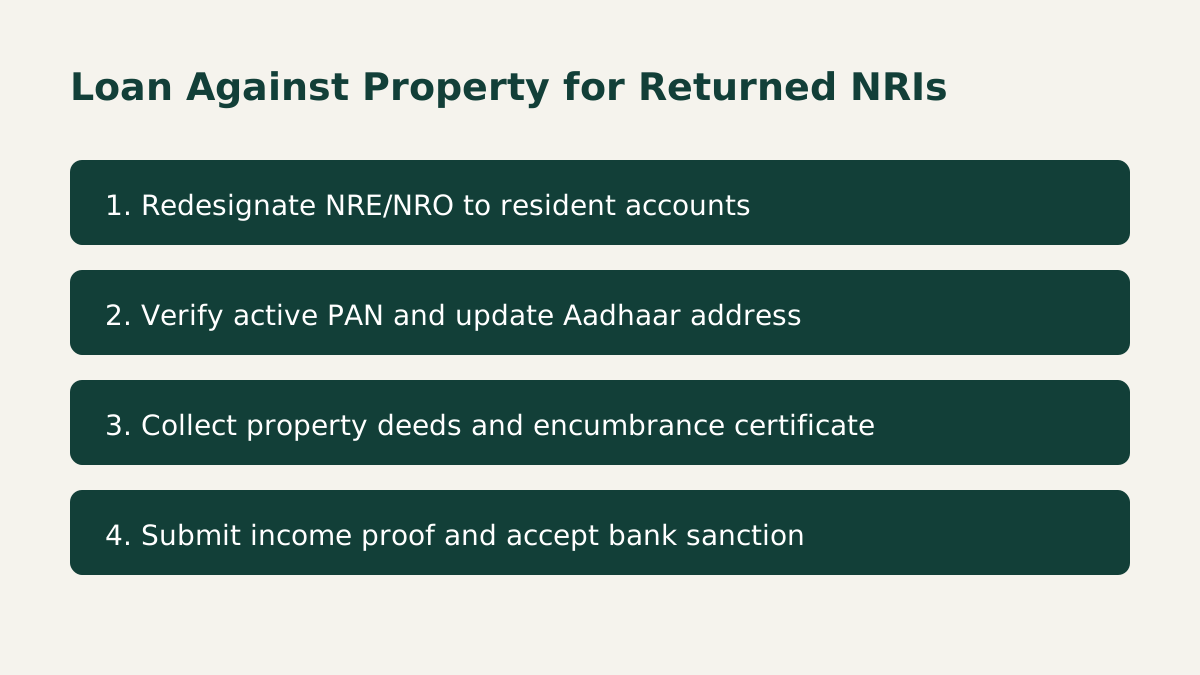
The 60-second version
Returned NRIs who have redesignated their bank accounts to resident status can apply for a Loan Against Property at most major banks. Eligibility hinges on the property being in the applicant's name, a clear title, and income proof in India. This page covers the full LAP workflow from account redesignation to disbursement.
Fast answer: yes, returned NRIs can get a Loan Against Property once accounts are redesignated
A Loan Against Property (LAP) is a secured loan where you pledge a residential, commercial, or industrial property you own in India as collateral. Major banks — SBI, ICICI Bank, HDFC Bank, and others — offer LAP to Indian residents, and a returned NRI becomes eligible as soon as the NRE/NRO accounts are redesignated to resident status under RBI rules.
The key prerequisite is that your residential status must be 'resident' under FEMA, meaning you have returned to India with the intention to stay for an uncertain period. Once the bank converts your NRE account to a resident savings account (or you open a new one), you can apply for LAP just like any other resident — subject to income proof, property valuation, and a clear title.
LAP amounts typically range from 50 % to 75 % of the property's current market value, with tenures stretching up to 15 years. Interest rates start around 8.5 % p.a. and vary by bank, property type, and borrower profile.
LAP eligibility: NRI status vs returned-resident status
Banks treat NRI and returned-resident applicants differently. This table compares the two paths.
| Factor | While still NRI | After return and redesignation |
|---|---|---|
| Eligible account | NRE / NRO / FCNR(B) | Resident savings / current |
| Income proof accepted | Foreign salary, NRE credits | Indian salary slips, ITR, business income |
| Property types | Residential and commercial (some banks restrict) | Residential, commercial, industrial, and special |
| Typical LTV | 50 %–60 % | Up to 65 %–75 % of market value |
| Loan tenure | Up to 15 years | Up to 15 years |
| Disbursement currency | INR only | INR only |
| Power of attorney | Often required for documentation | Usually not needed; applicant is in India |
| RBI framework | FEMA 5(R)/2016-RB for NRE/NRO ops | Domestic lending norms; FEMA constraints removed |
Step-by-step LAP process after returning to India
Follow these steps after you have physically returned and intend to stay.
Redesignate your bank accounts
Visit your NRE/NRO bank branch with your passport showing arrival stamps and a declaration of intent to stay. The bank converts NRE accounts to resident savings accounts. FCNR(B) deposits may continue to maturity at the contracted rate, per RBI FAQ Q3. NRO accounts are simply redesignated as resident accounts.
Update PAN and Aadhaar address
Ensure your PAN is active (verify at incometax.gov.in) and Aadhaar reflects your current Indian address. Banks require KYC with a resident address proof such as an Aadhaar card, utility bill, or passport with the current address.
Collect property documents
Gather the original sale deed, title deed, property tax receipts, approved building plan, encumbrance certificate (EC) for the last 13–30 years depending on the state, and the occupancy certificate. A clear, dispute-free title is mandatory for LAP.
Prepare income proof
Salaried applicants need the last six months' salary slips, bank statements, and Form 16. Self-employed applicants need the last three years' ITR with computation of income, audited financials (if applicable), and current-year bank statements.
Apply at the bank or online
Submit the application with your KYC documents, property papers, and income proof. SBI, ICICI Bank, and HDFC Bank accept online LAP applications; a relationship manager is assigned for property valuation and legal verification.
Property valuation and legal check
The bank sends an approved valuer to assess the property's market value and a legal team to verify the title chain. The loan amount is sanctioned as a percentage (LTV) of the valuation. HDFC Bank states decisioning within 7 days if all documents are submitted; cases involving property valuation or field investigation may take up to 25 days.
Accept the sanction letter and sign agreements
Review the interest rate, tenure, EMI, processing fee, and prepayment terms. Sign the loan agreement and mortgage deed. Processing fees are typically 0.5 %–1 % of the loan amount.
Disbursement
After registration of the mortgage at the sub-registrar's office, the bank disburses the loan to your resident savings account. EMI deductions begin from the following month.
Document checklist for returned-NRI LAP application
Keep these documents ready before you visit the bank.
- Passport with arrival stamp showing return to India
- PAN card (verified active at incometax.gov.in)
- Aadhaar card with current Indian address
- Resident savings account statement — last 6 months
- Salary slips (last 6 months) or ITR (last 3 years) for self-employed
- Form 16 or computation of income
- Original sale deed and title deed of the property
- Encumbrance certificate (13–30 years, state-dependent)
- Approved building plan and occupancy certificate
- Property tax paid receipts (current year)
- Photographs of the property (exterior and interior)
- Declaration of intent to stay in India (bank format)
FEMA compliance: redesignate before applying
If you apply for a LAP while your accounts are still NRE/NRO, the bank may process it under NRI lending norms with a lower LTV and stricter documentation. Redesignating to resident status first gives you access to standard domestic LAP terms with higher LTV ratios and simpler paperwork. RBI requires NRO accounts to be designated as resident accounts on the return of the account holder to India for any purpose indicating intention to stay for an uncertain period.
Current LAP interest rates and charges at major banks
Interest rates for LAP at major Indian banks start from approximately 8.5 % p.a. in October 2026. HDFC Bank lists LAP rates from 8.55 % p.a. onwards for salaried applicants. SBI's mortgage loan rates start from around 10 % p.a. ICICI Bank offers LAP with tenure up to 15 years and nil foreclosure charges for SME borrowers.
Processing fees typically range from 0.5 % to 1 % of the sanctioned amount, with most banks capping the fee. Prepayment and foreclosure charges differ: ICICI Bank waives foreclosure for SMEs, while individual borrowers on floating rate often face no prepayment penalty under RBI guidelines.
Always compare the Annual Percentage Rate (APR) rather than the headline rate, because processing fees, legal charges, valuation fees, and stamp duty on the mortgage deed add to the effective cost.
Need help with Banking?
Share your blocker in one line. Our experts will reply with practical next steps.
Tax implications of LAP for returned NRIs
LAP proceeds are not taxable because they represent borrowed funds, not income. However, the end-use matters for interest deductibility: if the LAP funds are used for business purposes, the interest paid is deductible as a business expense. If used for purchasing or constructing a residential property, Section 24(b) allows deduction of interest up to ₹ 2 lakh per year on self-occupied property.
If the LAP is used for personal expenses — medical bills, education, or debt consolidation — the interest is not tax-deductible. Returned NRIs in RNOR status (Resident but Not Ordinarily Resident) for the first two to three years after return should note that their foreign income is not taxable in India during the RNOR period, but domestic income including any rental income from the mortgaged property is fully taxable.
Planning visual

Animated decision map

Decision workflow map
Community signal
What to watch in real discussions
Treat repeated complaints as risk signals rather than official advice. This page does not link to community search results.
Interactive checkpoint
Turn this guide into a decision file
0 of 4 checked
Can a returned NRI get a Loan Against Property in India?
Yes. Once your residential status changes to 'resident' under FEMA and your bank accounts are redesignated from NRE/NRO to resident accounts, you are eligible for LAP at any major Indian bank under standard domestic lending norms.
What LTV ratio can a returned NRI expect on LAP?
Returned NRIs with resident status can typically get 60 %–75 % of the property's market value as a LAP, depending on the bank and property type. HDFC Bank offers up to 65 %, while ICICI Bank offers up to 75 % for eligible applicants.
Is it better to apply for LAP before or after returning to India?
It is usually better to apply after returning and redesignating accounts. NRI LAP applications face lower LTVs (50 %–60 %), require a Power of Attorney for documentation, and have stricter income verification. Resident status simplifies the process and improves terms.
What documents does a returned NRI need for LAP?
Key documents include passport with arrival stamp, PAN card, Aadhaar with Indian address, resident bank statements, income proof (salary slips or ITR), and complete property documents including sale deed, encumbrance certificate, and approved plan.
Can I use LAP funds for any purpose?
Yes, LAP is a general-purpose secured loan. You can use the funds for business expansion, education, medical expenses, debt consolidation, or any personal need. However, interest tax deductibility depends on the end-use.
How long does LAP approval take for returned NRIs?
If all documents are in order, banks typically decision within 7 days. Cases requiring property valuation or field investigation may take up to 25 days. The total process from application to disbursement usually takes 2–4 weeks.
Are there prepayment charges on LAP?
For individual borrowers on floating-rate LAP, RBI guidelines prohibit prepayment penalties. Fixed-rate LAP and business LAP may carry foreclosure charges, but some banks like ICICI Bank waive foreclosure for SMEs.
Your NRE account redesignation has a deadline.
Banks don't remind you. You need the right account stack before salary, rent, and EMIs start moving. Get the exact sequence.