The 60-second version
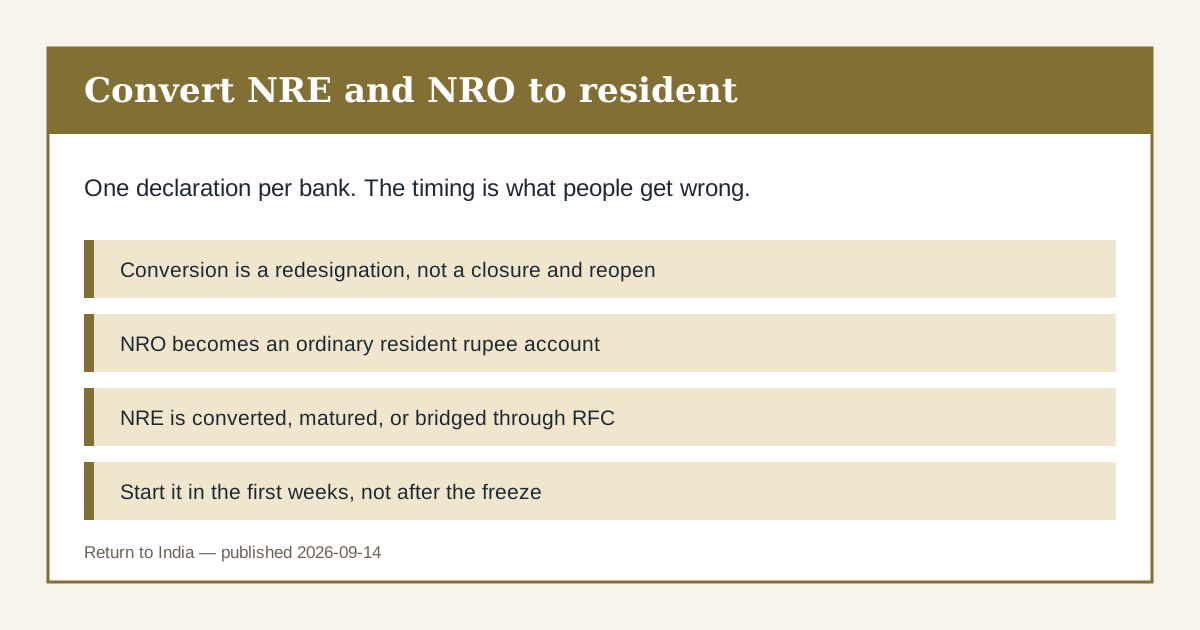
Conversion is a redesignation, not a new account. You sign a declaration of change of status at each bank, the NRO becomes an ordinary resident rupee account, the NRE balance is converted or moved into RFC, and the whole thing should be started within the first weeks of landing rather than after the bank notices.
You are asking the bank to change a field, not to open an account
The conversion request is a redesignation. You are telling the bank that your status has changed from person resident outside India to person resident in India, and asking it to re-record the account accordingly. You do not need a new account number, and in most cases you should refuse one, because redesignation keeps your standing instructions, mandates, ECS registrations and transaction history in place.
Two different things happen to two different accounts. The NRO account becomes an ordinary resident rupee account: same number, new status, interest still taxable, but now under resident rules. The NRE balance is the harder question. It cannot stay as an NRE account once you are resident, so the bank will either convert it to rupees in a resident account, or you move it into an RFC account where the conditions are met, or an existing FCNR(B) deposit is allowed to run to maturity first.
The timing error that costs people most is waiting. Nothing about the conversion requires a particular form to be filed by a particular week, but the bank's own compliance review will eventually compare the recorded status against your KYC file, and when it does, the outcome is a debit restriction or a freeze. That is exactly when you cannot afford it — normally the month you are paying school fees or a property instalment.
So do it early, do it in writing, and keep the acknowledgement. Then work through the document checklist before the visit so you are not sent home for a missing proof.
What conversion actually changes
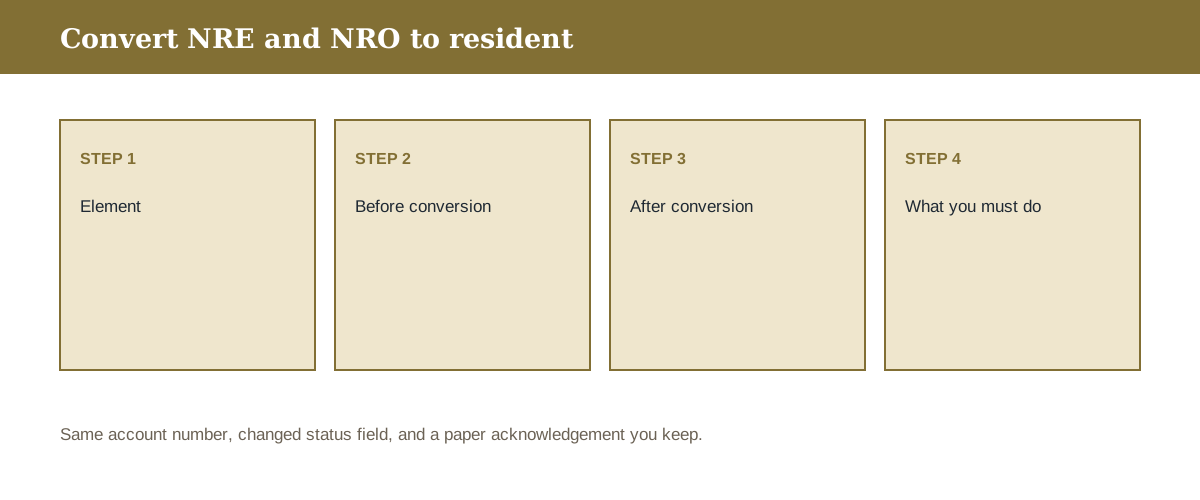
Four rows cover the entire practical difference. Everything else about the account stays as it was.
| Element | Before conversion | After conversion | What you must do |
|---|---|---|---|
| Account number | NRE or NRO account | Same number, resident designation | Insist on redesignation, not a new account |
| Interest treatment | NRE interest not taxed; NRO taxable | Resident rules apply throughout | Tell your accountant which part of the year was which |
| Repatriation | NRE freely repatriable; NRO capped with documentation | Normal remittance framework applies | Plan foreign-currency needs before you convert |
| Joint holder | Second holder often a resident with mandate limits | Mandate and operating rights must be re-recorded | Re-sign the mandate with the updated status |
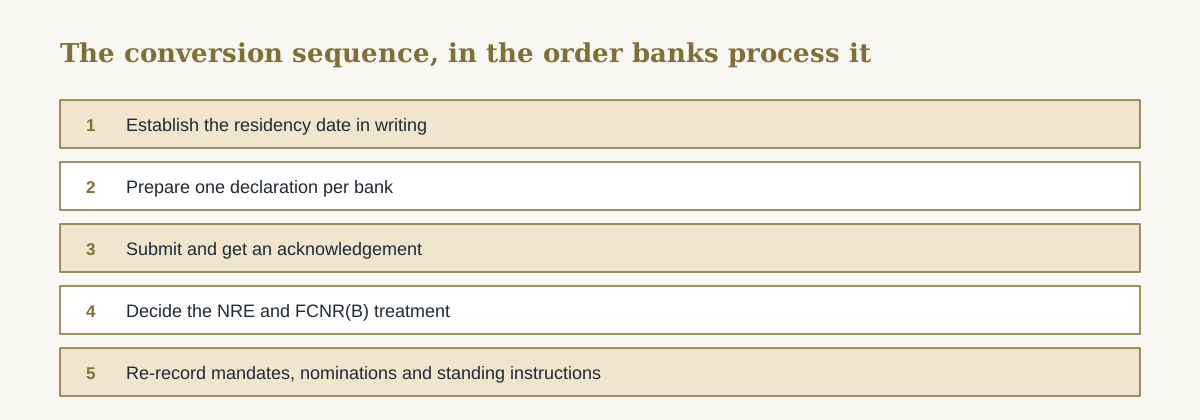
The conversion sequence, in the order banks process it
One branch visit can complete most of this if you arrive with everything already signed.
Establish the residency date in writing
Write down the date you became resident and the facts behind it. The bank will ask for this, and a consistent answer across institutions avoids a compliance query later.
Prepare one declaration per bank
The declaration states the change of status and requests redesignation of each listed account. One page per institution, signed by every holder.
Submit and get an acknowledgement
Do not leave without a stamped or system-generated acknowledgement that names each account you asked to convert. This is your evidence if the change is not applied.
Decide the NRE and FCNR(B) treatment
Choose between converting to rupees, letting the deposit run to maturity, or moving the balance into RFC. Decide this before the bank asks, because the default is conversion to rupees.
Re-record mandates, nominations and standing instructions
Joint holders, nominees and standing instructions all carry a status field. Re-sign them so a later debit does not bounce on an operating-right mismatch.
Verify the change actually landed
Check the next statement. If the account still prints the old designation, escalate with the acknowledgement rather than explaining again from the beginning.
Branch-visit pack for a conversion request
Take all of it, even the parts you think are obvious.
- Written residency date and the fact pattern behind it
- PAN and Aadhaar, with the link checked in advance
- Passport and the visa or entry record showing the move
- Proof of the new Indian address
- The declaration, one page per bank, signed by all holders
- The list of accounts and deposit reference numbers you want converted
- Nomination and mandate forms if holders or nominees have changed
- A stamped or system acknowledgement naming every account in the request
Before and after
Need help with Banking?
Share your blocker in one line. Our experts will reply with practical next steps.
Podcast: NRE and NRO in practice
"The decision episode that pairs with this guide — what differs, and where each account fails if you leave it alone."
Read on youtube ->Community explainer: the rule the bank applies
"Why an NRI account that should have been converted keeps working until it suddenly does not."
Read on youtube ->Conversion path
Need help with Banking?
Share your blocker in one line. Our experts will reply with practical next steps.
Never accept 'close and reopen'
A branch that offers to close the NRI account and open a fresh resident account is transferring the bank's compliance problem onto your transaction history. Redesignation is the correct route and preserves your standing instructions, ECS mandates and credit record.
The one-sentence answer
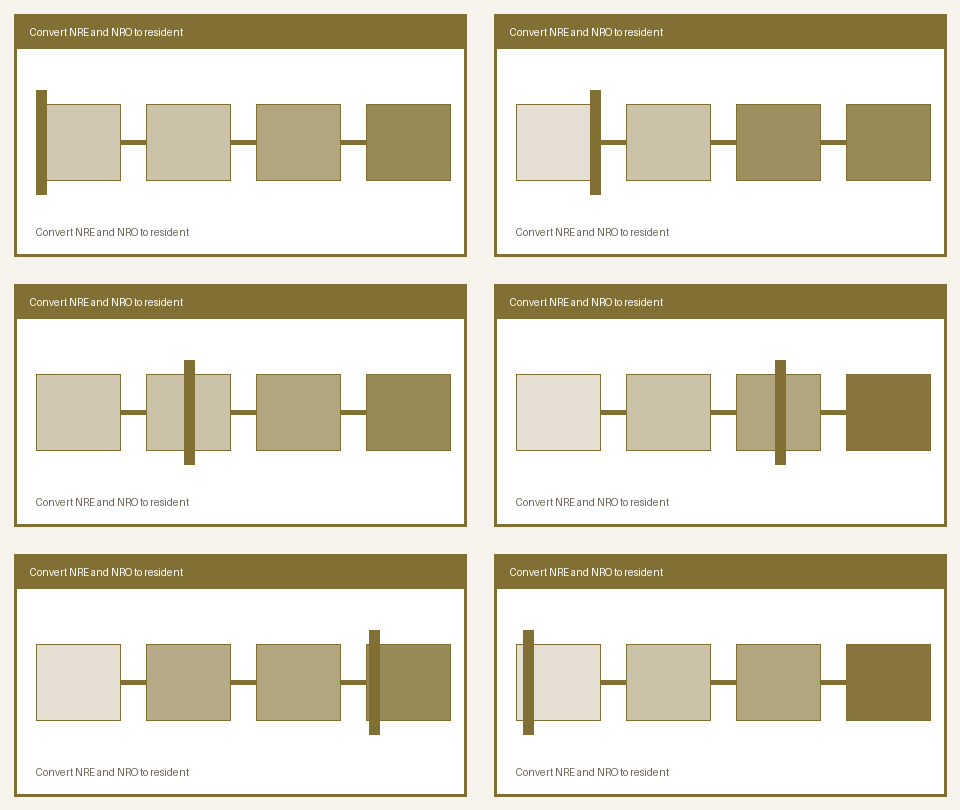
Conversion is a status redesignation signed at each bank: the NRO becomes an ordinary resident account, the NRE balance is converted, matured or bridged through RFC, and mandates are re-recorded on the same account number.
Animated decision map
Need help with Banking?
Share your blocker in one line. Our experts will reply with practical next steps.
Which account change applies to you?
Four questions. You get the course of action, in order, for your situation.
Question 1 of 4
Interactive checkpoint
Turn this guide into a decision file
0 of 4 checked
How do I convert my NRE account to a resident account?
Submit a written declaration of change of residency status at the branch and ask for the account to be redesignated. The bank re-records the status against the same account number rather than opening a new account.
Can a resident savings account be converted to NRE if I move abroad again?
In principle the reverse redesignation is possible when you again become a person resident outside India, but banks vary in how they handle it and many prefer a fresh NRE account. Ask the specific bank before you leave.
Do I have to close the NRO account instead of converting it?
No. Redesignation is standard and preferable, because it keeps the account's history, mandates and standing instructions intact.
What happens to my NRE fixed deposit when I convert?
The deposit runs its term. What changes is the designation attached to it, and whether the proceeds land in a resident account or in RFC. Decide which before you sign the conversion request.
Can I transfer money from NRE to NRO before converting?
Transfers between your own NRE and NRO accounts are permitted while you are non-resident. After the status change, ordinary resident transfer rules apply. If you need to move money for a specific purpose, do it in the right order.
Will conversion affect my credit history or loan?
The account number and thus the credit record usually stay continuous, which is one of the strongest reasons to insist on redesignation rather than closure. Verify with the bank that your loan mandates and auto-debits are re-linked.
How long does the conversion take?
Frequently the same visit, once the declaration and proofs are accepted. The delay is almost always documentary rather than procedural, and the follow-up check on the next statement is the part people skip.
What if my joint holder is still living abroad?
The joint holder's own status may not have changed, which changes the mandate outcome. The bank will usually want the joint holder's signature or a fresh mandate recorded, so plan for that in advance rather than at the counter.
Do I need to convert my demat and mutual fund accounts at the same time?
Separately, yes — they need their own update. The bank conversion does not reach them. Handle the bank first because the bank proof is usually what the demat and fund intermediaries ask for.
What if the bank refuses to convert and insists on closure?
Ask for the refusal in writing with the reason, then escalate to the bank's grievance redressal channel and, if needed, to the banking ombudsman. Redesignation on return is an ordinary service request, not a discretionary favour.
Your NRE account redesignation has a deadline.
Banks don't remind you. You need the right account stack before salary, rent, and EMIs start moving. Get the exact sequence.