The 60-second version
The expensive mistake is one mode for everything. Air is for time and density. Sea is for bulk and patience. Transfer of Residence paperwork is a third rail that sits under both. Families that book before they split the inventory pay twice — once in freight, once in storage and rebuy.
Why one mode for the whole house fails
Sea cargo wins on cost per cubic metre for furniture and bulk. Air cargo wins when school starts Monday and the winter coats are still in a US garage. Courier wins for passports, diplomas, and one critical hard drive — until someone tries to air-ship a TV and a sofa.
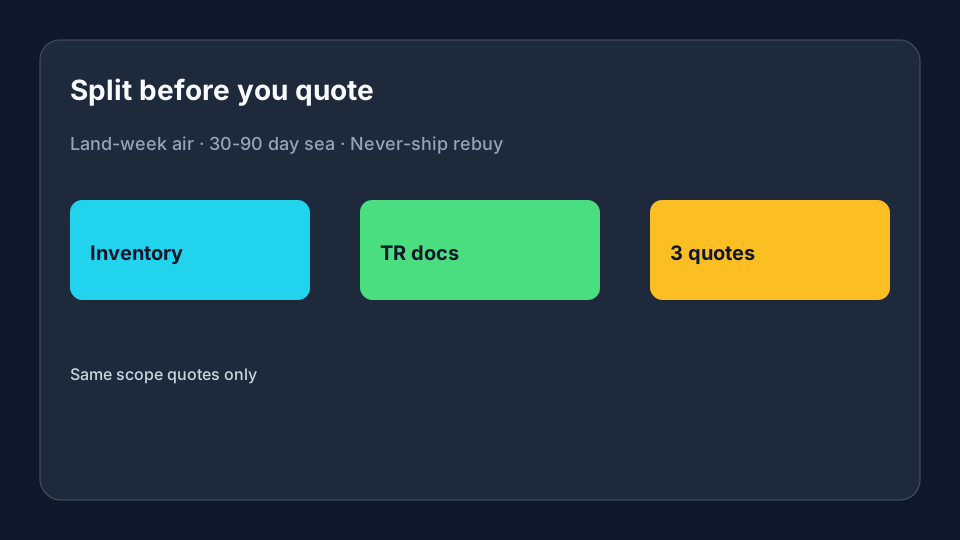
Treat the move as three inventories: (1) land-week kit (air or suitcase), (2) 4–12 week household (sea FCL/LCL), (3) never-ship / rebuy list. Transfer of Residence (TR) eligibility and unaccompanied baggage rules sit under lanes 1–2 — book freight only after you know which customs story you are telling.
Mode matrix (ops view)
| Mode | Best for | Typical pain | Avoid using for |
|---|---|---|---|
| Checked bags + cabin | Documents, meds, 1–2 weeks of clothes, kid school kit | Weight fees; battery rules | Bulk furniture |
| Courier / express boxes | Urgent small parcels, papers | Duty surprises; lost box risk | High-value electronics without insurance |
| Air cargo | Dense, time-critical household subset | High ₹/kg; airport pickup ops | Low-value bulky items |
| Sea LCL | Partial household when volume < full container | Consolidation delays; shared container risk | True urgency under 3–4 weeks |
| Sea FCL | Full home, cars separate lane | Port dwell, destination trucking | Tiny apartment moves |
| Rebuy in India | Mattresses, cheap furniture, some appliances | Quality variance | Irreplaceable heirlooms |
Cost and time levers (directional)
| Lever | Air | Sea |
|---|---|---|
| Primary price driver | Chargeable weight (actual vs volumetric) | Volume (CBM) + origin/destination pair |
| Door-to-door feel | Faster if docs clean; airport/warehouse handoff still real | Slower; port + ICD + trucking dominate calendar |
| Insurance | Critical — high value density | Critical — longer exposure window |
| Customs story | Unaccompanied baggage / TR still applies | Same TR/baggage framework for household |
| Change-order cost | Painful after flight booking | Painful after container stuff |
Usually never air (unless you accept the bill)
| Item class | Why | Prefer |
|---|---|---|
| Sofas, beds, large furniture | Volumetric weight destroys air math | Sea or rebuy |
| Empty suitcases / bulky low-value | You pay to move air | Sea or discard |
| Hazardous / battery-heavy packs without airline rules check | Refusal risk | Compliant packing or leave |
| Liquids / food with spoilage risk | Delay + customs friction | Do not ship |
Twelve-step split-shipment sequence
List every item with size, weight, value, and replaceability
Spreadsheet columns beat mental lists. Mark heirloom vs rebuy.
Mark land-week kit (must have within 7 days of landing)
Clothes, meds, school gear, work laptop path, one set of kitchen basics.
Mark 30–90 day household (sea candidates)
Furniture, bulk kitchen, books, seasonal clothes.
Run rebuy math for mattresses, cheap furniture, some appliances
India market prices + warranty often beat freight + duty + damage.
Confirm Transfer of Residence / baggage eligibility story
Read the TR deep guide; do not invent free-duty claims from forums.
Get 3 quotes on the same inventory split (air + sea separately)
Same CBM/kg, same origin ZIP, same destination city, same insurance ask.
Compare door-to-door scope: packing, export, destination clearance, trucking
“Port only” quotes are not comparable to door-to-door.
Book air only for the land-week subset after passport dates fixed
Air without landing date is storage with wings.
Book sea with buffer before lease start and school start
Add port dwell and inland transport — not sailing time alone.
Photograph inventory and seal cartons; keep packing list PDF
Claims and customs both need the list.
Carry originals of ID, passport stamps, OCI, and valuation proofs
Digital copies in DigiLocker help; originals still matter at handoff.
Plan destination week: warehouse pickup, labour, temporary housing storage
Container arrival into a unfinished flat is how things break.
Need help with this?
Share your blocker in one line. Our experts will reply with practical next steps.
How this pairs with Transfer of Residence
| Question | Air subset | Sea bulk |
|---|---|---|
| Same TR claim? | Possible for unaccompanied baggage lanes — confirm with broker | Common for household goods under TR rules when eligible |
| Document pack | Passport, packing list, invoices for new items | Same + fuller inventory + shipping bill set |
| Risk if wrong mode | Overpay freight | Overpay time / storage / hotel |
| Deep companion | This page (mode split) | TR customs deep guide (eligibility + baggage) |
Air/sea split kit
- Master inventory spreadsheet (kg, CBM, value, rebuy flag).
- Land-week kit list (max weight target).
- Sea bulk list with photos.
- Never-ship / rebuy list with India price notes.
- Three comparable quotes (air + sea).
- Insurance quotes and deductible notes.
- TR / baggage document folder (passport, OCI, residence proofs).
- Packing list PDF signed copy.
- Destination address, contact, and temporary storage plan.
- School/lease dates on one calendar with freight ETA buffer.
- DigiLocker / cloud backup of docs for the road.
Decision flow
Need help with this?
Share your blocker in one line. Our experts will reply with practical next steps.
Rates, duty, and baggage rules change
Freight rates, airline restrictions, and Customs baggage / Transfer of Residence rules are moving targets. This page is an operating checklist. Confirm current CBIC baggage/TR guidance with a licensed customs broker and your mover before you pay a deposit.
Myth: “Air is always safer than sea”
Air is faster, not automatically safer. Bad packing, no insurance, and airport dwell still destroy items. Safety is packing grade + insurance + chain of custody — not the word “air” on the invoice.
Animated decision map

Need help with this?
Share your blocker in one line. Our experts will reply with practical next steps.
Community signal
What to watch in real discussions
Search community threads for the exact phrase, then treat repeated complaints as risk signals rather than official advice.
Open nofollow community search ->Interactive checkpoint
Turn this guide into a decision file
0 of 4 checked
Should I air-ship my entire apartment?
Almost never. Air the land-week kit and dense high-priority items. Sea or rebuy the bulk. Full-apartment air freight is a common regret.
Is LCL cheaper than FCL?
For small volumes, LCL can be cheaper than paying for empty FCL space. For larger homes, FCL often wins on total cost and handling. Quote both with the same inventory.
Does air cargo skip Transfer of Residence rules?
No. Mode of transport does not create eligibility. Unaccompanied baggage and TR frameworks still need correct documents and facts. See the TR deep guide.
What should never go in cargo?
Passports, irreplaceable documents, critical medicines, and items you need the day you land — keep those in cabin/checked bags when rules allow.
How early should I book sea cargo?
Work backward from lease and school dates, then add port dwell and inland transport buffer. Booking after flights alone is how families live out of suitcases for months.
Courier vs air cargo?
Courier is for small urgent parcels. Air cargo is for denser household subsets with different handling. Do not assume courier duty treatment matches household TR claims.
How is this different from the short air-vs-sea page?
The short page is a fast decision map. This deep guide is the split-shipment execution sequence with TR pairing and a booking kit.
Should I run a test move first?
If you are unsure about city or housing, a pilot stay can prevent shipping a full house into the wrong city. See the test-move pilot guide before locking FCL.
You've done the research. Now get the plan.
The biggest mistake NRIs make is treating moving as something they'll figure out later. Later is expensive. Get expert clarity now.