RRSP After Return 2026: Keep, Withdraw, CRA Net
12-step RRSP path: keep invested, Part XIII cash-out, RRIF notes, RNOR vs ROR, Form 67 kit — Canada first, India second.
The 60-second version
An RRSP is not a TFSA and not a 401(k). After you leave Canada, every dollar you pull is a CRA non-resident event first — then an India residential-status year event. Families that cash out without a net model fund the institution’s withholding default and still face India paperwork.
Why RRSP after return is a CRA event first
When you are a non-resident of Canada for tax purposes, RRSP withdrawals are generally subject to non-resident withholding under the Part XIII framework administered by the CRA and remitted by the financial institution. The default rate many institutions apply on lump sums is often 25% of the gross unless a lower treaty rate is properly applied — you receive net, not headline balance.
India then asks a different question: what is your residential status in the year of receipt (RNOR vs ROR), and do you claim foreign tax credit via Form 67 with supporting proof (NR4, withholding evidence, TRC when relevant)? Treat the file as three workstreams: (1) keep vs withdraw vs RRIF path, (2) CRA withholding and slips, (3) India year + Form 67 pack.
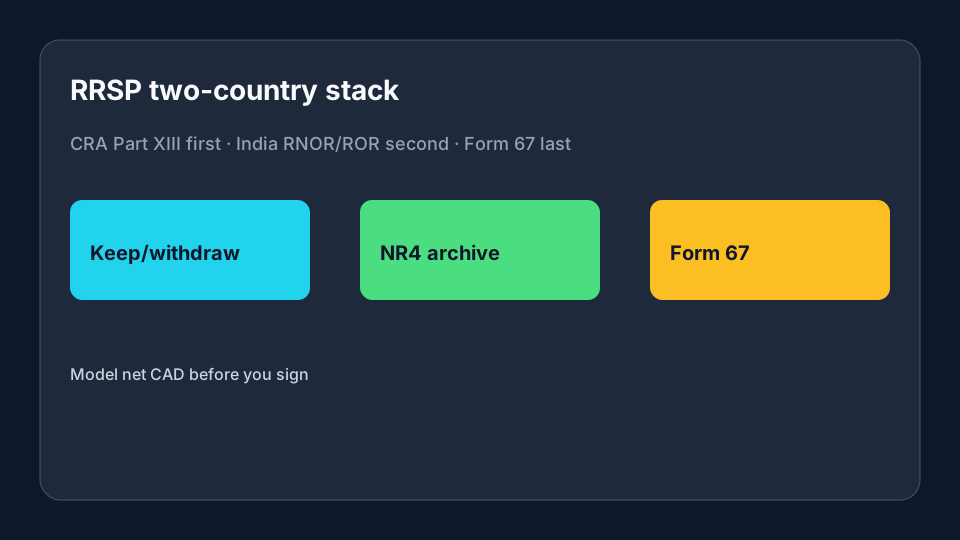
Option matrix after you leave Canada
| Option | Canada side | India side | Best when |
|---|---|---|---|
| Keep RRSP invested | No withdrawal event; institution may still need non-resident updates | Foreign asset tracking when schedules apply; no distribution income yet | No cash need; long horizon; fees acceptable |
| Partial / full withdrawal | Part XIII withholding at source; NR4-type reporting | RNOR/ROR character + possible Form 67 FTC | True cash need after net model |
| Convert / draw as RRIF (age path) | Different payment pattern and withholding mechanics | Annual income stream planning with India residency | Near retirement income needs; plan with cross-border CA |
| Spousal RRSP facts | Attribution / who is annuitant matters | Do not assume one spouse’s residency fixes both | Joint family plans — map each annuitant |
CRA withholding traps (ops view)
| Trap | What you feel | Mitigation |
|---|---|---|
| 25% default lump sum | Cash received is far below statement balance | Ask institution about treaty rate process before transfer; keep paperwork |
| Treaty rate paperwork late | Full withholding already remitted | Do not assume bank will re-open rate after wire |
| Wrong residency status on file | Forms bounce; delays | Update non-resident status and address before large request |
| Missing NR4 / slip | India Form 67 weak support | Download slips; archive PDF with wire confirmation |
| TFSA mixed into RRSP mental model | Wrong expectations on tax character | Use TFSA guide separately — different rules |
India timing: RNOR vs ROR for RRSP receipts
| Receipt year | Planning question | Ops move |
|---|---|---|
| RNOR transition year | Does India tax this foreign retirement-style receipt this year? | Model with India CA before CRA withdrawal date |
| ROR year | Worldwide income + FTC path | Build Form 67 pack with NR4 + withholding proof |
| Split-year facts | Day-count and residential tests | Section 6 worksheet before fixing withdrawal calendar |
| Wire to NRE/NRO | Banking/FEMA path ≠ tax character | Coordinate AD bank for large CAD/USD wires |
Twelve-step RRSP sequence for India returnees
Pull RRSP (and spousal RRSP) statements + annuitant names
Know balances, locked-in vs regular, and who legally owns each plan.
Confirm Canadian tax residency departure facts
Departure year, ties, and CRA non-resident status drive Part XIII treatment.
Decide keep vs withdraw vs staged withdrawals
One full cash-out is not the only design — model tax years on both sides.
Request the institution’s non-resident withdrawal package
Forms, ID, address, and any treaty-rate process must be explicit.
Model gross → withhold → net → India tax year
Spreadsheet columns beat hopeful social-media rates.
Coordinate with India CA on RNOR/ROR year of receipt
Same CAD amount in two FYs can produce two India outcomes.
If claiming treaty relief later: plan TRC / residency proofs
Form 67 without support is a weak file.
Execute withdrawal only after net model sign-off
Get withholding estimate in writing when possible.
Wire through channels your India AD bank accepts
Large remittances need bank process — ask before SWIFT leaves Canada.
Archive NR4/slips, bank remittance proof, and statements
One folder for CRA + India ITR season.
India ITR: foreign income schedules + Form 67 if FTC claimed
Match amounts to slips; do not invent treaty articles.
If keeping invested: calendar annual non-resident admin
Address, beneficiary, login/OTP path, and fee reviews from India.
Need help with Tax & Residency?
Share your blocker in one line. Our experts will reply with practical next steps.
RRSP vs US 401(k) after return (do not copy playbooks)
| Topic | RRSP (Canada) | 401(k) (US) |
|---|---|---|
| Source country tax on cash-out | CRA Part XIII non-resident withholding common | US income tax + possible early distribution tax |
| Typical “leave invested” | Yes, subject to institution non-resident ops | Yes, subject to plan former-employee rules |
| Common deep companion | This page + thin non-resident withdrawal map | 401k-after-return-leave-roll-withdraw-rnor-2026 |
| Pension siblings | CPP/OAS continue abroad with own rules | Social Security / IRA cluster |
RRSP return kit
- RRSP + spousal RRSP statements (PDF).
- Annuitant IDs and SIN references as institution requires.
- CRA departure / non-resident status notes.
- Institution non-resident withdrawal forms.
- Withholding estimate and any treaty paperwork.
- Decision memo: keep / partial / full / RRIF path.
- India CA + Canadian tax pro on the same memo.
- RNOR/ROR day-count worksheet for target year.
- India AD bank path for large CAD/USD wire.
- NR4/slips + SWIFT archive for Form 67.
- CPP/OAS address update if pensions also apply.
Decision flow
Need help with Tax & Residency?
Share your blocker in one line. Our experts will reply with practical next steps.
Rates, treaty articles, and residency facts change
Part XIII rates, treaty relief procedures, RRIF rules, RNOR taxation of foreign receipts, and Form 67 mechanics are fact-specific. This page is an operating checklist. Confirm with a Canadian tax professional and an India CA before you withdraw, convert, or wire.
Myth: “India RNOR means CRA will not withhold”
CRA non-resident withholding is a Canada-source event. RNOR may change India-side treatment for some foreign income classes, but it does not switch off institution withholding on RRSP cash-outs. Model net dollars, not headlines.
Animated decision map

Need help with Tax & Residency?
Share your blocker in one line. Our experts will reply with practical next steps.
Community signal
What to watch in real discussions
Search community threads for the exact phrase, then treat repeated complaints as risk signals rather than official advice.
Open nofollow community search ->Interactive checkpoint
Turn this guide into a decision file
0 of 4 checked
Must I cash out my RRSP when I move to India?
No. Many people keep RRSP invested after becoming non-residents, subject to institution rules and admin. Cash-out is a choice with CRA withholding consequences.
What is Part XIII withholding on RRSP withdrawals?
Non-resident tax often withheld at source by the payer on Canadian-source payments such as RRSP withdrawals. Institutions frequently default to a high percentage on lump sums unless a lower treaty process applies.
How does Form 67 help?
If India taxes the same income and you paid foreign tax, Form 67 is the usual path to claim foreign tax credit — with supporting slips and proofs. Confirm applicability with your CA.
Is RRSP the same as TFSA after return?
No. TFSA has a different Canadian tax character and a separate planning guide. Do not reuse RRSP withdrawal math on TFSA.
What about CPP and OAS?
Those are separate pension streams with their own residency and withholding rules. See the CPP/OAS after-moving guide; do not merge them into RRSP cash-out paperwork.
Can I wire proceeds to an NRE account?
Large wires have bank and FEMA process requirements. Tax character and banking credit path are separate. Coordinate with your AD bank before the Canadian institution sends funds.
How is this different from the thin non-resident withdrawal page?
The thin page is a quick CRA withhold map. This deep guide is the keep/withdraw decision tree with India RNOR sequencing and a twelve-step kit.
Should US 401(k) holders read this?
Only if they also hold RRSP. US plans use the 401(k) deep guide — different source-country rules.
Your tax year is already running.
RNOR status, exit timing, and DTAA benefits all depend on decisions you make before you land. Don't guess.