RNOR Full Form and Meaning in Income Tax, Explained
RNOR full form is Resident but Not Ordinarily Resident. This guide explains the exact Section 6(6) wording, the two conditions that create RNOR, what income stays...
The 60-second version
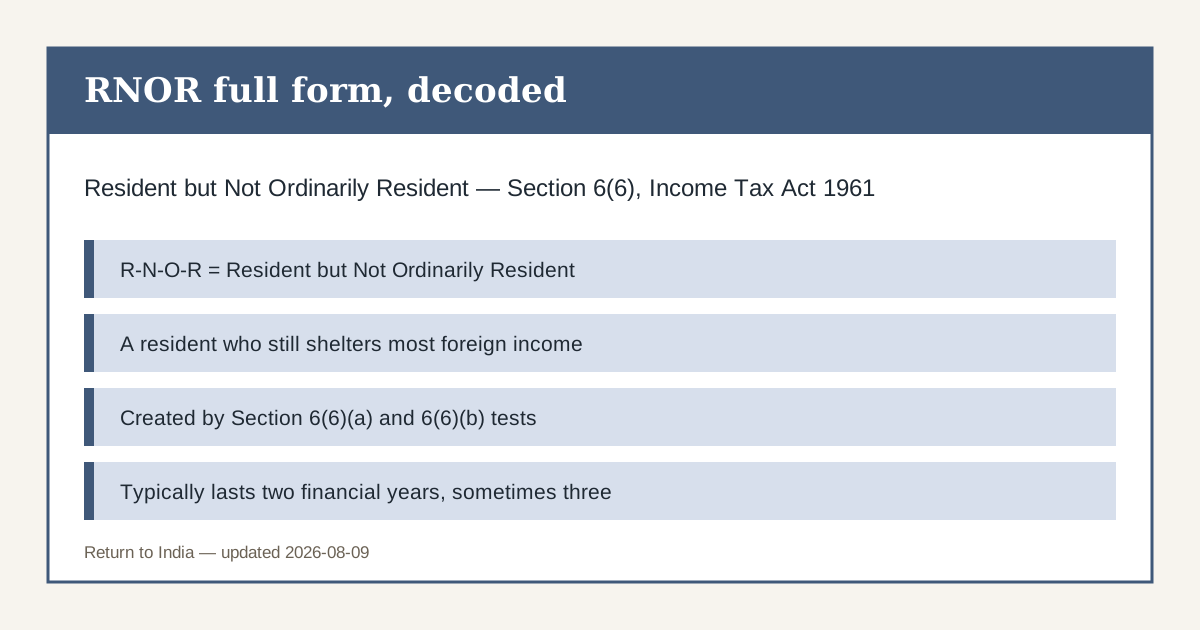
RNOR stands for Resident but Not Ordinarily Resident. It is a middle tax status between NRI and ordinary resident: you are resident in India for the year, but your foreign income generally stays outside the Indian tax net unless it is derived from a business controlled from India.
Fast answer: RNOR is four words, and each word changes a different thing
RNOR is the acronym for Resident but Not Ordinarily Resident. It is not a scheme you apply for, not a certificate you download, and not something a bank grants you. It is a status the Income Tax Act assigns to you automatically for a given financial year, based purely on how many days you were physically in India across the current year and the ten years before it.
Read the acronym as two halves. 'Resident' means India can treat you as a tax resident for that year and you file an Indian return. 'Not Ordinarily Resident' means the second, wider net — the one that taxes worldwide income — does not close on you yet. Foreign salary you already stopped earning, foreign interest, foreign dividends, foreign capital gains and foreign rent generally stay outside Indian tax during RNOR years, with one important exception: income from a business controlled in or a profession set up in India.
That gap is the whole point. For most people coming back after a long stint abroad, RNOR is a two-year window — sometimes three — in which you can unwind foreign accounts, take retirement-account distributions, sell foreign holdings and rebalance without India taxing the proceeds. Miss the window and the same transactions land inside Resident and Ordinarily Resident years, where worldwide income is fully taxable.
The three residency states, side by side
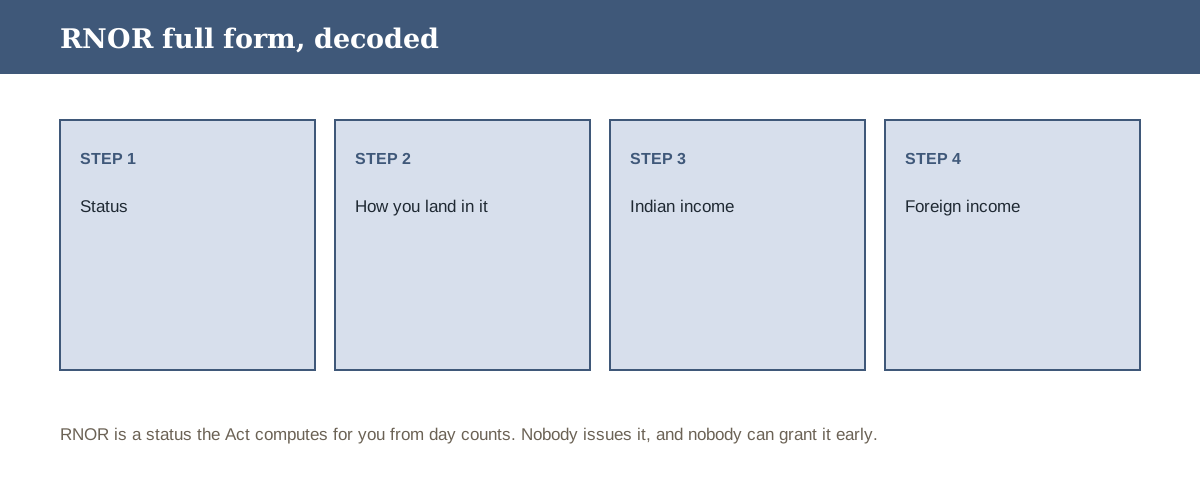
Every Indian financial year puts you in exactly one of these three boxes. The label decides the scope of income India can tax — not your passport, not your visa, not your OCI card.
| Status | How you land in it | Indian income | Foreign income | Typical returnee year |
|---|---|---|---|---|
| Non-Resident (NRI) | Under 182 days in India in the year, and you fail the alternate 60-day/365-day test | Taxable in India | Not taxable in India | Every year you lived abroad full time |
| Resident but Not Ordinarily Resident (RNOR) | You are resident for the year, but you satisfy Section 6(6)(a) or 6(6)(b) | Taxable in India | Generally not taxable, except business controlled from or profession set up in India | Usually the first two years after you land, sometimes three |
| Resident and Ordinarily Resident (ROR) | Resident for the year and you fail both Section 6(6) tests | Taxable in India | Fully taxable in India on a worldwide basis | Year three onward for most returnees |
| Deemed resident | Indian citizen, Indian-sourced income above the statutory threshold, and not liable to tax in any other country | Taxable in India | Treated as RNOR by statute | Rare — usually stateless-tax or zero-tax-jurisdiction cases |
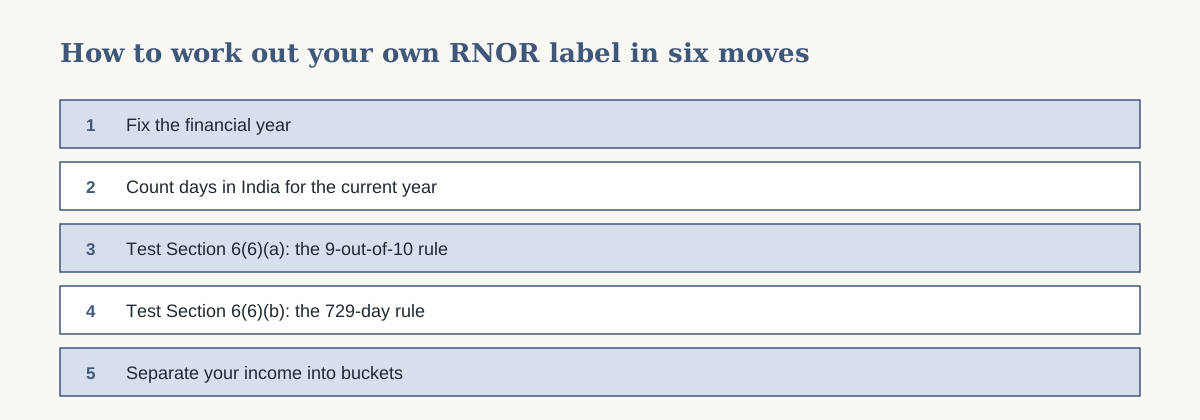
How to work out your own RNOR label in six moves
Do this on paper before you talk to anyone. The inputs are boring — dates on passport stamps — and the output decides tens of lakhs of tax exposure.
Fix the financial year
India runs 1 April to 31 March. Convert every travel date to that calendar first. A December landing and an April landing produce completely different first-year day counts.
Count days in India for the current year
Count physical presence, including the day of arrival and the day of departure. Use passport stamps or the immigration record, not memory. 182 days or more makes you resident; below that, run the 60-day plus 365-day-over-four-years alternate test.
Test Section 6(6)(a): the 9-out-of-10 rule
If you were a non-resident in nine or more of the ten financial years immediately preceding this year, you are Not Ordinarily Resident. Long-stay returnees usually clear this easily in year one.
Test Section 6(6)(b): the 729-day rule
If your total stay in India across the seven financial years immediately preceding this year is 729 days or less, you are Not Ordinarily Resident. Satisfying either test — (a) or (b) — is enough.
Separate your income into buckets
Indian-sourced income, foreign-sourced passive income, and income from a business controlled from India or a profession set up in India. Only the third bucket follows you into RNOR years.
Pick the ITR form and disclose
RNOR returns usually need ITR-2 or ITR-3, never ITR-1. Fill the residential status schedule honestly, and check whether Schedule FA foreign-asset disclosure applies for your status that year.
RNOR evidence file — build it in year one
RNOR is claimed on a return, and an assessing officer can ask you to prove it years later. These are the documents that make the claim defensible.
- Passport pages covering the last ten financial years, including expired passports.
- A day-count spreadsheet with arrival and departure dates converted to the Indian financial year.
- Written computation of the Section 6(6)(a) nine-of-ten test.
- Written computation of the Section 6(6)(b) 729-day test.
- Foreign tax residency certificates or equivalent proof for the years you claim non-resident status.
- A list of every foreign account, retirement plan and brokerage holding with the balance on the landing date.
- A note recording whether any income comes from a business controlled from India or a profession set up in India.
- The residential-status page of each filed ITR, saved as a PDF with its acknowledgement number.
- A dated calendar showing when the RNOR window is expected to close.
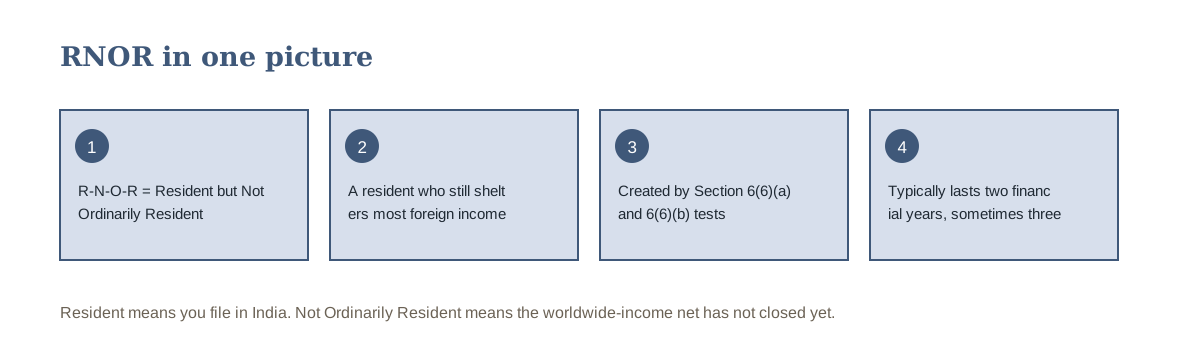
RNOR in one picture
Need help with Tax & Residency?
Share your blocker in one line. Our experts will reply with practical next steps.
Community signal: returnees search the acronym before the rule
Unable to embed reddit content. View on reddit
"The first question is almost always 'what does RNOR even stand for', and the second is 'how many years do I get'. Both are answered by the same section."
Read on reddit ->Forum signal: the acronym is often mixed up with NRI
"RNOR and NRI are frequently conflated in public answers. They are opposite sides of the residency line — RNOR is a resident status, NRI is not."
Read on quora ->RNOR determination diagram
Need help with Tax & Residency?
Share your blocker in one line. Our experts will reply with practical next steps.
The most expensive misreading
RNOR does not mean 'tax-free'. Indian-sourced income — rent from an Indian flat, interest on an NRO account, Indian capital gains, Indian salary — is fully taxable in every RNOR year. What RNOR shelters is foreign-sourced income, and only while the status lasts.
The one-sentence answer
RNOR is short for Resident but Not Ordinarily Resident: a statutory two-to-three-year window where you file as an Indian resident but most of your foreign income stays outside the Indian tax net.
Animated decision map

Need help with Tax & Residency?
Share your blocker in one line. Our experts will reply with practical next steps.
Interactive checkpoint
Turn this guide into a decision file
0 of 4 checked
What is the full form of RNOR?
RNOR stands for Resident but Not Ordinarily Resident. It is a residential status under Section 6(6) of the Income Tax Act 1961, sitting between Non-Resident (NRI) and Resident and Ordinarily Resident (ROR).
What does RNOR mean in income tax?
It means you are treated as a resident of India for that financial year and file an Indian return, but the worldwide-income rule does not apply to you yet. Foreign income generally stays outside Indian tax during RNOR years, except income from a business controlled from India or a profession set up in India.
Is RNOR the same as NRI?
No. They are on opposite sides of the residency line. An NRI is not resident in India for the year. An RNOR is resident, files an Indian return, and reports Indian income — but keeps the narrower foreign-income scope for a limited period.
How many years does RNOR status last?
Usually two financial years after you return, and in some landing patterns three. It is recomputed each year from the Section 6(6) tests, so the exact number depends on your day counts, not on a fixed rule.
Do I have to apply for RNOR status?
No. There is no application, no form and no certificate. The status is computed from your day counts and declared by you in the residential-status schedule of your income tax return. Keep the working papers in case the claim is questioned.
Is foreign income completely tax free during RNOR?
Not completely. Foreign passive income is generally outside the Indian net during RNOR years, but income derived from a business controlled in India or a profession set up in India is taxable even for an RNOR. Indian-sourced income is always taxable.
Which ITR form does an RNOR file?
Typically ITR-2, or ITR-3 if there is business or professional income. ITR-1 is not available where the residential status is Not Ordinarily Resident or where foreign assets and foreign income features apply.
Does RNOR status affect my bank accounts?
Indirectly. Your FEMA residency and your income tax residency are separate concepts governed by different laws. On permanent return, FEMA generally expects NRE and NRO accounts to be redesignated as resident accounts, regardless of whether you are RNOR or ROR for tax that year.
What is the difference between Section 6(6)(a) and 6(6)(b)?
6(6)(a) looks at status: were you a non-resident in nine of the ten preceding financial years. 6(6)(b) looks at days: was your total stay in India 729 days or fewer across the seven preceding financial years. Satisfying either one is enough to be Not Ordinarily Resident.
Your tax year is already running.
RNOR status, exit timing, and DTAA benefits all depend on decisions you make before you land. Don't guess.