Pio Card to Oci Conversion 2026 Fee Process Eligibility...
A practical 2026 guide for the 3-4 million legacy PIO (Person of Indian Origin) cardholders who want to convert to OCI:...
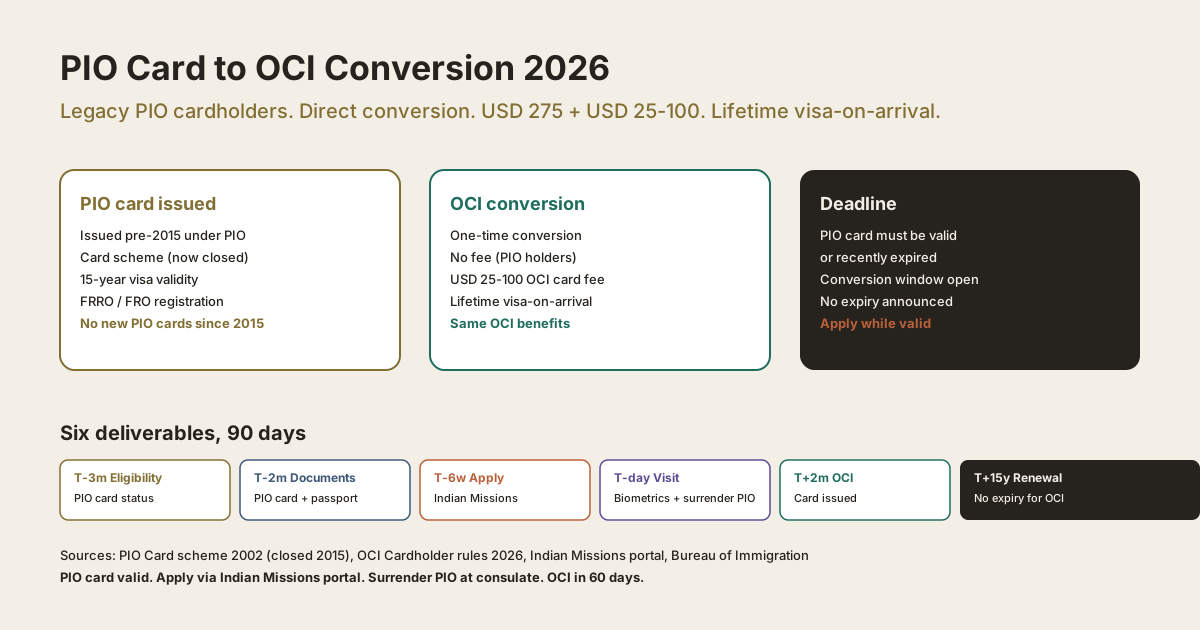
Why PIO to OCI conversion is the simplest and most under-served OCI pathway (and why 2026 changed it)
Every PIO cardholder with a valid or recently expired PIO card faces a four-layer PIO-to-OCI pathway: (1) the PIO cardholder on the legacy PIO card (15-year visa validity, FRRO / FRO registration required, no property purchase parity, no mutual fund investment parity, no Aadhaar / PAN / Indian mobile number eligibility for the PIO cardholder), (2) the PIO cardholder who converts to OCI (no OCI registration fee + USD 25-100 OCI card fee, lifetime visa-on-arrival, exemption from FRRO / FRO registration for stays under 180 days, property purchase parity with NRIs, mutual fund investment parity with NRIs, Aadhaar + PAN + Indian mobile number eligibility, OCI benefits for life), (3) the PIO cardholder who lets the PIO card expire without converting (loses the PIO benefits + must apply for fresh OCI for self with USD 275 OCI fee + USD 25-100 OCI card fee + new OCI number issued, no fee waiver), (4) the PIO cardholder who holds both PIO and OCI simultaneously (not permitted, must surrender PIO at consulate when OCI is issued). The 2002 PIO Card scheme was closed to new applicants in 2015 when OCI was rolled out as the replacement, and the 2026 simplified rules cut the average OCI conversion processing time at the Indian consulate from 3-6 months to 30-60 days, and unified the fee schedule (no OCI registration fee for PIO holders + USD 25-100 OCI card fee). The OCI conversion preserves the same OCI number as the PIO reference, so the PIO cardholder does not need to update any existing Indian records that reference the PIO number. The 2026 landscape has expanded the pathway at every layer: more legacy PIO cardholders are converting to OCI before the PIO card expires, more expired PIO cardholders are applying for fresh OCI for self with USD 275 fee, and the PIO-to-OCI conversion has become the simplest and most under-served OCI workflow.
The decision is not just about the conversion. It is also about the eligibility (the PIO card must be valid or recently expired, the applicant must be a Person of Indian Origin by birth / descent / marriage, no prior Indian citizenship, no fraud / misrepresentation at the original PIO application), the document checklist (original PIO card + foreign passport with 6+ months validity + Indian-origin proof documents + Indian parent / grandparent passport or OCI card + birth certificate showing Indian parentage + Indian marriage certificate for spouse of Indian origin + address proof + 35x35mm photograph), the application process (Indian Missions portal online OCI conversion application + VFS Global document submission + in-person consulate visit for biometrics + PIO card physical surrender + OCI card issuance in 30-60 days), the fee schedule (no OCI registration fee for PIO holders + USD 25-100 OCI card fee + Indian Missions portal service fee + VFS Global service fee, total USD 50-150), the OCI benefits transferred from PIO (lifetime visa-on-arrival + exemption from FRRO / FRO registration for stays under 180 days + parity with NRIs for property purchase + mutual fund investment + education + Aadhaar + PAN + Indian mobile number eligibility), the tax status flip (was PIO cardholder = NRI for tax purposes in most cases, OCI conversion makes the person ROR for Indian tax purposes, with global income taxed in India + Form 67 for foreign tax credit + 80C / 80D / 80TTA claim), the 5 PIO scenarios (PIO card valid + expired PIO card + never had PIO + lost PIO card + dual PIO+OCI), the OCI revalidation + renewal framework (first revalidation free at 5y from PIO card expiry, then on each PIO card expiry cycle, then on each subsequent renewal cycle for OCI), and the worst-case scenarios (expired PIO card over 10 years requires fresh OCI for self with USD 275 fee + lost PIO card requires affidavit of loss + dual PIO+OCI requires surrender at consulate + fraud / misrepresentation at conversion leads to OCI revocation + foreign tax compliance failure). The cleanest plan is to confirm the PIO card validity + pre-stage the documents + submit the OCI conversion application within 90 days of the planned conversion, and to maintain the PIO card surrender at the consulate visit + the OCI card issuance + the ongoing tax compliance. The order is fixed; the deliverables are not optional.
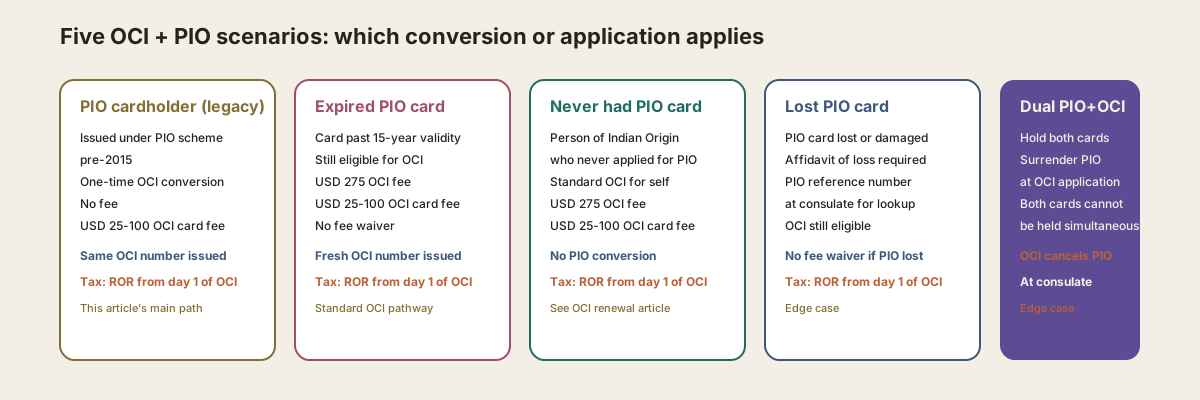
Five PIO scenarios: which conversion or fresh application applies
The five PIO scenarios have different eligibility, fee, process, and outcome. The right approach depends on whether the PIO card is valid or expired, whether the card is available or lost, and whether the applicant holds a PIO card from before 2015.
| Scenario | Eligibility | Timeline | Cost (USD) | Process | Outcome |
|---|---|---|---|---|---|
| PIO card valid (the main path) | PIO cardholder who received the PIO card under the 2002 scheme + card still within 15-year validity + Person of Indian Origin by birth / descent / marriage + no prior Indian citizenship + no fraud / misrepresentation | PIO validity check 3m before + documents 2m before + apply 6w before + consulate visit + OCI card in 60 days | No OCI registration fee + USD 25-100 OCI card fee + Indian Missions portal fee + VFS Global fee = USD 50-150 | Indian Missions portal OCI conversion application + VFS Global + consulate visit for biometrics + PIO card physical surrender + OCI card issuance | OCI card with same OCI number as PIO reference + lifetime visa-on-arrival + FRRO exemption + property + mutual fund parity + Aadhaar + PAN + Indian mobile number eligibility |
| Expired PIO card (recently expired) | PIO cardholder whose PIO card has expired within the last 5-10 years (Indian consulate discretion); Person of Indian Origin status still applies; card may be available for surrender | Same as valid PIO card if within 10y expiry | Same as valid PIO card if within 10y expiry; otherwise USD 275 OCI fee + USD 25-100 OCI card fee = USD 300-375 | Same as valid PIO card if within 10y expiry; otherwise standard OCI for self application at full fee | OCI card with fresh OCI number if outside 10y expiry; same OCI number if within 10y expiry window |
| Never had PIO card | Person of Indian Origin who never applied for PIO card (e.g. issued after 2015 when PIO scheme was closed); eligible for standard OCI for self pathway | Standard OCI for self timeline (30-60 days for processing) | USD 275 OCI fee + USD 25-100 OCI card fee + Indian Missions portal fee + VFS Global fee = USD 350-450 | Standard OCI for self application + VFS Global + consulate visit for biometrics + OCI card issuance | OCI card with new OCI number + lifetime visa-on-arrival + same OCI benefits as PIO conversion path |
| Lost PIO card | PIO cardholder who cannot produce the original PIO card at conversion; affidavit of loss required; PIO reference number at consulate for lookup | Same as valid PIO card | No OCI registration fee + USD 25 OCI card fee + USD 25 affidavit of loss + USD 25-100 Indian Missions portal fee = USD 75-150 | Affidavit of loss at Indian consulate + OCI conversion application + VFS Global + consulate visit + OCI card issuance | OCI card with same OCI number as PIO reference; same OCI benefits as PIO conversion path |
| Dual PIO+OCI (not permitted) | PIO cardholder who is also applying for fresh OCI without surrendering PIO; not permitted; PIO card must be surrendered at consulate when OCI is issued | OCI application paused until PIO surrender is completed | USD 25-100 OCI card fee (no OCI registration fee for PIO holders) | PIO surrender at consulate + OCI conversion application + consulate visit + OCI card issuance | OCI card issued after PIO surrender; both cards cannot be held simultaneously |
Execution sequence: from PIO validity check to OCI card in 90 days
Plan the order. The PIO validity check, the document pre-staging, the Indian Missions portal application, the consulate visit, the PIO card physical surrender, and the OCI card issuance are not simultaneous — but they are interdependent, and an error in one is hard to fix after the OCI is issued.
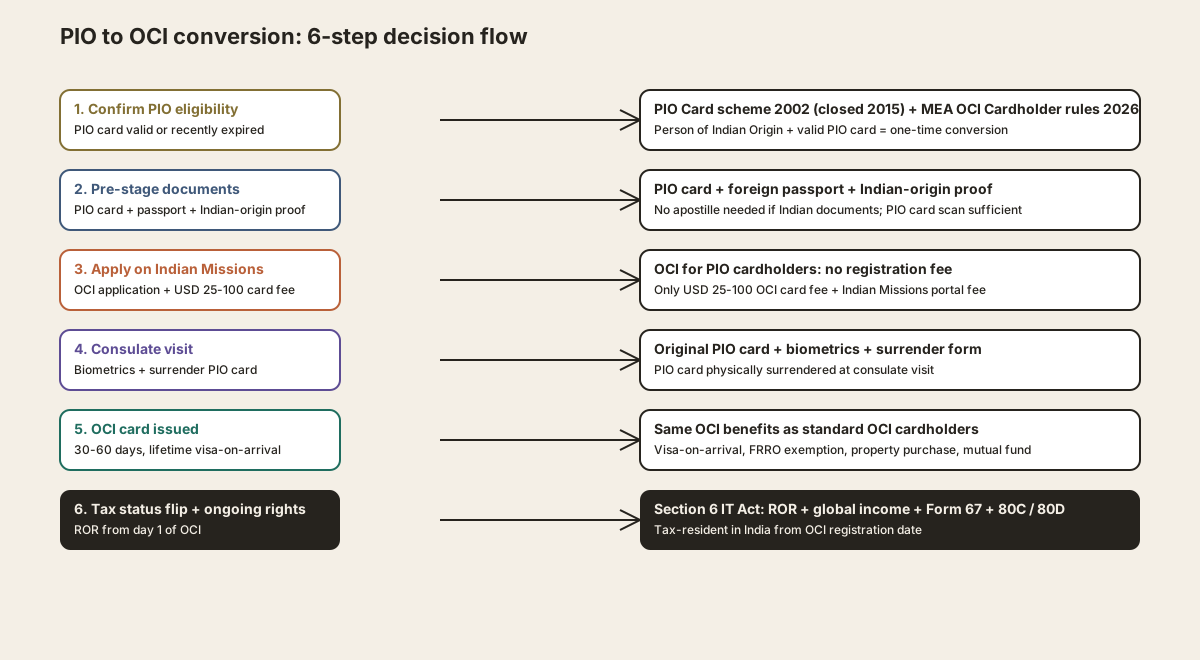
Confirm the eligibility: PIO card valid or recently expired + Person of Indian Origin (T-3m)
Before any application, confirm the eligibility for the PIO-to-OCI conversion: (1) the applicant must hold a PIO card issued under the 2002 PIO Card scheme (PIO scheme was closed to new applicants in 2015 when OCI was rolled out as the replacement), (2) the PIO card must be valid (within 15-year validity) or recently expired (within 5-10 years, Indian consulate discretion - some consulates accept expired PIO cards indefinitely, others require the card to have expired within a specific window), (3) the applicant must be a Person of Indian Origin by birth (parent or grandparent was an Indian citizen), by descent (the applicant was born outside India to an Indian parent), or by marriage (the applicant is married to an Indian citizen or OCI cardholder), (4) the applicant must not have held Indian citizenship at any prior point (an Indian citizen who acquired foreign nationality is eligible for OCI directly, not for the PIO-to-OCI conversion), (5) the applicant must not have had the original PIO card revoked for fraud / misrepresentation / violation of PIO Cardholder rules, (6) the applicant must hold a foreign passport with 6+ months validity and at least 2 blank pages. The cleanest plan is to confirm all 6 eligibility criteria before starting the document pre-staging, because a single missing criterion (e.g. an expired PIO card over 10 years, a missing Indian-origin proof document, a missing foreign passport) can delay the application by 3-6 months.
Pre-stage the document checklist: original PIO card + Indian-origin proof + foreign passport + photo (T-2m)
Pre-stage the full document checklist before the Indian Missions portal application: (1) original PIO card (the physical booklet issued under the 2002 PIO Card scheme, with the PIO reference number + the applicant's name + photograph + the issue date + the expiry date), (2) foreign passport (6+ months validity, 2+ blank pages, clear scan of the bio page + all stamped pages), (3) Indian-origin proof documents (parent's or grandparent's Indian passport or OCI card with clear scan, birth certificate showing Indian parentage with apostille + English translation if foreign, Indian marriage certificate for spouse of Indian origin), (4) address proof (rental agreement, utility bill, bank statement in the applicant's name with the foreign address), (5) 35x35mm photograph (white background, taken within the last 6 months, with the applicant's name + PIO reference number on the back), (6) affidavit of loss (if the PIO card is lost, with notarized signature + a clear declaration that the PIO card has been lost + the date and circumstances of the loss + the PIO reference number), (7) Indian Missions portal account (created with the applicant's email + phone, with the personal details filled in + the OCI conversion application completed in full), (8) VFS Global appointment booking (if applicable for the applicant's country of residence, with the in-person consulate visit date + time confirmed for biometrics + PIO card surrender, and the service fee paid). The cleanest plan is to scan all documents at 300 DPI in PDF format, with clear color, no glare, all four corners visible, and the file size under 5 MB per document.
Submit the Indian Missions portal OCI conversion application + pay the OCI card fee + book the consulate appointment (T-6w)
Submit the OCI conversion application on the Indian Missions portal (icrp.mea.gov.in or equivalent): (1) create an account with the applicant's email + phone, (2) fill in the application form (applicant's name, PIO reference number, passport number, foreign address, intended India address, PIO issue date + expiry date, visa type = OCI conversion for PIO cardholder), (3) upload all pre-staged documents in the correct slots (original PIO card scan, foreign passport bio page, Indian-origin proof documents, address proof, 35x35mm photograph, affidavit of loss if applicable), (4) pay the OCI card fee of USD 25-100 + the Indian Missions portal service fee + the VFS Global service fee (where applicable) - note that there is NO OCI registration fee for PIO holders converting to OCI, (5) book the in-person appointment at the Indian consulate for biometrics + PIO card physical surrender + OCI card issuance. The application is reviewed by the Indian consulate within 7-14 days, and the applicant is either (a) approved and asked to attend the in-person appointment, (b) asked for additional documents (the most common ask is for the Indian-origin proof document if the parent's or grandparent's Indian passport or OCI card is not available), or (c) rejected (the most common rejection reason is an expired PIO card over 10 years or missing Indian-origin proof). The cleanest plan is to submit the application 6 weeks before the planned India move, so the 30-60 day processing time + the 2-4 week appointment availability all fit in the 6-week window.
Attend the in-person consulate appointment: biometrics + PIO card surrender + OCI card issuance (T-day)
Attend the in-person appointment at the Indian consulate: (1) bring all original documents (original PIO card, foreign passport, Indian-origin proof originals, address proof, 35x35mm photograph, affidavit of loss if applicable) + a set of clear photocopies, (2) provide biometrics (fingerprints + photograph + signature), (3) physically surrender the original PIO card at the consulate (the PIO card is collected by the consulate and not returned), (4) answer the consul's questions (the PIO card history, the Indian-origin proof, the foreign tax compliance, the intended India stay), (5) receive the OCI card on the same day (in some consulates) or within 30-60 days (in most consulates) - the OCI card is issued either as a physical booklet or as an e-OCI digital card with a verifiable QR code. The in-person appointment takes 30-60 minutes, and the OCI card is usually issued within 30-60 days. The most common reasons for rejection at the in-person appointment are (a) the PIO card is not available for surrender (lost without affidavit of loss), (b) the Indian-origin proof is missing or insufficient, (c) the foreign passport is about to expire, (d) the applicant holds dual PIO+OCI without surrendering the PIO. The cleanest plan is to attend the appointment with all original documents + clear copies + the original PIO card for surrender, and to be prepared to answer the PIO card history + Indian-origin proof + foreign tax compliance questions in detail.
On OCI card issuance, file the transition-year ITR with Form 67 for DTAA credit (T+2m)
On the OCI card issuance, the tax status flips from PIO cardholder (typically NRI for tax purposes in most cases, but depends on the specific facts and treaty position) to OCI cardholder (ROR for Indian tax purposes, with global income taxed in India). The transition-year tax mechanics are covered in a separate article (NRI / RNOR / ROR transition-year tax), but the key points are: (1) the new OCI cardholder's status is ROR for the AY of OCI issuance + all subsequent AYs (the OCI registration makes the person a person of Indian origin, and the 365-of-4-preceding-years rule + the 730-of-7-preceding-years rule apply for ROR / RNOR classification), (2) the new OCI cardholder must file an ITR-1 SAHAJ (if simple income), ITR-2 (if capital gains + foreign income), or ITR-3 (if business income) for the AY of OCI issuance, (3) the new OCI cardholder must claim Form 67 for any foreign tax credit on US / UK / Canadian / Australian income (US federal + state tax for US citizens / permanent residents, UK Income Tax + NI for UK residents, Canadian federal + provincial tax for Canadian residents, Australian federal tax for Australian residents), (4) the new OCI cardholder can claim Section 80C (Rs 1.5 lakh for ELSS / EPF / PPF / home loan principal), Section 80D (Rs 25,000 for self + family + Rs 50,000 for senior parent), Section 80DDB (Rs 40,000 / Rs 1 lakh for medical treatment of dependent), and Section 80TTA (Rs 10,000 for interest income) for the ROR portion of the year. The cleanest plan is to engage a chartered accountant with cross-border tax experience 6 months before the OCI conversion, so the new OCI cardholder's tax status change is structured correctly and the FY of OCI issuance is the first ROR FY.
Document checklist before the PIO to OCI conversion application is submitted
Most PIO to OCI conversion application failures are caused by missing or mismatched documents at the application or appointment stage. Confirm each item before submitting the conversion application.
- Original PIO card (the physical booklet issued under the 2002 PIO Card scheme, with the PIO reference number + the applicant's name + photograph + the issue date + the expiry date). If the PIO card is lost, an affidavit of loss is required.
- Foreign passport (6+ months validity, 2+ blank pages, clear scan of the bio page + all stamped pages).
- Indian-origin proof documents (parent's or grandparent's Indian passport or OCI card with clear scan, birth certificate showing Indian parentage with apostille + English translation if foreign, Indian marriage certificate for spouse of Indian origin).
- Address proof (rental agreement, utility bill, bank statement in the applicant's name with the foreign address, with the full address + landlord / owner details).
- 35x35mm photograph (white background, taken within the last 6 months, with the applicant's name + PIO reference number on the back of the photo).
- Affidavit of loss (if the PIO card is lost, with notarized signature + a clear declaration that the PIO card has been lost + the date and circumstances of the loss + the PIO reference number + the applicant's signature).
- PIO card surrender form (filled in at the consulate visit, with the applicant's name + PIO reference number + the surrender date + the consulate witness's signature).
- OCI conversion application fee (USD 25-100 for the OCI card only - NO OCI registration fee for PIO holders, paid at the Indian Missions portal or at the consulate).
- Indian Missions portal service fee (USD 25-100, paid at the application stage).
- VFS Global service fee (USD 25-100, paid at the application stage where applicable).
- Foreign tax compliance documents (US 1040 + W-2 for US citizens / permanent residents, UK SA302 + P60 for UK residents, Canadian T1 + Notice of Assessment for Canadian residents, Australian Notice of Assessment for Australian residents - all of which reference the OCI card for Indian tax purposes).
- Indian tax compliance documents (if previously filed Indian ITR as PIO cardholder, the last ITR + Form 26AS + AIS extracts + bank statements + the OCI card number for tax filing reference).
- Indian Missions portal account (created with the applicant's email + phone, with the personal details filled in + the OCI conversion application completed in full + the OCI card request submitted).
PIO to OCI conversion decision flow
Community pattern: where PIO to OCI conversion actually breaks
Unable to embed reddit content. View on reddit
"The repeated pattern: legacy PIO cardholders who attempt to convert to OCI without producing the original PIO card, only to find at the in-person consulate appointment that the application is paused until the PIO card is produced or an affidavit of loss is submitted. The fix is straightforward: locate the original PIO card before starting the conversion, or obtain a notarized affidavit of loss with a clear declaration of the date and circumstances of the loss + the PIO reference number. The other repeated pattern: legacy PIO cardholders who submit the OCI conversion application without the Indian-origin proof document (e.g. parent's Indian passport or OCI card, birth certificate showing Indian parentage), only to find at the in-person consulate appointment that the application is rejected for the missing Indian-origin proof. The fix is to obtain the parent's Indian passport or OCI card scan + the birth certificate with apostille + English translation before starting the conversion. The third repeated pattern: legacy PIO cardholders who hold both PIO and OCI cards simultaneously (e.g. the PIO card is not surrendered at the consulate visit when the OCI card is issued), only to find that both cards cannot be held simultaneously and the OCI card may be revoked for non-surrender. The fix is to physically surrender the PIO card at the consulate visit when the OCI card is issued, and to keep the consulate surrender receipt for at least 7 years for reference."
Read on reddit ->Need help with Move Planning?
Share your blocker in one line. Our experts will reply with practical next steps.
PIO to OCI conversion: the six-layer stack
Letting the PIO card expire without converting is the most expensive PIO mistake
The most common PIO mistake is letting the PIO card expire without converting to OCI. The 2002 PIO Card scheme was closed to new applicants in 2015, and the PIO card has a 15-year validity from the issue date. Most PIO cards issued in 2002-2015 have now expired or will expire soon. If the PIO card has expired within 5-10 years, the Indian consulate may still accept the conversion at no OCI registration fee. If the PIO card has expired over 10 years, the applicant must apply for fresh OCI for self with USD 275 OCI fee + USD 25-100 OCI card fee + new OCI number issued, which is significantly more expensive than the no-fee conversion. The fix is to (a) check the PIO card expiry date today, (b) if the PIO card is still valid, start the conversion within 90 days of the planned conversion, (c) if the PIO card has recently expired (within 5-10 years), confirm with the Indian consulate whether the conversion at no fee is still accepted, (d) if the PIO card has expired over 10 years, apply for fresh OCI for self with USD 275 OCI fee + USD 25-100 OCI card fee, (e) if the PIO card is lost, obtain an affidavit of loss before starting the conversion. The cost of missing the no-fee conversion window is USD 275-375 / Rs 22,500-30,000 in additional OCI fees, plus the cost of the standard OCI for self application process, plus the cost of the fresh OCI number setup. The cleanest plan is to check the PIO card expiry date today and to start the conversion within 90 days if the card is still valid or recently expired.
Animated decision map

Interactive checkpoint
Turn this guide into a decision file
0 of 4 checked
What is PIO to OCI conversion in 2026?
PIO to OCI conversion is a one-time conversion from the legacy PIO (Person of Indian Origin) Card scheme to the modern OCI (Overseas Citizenship of India) scheme. The 2002 PIO Card scheme was closed to new applicants in 2015 when OCI was rolled out as the replacement, but existing PIO cardholders are eligible for a one-time conversion to OCI at no OCI registration fee (only USD 25-100 OCI card fee). The conversion is processed at the Indian consulate (online application on the Indian Missions portal + VFS Global document submission + in-person visit for biometrics + PIO card physical surrender + OCI card issuance), takes 30-60 days per the 2026 simplified rules, and costs USD 25-100 OCI card fee + Indian Missions portal service fee + VFS Global service fee (total USD 50-150). The OCI card is issued with the same OCI number as the PIO reference, granting lifetime visa-on-arrival, exemption from FRRO / FRO registration for stays under 180 days, parity with NRIs for property purchase + mutual fund investment + education, and Aadhaar + PAN + Indian mobile number eligibility.
Who is eligible for PIO to OCI conversion?
The eligibility for PIO to OCI conversion is: (1) the applicant must hold a PIO card issued under the 2002 PIO Card scheme (PIO scheme was closed to new applicants in 2015), (2) the PIO card must be valid (within 15-year validity) or recently expired (within 5-10 years, Indian consulate discretion), (3) the applicant must be a Person of Indian Origin by birth (parent or grandparent was an Indian citizen), by descent (the applicant was born outside India to an Indian parent), or by marriage (the applicant is married to an Indian citizen or OCI cardholder), (4) the applicant must not have held Indian citizenship at any prior point, (5) the applicant must not have had the original PIO card revoked for fraud / misrepresentation / violation of PIO Cardholder rules, (6) the applicant must hold a foreign passport with 6+ months validity and at least 2 blank pages. The eligibility is strict, and a single missing criterion (e.g. an expired PIO card over 10 years, a missing Indian-origin proof document, a missing foreign passport) can delay the application by 3-6 months or require a fresh OCI for self application with full USD 275 fee.
What is the cost of PIO to OCI conversion in 2026?
The 2026 cost of PIO to OCI conversion is: (1) NO OCI registration fee for PIO holders (the major cost saving), (2) USD 25-100 for the OCI card fee (paid at the application stage), (3) USD 25-100 for the Indian Missions portal service fee + the VFS Global service fee (where applicable), (4) USD 25-100 for the apostille + certified English translation of the Indian-origin proof documents (where applicable, e.g. for foreign birth certificates showing Indian parentage), (5) USD 25 for the affidavit of loss (where applicable, if the PIO card is lost), (6) USD 100-300 for the cross-border tax lawyer consultation (recommended for the first Indian tax filing after OCI conversion). The total cost for the PIO to OCI conversion + tax compliance is USD 200-600 / Rs 16,000-50,000, which is significantly less than the USD 300-450 / Rs 25,000-37,000 for a fresh OCI for self application. The cost saving of the PIO to OCI conversion vs. fresh OCI is USD 275 / Rs 22,500 in OCI registration fee.
How long does PIO to OCI conversion take?
The 2026 processing time for PIO to OCI conversion is 30-60 days at the Indian consulate, down from 3-6 months in the pre-2026 system. The processing time includes: (1) 7-14 days for the online OCI conversion application review by the Indian consulate, (2) 14-30 days for the in-person appointment availability at the Indian consulate (this is the bottleneck in high-traffic consulates like San Francisco, New York, London, Dubai), (3) 30-60 days for the OCI card issuance after the in-person appointment. The cleanest plan is to start the conversion 3 months before the planned India move (PIO validity check at T-3m + documents pre-staged at T-2m + application at T-6w + consulate visit at T-day + OCI card in hand at T+2m), so the 30-60 day conversion processing time + the 2-4 week appointment availability all fit in the 3-month window with a buffer for any additional document requests.
What is the difference between PIO and OCI?
The difference between PIO and OCI is: (1) duration: PIO card is 15-year validity, OCI is lifetime, (2) stay limit: PIO card allows India entry + stay with FRRO / FRO registration, OCI grants visa-on-arrival with no stay limit, (3) FRRO / FRO registration: PIO card requires FRRO / FRO registration within 14 days of arrival + extension for stays over 180 days, OCI grants exemption from FRRO / FRO registration for stays under 180 days, (4) economic activity: PIO card allows limited economic activity (no property purchase parity, no mutual fund investment parity, no business parity), OCI grants parity with NRIs for property purchase + mutual fund investment + education + employment with restrictions, (5) tax status: PIO cardholder is generally treated as NRI for tax purposes (foreign national), OCI cardholder is treated as ROR for tax purposes (person of Indian origin with global income taxed in India), (6) eligibility: PIO card was issued pre-2015 to Person of Indian Origin by birth / descent / marriage, OCI is issued to PIO cardholders (conversion) + Indian-origin persons (standard pathway) + minor children of Indian / OCI parents + foreign spouses of Indian / OCI citizens + foreign parents of NRI / OCI / PIO children, (7) cost: PIO card was issued pre-2015 at a fee (USD 100-300 depending on nationality + validity), OCI conversion is no OCI registration fee for PIO holders + USD 25-100 OCI card fee. The cleanest plan is to convert the PIO card to OCI at the no-fee window while the PIO card is valid or recently expired.
What is the worst-case scenario if PIO to OCI conversion is missed?
Five things can go wrong: (1) the PIO card expires without conversion - the applicant must apply for fresh OCI for self with USD 275 OCI fee + USD 25-100 OCI card fee + new OCI number issued, which is significantly more expensive than the no-fee conversion, (2) the PIO card is lost without affidavit of loss - the OCI conversion is paused until the affidavit is submitted, and the processing time is extended by 2-4 weeks, (3) the Indian-origin proof is missing - the OCI conversion is rejected, and the applicant must obtain the Indian-origin proof (parent's Indian passport or OCI card + birth certificate with apostille + English translation) before restarting the application, (4) dual PIO+OCI is held without PIO surrender at consulate - the OCI card may be revoked for non-surrender of the PIO card, and the applicant must re-apply for OCI from scratch, (5) fraud / misrepresentation at the original PIO application is discovered at the OCI conversion - the OCI conversion is rejected, and the original PIO card may be revoked. Each of these is fixable, but the cost is USD 275-375 / Rs 22,500-30,000 in additional OCI fees + the cost of the cross-border tax lawyer consultation + the stress of the missed conversion. The cleanest plan is to confirm the PIO card validity today + pre-stage the documents + submit the OCI conversion application with the original PIO card + Indian-origin proof + foreign passport + address proof + 35x35mm photograph, and to physically surrender the PIO card at the consulate visit when the OCI card is issued.
The plan is only as good as the sequence.
Tax, banking, schools, shipping — they all have dependencies. A wrong order costs months and lakhs. Get it right.