Oci Surrender After Indian Citizenship 2026 Naturalisation...
A practical 2026 guide for OCI cardholders who acquire Indian citizenship by naturalisation, registration, or descent, and for former Indian citizens who want to...
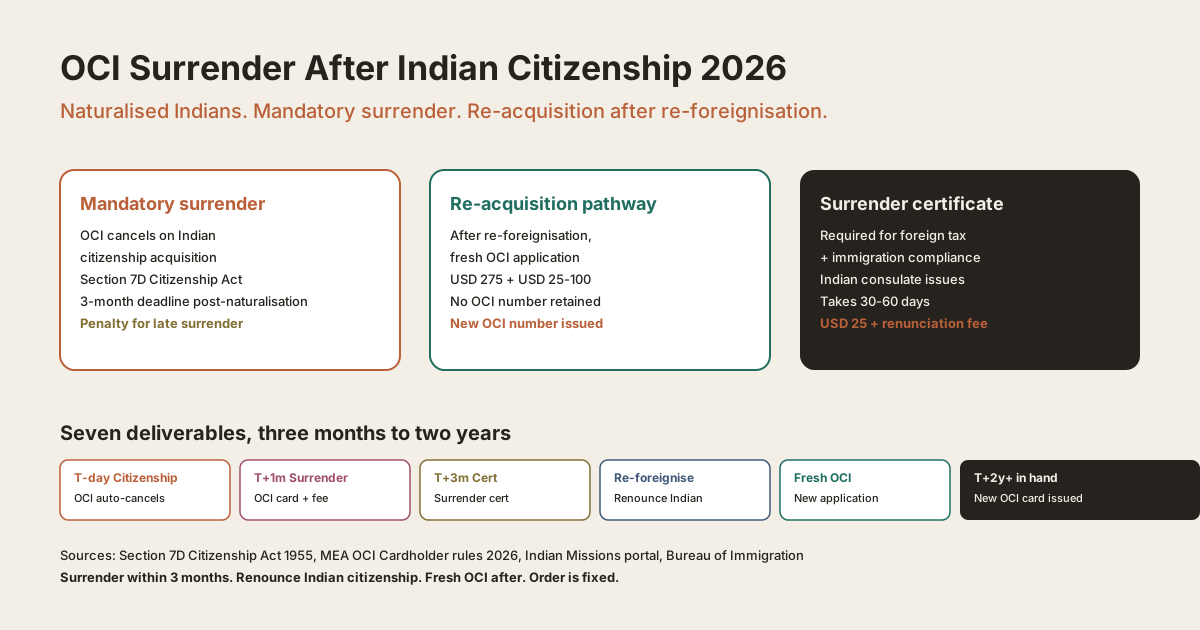
Why OCI surrender after Indian citizenship is the most under-served post-naturalisation compliance pathway (and why 2026 changed it)
Every OCI cardholder who acquires Indian citizenship by any means faces a four-layer post-naturalisation compliance pathway: (1) the OCI auto-cancels the moment Indian citizenship is acquired (no grace period, no exception for dual citizenship, no exception for child / spouse / parent OCI holders), (2) the OCI cardholder must surrender the OCI card at the Indian consulate within 3 months of Indian citizenship acquisition (with a late-surrender penalty of USD 25 per month capped at USD 5,000), (3) the OCI cardholder must obtain a surrender certificate from the Indian consulate (required for foreign tax + immigration compliance, including IRS Form 8854 expatriation, HMRC SA109 self-assessment, CIC Record of Landing for Canadian citizenship), (4) the OCI cardholder can apply for a fresh OCI after renouncing Indian citizenship under Section 8 of the Citizenship Act 1955 (which makes the former Indian citizen a foreign national again, eligible for OCI under the standard OCI for self pathway with USD 275 OCI fee + USD 25-100 OCI card fee and a NEW OCI number issued). Section 7D of the Citizenship Act 1955 makes the OCI auto-cancel the moment an Indian citizen acquires Indian citizenship, regardless of how the OCI was originally obtained. The 2026 simplified rules cut the surrender certificate processing time at the Indian consulate from 3-6 months to 30-60 days, and unified the fee schedule (USD 25 for surrender + USD 25 for renunciation + USD 275 for fresh OCI + USD 25-100 for OCI card). The 2026 landscape has expanded the pathway at every layer: more naturalised Indians / Canadians / Australians / British citizens are discovering the OCI surrender requirement, more former Indian citizens are applying for fresh OCI after renunciation, and the post-naturalisation compliance pathway has become the most under-served and most-mistaken OCI workflow.
The decision is not just about the surrender. It is also about the eligibility for surrender (any OCI cardholder who acquires Indian citizenship by any means - whether by naturalisation, by registration, by descent, or by any other means - regardless of how the OCI was originally obtained, and regardless of whether the OCI cardholder is a spouse, parent, minor child, or self-OCI), the mandatory surrender timeline (3-month deadline from the date of Indian citizenship acquisition, with the surrender application submitted at the Indian consulate with the original OCI card + the Indian naturalisation certificate + the surrender form + USD 25 fee), the late surrender penalty (USD 25 per month after the 3-month deadline, capped at USD 5,000, with the Indian consulate having discretion to waive the penalty in exceptional cases such as medical emergency or natural disaster), the surrender certificate (issued by the Indian consulate within 30-60 days, required for IRS Form 8854 expatriation statement, HMRC SA109 self-assessment, CIC Record of Landing, and other foreign tax + immigration compliance), the renunciation of Indian citizenship under Section 8 (declaration at the Indian consulate + USD 25 fee + renunciation certificate + new foreign passport without Indian citizenship, which makes the former Indian citizen a foreign national eligible for OCI re-application), the fresh OCI application (Indian Missions portal + VFS Global + USD 275 OCI fee + USD 25-100 OCI card fee + in-person consulate visit for biometrics + new OCI number issued in 30-60 days), the tax status flip (was Indian citizen = ROR with global income taxed in India, then Indian citizen with OCI = ROR, then renunciation = foreign national = NRI, then new OCI = ROR, with transition-year tax mechanics for both the renunciation year and the OCI re-acquisition year), the foreign tax + immigration compliance (IRS Form 8854 for US citizens / permanent residents who renounce Indian citizenship, HMRC SA109 for UK residents who renounce Indian citizenship, CIC Record of Landing for Canadian citizens who renounce Indian citizenship, ATO expatriation statement for Australian citizens who renounce Indian citizenship), and the worst-case scenarios (late surrender with USD 5,000 penalty, missed surrender deadline blocking re-acquisition, dual-citizenship claim rejected, lost OCI card without replacement affidavit, foreign tax compliance failure). The cleanest plan is to surrender the OCI card at the Indian consulate within 3 months of Indian citizenship acquisition, obtain the surrender certificate for foreign tax compliance, then renounce Indian citizenship under Section 8, then apply for a fresh OCI as a foreign national. The order is fixed; the deliverables are not optional.
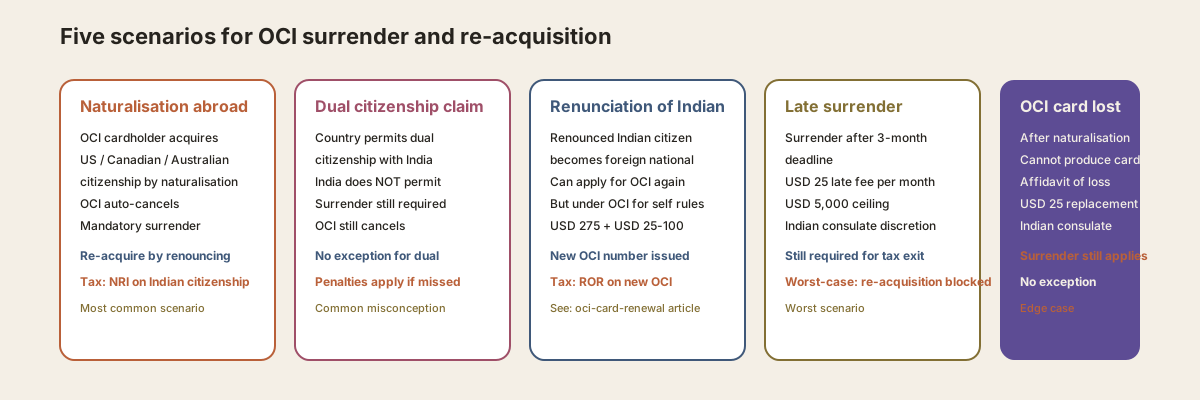
Five scenarios for OCI surrender and re-acquisition
The five surrender scenarios have different eligibility, timeline, cost, and process. The right approach depends on how the Indian citizenship was acquired, whether the OCI card can be produced, and whether the former Indian citizen wants to re-acquire OCI after renunciation.
| Scenario | Eligibility | Timeline | Cost (USD) | Process | Re-acquisition |
|---|---|---|---|---|---|
| Naturalisation abroad (most common) | OCI cardholder who acquires US / Canadian / Australian / British citizenship by naturalisation; OCI auto-cancels on the date of naturalisation; surrender required within 3 months | 3 months from naturalisation date; surrender certificate in 30-60 days | USD 25 surrender + USD 25 renunciation + USD 275 fresh OCI + USD 25-100 OCI card = USD 350-425 | Surrender OCI card at Indian consulate + obtain surrender certificate + renounce Indian citizenship under Section 8 + apply for fresh OCI as foreign national | Yes - fresh OCI after renunciation; new OCI number issued; OCI for self pathway applies |
| Dual citizenship claim (rejected) | OCI cardholder who acquires foreign citizenship while claiming dual citizenship is permitted; India does NOT permit dual citizenship; OCI still cancels; surrender still required | Same as naturalisation abroad | Same as naturalisation abroad | Same as naturalisation abroad, plus the dual citizenship claim must be withdrawn at the Indian consulate; no exception for dual citizenship | Same as naturalisation abroad - fresh OCI after renunciation |
| Renunciation of Indian citizenship | OCI cardholder who renounces Indian citizenship under Section 8 of the Citizenship Act 1955; declaration at Indian consulate; USD 25 fee; renunciation certificate issued | Renunciation in 30-60 days; surrender in parallel within 3 months of renunciation date | USD 25 renunciation + USD 25 surrender + USD 275 fresh OCI + USD 25-100 OCI card = USD 350-425 | Renounce Indian citizenship at Indian consulate + surrender OCI card + apply for fresh OCI as foreign national | Yes - fresh OCI after renunciation; new OCI number issued |
| Late surrender with penalty | OCI cardholder who fails to surrender within 3-month deadline; USD 25 per month penalty capped at USD 5,000; Indian consulate discretion to waive in exceptional cases | Penalty accrues monthly after 3-month deadline; surrender still required regardless of penalty | USD 25 surrender + USD 25-5,000 late penalty + USD 25 renunciation + USD 275 fresh OCI + USD 25-100 OCI card = USD 350-5,425 | Late surrender application at Indian consulate + pay late penalty + obtain surrender certificate + renounce Indian citizenship + apply for fresh OCI | Possible but harder - Indian consulate may scrutinise the late surrender more closely; re-acquisition may be delayed by 6-12 months |
| OCI card lost after naturalisation | OCI cardholder who cannot produce the original OCI card at surrender; affidavit of loss required; replacement OCI card cannot be obtained (OCI is cancelled); | Same as naturalisation abroad | USD 25 surrender + USD 25 affidavit of loss + USD 25 renunciation + USD 275 fresh OCI + USD 25-100 OCI card = USD 375-450 | Affidavit of loss at Indian consulate + surrender form (without original card) + obtain surrender certificate + renounce Indian citizenship + apply for fresh OCI | Same as naturalisation abroad - fresh OCI after renunciation |
Execution sequence: from Indian citizenship acquisition to fresh OCI in 2 years
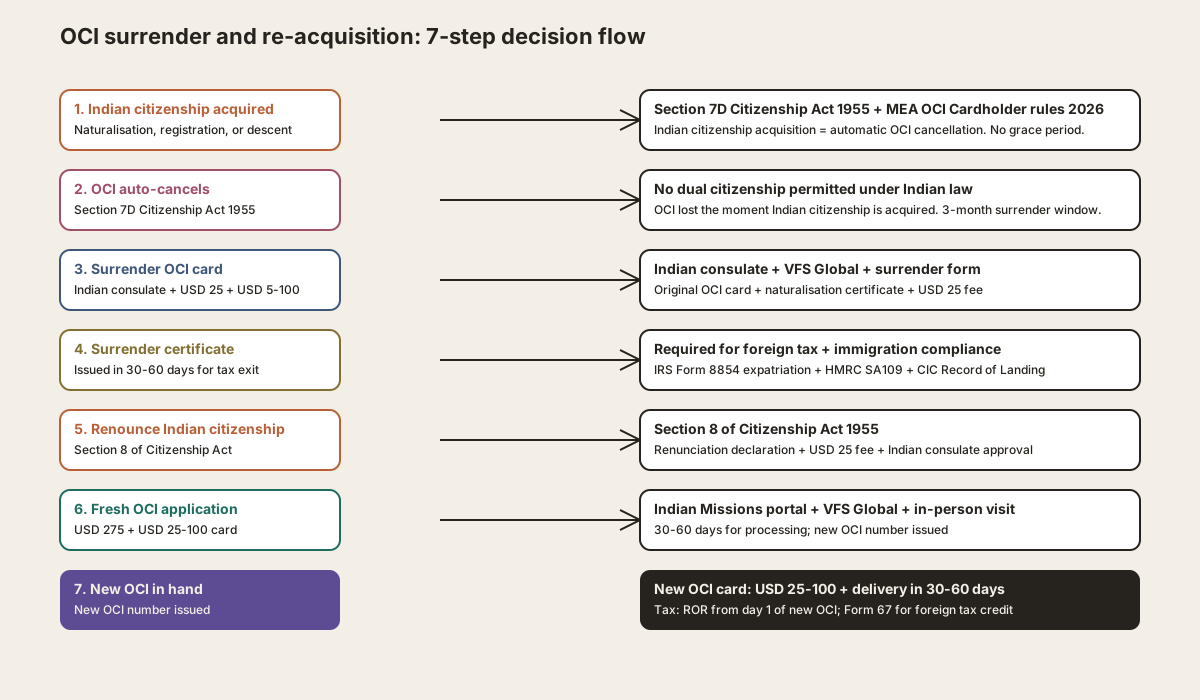
Plan the order. The Indian citizenship acquisition, the OCI auto-cancellation, the OCI surrender at the Indian consulate, the surrender certificate issuance, the renunciation of Indian citizenship under Section 8, and the fresh OCI application 2 years later are not simultaneous — but they are interdependent, and an error in one is hard to fix after the OCI surrender certificate is issued.
Indian citizenship acquired: naturalisation abroad, registration in India, or descent (T-day)
On the date of Indian citizenship acquisition, the OCI auto-cancels under Section 7D of the Citizenship Act 1955. This happens automatically regardless of how the Indian citizenship was acquired: (a) naturalisation in India under Section 5 (registration for Indian citizenship after 5 years of residence in India), (b) naturalisation abroad under Section 6 (registration as an Indian citizen by descent of an Indian parent or grandparent, or by registration at an Indian consulate after 5 years of residence in India), (c) registration of a minor child under Section 4 (where both parents are Indian citizens), or (d) descent under Section 3 (where at least one parent is an Indian citizen at the time of birth). The OCI card becomes invalid on this date, and any use of the OCI card for India entry, India banking, India property purchase, or India tax compliance is a violation. The cleanest plan is to confirm the Indian citizenship acquisition date (the date on the naturalisation certificate, registration certificate, or descent certificate) and to start the OCI surrender within 30 days of this date, because a single missed day can trigger the late surrender penalty and the foreign tax + immigration compliance complications.
Surrender OCI card at Indian consulate within 3 months (T+1m to T+3m)
Surrender the OCI card at the Indian consulate within 3 months of Indian citizenship acquisition: (1) download the OCI surrender form from the Indian Missions portal or the Indian consulate website, (2) fill in the form (OCI number, name, date of birth, date of Indian citizenship acquisition, reason for surrender = Indian citizenship acquisition), (3) attach the original OCI card + the Indian naturalisation certificate / registration certificate / descent certificate + a copy of the foreign passport + a copy of the Indian passport (if issued), (4) pay the surrender fee of USD 25 + the VFS Global service fee (where applicable), (5) submit the surrender application in person at the Indian consulate (or via VFS Global where applicable). The Indian consulate reviews the surrender application within 7-14 days, and the surrender is either approved (with the OCI card cancelled in the MEA OCI database) or rejected (with a request for additional documentation). The cleanest plan is to submit the surrender application within 30 days of Indian citizenship acquisition, so the surrender is processed well before the 3-month deadline and the late surrender penalty is avoided.
Obtain surrender certificate from Indian consulate within 30-60 days (T+3m to T+5m)
After the OCI surrender is approved, the Indian consulate issues a surrender certificate within 30-60 days. The surrender certificate is required for: (a) IRS Form 8854 expatriation statement for US citizens / permanent residents who are required to certify their Indian citizenship and OCI status for US tax exit compliance, (b) HMRC SA109 self-assessment for UK residents who are required to report their Indian citizenship and OCI status for UK tax exit compliance, (c) CIC Record of Landing for Canadian citizens who are required to report their Indian citizenship and OCI status for Canadian immigration compliance, (d) ATO expatriation statement for Australian citizens who are required to report their Indian citizenship and OCI status for Australian tax exit compliance, (e) foreign bank account closure (where the OCI was used to open NRE / NRO / FCNR accounts that need to be reclassified to resident or closed), (f) Indian tax filing compliance (where the OCI was used to file Indian ITR as ROR with global income taxed in India). The cleanest plan is to obtain the surrender certificate within 60 days of the surrender application, and to keep the surrender certificate in a safe place for at least 7 years (the Indian tax retention period) and for at least 10 years (the US / UK / Canadian / Australian tax retention period).
Renounce Indian citizenship under Section 8 of the Citizenship Act 1955 (T+1y to T+2y)
After the OCI surrender and surrender certificate issuance, the next step is to renounce Indian citizenship under Section 8 of the Citizenship Act 1955: (1) download the renunciation declaration form from the Indian Missions portal or the Indian consulate website, (2) fill in the form (name, date of birth, place of birth, current address, Indian passport number, foreign passport number, reason for renunciation), (3) attach the surrender certificate + the Indian naturalisation certificate / registration certificate / descent certificate + the Indian passport (for cancellation) + the foreign passport + 2-4 passport-sized photographs, (4) pay the renunciation fee of USD 25 + the VFS Global service fee (where applicable), (5) submit the renunciation declaration in person at the Indian consulate. The Indian consulate reviews the renunciation declaration within 30-60 days, and the renunciation is either approved (with the renunciation certificate issued and the Indian passport cancelled) or rejected (with a request for additional documentation). The renunciation takes effect on the date of the renunciation certificate, and the former Indian citizen becomes a foreign national eligible for OCI re-application under the standard OCI for self pathway. The cleanest plan is to renounce Indian citizenship within 1-2 years of the Indian citizenship acquisition, so the foreign national can apply for fresh OCI without complications from the dual-citizenship period.
Apply for fresh OCI under the standard OCI for self pathway (T+1.5y)
After renunciation of Indian citizenship, the former Indian citizen becomes a foreign national again and can apply for fresh OCI under the standard OCI for self pathway: (1) confirm the eligibility (the former Indian citizen must be a Person of Indian Origin, must hold a foreign passport, must never have been a citizen of a country where Indian citizens are not eligible for OCI - Pakistan / Bangladesh / Sri Lanka / Nepal / Bhutan / Afghanistan / Iran / China, depending on bilateral arrangements), (2) submit the OCI application on the Indian Missions portal (oci.dialmea.gov.in or equivalent), (3) upload the pre-staged documents (foreign passport with 6+ months validity, renunciation certificate, surrender certificate, Indian-origin proof, address proof, photograph 35x35mm), (4) pay the fresh OCI fee of USD 275 + the OCI card fee of USD 25-100 + the Indian Missions portal service fee + the VFS Global service fee, (5) attend the in-person appointment at the Indian consulate for biometrics + OCI card issuance. The fresh OCI application is processed within 30-60 days per the 2026 simplified rules, and a NEW OCI number is issued (no continuity from the cancelled OCI number). The cleanest plan is to apply for the fresh OCI within 6 months of the renunciation certificate issuance, so the foreign national has the OCI card in hand before any India travel, school admission, property purchase, or mutual fund investment is needed.
On fresh OCI in hand, file the transition-year ITR with Form 67 for DTAA credit (T+2y)
On the fresh OCI in hand, the tax status flips from foreign national (NRI) to OCI cardholder (ROR). The transition-year tax mechanics are covered in a separate article (NRI / RNOR / ROR transition-year tax), but the key points are: (1) the fresh OCI cardholder's status is ROR for the AY of fresh OCI registration + all subsequent AYs (the fresh OCI registration makes the foreign national a person of Indian origin, and the 365-of-4-preceding-years rule + the 730-of-7-preceding-years rule apply for ROR / RNOR classification), (2) the fresh OCI cardholder must file an ITR-1 SAHAJ (if simple income), ITR-2 (if capital gains + foreign income), or ITR-3 (if business income) for the AY of fresh OCI registration, (3) the fresh OCI cardholder must claim Form 67 for any foreign tax credit on US / UK / Canadian / Australian income (US federal + state tax for US citizens / permanent residents, UK Income Tax + NI for UK residents, Canadian federal + provincial tax for Canadian residents, Australian federal tax for Australian residents), (4) the fresh OCI cardholder can claim Section 80C (Rs 1.5 lakh for ELSS / EPF / PPF / home loan principal), Section 80D (Rs 25,000 for self + family + Rs 50,000 for senior parent), Section 80DDB (Rs 40,000 / Rs 1 lakh for medical treatment of dependent), and Section 80TTA (Rs 10,000 for interest income) for the ROR portion of the year. The cleanest plan is to engage a chartered accountant with cross-border tax experience 6 months before the fresh OCI registration, so the foreign national's tax status change is structured correctly and the FY of fresh OCI registration is the first ROR FY.
Document checklist before the OCI surrender application is submitted
Most OCI surrender application failures are caused by missing or mismatched documents at the application or appointment stage. Confirm each item before submitting the surrender application.
- Original OCI card (the physical booklet, not a photocopy, not a digital scan). If the OCI card is lost, an affidavit of loss is required.
- OCI surrender form (downloaded from the Indian Missions portal or the Indian consulate website, filled in full with OCI number + name + date of birth + date of Indian citizenship acquisition + reason for surrender).
- Indian naturalisation certificate OR registration certificate OR descent certificate (the official document issued by the Indian consulate or the Indian government confirming the Indian citizenship acquisition date).
- Foreign passport (valid, with 6+ months validity + clear scan of the bio page + all stamped pages).
- Indian passport (if issued, for cancellation at the Indian consulate). If the Indian passport is not yet issued, an affidavit stating that no Indian passport has been issued is required.
- Surrender fee of USD 25 (paid at the Indian consulate or via VFS Global, depending on the consulate).
- 2-4 passport-sized photographs (35x35mm white background, taken within the last 6 months, with the OCI cardholder's name + OCI number on the back of each photo).
- VFS Global appointment booking (if applicable for the OCI cardholder's country of residence, with the in-person consulate visit date + time confirmed for OCI surrender biometrics + surrender certificate issuance, and the service fee paid).
- Affidavit of loss (if the OCI card is lost, with notarized signature + a clear declaration that the OCI card has been lost + the date and circumstances of the loss + the OCI number + the OCI cardholder's signature).
- Renunciation certificate (required for the fresh OCI application after renunciation, issued by the Indian consulate under Section 8 of the Citizenship Act 1955 with the renunciation date + the renunciation certificate number + the Indian consulate's stamp).
- Foreign tax compliance documents (IRS Form 8854 for US citizens / permanent residents, HMRC SA109 for UK residents, CIC Record of Landing for Canadian citizens, ATO expatriation statement for Australian citizens - all of which reference the OCI surrender certificate as proof of OCI surrender).
- Indian tax compliance documents (the OCI cardholder's last Indian ITR + Form 26AS + AIS extracts + bank statements + the surrender certificate for tax filing reference).
- Indian Missions portal account (created with the OCI cardholder's email + phone, with the personal details filled in + the surrender form completed in full + the fresh OCI application for foreign national after renunciation).
OCI surrender and re-acquisition decision flow
Community pattern: where OCI surrender after Indian citizenship actually breaks
Unable to embed reddit content. View on reddit
"The repeated pattern: OCI cardholders who naturalise in the US / Canada / Australia / UK and assume dual citizenship is permitted (because the foreign country permits it), only to find at the Indian consulate that India does NOT permit dual citizenship and the OCI auto-cancels on the date of naturalisation. The fix is to surrender the OCI card at the Indian consulate within 3 months of naturalisation, obtain the surrender certificate, and either renounce Indian citizenship under Section 8 (to re-acquire OCI as a foreign national) or accept the Indian citizenship and lose the OCI permanently. The other repeated pattern: OCI cardholders who fail to obtain the surrender certificate and then file IRS Form 8854 expatriation, only to find that the IRS rejects the form without the OCI surrender certificate as proof of OCI surrender. The fix is to obtain the surrender certificate from the Indian consulate within 60 days of the surrender application, and to keep the surrender certificate in a safe place for at least 7 years (the Indian tax retention period) and at least 10 years (the US / UK / Canadian / Australian tax retention period). The third repeated pattern: OCI cardholders who attempt to apply for fresh OCI without renouncing Indian citizenship first, only to find at the Indian consulate that the fresh OCI application is rejected because the applicant is still an Indian citizen (and the OCI is not available to Indian citizens). The fix is to renounce Indian citizenship under Section 8 first, obtain the renunciation certificate, then apply for fresh OCI as a foreign national with the renunciation certificate as the Indian-origin proof."
Read on reddit ->Need help with Move Planning?
Share your blocker in one line. Our experts will reply with practical next steps.
OCI surrender and re-acquisition: the seven-layer stack
Missing the surrender certificate is the most expensive OCI surrender mistake
The most common OCI surrender mistake is missing the surrender certificate. The surrender certificate is required for: (1) IRS Form 8854 expatriation statement for US citizens / permanent residents who are required to certify their Indian citizenship and OCI status for US tax exit compliance - without the surrender certificate, the IRS rejects the form and the OCI surrender is not recognised for US tax purposes, (2) HMRC SA109 self-assessment for UK residents who are required to report their Indian citizenship and OCI status for UK tax exit compliance - without the surrender certificate, the HMRC may treat the OCI surrender as incomplete and impose additional tax + penalties, (3) CIC Record of Landing for Canadian citizens who are required to report their Indian citizenship and OCI status for Canadian immigration compliance - without the surrender certificate, the CIC may require additional documentation before recognising the OCI surrender, (4) ATO expatriation statement for Australian citizens who are required to report their Indian citizenship and OCI status for Australian tax exit compliance - without the surrender certificate, the ATO may treat the OCI surrender as incomplete and impose additional tax + penalties, (5) foreign bank account closure where the OCI was used to open NRE / NRO / FCNR accounts that need to be reclassified to resident or closed, (6) Indian tax filing compliance where the OCI was used to file Indian ITR as ROR with global income taxed in India. The fix is to (a) obtain the surrender certificate from the Indian consulate within 60 days of the surrender application, (b) keep the surrender certificate in a safe place for at least 7 years (the Indian tax retention period) and at least 10 years (the US / UK / Canadian / Australian tax retention period), (c) attach the surrender certificate to every foreign tax filing that references the OCI surrender, (d) consult a cross-border tax lawyer before filing the first foreign tax return after the OCI surrender. The cost of missing the surrender certificate is the additional foreign tax + penalties + interest + the cost of foreign tax filing amendments + the cost of the cross-border tax lawyer. The cleanest plan is to obtain the surrender certificate within 60 days of the surrender application, and to keep the surrender certificate in a safe place for at least 10 years.
Animated decision map

Interactive checkpoint
Turn this guide into a decision file
0 of 4 checked
What is OCI surrender after Indian citizenship in 2026?
OCI surrender after Indian citizenship is the mandatory cancellation of an OCI card when the OCI cardholder acquires Indian citizenship by naturalisation, registration, or descent. Section 7D of the Citizenship Act 1955 makes the OCI auto-cancel on the date of Indian citizenship acquisition, regardless of how the OCI was originally obtained. The surrender must be completed within 3 months of Indian citizenship acquisition, with a USD 25 surrender fee + a USD 25-5,000 late penalty if past the 3-month deadline. The surrender certificate is issued within 30-60 days and is required for foreign tax + immigration compliance (IRS Form 8854, HMRC SA109, CIC Record of Landing, ATO expatriation statement). After renunciation of Indian citizenship under Section 8 of the Citizenship Act 1955, the former Indian citizen can apply for a fresh OCI under the standard OCI for self pathway, with USD 275 OCI fee + USD 25-100 OCI card fee + 30-60 days for processing + a NEW OCI number issued. The fresh OCI makes the foreign national a person of Indian origin again, eligible for OCI rights including lifetime visa-on-arrival, exemption from FRRO / FRO registration for stays under 180 days, parity with NRIs for property purchase + mutual fund investment + education.
Who must surrender OCI after Indian citizenship?
Any OCI cardholder who acquires Indian citizenship by any means must surrender the OCI card at the Indian consulate within 3 months of Indian citizenship acquisition. This applies regardless of how the OCI was originally obtained (by birth, by marriage to an Indian citizen, by parent sponsorship, by minor-child registration, by PIO conversion, or by naturalisation) and regardless of whether the OCI cardholder is a spouse, parent, minor child, or self-OCI. The Indian citizenship acquisition can be by naturalisation abroad (Section 6 of the Citizenship Act 1955 - e.g. US / Canadian / Australian / British naturalisation with Indian consulate registration), by registration in India (Section 5 - 5 years of residence in India + application for Indian citizenship), by descent (Section 3 - parent or grandparent was an Indian citizen at the time of birth), or by minor child registration (Section 4 - both parents are Indian citizens). The surrender is mandatory regardless of the acquisition method, and late surrender attracts USD 25 per month penalty capped at USD 5,000 with Indian consulate discretion to waive in exceptional cases.
What is the cost of OCI surrender and re-acquisition in 2026?
The 2026 cost of OCI surrender and re-acquisition is: (1) USD 25 for the OCI surrender fee (paid at the Indian consulate), (2) USD 25-5,000 for the late surrender penalty if past the 3-month deadline (USD 25 per month capped at USD 5,000), (3) USD 25 for the renunciation fee (paid at the Indian consulate under Section 8 of the Citizenship Act 1955), (4) USD 275 for the fresh OCI fee (paid to the Indian Missions portal after renunciation), (5) USD 25-100 for the fresh OCI card fee (paid at the OCI registration), (6) USD 25-100 for the Indian Missions portal service fee + the VFS Global service fee (paid at the surrender + renunciation + fresh OCI stages), (7) USD 100-500 for the cross-border tax lawyer consultation (recommended for the first foreign tax filing after the OCI surrender), (8) USD 50-200 for the Indian tax filing in the renunciation year + the fresh OCI year. The total cost for the OCI surrender + renunciation + fresh OCI + tax compliance is USD 800-1,500 / Rs 65,000-1.25 lakh over 2-3 years, with the bulk of the cost being the cross-border tax lawyer consultation + the Indian tax filing.
How long does OCI surrender and re-acquisition take?
The 2026 processing time for OCI surrender and re-acquisition is 30-60 days for the surrender + 30-60 days for the surrender certificate + 30-60 days for the renunciation + 30-60 days for the fresh OCI application, totaling 4-8 months for the entire process if started immediately after Indian citizenship acquisition, or 2-3 years if started after a 1-2 year wait (which is the typical timing for naturalised Indians / Canadians / Australians who wait for the foreign citizenship to mature before renouncing Indian citizenship). The processing time includes: (1) 7-14 days for the OCI surrender application review by the Indian consulate, (2) 30-60 days for the surrender certificate issuance, (3) 30-60 days for the renunciation declaration review by the Indian consulate, (4) 30-60 days for the fresh OCI application processing. The cleanest plan is to surrender the OCI card within 30 days of Indian citizenship acquisition, obtain the surrender certificate within 60 days, renounce Indian citizenship within 1-2 years, and apply for fresh OCI within 6 months of renunciation.
What is the difference between OCI surrender and OCI revocation?
The difference between OCI surrender and OCI revocation is: (1) trigger: OCI surrender is triggered by the OCI cardholder acquiring Indian citizenship voluntarily (naturalisation, registration, descent); OCI revocation is triggered by the Indian government cancelling the OCI for cause (fraud, misrepresentation, violation of OCI Cardholder rules, disaffection toward the Indian Constitution, imprisonment for more than 2 years, marriage fraud for OCI for foreign spouse), (2) process: OCI surrender is initiated by the OCI cardholder at the Indian consulate; OCI revocation is initiated by the Indian government with notice to the OCI cardholder, (3) timing: OCI surrender must be completed within 3 months of Indian citizenship acquisition; OCI revocation is immediate upon the Indian government's notice, (4) re-acquisition: OCI surrender allows re-acquisition after renunciation of Indian citizenship; OCI revocation may or may not allow re-acquisition, depending on the reason for revocation (fraud-based revocation usually blocks re-acquisition permanently), (5) documentation: OCI surrender produces a surrender certificate that can be used for foreign tax + immigration compliance; OCI revocation produces a revocation notice that may not be recognised by foreign tax + immigration authorities, (6) cost: OCI surrender is USD 25 + USD 25-5,000 late penalty; OCI revocation has no surrender fee but may have re-application fees if re-acquisition is permitted. The cleanest plan is to voluntarily surrender the OCI within 3 months of Indian citizenship acquisition, rather than waiting for OCI revocation, which can have more severe consequences for foreign tax + immigration compliance.
What is the worst-case scenario if OCI surrender is missed?
Five things can go wrong: (1) the OCI surrender is missed beyond the 3-month deadline - the OCI cardholder is liable for the late surrender penalty of USD 25 per month capped at USD 5,000, plus the foreign tax + immigration compliance complications (IRS Form 8854 rejection, HMRC SA109 additional tax + penalties, CIC Record of Landing additional documentation), (2) the OCI surrender certificate is not obtained within 60 days of the surrender application - the foreign tax + immigration compliance is blocked, and the OCI cardholder may face additional foreign tax + penalties + interest, (3) the renunciation of Indian citizenship is missed - the former Indian citizen remains an Indian citizen (not a foreign national) and is not eligible for fresh OCI, (4) the dual-citizenship claim is rejected at the Indian consulate - the OCI surrender must still be completed, and the foreign tax + immigration compliance complications apply, (5) the OCI card is lost after naturalisation and the affidavit of loss is not obtained - the OCI surrender cannot be completed without the affidavit of loss, and the foreign tax + immigration compliance is blocked. Each of these is fixable, but the cost is USD 5,000-10,000 / Rs 4-8 lakh in late surrender penalties + foreign tax + penalties + interest + cross-border tax lawyer consultation + Indian tax filing + the stress of the missed compliance. The cleanest plan is to surrender the OCI card within 30 days of Indian citizenship acquisition, obtain the surrender certificate within 60 days, renounce Indian citizenship within 1-2 years, apply for fresh OCI within 6 months of renunciation, and keep the surrender certificate + renunciation certificate in a safe place for at least 10 years.
The plan is only as good as the sequence.
Tax, banking, schools, shipping — they all have dependencies. A wrong order costs months and lakhs. Get it right.