The 60-second version
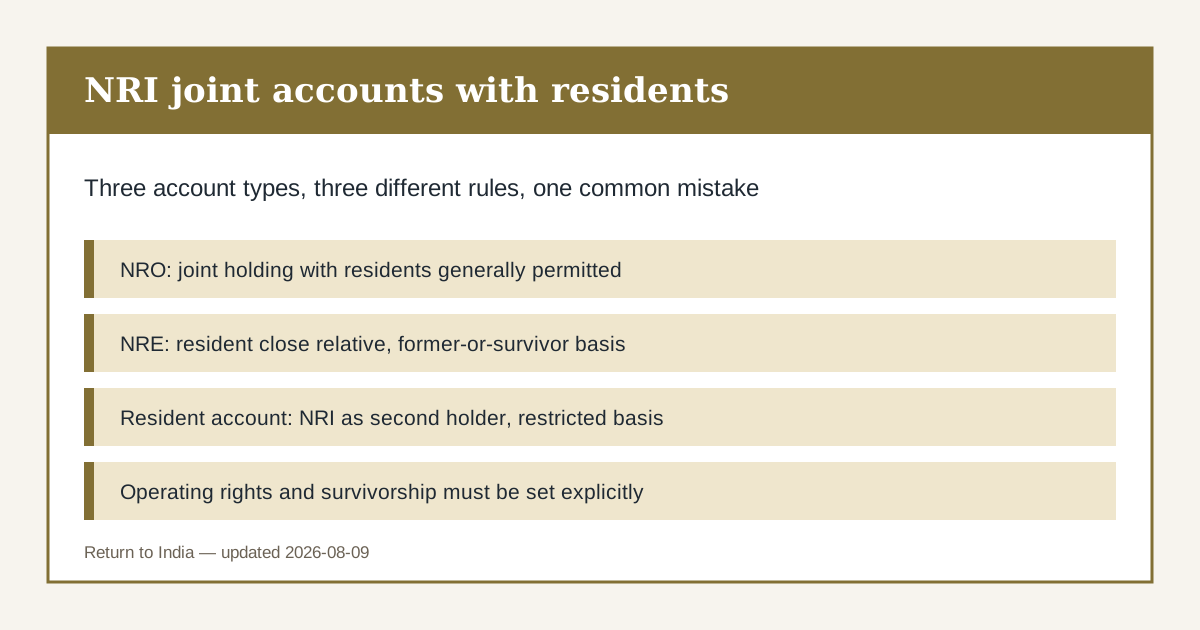
An NRO account may generally be held jointly with residents. An NRE account may be held with a resident close relative only on a former-or-survivor basis. A resident savings account may add an NRI as a joint holder only on that same restricted basis. Operating rights and survivorship are where families get it wrong.
Fast answer: it depends entirely on which account you are asking about
The question 'can an NRI open a joint account with a resident' has no single answer, because the RBI framework treats NRE, NRO and ordinary resident accounts as three separate products with three separate joint-holding rules. Branch staff often generalise from whichever one they handle most, which is why families get contradictory answers from two branches of the same bank.
The broad position is this. An NRO account may generally be held jointly with residents as well as with other non-residents. An NRE account may be held jointly with a resident who is a close relative, but on a former-or-survivor basis — meaning the non-resident operates the account during their lifetime and the resident's rights crystallise on the non-resident's death. An ordinary resident account may add a non-resident close relative as a joint holder, again on a restricted basis rather than as an equal operator.
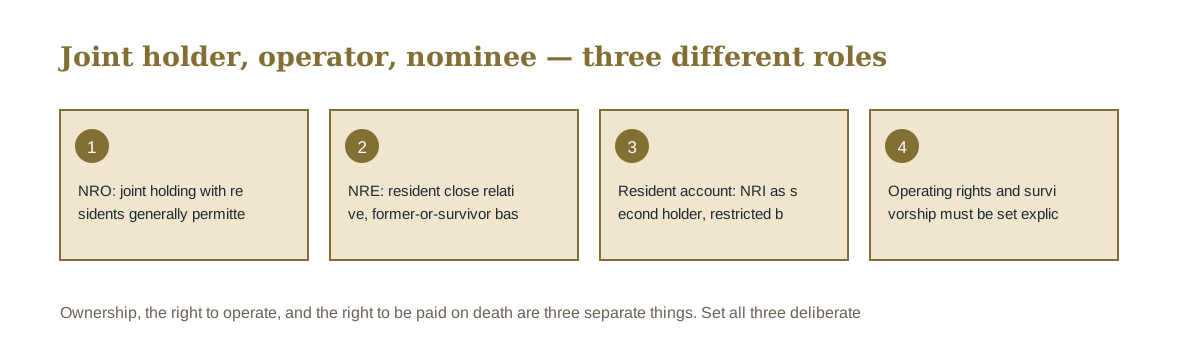
The second half of the question — who can actually operate the account — is where the real risk sits. 'Joint holder' and 'authorised to operate' are not the same thing. A former-or-survivor mandate deliberately limits the resident's operating rights while the non-resident is alive, and a power of attorney is a different instrument again with its own restrictions on what the holder may do.
Who can be a joint holder, on what basis
This is the matrix branch staff should be working from. Take a printed copy of the relevant Master Direction paragraph if you expect resistance.
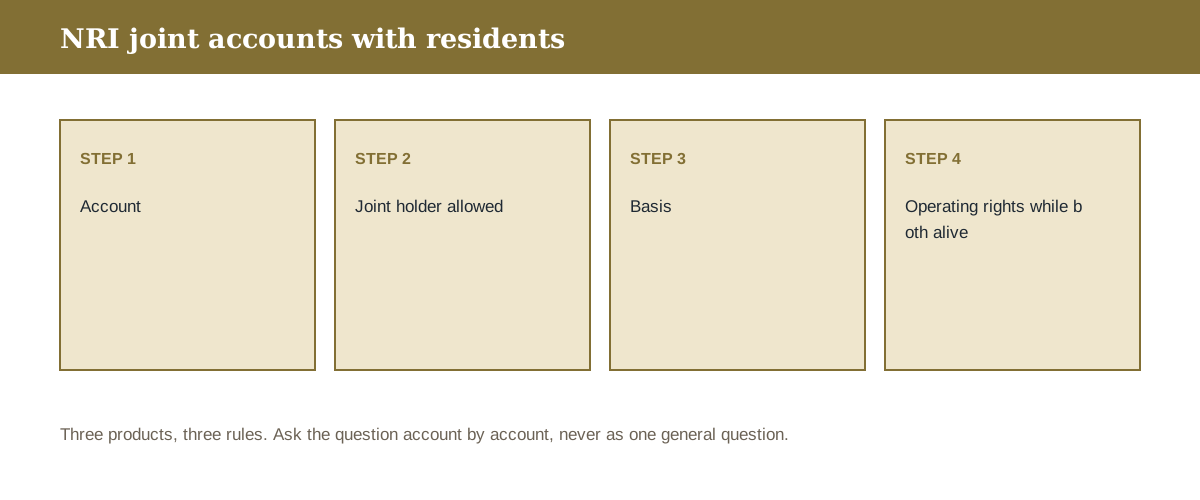
| Account | Joint holder allowed | Basis | Operating rights while both alive | On the NRI's return |
|---|---|---|---|---|
| NRO savings or deposit | Residents and non-residents | Generally on the usual joint-holding modes | As per the mandate chosen at opening — either or survivor, jointly, and so on | Redesignated as an ordinary resident joint account |
| NRE savings or deposit | Another non-resident; a resident close relative | With a resident: former-or-survivor only | The non-resident operates; the resident's rights arise on the non-resident's death | Redesignated to resident, or the balance moves to an RFC account |
| FCNR(B) deposit | Another non-resident; a resident close relative | With a resident: former-or-survivor only | The non-resident operates during their lifetime | Runs to maturity or is converted per bank practice on redesignation |
| Ordinary resident savings account | A non-resident close relative may be added | Former-or-survivor basis, with the resident as the first holder | The resident operates; the non-resident does not operate the account | Continues, with KYC updated to reflect the changed status |
| Any of the above via power of attorney | A resident may be given a power of attorney instead of joint holding | Local-payments mandate, not ownership | Restricted to permitted local payments; typically cannot repatriate or gift | The power of attorney should be reviewed and usually replaced |
Setting up a joint account correctly, in seven steps
Most joint-account disputes are traceable to something skipped in steps three, four or five.
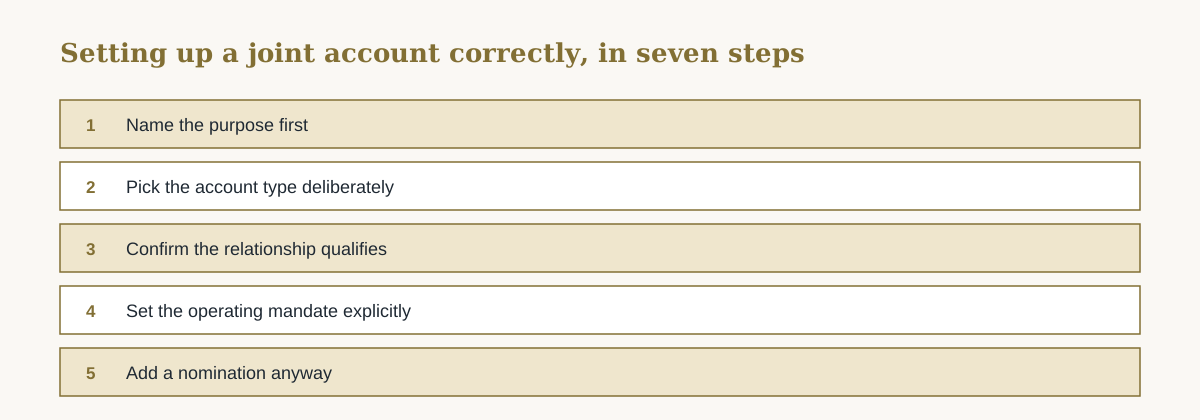
Name the purpose first
Are you creating this account so a parent in India can pay bills, so a spouse can access funds in an emergency, or so an asset passes cleanly on death? The purpose determines whether joint holding, a power of attorney or a nomination is the right instrument.
Pick the account type deliberately
If Indian income will be credited, it belongs in an NRO account. If the funding is foreign earnings, NRE. Getting this wrong at opening is far harder to fix than choosing correctly.
Confirm the relationship qualifies
Where the rule requires a resident close relative, be ready to evidence the relationship. Keep the supporting documents on file with the account opening form.
Set the operating mandate explicitly
Write down whether the mandate is former-or-survivor, either-or-survivor, or jointly. Do not accept a default. Ask for the mandate to be reflected on the account statement or a written confirmation.
Add a nomination anyway
Joint holding and nomination solve different problems. A nomination gives the bank a person to pay; it does not decide legal ownership. Register one on every account.
Record the tax consequence
Interest income has to be reported by the right person. Agree in writing whose income it is, because tax deducted at source will follow the account's primary holder and PAN.
Plan the account for the day the NRI returns
Redesignation changes the account's character and can change the mandate. Note in advance what the account becomes and who will operate it afterwards.
Joint-account file every NRI family should keep
This file is what resolves an argument with a branch, or a dispute among heirs.
- The account opening form showing account type and the joint-holding basis.
- Written confirmation of the operating mandate — former-or-survivor, either-or-survivor or jointly.
- Proof of relationship where a close-relative condition applies.
- A registered nomination on every account, refreshed after any family change.
- PAN details of the holder whose income the interest represents.
- A note recording the source of funds credited to the account.
- Any power of attorney, with its scope and expiry clearly stated.
- A copy of the RBI Master Direction paragraph the arrangement relies on.
- A dated plan for what happens to the account when the non-resident returns to India.
Joint holder, operator, nominee — three different roles
Need help with Banking?
Share your blocker in one line. Our experts will reply with practical next steps.
Community signal: two branches, two answers
Unable to embed reddit content. View on reddit
"The most common complaint is inconsistent guidance between branches. Carrying the relevant Master Direction paragraph usually resolves it in one visit."
Read on reddit ->Reference signal: the rule sits in the deposits Master Direction
Unable to embed linkedin content. View on linkedin
"Professional commentary consistently points back to the same source — the RBI Master Direction on Deposits and Accounts, read together with the non-resident accounts FAQ."
Read on linkedin ->Joint holding decision diagram
Need help with Banking?
Share your blocker in one line. Our experts will reply with practical next steps.
A nomination is not a will
A nominee is the person the bank may pay; they are not automatically the legal owner of the money. Where the amount is significant, the account arrangement should be consistent with a will or the applicable succession law, not a substitute for it.
The one-sentence answer
An NRI can generally be a joint holder on an NRO account with residents, can hold an NRE or FCNR(B) account with a resident close relative only on a former-or-survivor basis, and can be added to a resident account on that same restricted basis — so set the account type, the mandate and the nomination explicitly at opening.
Animated decision map

Need help with Banking?
Share your blocker in one line. Our experts will reply with practical next steps.
Interactive checkpoint
Turn this guide into a decision file
0 of 4 checked
Can an NRI open a joint account with a resident Indian?
Yes, but the basis depends on the account. An NRO account may generally be held jointly with residents. An NRE or FCNR(B) account may be held with a resident close relative only on a former-or-survivor basis.
Can an NRI be added to my existing resident savings account?
A non-resident close relative may generally be added to a resident account on a former-or-survivor basis, with the resident as the first holder. The non-resident does not operate the account during the resident's lifetime.
What does 'former or survivor' actually mean?
The first-named holder — the former — operates the account during their lifetime. The second-named holder — the survivor — acquires rights only on the death of the first holder. It is a deliberate restriction, not a formality.
Who counts as a close relative for these rules?
The RBI framework refers to the definition of relative in the Companies Act 2013. Because that list is specific, confirm that your relationship falls inside it before assuming the arrangement is permitted.
Can my parents operate my NRE account while I am abroad?
Not as an equal joint operator. A resident close relative can be a joint holder only on a former-or-survivor basis. For day-to-day operation, a power of attorney limited to permitted local payments is the usual route.
Whose income is the interest on a joint account?
Generally the person who owns the funds, and in practice tax deducted at source follows the primary holder's PAN. Agree and document this at the outset so the tax returns of both holders are consistent.
Does joint holding replace the need for a nomination?
No. Joint holding and nomination address different problems. Register a nomination on every account regardless of joint-holding arrangements, and keep it aligned with your will.
What happens to the joint account when the NRI returns to India?
The account is redesignated in line with the holder's changed FEMA status. NRE and NRO accounts convert, mandates may need to be re-executed, and KYC has to be refreshed for both holders.
Can two NRIs hold an account jointly?
Yes. Joint holding between non-residents is the least restricted case for NRE, NRO and FCNR(B) accounts. The restrictions arise specifically when one holder is a resident.
Your NRE account redesignation has a deadline.
Banks don't remind you. You need the right account stack before salary, rent, and EMIs start moving. Get the exact sequence.