NR301 After Moving to India: Canadian Payer, Treaty Evidence and Renewal
Prepare CRA NR301 for Canadian income after moving to India: beneficial ownership, treaty residence, recipient, expiry and exceptions without assuming a tax rate.
The 60-second version
NR301 can support a reduced treaty withholding rate when you are genuinely eligible. For Canadian Part XIII income, it normally goes to the payer or intermediary that requested it—not automatically to the CRA.
Fast answer: give treaty evidence to the right payer
If you receive Canadian income after moving to India, Form NR301 can help a payer establish entitlement to reduced withholding under a tax treaty. It is not a universal tax-reduction application and does not automatically make every pension, RRSP withdrawal or investment payment eligible for the same rate. For Part XIII income, the CRA form instructions normally direct you to send it to the payer, agent or intermediary that requested it.
The declaration covers beneficial ownership, residence for treaty purposes and eligibility for treaty benefits on the specified income. A change of postal address to India is not enough. Establish your actual treaty position first, then identify the income and the appropriate payer. If the payer accepts equivalent information, the CRA instructions recognise that alternative; the point is reliable evidence, not merely possession of a PDF.
This page is about preparing and renewing the declaration. It does not replace the RRSP or RRIF decision guides, calculate a Canada–India treaty rate, or decide your Indian tax return. The correct rate depends on the actual payment and treaty conditions. Ask the payer to confirm how it classifies the payment before authorising a withdrawal.
Where does the declaration go?
| Situation | Usual recipient under the instructions | Check first |
|---|---|---|
| Canadian Part XIII payer requested evidence | That payer, agent, nominee or intermediary | Which account and income types are covered |
| Income through a partnership or hybrid entity | The entity requesting your declaration | Whether the correct entity-specific form is needed |
| Treaty-protected property compliance certificate | CRA with the relevant T2062 or T2062A paperwork | The separate certificate procedure |
| Uncertain Canadian residence | Residency analysis; NR73 may be relevant | NR301 does not request a residence opinion |
Read the certification before choosing a rate
The NR301 instructions describe Part XIII tax as generally 25%, subject to statutory exceptions and treaty relief. That is a general starting point, not a quoted rate for your payment. The payer is responsible for withholding and remitting correctly and may request NR301 or equivalent information before applying less than the full rate.
You certify that the person named is the beneficial owner, that the information is correct and complete, and that the person is entitled to the relevant treaty benefits. Do not sign simply because someone says all people living in India qualify. Treaty residence, the kind of recipient and the income provision all need to match the circumstances. If you hold investments through an entity, the person entitled to the income may not be the individual completing a familiar bank form.
The form itself distinguishes recipient types and says partnerships should use NR302 and hybrid entities NR303 where appropriate. Those are not interchangeable signatures on the same application. An individual should also avoid using a declaration meant for one account as evidence that every Canadian payment has identical tax treatment.
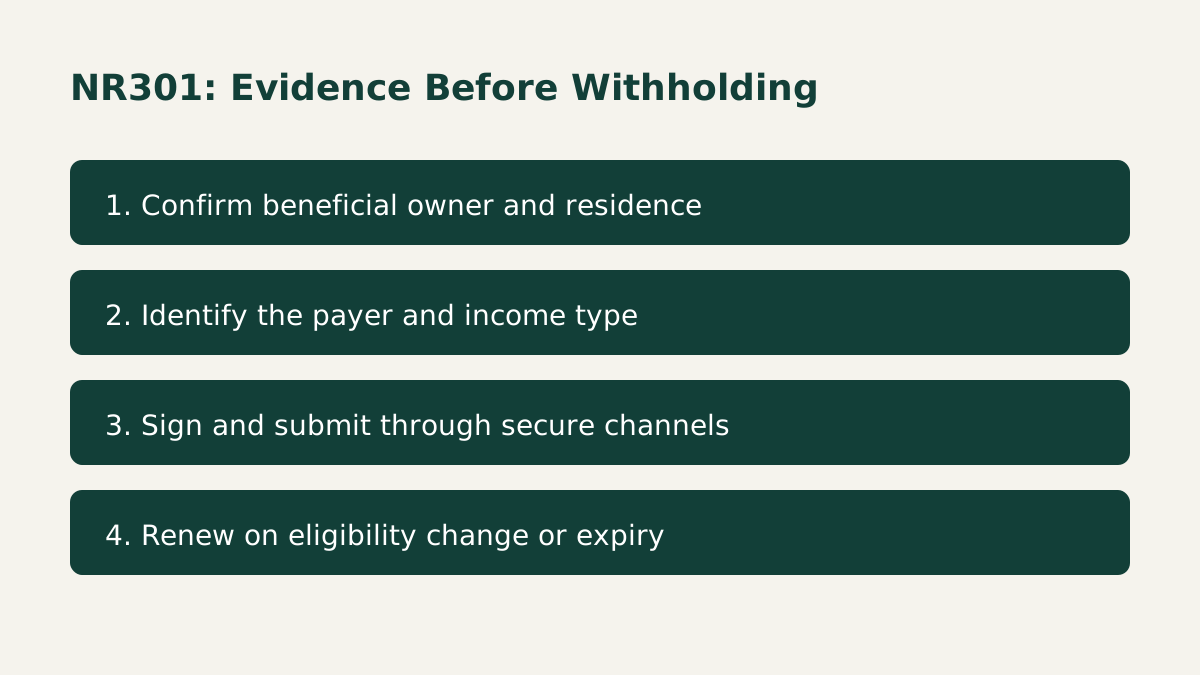
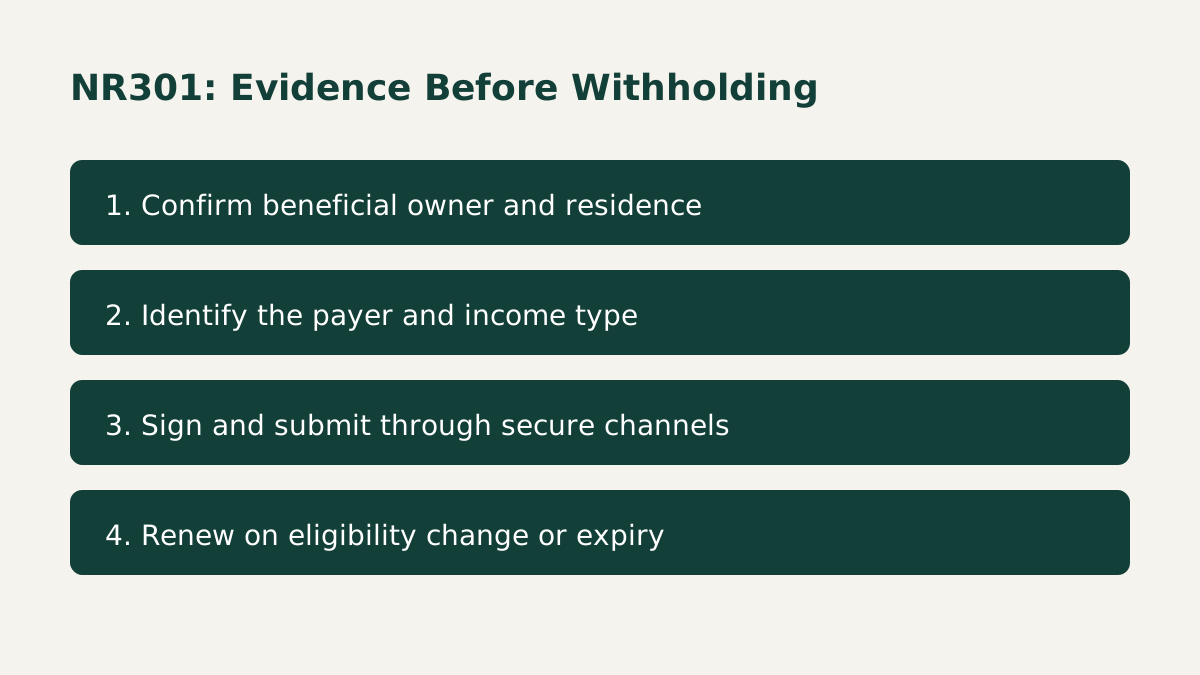
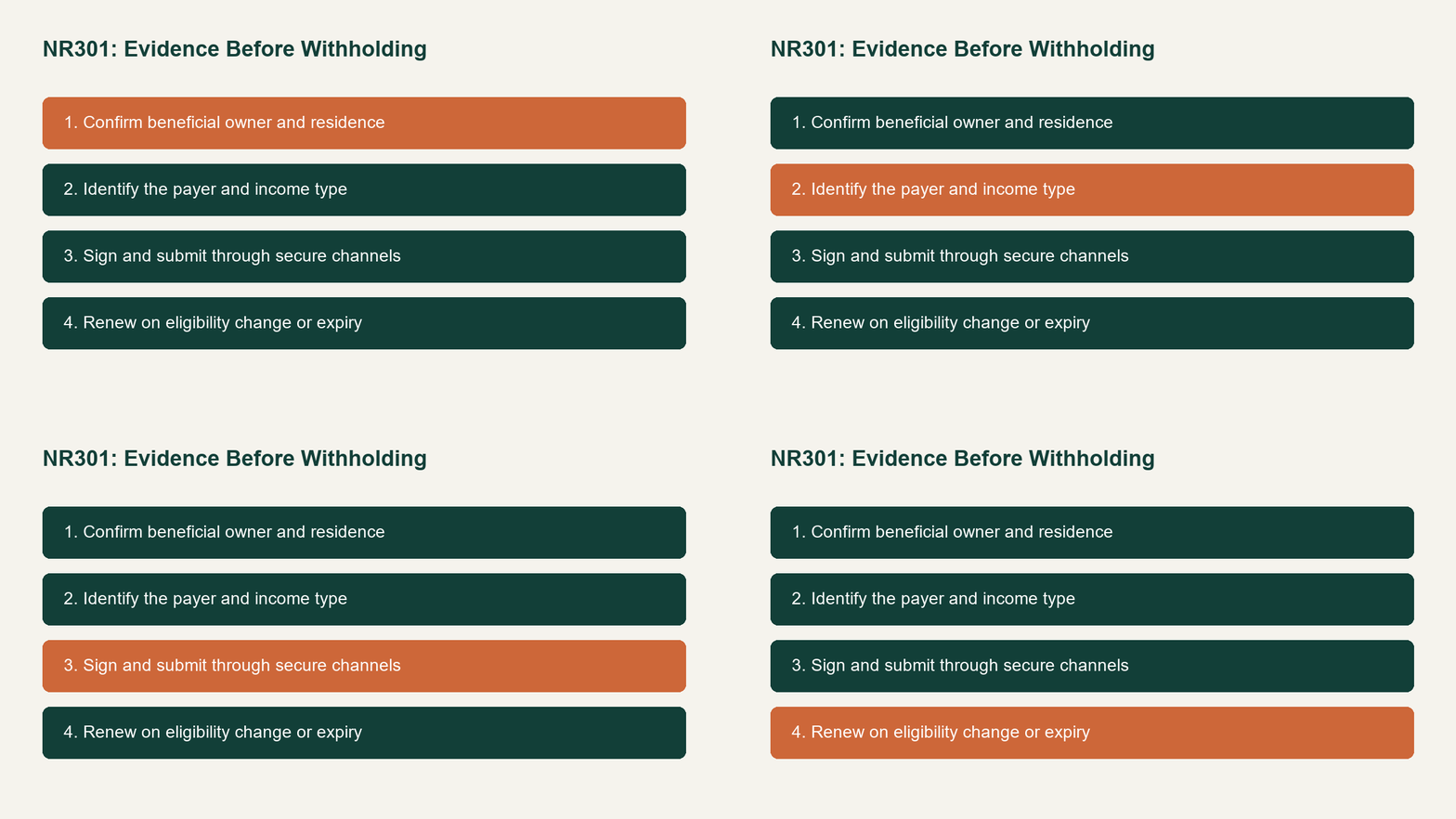
Prepare the payer packet in the right order
Identify the payer and payment
List the institution, account, actual recipient and income type. Ask whether a proposed pension or registered-plan payment is periodic or a different kind of withdrawal for its withholding review.
Confirm treaty residence and ownership
Resolve the actual tax residence and beneficial owner before signing. If Canada and India both have a residence claim, obtain advice rather than selecting India solely from your mailing address.
Complete the current form accurately
Use the legal name, mailing address, foreign tax identification number where applicable, recipient type, Canadian tax number if you have one, country of treaty residence and the covered income.
Submit securely to the requester
For ordinary Part XIII payer evidence, send it to the institution that requested it using its approved secure channel. Keep an acknowledgement and confirm the date on which it will apply the accepted treatment.
Reconcile the first payment
Compare gross income, withholding and net proceeds with the payer confirmation. If treatment differs, ask for the reason before assuming the bank has accepted the declaration.
Expiry: a calendar rule and an earlier change trigger
For Part XIII withholding, the NR301 declaration expires when treaty-benefit eligibility changes or three years from the end of the calendar year in which it was signed and dated, whichever happens first. Do not read that as exactly three years after the signature date. Equally, do not wait for the calendar expiry if the underlying eligibility has already changed.
The instructions require immediate notification when a change makes the information incorrect and a new form where needed. Keep a renewal reminder together with a change-of-circumstances checklist: country of residence, beneficial ownership, income coverage and recipient details. A payer can request updated evidence when the existing declaration no longer supports the reduced treatment.
An acknowledgement proves receipt, not that a particular treaty rate was approved. Ask for the classification and accepted rate in writing. Save the signed declaration, payer correspondence, payment statements and withholding records so your Canadian and Indian tax advisers can reconcile what happened rather than reconstruct it later.
Need help with Country Guides?
Share your blocker in one line. Our experts will reply with practical next steps.
NR5 and tax returns remain separate questions
The NR301 instructions exclude certain pension-exemption situations where NR5 and a CRA authorisation are required. They also distinguish relief under the Income Tax Act from relief under a treaty. Do not use NR301 as a substitute for an NR5 authorisation, a services withholding waiver or the separate rental-income procedure.
Likewise, a payer accepting treaty evidence does not settle all final Canadian or Indian tax. A Canadian return or election may still be relevant, and Indian taxation depends on your actual status and income. Retain the gross income and foreign withholding records; a smaller bank credit alone is not a tax calculation. Never present an accepted declaration as proof that India will exempt the payment.
Before signing NR301
- Correct person, recipient type and beneficial owner
- Actual country of treaty residence
- Income type and account covered by the declaration
- Tax numbers where applicable and current contact details
- Correct recipient and secure submission channel
- Expiry reminder, change notification and payment readback
Do not put an unsupported treaty rate on a withdrawal instruction
The Canadian payer needs sufficient evidence and the payment must qualify. NR301 is not a guarantee of reduced tax or a refund. Resolve classification and any NR5 exception before committing to the payment.
Need help with Country Guides?
Share your blocker in one line. Our experts will reply with practical next steps.
NR301 After Moving to India: Canadian Payer, Treaty Evidence and Renewal
Animated preparation checklist
Decision before submission
Need help with Country Guides?
Share your blocker in one line. Our experts will reply with practical next steps.
Community signal
What to watch in real discussions
Treat repeated complaints as risk signals rather than official advice. This page does not link to community search results.
Interactive checkpoint
Turn this guide into a decision file
0 of 4 checked
Do I send NR301 directly to the CRA?
For ordinary Part XIII income, the instructions say to give it to the requesting payer or intermediary. Other uses, such as a property compliance certificate, have different recipients.
Does an Indian address prove treaty eligibility?
No. The certification concerns beneficial ownership, treaty residence and entitlement for the income. A mailing address is only part of the information.
Is the form mandatory if my payer accepts equivalent information?
The instructions refer to NR301 or equivalent information. Confirm what the payer accepts; it remains responsible for correct withholding.
When does NR301 expire?
For Part XIII withholding, on an eligibility change or three years from the end of the signing calendar year, whichever is earlier. Notify the payer immediately when relevant information changes.
Can NR301 replace NR5?
No. The instructions identify pension situations where NR5 and a CRA authorisation are required instead. Have the payer identify the applicable route.
Does acceptance settle my Indian taxes?
No. Canadian withholding evidence and Indian tax reporting are separate. Keep payment and withholding statements and assess the Indian rules for your actual status.
Your country's rules are the starting point, not the finish line.
Tax exits, pension continuity, banking notifications — the India side has its own rules too. Get both sides clear.