Indians Leaving Canada: The Exit Checklist for Moving Home
Why Indian permanent residents and students are leaving Canada, what it costs to unwind a Canadian life, and the departure-tax, RRSP, TFSA, CPP and...
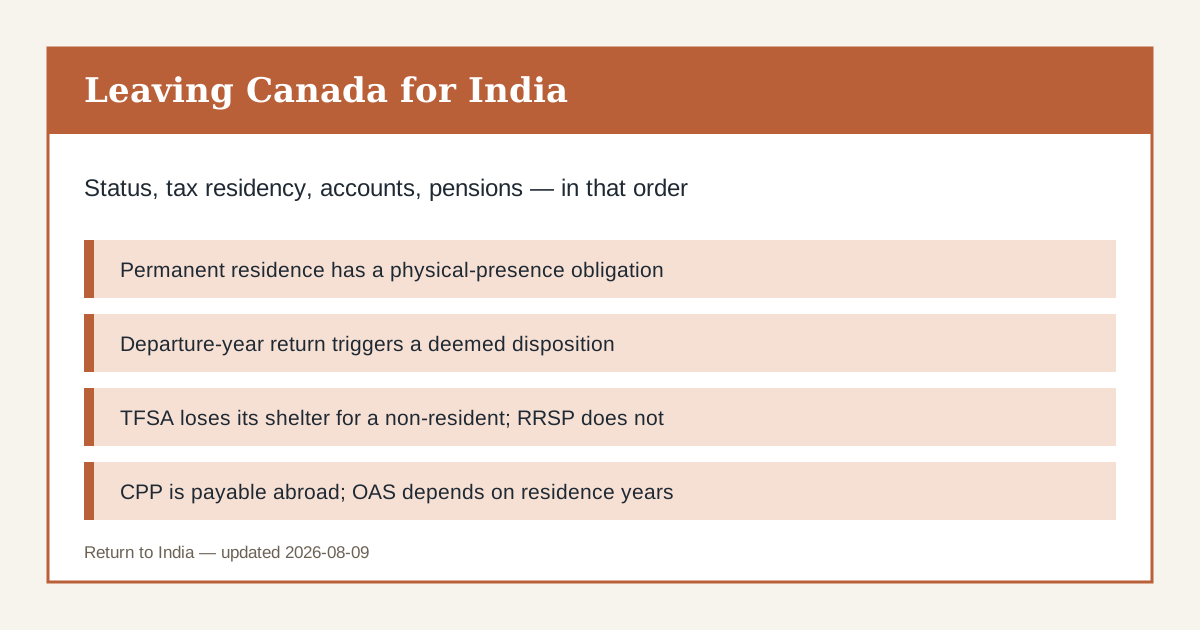
The 60-second version
Leaving Canada for India is not one decision — it is a stack of them: whether to keep permanent residence, when to sever tax residency, what happens to RRSP, TFSA and CPP, and how the departure-year return is filed. Getting the order wrong is what makes the move expensive.
Fast answer: separate the immigration decision from the tax decision
The single most common error in a Canada-to-India move is treating 'leaving Canada' as one event. It is two independent decisions that happen to occur around the same time. The first is your immigration status: whether you keep permanent residence, let it lapse, or formally renounce it. The second is your tax residency: whether and when you cease to be a resident of Canada for tax purposes.
They are governed by different authorities and different tests. Immigration status turns on a physical-presence obligation counted over a rolling five-year window. Tax residency turns on residential ties — where your home, spouse, dependants, bank accounts, driving licence, health card and personal property are. You can keep permanent residence and still become a non-resident for tax. You can also lose permanent residence while the tax authority still considers you resident, which is the worst of both worlds.
Everything else — the deemed disposition on departure, what happens to your registered accounts, whether Canada withholds on payments to you afterwards, and how India taxes any of it — follows from those two decisions and the dates attached to them. Fix the dates first, then work outwards.
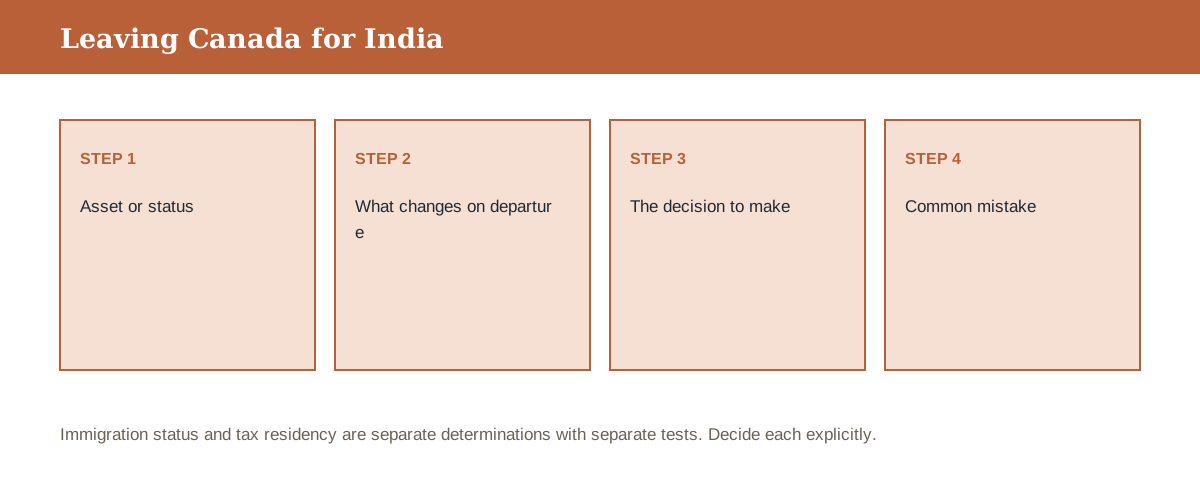
What happens to each Canadian asset when you leave
Treat this as the inventory sheet. Every line needs a decision and a date before you book the flight.
| Asset or status | What changes on departure | The decision to make | Common mistake |
|---|---|---|---|
| Permanent residence | Subject to a physical-presence obligation over a rolling five-year period | Keep and comply, let it lapse, or formally renounce | Assuming a permanent resident card's expiry date is the deadline that matters |
| Tax residency | Ceases when residential ties are severed; a departure-year return is filed | Fix and document the departure date | Leaving a home, spouse or health card behind and assuming residency ended anyway |
| Non-registered investments | Deemed disposition at fair market value on the departure date | Realise, hold, or file the security election for deferral | Discovering the deemed disposition after the departure year has closed |
| RRSP | Can generally be retained; withdrawals attract non-resident withholding | Retain and draw down later, or convert to a RRIF for a lower withholding rate | Collapsing the whole plan in one year and paying the top withholding rate |
| TFSA | Contribution room stops accruing; contributions while non-resident attract a penalty | Usually withdraw before departure or hold without contributing | Continuing to contribute after becoming non-resident |
| CPP | Payable abroad once you qualify; not tied to continued residence | Confirm the payment destination and currency | Not updating the payment address, causing suspended payments |
| OAS | Payable abroad only if the residence-year condition is met | Count your Canadian residence years before assuming eligibility | Assuming OAS behaves like CPP and travels automatically |
| Provincial health coverage | Ends after a defined absence | Arrange Indian health cover before, not after | Flying without cover in the gap between the two systems |
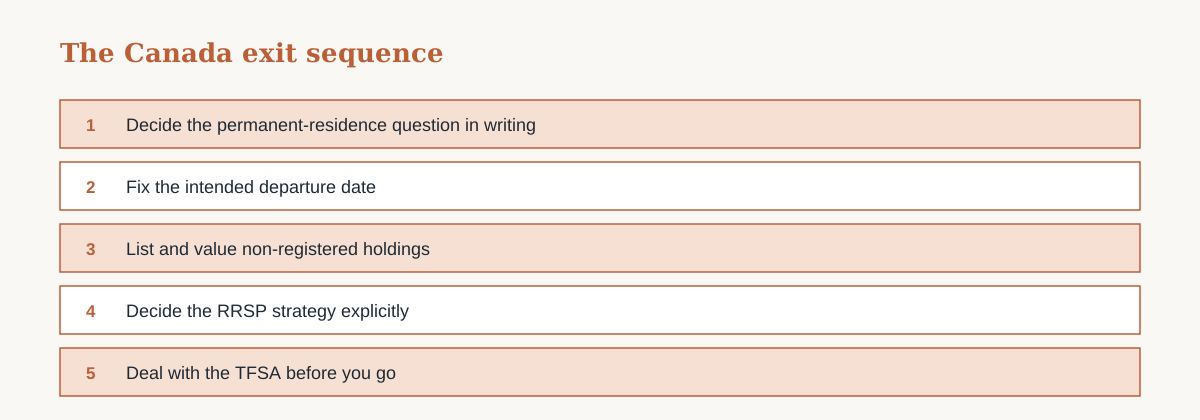
The Canada exit sequence
Start about six months out. The tax and pension steps have lead times you cannot compress.
Decide the permanent-residence question in writing
Count your physical-presence days over the rolling window, decide whether you intend to satisfy the obligation, and record the decision. This drives whether you keep a Canadian footprint at all.
Fix the intended departure date
Both the tax authority and your financial institutions will ask for it. Everything from the deemed disposition to the withholding rate on later payments hangs off this single date.
List and value non-registered holdings
The departure-year deemed disposition treats these as sold at fair market value. Get the valuations before you leave, when you can still access statements easily.
Decide the RRSP strategy explicitly
Holding it, drawing it down over several years, or converting it are different tax outcomes. Model them against your expected Indian residential status, because RNOR years change the answer.
Deal with the TFSA before you go
The tax shelter does not travel well and contributions while non-resident are penalised. Most people withdraw before departure rather than hold an account they cannot use.
Notify every institution and the tax authority
Banks, brokers, employers, pension administrators and the tax authority all need the departure date and a valid overseas address. Missing one is what causes withholding at the wrong rate.
Set up the Indian side before you land
An account to receive pension and investment income, a plan for your Indian residential status, and a note of which RNOR years you expect. The Canadian decisions should be sequenced against those years.
Canada departure checklist
Work through this in the final ninety days. Every unchecked box becomes a problem after you land.
- Physical-presence days counted and the permanent-residence decision recorded.
- Departure date fixed and communicated consistently to every institution.
- Fair market valuations obtained for all non-registered holdings.
- RRSP strategy modelled against expected Indian residential status.
- TFSA position resolved before the departure date.
- Employer pension or group plan options confirmed in writing.
- CPP payment destination and address updated.
- OAS residence-year eligibility checked, not assumed.
- Provincial health coverage end date noted and Indian cover arranged to start earlier.
- Driving licence, health card and other residential ties dealt with deliberately.
- Overseas address registered with the tax authority and every financial institution.
- Departure-year filing obligations diarised, including the deemed disposition reporting.
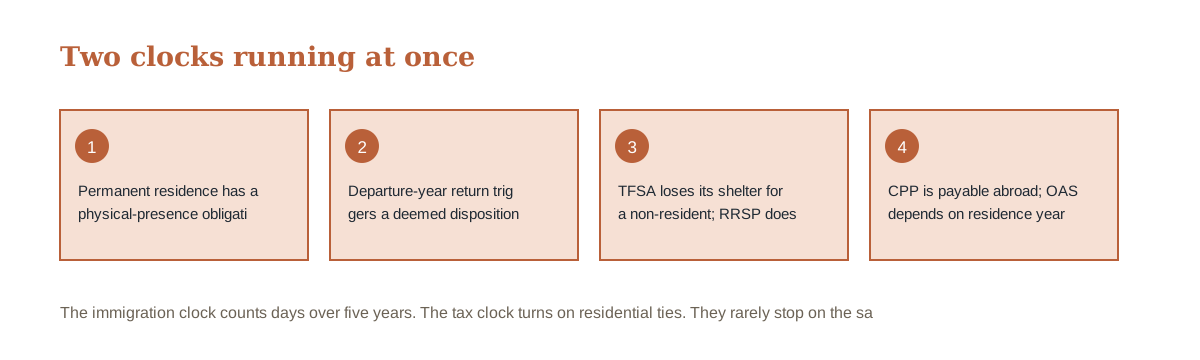
Two clocks running at once
Need help with Country Guides?
Share your blocker in one line. Our experts will reply with practical next steps.
Community signal: the departure tax is the recurring surprise
Unable to embed reddit content. View on reddit
"Threads on leaving Canada return again and again to the deemed disposition, which people discover after the departure year has already closed."
Read on reddit ->Community signal: PR versus tax residency confusion
Unable to embed reddit content. View on reddit
"The second recurring theme is people assuming that keeping permanent residence means staying a tax resident, or the reverse. They are independent determinations."
Read on reddit ->Canada-to-India exit diagram
Need help with Country Guides?
Share your blocker in one line. Our experts will reply with practical next steps.
The deemed disposition has no reminder
Nobody sends a notice about the departure-year deemed disposition on non-registered holdings. It surfaces when the return is prepared, often months after the fact, by which point the valuations are harder to reconstruct. Get the valuations before you leave.
The one-sentence answer
Leaving Canada for India means settling two separate questions — whether you keep permanent residence, and when you cease to be a Canadian tax resident — and then sequencing the deemed disposition, RRSP, TFSA, CPP and OAS decisions against your expected Indian RNOR years.
Animated decision map
Need help with Country Guides?
Share your blocker in one line. Our experts will reply with practical next steps.
Interactive checkpoint
Turn this guide into a decision file
0 of 4 checked
Are Indians actually leaving Canada in large numbers?
Reverse movement from Canada to India has become a visible trend in community discussion, driven by cost of living, housing, job-market conditions and family reasons. For statistical rather than anecdotal answers, use official migration and statistical releases rather than social media claims.
Do I have to give up permanent residence if I move to India?
No, but permanent residence carries a physical-presence obligation counted over a rolling period. If you cannot meet it, you can let the status lapse or renounce it formally. Either way, record the decision and the date.
What is the Canadian departure tax?
On ceasing Canadian tax residency, you are generally treated as having disposed of certain property at fair market value, which can create a capital gain in the departure year. Some property types are excluded and a security election may allow deferral.
Can I keep my RRSP after moving to India?
Generally yes. The plan can usually be retained after you become non-resident, with withholding applying to withdrawals. Converting to a RRIF can change the withholding treatment on periodic payments, so model the options before acting.
What happens to my TFSA when I leave Canada?
Contribution room stops accruing while you are non-resident and contributions made during that period attract a penalty. The account's tax shelter is also generally not recognised outside Canada, so many people withdraw before departure.
Will I still receive CPP in India?
Canada Pension Plan retirement benefits are generally payable to eligible recipients living abroad. Update the payment destination and address with Service Canada before you move so payments are not suspended.
Is Old Age Security payable in India?
OAS payment abroad depends on meeting a Canadian residence-year condition. It does not behave like CPP. Check your residence years against the published rule before assuming the benefit travels with you.
Does the Canada-India social security agreement help?
The agreement is designed to help people who have contributed in both countries by addressing coverage and, in defined circumstances, the totalising of periods. Its effect depends on your specific contribution history in each country.
When should I time RRSP withdrawals relative to landing in India?
Model the withdrawals against your expected Indian residential status. RNOR years and Resident and Ordinarily Resident years produce very different Indian outcomes, so the sequencing decision should be made before the first withdrawal, not after.
Your country's rules are the starting point, not the finish line.
Tax exits, pension continuity, banking notifications — the India side has its own rules too. Get both sides clear.