Health Insurance for OCI Holders in India: Eligibility and Documents
Can OCI holders buy health insurance in India? Check insurer acceptance, passport and residence documents, underwriting, waiting periods and treatment territory.
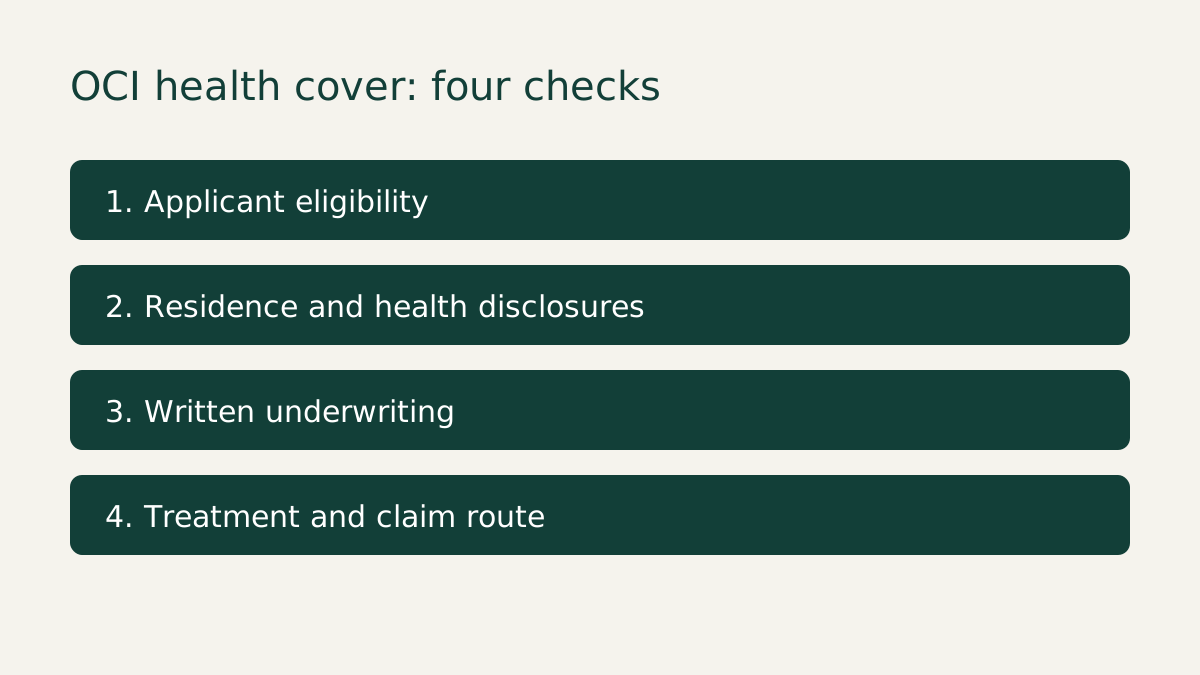
The 60-second version
OCI holders can apply for Indian health insurance, but the insurer's product terms and underwriting determine acceptance and cover. A valid OCI card is not proof that a policy covers your medical history, overseas treatment or an immediate hospital admission. Get those answers in writing before replacing existing protection.
Yes, you can apply—but eligibility is not a coverage guarantee
OCI holders can apply for health insurance in India. ICICI Bank's published eligibility explanation explicitly includes Persons of Indian Origin and Overseas Citizens of India, while stating that the concerned insurer determines terms and approval. Treat that as a starting point, not a guarantee of acceptance by every insurer or every plan. Ask the insurer to confirm acceptance of your foreign passport, OCI status and actual residence for the named product.
The next question is whether the issued policy covers the care you need. IRDAI's policyholder guidance tells buyers to inspect pre-existing-disease exclusions, waiting periods, expense limits, co-payments, entry and renewal conditions, and medical-test requirements. An agent saying that OCI applicants are allowed does not answer any of these coverage questions.
Use the Move Planning hub for the transition sequence and the waiting-period guide for the separate coverage clock. This article concerns applicant eligibility and the document-to-underwriting handoff, not rankings, premium estimates or a promise of foreign-policy portability.
The written answers to obtain before paying
| Issue | Ask the insurer | Keep as evidence |
|---|---|---|
| Foreign citizenship and OCI | Does this exact product accept my citizenship, OCI category and present residence? | Written eligibility response naming the product |
| Identity and address | Which passport, OCI, address and KYC documents are required? | Accepted document list and acknowledgment |
| Medical history | Are these disclosed conditions accepted, excluded, loaded or subject to a waiting period? | Proposal copy, medical reports and underwriting decision |
| Treatment territory | Does the wording cover treatment in India only, or any defined overseas care? | Relevant policy clause, not an advertising headline |
| Cashless access | Is the intended hospital in this product's network, and what approval process applies? | Current network check and authorization procedure |
| Cost sharing | What room limits, co-payments, deductibles and sub-limits apply? | Policy wording, schedule and customer information |
| Move and renewal | What must be updated if I move to India or later move abroad? | Servicing and renewal instructions |
Build a document pack around your real circumstances
Ask for the insurer's list rather than assuming a local address or Aadhaar is universally required. Have your foreign passport and OCI record available, together with actual residence and contact information, the proposed insured persons' details and the payment arrangement the insurer accepts. The precise KYC and payment requirements are product- and insurer-specific; disclose if you are still abroad and when you expect to move.
Prepare a truthful medical history: diagnoses, medicines, investigations, past admissions, surgeries and ongoing treatment. IRDAI specifically warns against concealing health problems, including conditions such as high blood pressure or diabetes. Check the proposal form yourself even when an intermediary enters the answers. Keep the completed version so you can establish what was disclosed.
If tests are required, ask where they can be carried out, whether reports from abroad are acceptable and who pays. Do not assume a familiar overseas provider or existing prescription will satisfy the insurer's underwriting process. The outcome must be reflected in the issued policy and endorsements, not just a preliminary quote.
Apply without creating a gap in protection
Name the applicants and treatment needs
Separate the OCI holder, Indian-citizen spouse, children and parents. Record actual residence, expected move and the hospitals or treatment locations that matter.
Confirm eligibility for the exact product
Obtain a written answer on foreign-passport and OCI acceptance. Distinguish applicant eligibility from whether each medical condition will be covered.
Submit complete disclosures
Check the proposal answers, provide requested records and complete medical tests. Preserve the submitted proposal and any later clarification.
Read the underwriting outcome
Check exclusions, waiting periods, loading, co-payments, deductibles and limits against your needs. Ask for unclear points to be explained in writing.
Verify issued cover and its start
Confirm the policy schedule, insured names, endorsements, effective date and claim procedure. Payment or a quote alone is not proof of immediate cover for planned treatment.
Coordinate existing protection
Do not cancel a policy you rely on until you understand the replacement's effective cover and exclusions. Foreign-policy waiting-period credit must not be assumed.
Separate India treatment, overseas treatment and emergency travel
An Indian hospitalization policy should not be assumed to pay for treatment abroad merely because the buyer is an OCI holder. Read the territorial clause. A plan with a defined overseas benefit may have its own restrictions; travel insurance and routine resident health insurance are also different contracts. Match the wording to where care will actually be delivered.
Cashless treatment is a claims arrangement, not a promise that every admission will be paid. Check the intended hospital's current network status and the authorization process, then consider exclusions and cost sharing. Keep enough information to use the reimbursement route if the contract provides it; do not rely only on a hospital logo in a brochure.
Hypothetical example: an OCI couple returns from Canada and one partner has ongoing diabetes treatment. Eligibility to apply does not establish immediate diabetes coverage, transfer of the Canadian policy's history or cover for future Canadian admissions. Their decision requires the Indian insurer's written underwriting and territorial terms, plus a plan for any uncovered transition period.
Read the issued policy before calling the job done
- Every insured person's name and identifying details are correct
- Foreign citizenship, residence and OCI status were disclosed accurately
- The proposal copy and medical disclosures are saved
- Underwriting terms match what was agreed
- Waiting periods and exclusions are understood
- Treatment territory and hospital access meet the need
- Claim and renewal instructions are accessible after the move
- Existing protection has not been cancelled on an unconfirmed assumption
Need help with Move Planning?
Share your blocker in one line. Our experts will reply with practical next steps.
Keep a written trail if servicing goes wrong
IRDAI's policyholder guidance says to complain to the insurer or its Grievance Redressal Officer in writing with supporting documents and obtain a dated acknowledgment. Use the current official escalation process if the response is unresolved or unsatisfactory. A dispute file should contain the proposal, policy, endorsements and the specific correspondence—not only a sales conversation.
From eligible applicant to usable cover
Planning visual

Animated decision map

Community signal
What to watch in real discussions
Treat repeated complaints as risk signals rather than official advice. This page does not link to community search results.
Interactive checkpoint
Turn this guide into a decision file
0 of 4 checked
Can an OCI holder take medical insurance in India?
OCI holders can apply, but acceptance depends on the insurer and product. Get written confirmation covering foreign citizenship, actual residence, required documents and medical underwriting; the OCI card is not a guarantee of coverage.
Can an NRI take out health insurance in India?
NRIs can apply for Indian health insurance subject to product eligibility and underwriting. Ask about residence declarations, medical tests, treatment territory and servicing after the move. Do not assume overseas treatment or automatic credit for a foreign policy.
What are the disadvantages of OCI card in India?
For insurance decisions, the relevant limitation is that OCI status does not settle product eligibility, medical underwriting, treatment territory or tax residency. It is not citizenship. Read the applicable policy rather than treating the card as universal eligibility evidence.
Can OCI holders buy life insurance in India?
This article verifies the health-insurance application question, not life-insurance acceptance. Life insurance has different underwriting, residence and product conditions. Obtain a product-specific answer rather than applying a health-policy explanation to it.
The plan is only as good as the sequence.
Tax, banking, schools, shipping — they all have dependencies. A wrong order costs months and lakhs. Get it right.