The 60-second version
FCNR(B) does not auto-solve itself on landing day. You separate three decisions: can the deposit run to contracted maturity under bank/RBI treatment; when does interest become taxable for you as a resident; and whether maturity proceeds should stay foreign-currency (RFC where eligible), convert to rupees, or feed a repatriation plan. This page is that operating matrix — not a product pitch.
Why FCNR(B) is a maturity problem, not a panic problem
A common landing-week mistake is treating every NRI product as “must close now.” FCNR(B) is a term foreign-currency deposit. The contracted tenure, premature-withdrawal penalties, and bank redesignation process matter more than airport Wi-Fi advice.
Your residential status for RBI banking products and your residential status for Indian income tax are related but not identical calendars. Banks redesignate accounts when you become resident under FEMA/banking rules; tax on interest follows the Income-tax Act for your status in that year. Read both clocks before you break a deposit for a flat booking.
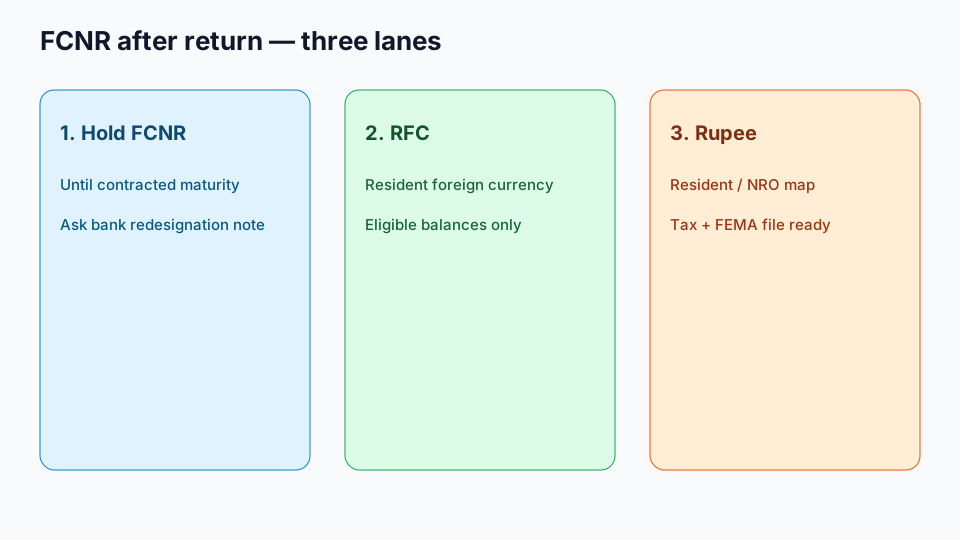
Three-lane matrix after return
Exact bank forms differ. Use this matrix to interview the branch/relationship manager with a script.
| Lane | When it fits | What you verify in writing | Common failure |
|---|---|---|---|
| Hold FCNR(B) to maturity | You do not need the foreign currency soon; deposit is intact | Can existing FCNR run to maturity after residential status change? Ticket ID? | Assuming auto-closure on day of landing |
| RFC (resident foreign currency) | Eligible foreign-currency balances should stay in FX as resident | Eligibility, what can credit, interest treatment, conversion rules | Opening RFC for money that does not qualify |
| Rupee resident / NRO map | You need INR cash flow or account structure cleanup | Redesignation path, TDS, joint holder rules, cheque book KYC | Mixing NRE/FCNR proceeds into wrong account type |
| Premature withdrawal | Only if liquidity crisis beats penalty + tax cost | Penalty rate, revised interest, tax year of interest credit | Breaking FCNR to “simplify” without cash need |
FCNR vs NRE vs NRO vs RFC (returnee view)
| Product | Currency | Typical post-return question | Do not assume |
|---|---|---|---|
| FCNR(B) | Foreign currency term deposit | Hold to maturity or break? | That interest stays tax-free forever after you are resident |
| NRE | Rupee (repatriable while NRI) | Redesignate when resident? | That NRE can stay NRE indefinitely after return |
| NRO | Rupee (India income / local) | TDS, 15CA/15CB, USD 1M repatriation stack | That all balances freely leave without paperwork |
| RFC | Foreign currency as resident (eligibility-bound) | Where maturity FX should sit | That every bank opens RFC the same week with zero docs |
Nine-step FCNR operating sequence
Inventory every FCNR deposit
Bank, account number, currency, principal, contracted rate, start date, maturity date, joint holders, nomination. Photo of advice slip + online screenshot.
Confirm residential status trigger with the bank
Ask what document they need (passport stamps, OCI, address proof, self-declaration) and when they redesignate related NRE/NRO products. Get a ticket or email trail.
Ask the hold-to-maturity question explicitly
Script: “I am becoming resident. Can this existing FCNR(B) continue until the contracted maturity date? What changes on interest credit and certificates?”
Price premature withdrawal before emotion
Request written premature rates / penalty. Compare to the actual INR need (deposit, school fee, medical). If the need is smaller, break less or borrow against a plan — do not default to full break.
Map maturity proceeds day −30
Thirty days before maturity: decide RFC vs conversion vs transfer path. Incomplete KYC on the destination account is how maturity money sits in limbo.
Align tax file for interest
As a resident (tax), foreign-currency deposit interest may enter your India tax computation differently than when you were NRI. Keep interest certificates, Form 26AS/AIS matches, and advisor notes for that year. This is not a substitute for a CA opinion on your facts.
Pair with NRE redesignation calendar
FCNR rarely lives alone. NRE savings/FDs often need redesignation on the same residential-status event. One checklist for the whole banking wallet prevents half-done KYC freezes.
Keep repatriation separate from maturity
Needing money abroad later is an NRO/RFC/FEMA paperwork problem. Do not confuse “I might remortgage a US house in 2028” with “break FCNR this week.”
90-day banking audit after landing
Re-list all accounts: status labels in net banking, interest TDS, joint mandates, cheque books, and whether any FCNR is within 90 days of maturity without a destination plan.
Returnee scenario map
| Scenario | Default bias | Watch-outs |
|---|---|---|
| Single FCNR, 8 months to maturity, strong INR cash buffer | Hold to maturity | Do not break for “cleanup”; fix NRE/NRO first |
| Multiple FCNRs, need INR down payment in 60 days | Partial break / ladder only what is required | Penalty + tax year of interest; document which deposit you break |
| Wants FX retained for foreign spending / future travel | Evaluate RFC eligibility at maturity | RFC is not a magic tax-free forever box — confirm rules |
| Joint FCNR with parent still NRI | Read joint mandate + survivor rules with bank | Residential status of each holder can diverge |
| FCNR was auto-renewed without attention | Stop auto-renew if you need a planned exit | Auto-renew can push a decision into a worse tax year |
FCNR after-return kit
- Deposit inventory spreadsheet (maturity, currency, principal, joint holders).
- Bank ticket: hold-to-maturity confirmation after residential status change.
- Premature withdrawal quote in writing (if liquidity pressure exists).
- Destination plan for maturity: RFC / resident INR / other (named account).
- KYC pack: PAN-Aadhaar link status, address, mobile OTP path.
- NRE/NRO redesignation checklist on the same calendar.
- Interest certificate folder for the year you become resident.
- Nomination and emergency access note for joint accounts.
- 90-day re-audit date on calendar.
Need help with Banking?
Share your blocker in one line. Our experts will reply with practical next steps.
Decision flow
Bank and tax rules are fact-specific
RBI product rules, bank circulars, and Income-tax treatment depend on your residential status facts, deposit contract, and year of interest credit. This page is an operating checklist for returnees. Confirm with your bank and a qualified Indian tax professional before you break, renew, or redesignate any deposit.
Myth: “FCNR interest stays tax-free after I return”
NRI-period treatment and resident-period treatment are not the same conversation. Do not plan lifestyle cash on a forum claim. Match interest certificates to AIS/26AS and get a written view for the year you change status.
Animated decision map

Community signal
What to watch in real discussions
Treat repeated complaints as risk signals rather than official advice. This page does not link to community search results.
Interactive checkpoint
Turn this guide into a decision file
0 of 4 checked
Can I keep my FCNR(B) deposit after becoming a resident of India?
Often the deposit can continue to its contracted maturity under bank/RBI treatment, but you must confirm redesignation and documentation with your bank in writing. Do not assume automatic closure or automatic continuation without asking.
Should I break FCNR as soon as I land?
Only if you have a priced liquidity need that beats penalty and tax cost. Many returnees hold to maturity while they fix NRE/NRO KYC and build an INR runway from other sources.
What is RFC and when does it matter for FCNR?
RFC is a resident foreign-currency account path for eligible balances. It can be relevant when FCNR matures and you still want foreign currency as a resident — subject to bank eligibility and current rules.
Is FCNR interest taxable after I return?
Tax depends on your residential status for income-tax purposes and the year interest is taxable. Treat “tax-free forever” claims as unsafe. Keep certificates and get professional advice for your facts.
How is FCNR different from NRE after return?
FCNR(B) is a foreign-currency term deposit. NRE is a rupee account product for NRIs that typically must be redesignated when you become resident. Map each product on its own row.
Can joint FCNR with a parent stay open if only I return?
Joint-holder and mandate rules are bank-specific. Residential status of holders can diverge. Ask the bank how survivor/former-or-survivor mandates behave after your status change.
Does FCNR help with the USD 1 million NRO repatriation limit?
Repatriation limits and documentation primarily attach to the relevant account and FEMA path (often discussed with NRO). Do not treat FCNR maturity as automatically the same stack. Plan remittances with the correct forms and advice.
Your NRE account redesignation has a deadline.
Banks don't remind you. You need the right account stack before salary, rent, and EMIs start moving. Get the exact sequence.