The 60-second version
An NRO joint account survives return — but the friction moves to mandate, tax residency of each holder, and who can authorise outward remittance. Families that treat it like a normal savings account discover week-long branch holds on Form 15CA wires and rent TDS mismatches.
Why NRO joint is a remittance problem, not a product name problem
NRO joint with a resident relative is common: rental credits, property sale proceeds, inherited rupees, and domestic interest sit in one pool. After you return, the account can redesignate while both holders may now be resident for banking. The product still carries FEMA repatriation discipline — including the familiar USD 1 million per financial year outward path from NRO for eligible balances.
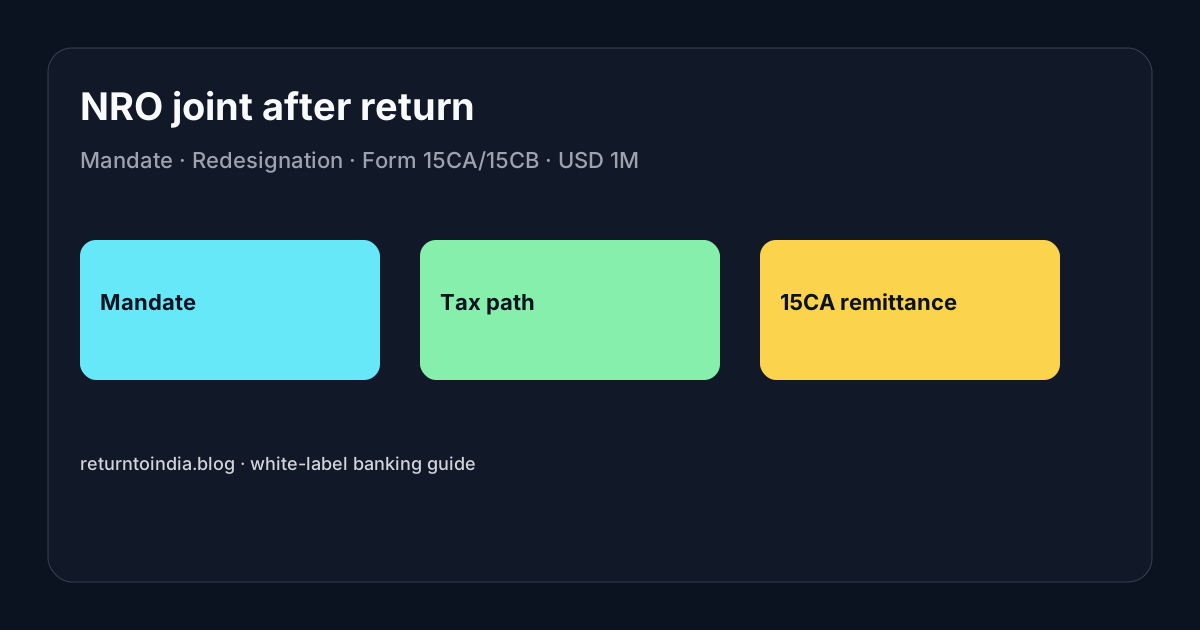
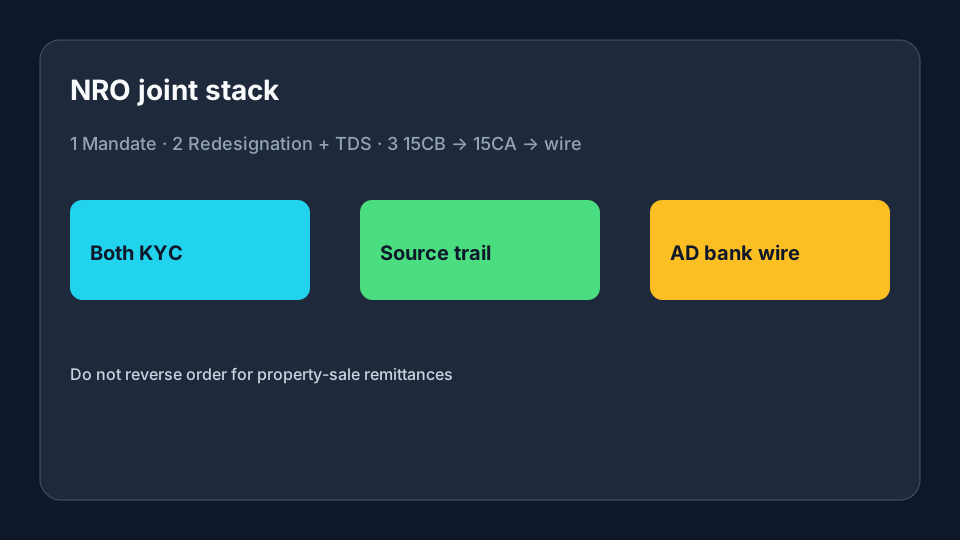
Treat the fix as three workstreams: (1) operating mandate (who can debit / who must co-sign), (2) redesignation and tax stack (interest TDS, Form 15G/H if eligible, AIS/26AS), (3) remittance kit (Form 15CA, Form 15CB CA certificate, bank FEMA declaration). Skipping (3) is how a clean property sale becomes a three-week branch queue.
NRO joint vs NRE joint after return (do not mix playbooks)
| Topic | NRO joint | NRE joint |
|---|---|---|
| Typical balance source | India-source rupees (rent, sale, inheritance) | Foreign inward remittances / eligible NRE credits |
| Interest tax | Taxable; TDS often applies | NRE interest tax treatment differs — confirm post-redesignation product |
| Outward remittance | USD 1M FY path + 15CA/15CB stack (typical) | Different product path; do not copy NRO forms blindly |
| Joint relative rules | Often used with resident spouse/parent | Close-relative rules stricter on pure NRE joint modes |
| After both holders resident | Domestic NRO ops + FEMA remittance discipline remains | Redesignation / RFC / resident product path |
Holder-mix matrix after return
Ask the bank to mark which row matches your NRO account number.
| Holder mix | Typical pre-return setup | After return | First bank ask |
|---|---|---|---|
| NRI primary + resident spouse | Either-or or former-or-survivor; rent credits | Primary may redesignate as resident | Fresh mandate + both KYC refresh |
| NRI primary + resident parent | Parent operates for property rent | Same — OTP and address update lag | Mobile/OTP on both profiles |
| Two NRIs joint (couple abroad) | Both NRI-era KYC | One or both land → dual status flip | Sequence redesignation for each holder |
| Inherited NRO joint/transmission | Nominee or heir path incomplete | Heir KYC before large debit | Succession / legal heir papers |
Risk matrix if you skip NRO joint re-paperwork
| Area | What can go wrong | Mitigation |
|---|---|---|
| Outward wire | Branch rejects 15CA because second holder did not sign mandate / CA papers | Align mandate + both PANs before CA appointment |
| USD 1M cap | Assuming joint doubles the limit | Cap is per person per FY — plan calendar year/FY mapping with CA |
| Interest TDS | High withholding; cashflow squeeze | Form 15G/H if eligible; link PAN–Aadhaar; monitor 26AS |
| Rent / 194-I | Tenant credits wrong PAN or joint mismatch | Lease TDS clause + AIS reconcile monthly |
| Property sale 194-IA | Buyer TDS credit stuck; sale proceeds trapped | NRO credit path + Form 16B + 15CB sequence planned before registry |
| OTP / debit card | Foreign mobile still on joint profile | Update India mobile on both holders before large transfers |
Twelve-step NRO joint sequence after landing
Print account master + mandate mode
Get a branch printout: product type (NRO), joint mode (either-or / former-or-survivor / jointly), and registered mobiles.
Map residential status of each holder
Banking KYC status is not the same as Income-tax RNOR/ROR, but the bank will re-check both. Write the intended bank status per holder.
Refresh KYC for both holders
India address, PAN, Aadhaar (if applicable), photo, signature. One stale holder freezes the whole account.
Rewrite operating mandate if life changed
Divorce, death, or “spouse will operate everything” needs a new mandate form — not a WhatsApp agreement.
Complete redesignation paperwork for the returning holder
Return proof, passport stamps/OCI as bank requires, and product status update. Keep acknowledgement.
Retest OTP and debit path
Small transfer, UPI if enabled, card pin. Fix foreign SIM OTP before school fees or rent.
Interest TDS and Form 15G/H review
If eligible, file Form 15G/H early in the FY. Unlinked PAN–Aadhaar can worsen TDS friction.
Build remittance folder before any large wire
Source-of-funds docs, property sale papers if relevant, prior 15CA/15CB PDFs, CA engagement letter.
Book CA for Form 15CB when required
Do not walk into the branch with only a filled 15CA. CA certificate timing is the critical path.
File Form 15CA on the Income Tax portal as currently labelled
Match amounts, bank, and beneficiary exactly to the CA certificate and SWIFT instruction.
Submit FEMA / bank outward remittance forms with both signatures if required
Joint mandate can force dual signatures on large remittances even when daily debit is either-or.
Reconcile 26AS/AIS and remittance acknowledgements
Save UTR, 15CA ARN, 15CB PDF, and bank remittance certificate in one tax folder for ITR season.
Need help with Banking?
Share your blocker in one line. Our experts will reply with practical next steps.
Who signs what on a joint NRO remittance
| Document | Typical purpose | Joint-account friction |
|---|---|---|
| Bank mandate | Who may operate debit | Either-or for UPI ≠ either-or for international wire |
| Form 15CB | CA certifies nature of remittance / tax | CA needs both holders’ PAN and purpose docs |
| Form 15CA | Remitter declaration on e-Filing | Wrong remitter PAN or amount mismatch rejects at bank |
| FEMA declaration / A2-style bank form | AD bank compliance | Branch may insist on both holders for large tickets |
| Purpose evidence | Sale deed, inheritance, rent trail | Missing chain = hold even with perfect forms |
USD 1M NRO repatriation — joint myths
| Myth | Operating reality | Plan instead |
|---|---|---|
| Joint account = USD 2M | Cap is generally per person per FY, not per account | Calendar remittances with CA; do not invent double limit |
| Any balance is remittable tomorrow | Eligible balances + documentation + tax stack required | Source trail before broker booking abroad |
| 15CA alone is enough | Many remittances need 15CB + bank forms | CA first, branch second |
| Nominee can wire freely | Transmission/succession incomplete → freezes | Legal heir / Will path before emergency remittance |
NRO joint return kit
- Account number printout with mandate mode and product type.
- Both holders’ PAN, Aadhaar (if any), passport/OCI copies.
- India mobile OTP working on both profiles.
- Redesignation acknowledgement for returning holder.
- Fresh mandate form if life events changed control.
- Interest TDS / Form 15G-H plan for the FY.
- Source-of-funds folder (rent ledger, sale deed, inheritance papers).
- CA engagement for Form 15CB when remitting.
- Form 15CA ARN + bank remittance UTR archive.
- 26AS/AIS downloads after large credits and wires.
- Cross-link: joint NRE playbook if you also hold joint NRE.
Need help with Banking?
Share your blocker in one line. Our experts will reply with practical next steps.
Decision flow
FEMA, TDS, and forms change
NRO joint mandate rules, USD 1M repatriation eligibility, Form 15CA/15CB applicability, and TDS rates are statutory and bank-practice moving targets. This page is an operating checklist. Confirm current requirements with your Authorised Dealer bank and a qualified CA before you wire, sell property, or file.
Myth: “Either-or survivor means I can always send abroad alone”
Daily debit and international remittance compliance are different layers. Banks often escalate large outward remittances to dual documentation even when the mandate looks either-or for local spends. Test a small compliant remittance early — not the week the overseas down-payment is due.
Need help with Banking?
Share your blocker in one line. Our experts will reply with practical next steps.
Animated decision map

Community signal
What to watch in real discussions
Search community threads for the exact phrase, then treat repeated complaints as risk signals rather than official advice.
Open nofollow community search ->Interactive checkpoint
Turn this guide into a decision file
0 of 4 checked
Does an NRO joint account remain valid after I return?
Usually yes. The friction is redesignation, dual KYC, mandate refresh, and remittance documentation — not automatic closure. Confirm product status with your bank after landing.
Is joint NRO the same as joint NRE after return?
No. NRO is for India-source rupees with a different tax and repatriation stack. Use the joint NRE deep guide for NRE mandate and redesignation; do not copy forms across products.
Does a joint NRO double the USD 1 million repatriation limit?
No. Do not assume the cap doubles because two names are on the account. Plan remittances per person per financial year with your CA and AD bank.
Who files Form 15CA for a joint NRO outward remittance?
The remitter declaration must match bank and CA paperwork. Joint accounts create signature and PAN alignment issues — fix mandate and holder details before the CA appointment.
Can property sale proceeds go into an NRO joint account?
Often yes for India property sales into NRO, subject to bank acceptance and TDS (e.g. 194-IA paths). Plan Form 16B credit, AIS reconcile, and later 15CA/15CB before you need funds abroad.
What if only one joint holder has returned to India?
Map each holder’s banking residential status separately. One resident + one NRI can still work, but OTP, KYC, and remittance signatures must match the mandate the bank actually holds.
Should I close NRO after return?
Only after balances are no longer needed for India-source credits or planned remittances. Some families convert domestic surplus to resident savings once remittance needs end — product choice is bank-specific.
How does this relate to the thin NRO joint rules page?
The short rules page is a quick map. This deep guide is the mandate + 15CA/15CB execution sequence for returning families.
Your NRE account redesignation has a deadline.
Banks don't remind you. You need the right account stack before salary, rent, and EMIs start moving. Get the exact sequence.