Nri Parent Indian Reit Invit Business Trust Section 115ua...
Complete 2026 guide for NRI / OCI senior parents holding or inheriting Indian REIT (Real Estate Investment Trust) + InvIT (Infrastructure Investment Trust) +...
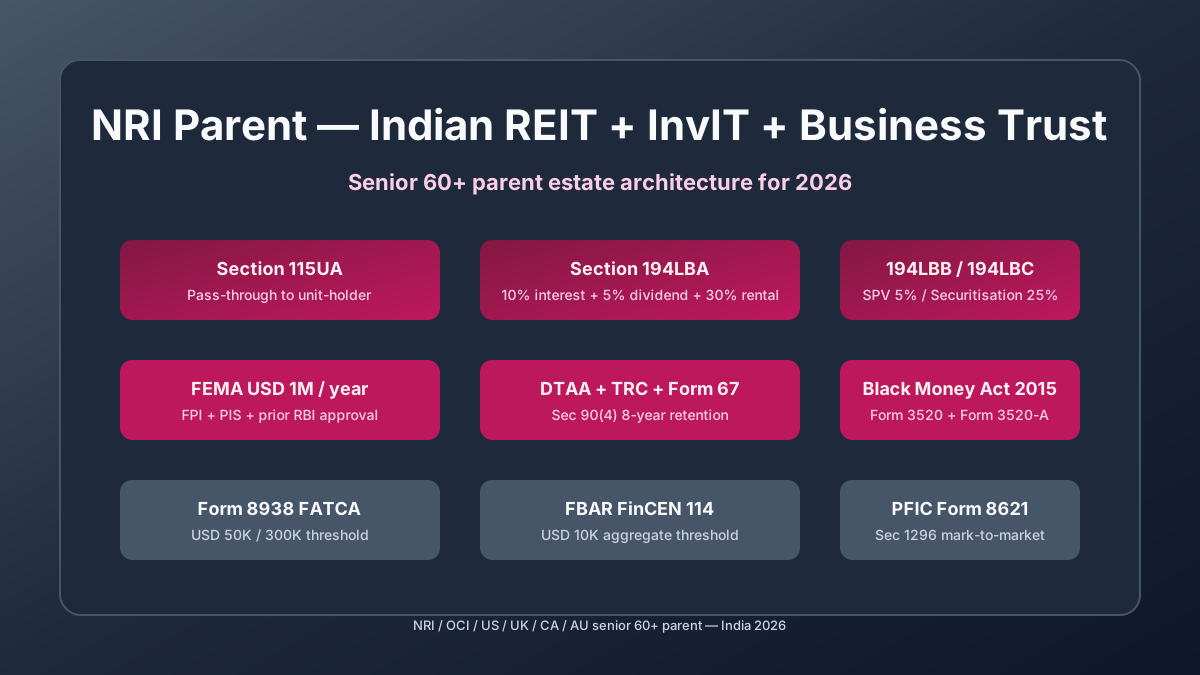
Critical: Indian REIT + InvIT + Business Trust held by NRI / OCI / US person — Section 115UA pass-through + Section 194LBA unit-holder 5% / 10% / 30% TDS + Section 194LBB SPV 5% TDS + FEMA prior RBI approval for NRI REIT / InvIT private placement + Form 8938 FATCA + PFIC Form 8621
Indian REIT (Real Estate Investment Trust) + InvIT (Infrastructure Investment Trust) + Business Trust held by NRI / OCI senior 60+ parent are classified as pass-through vehicles per Section 115UA + REIT structure per SEBI REIT Regulations 2014 + InvIT structure per SEBI InvIT Regulations 2014. Section 45 transfer + Section 48 computation + Section 50C stamp duty valuation (REIT / InvIT — immovable property underlying asset — stamp duty value deemed sale consideration if higher + > 10% threshold per Section 50C(2)) + Section 111A STCG 15% on listed REIT / InvIT units (STT paid on recognised stock exchange NSE / BSE) + Section 112A LTCG 10% on listed REIT / InvIT units (holding > 12 months + sale consideration > INR 1 lakh aggregate per year + without indexation + 4% cess) + Section 112 LTCG 20% on unlisted REIT / InvIT units (holding > 24 months + 4% cess + Indexation Section 48(ii) CII 2001 base) + Section 194LBA unit-holder 5% / 10% / 30% TDS on distribution from business trust (10% on interest + 5% on dividend + 30% on rental income from SPV to business trust) + Section 194LBB SPV 5% TDS on interest paid to business trust + Section 194LBC securitisation trust 25% TDS + Section 194LC 5% TDS on Indian rupee-denominated bond interest to non-resident + Section 194LD 5% TDS on listed company / business trust infrastructure bond interest to non-resident + Section 195 NRI TDS at applicable rate + DTAA rate + Section 197A lower TDS + Section 197 lower-rate certificate + Form 13. FEMA USD 1M / year LRS per FEMA 1999 + RBI Master Direction 2024 + FEMA FPI (Foreign Portfolio Investor) route per Schedule 2 of FEMA 1999 + RBI FPI Master Direction 2024 + FEMA PIS (Portfolio Investment Scheme) route per Schedule 3 of FEMA 1999 + FEMA prior RBI approval for REIT / InvIT private placement by NRI + Form A2 + AD-1 + 7-year NRO retention debated (typically REIT / InvIT unit sale proceeds treated as current income repatriable immediately per RBI Circular 47/2015 + 12/2015) + 10-year US/UK/CA/AU retention for inheritance from person domiciled there + FEMA compounding penalty up to 3x per FEMA 1999 Section 13. DTAA Article 6 immovable property income + Article 11 interest + Article 10 dividend (US-India DTAA Article 10 — typically 15% withholding on dividend from Indian trust to US person; saving clause applies) + Article 13 capital gains + saving clause + MAV main purpose test + Form 8833 treaty disclosure + Section 6114 + 25% treaty penalty + Section 7701(b) treaty tie-breaker + Estate Tax Treaty + Gift Tax Treaty + Section 90(4) 8-year retention of TRC + Form 67 mandatory per CBDT Notification 3/2022 + Circular 11/2022 + 12/2022 stricter rules + Section 90(5) limitation of benefits + panchnama if AO suspects non-genuine treaty claim.
NRI parent senior 60+ Indian REIT + InvIT + business trust — pass-through architecture for foreign investors
Indian REIT + InvIT + business trust held by NRI / OCI senior 60+ parent represents a deeply specialised foreign-investor asset class that combines yield-oriented Indian real-estate + infrastructure exposure with layered Section 115UA pass-through taxation + SEBI REIT Regulations 2014 / SEBI InvIT Regulations 2014 structural safeguards. Unlike direct Indian real estate (where NRI / OCI faces Section 195 TDS on rental income + Section 80IBA 100% deduction for affordable housing + Section 54 LTCG reinvestment in residential property + RERA registration + stamp duty state schedule + Section 56(2)(vii)/(xi) heir rules), REIT + InvIT + business trust units confer a securitised, listed-or-privately-placed, dematerialised, demat-account-held vehicle for indirect exposure to the underlying commercial office + retail mall + warehouse + data centre + hospital + hotel + industrial + residential properties (for REIT) and road + power transmission + gas pipeline + telecom tower + solar + wind + hydropower infrastructure (for InvIT) — all under a single SEBI-registered, trustee-supervised, SPV-pooled trust structure that NRI / OCI senior 60+ parent can subscribe to through FEMA-compliant routes without direct foreign direct investment (FDI) into the underlying immovable property.
The tax architecture under Section 115UA marks REIT + InvIT + business trust as pass-through vehicles, meaning the trust itself is generally not taxed at the entity level on its rental income + interest income + dividend income (subject to Section 10(23D) MF exemption which does not apply to REIT + InvIT + business trust) — instead, income flows through to the unit-holder hands (NRI / OCI senior 60+ parent) per Section 115UA(1) which states that the total income of the business trust — being a REIT + InvIT — shall be deemed to be the income of the unit-holder in the same proportion as the unit-holder holds units, with Section 115UA(2) treating the business trust as an Association of Persons (AOP) for TDS purposes (Section 194LBA + Section 194LBB + Section 194LBC), and Section 115UA(3) requiring the trustee + SPV to furnish statements in the prescribed form per Rule 5B of Income-tax Rules 1962. This pass-through mechanism fundamentally shifts the compliance burden from the trust to the unit-holder (NRI / OCI senior 60+ parent) — who must declare income under the head 'Income from House Property' (rental), 'Income from Capital Gains' (sale of units), 'Income from Other Sources' (interest + dividend distribution) in the Indian income-tax return Form ITR-2 (for NRI not having business income) or Form ITR-3 (for NRI having business income) — and claim DTAA benefit per Section 90 / 91 + TRC + Form 67 if eligible for treaty-rate withholding.
Senior 60+ parent estate planning angle: Indian REIT + InvIT + business trust units are ideal candidates for inheritance transmission to NRI / OCI / US / UK / CA / AU resident children because units are held in dematerialised form (CDSL / NSDL Depository Participant), nominated per SEBI circular 2018 + Companies Act 2013 Section 72 + 105 + depository rules, transmission is straightforward without probate in most cases (CDSL / NSDL Byelaws + Operating Instructions + Form TRAN-1 / TRAN-2 transmission forms + death certificate + succession certificate / Will / probate / Letters of Administration as applicable), and the cost of acquisition to the heir is the cost to the deceased per Section 49(1) read with Section 55(2) (for immovable property) or Section 55(2A) (for unlisted shares — but REIT + InvIT units are typically listed on recognised stock exchange NSE / BSE so Section 55(2A) is debated; generally Section 49(2)(iii) applies for capital asset inherited). Section 56(2)(vii) FULL EXEMPT the heir receiving REIT / InvIT / business trust unit from a specified relative (deceased parent is 'specified relative' per Section 56(2)(vii)(b) Explanation) — so no deemed gift tax on heir receiving inherited REIT / InvIT / business trust unit. However, US person children inheriting foreign REIT / InvIT unit face Form 8938 FATCA reporting if > USD 50K end-of-year (single / MFS) or > USD 300K end-of-year (MFJ) + FBAR FinCEN 114 if foreign account aggregate > USD 10K at any point during calendar year + PFIC Form 8621 (Indian REIT / InvIT is typically treated as PFIC for US tax per Section 1295 + Section 1296 + Section 1297 — QEF election requires PFIC annual information statement from Indian REIT / InvIT manager, which is rarely provided; mark-to-market per Section 1296 is the practical workaround for marketable PFIC, but Indian REIT / InvIT units may not be 'marketable' for Section 1296 purposes if thinly traded).
NRI parent senior 60+ — Indian REIT + InvIT + business trust asset-class comparison
| Asset Class | Underlying Asset | SEBI Regulation | Distribution Mandate | NRI / OCI Subscription Route | Section 115UA Pass-Through | Section 194LBA / 194LBB / 194LBC TDS | Capital Gains Treatment |
|---|---|---|---|---|---|---|---|
| REIT — Real Estate Investment Trust | Commercial office + retail mall + warehouse + data centre + hospital + hotel + industrial + residential | SEBI (Real Estate Investment Trusts) Regulations 2014 | ≥ 90% of net distributable cash flows per SEBI REIT Regulations 2014 | FEMA FPI route (Schedule 2 FEMA 1999) for listed REIT units + FEMA PIS route (Schedule 3 FEMA 1999) for listed REIT units + FEMA prior RBI approval for private placement | Yes — rental income + interest + dividend distribution pass-through to unit-holder | 194LBA unit-holder 10% TDS on interest + 5% TDS on dividend distribution + 30% TDS on rental from SPV to business trust (if applicable) | Section 111A STCG 15% (listed + STT paid) + Section 112A LTCG 10% (listed + 12m+ + > INR 1L aggregate) + Section 112 LTCG 20% (unlisted + 24m+ + Indexation) |
| InvIT — Infrastructure Investment Trust | Road + power transmission + gas pipeline + telecom tower + solar + wind + hydropower | SEBI (Infrastructure Investment Trusts) Regulations 2014 | ≥ 90% of net distributable cash flows per SEBI InvIT Regulations 2014 | FEMA FPI route (Schedule 2 FEMA 1999) for listed InvIT units + FEMA prior RBI approval for private placement | Yes — interest + dividend + rental pass-through to unit-holder | 194LBA unit-holder 10% TDS on interest + 5% TDS on dividend distribution | Section 111A STCG 15% (listed + STT paid) + Section 112A LTCG 10% (listed + 12m+ + > INR 1L aggregate) + Section 112 LTCG 20% (unlisted + 24m+ + Indexation) |
| Business Trust — Other than REIT + InvIT | Typically securitisation + asset reconstruction + structured finance | Companies Act 2013 Section 2(13) + Indian Trusts Act 1882 + SEBI (Portfolio Managers) Regulations 1993 (if structured) | Varies per trust deed + SEBI / RBI guidelines | FEMA FPI route + FEMA prior RBI approval for private placement | Yes — interest + dividend + rental pass-through to unit-holder | 194LBB SPV 5% TDS on interest paid to business trust + 194LBC securitisation trust 25% TDS + 194LBA unit-holder 10% TDS on interest | Section 111A STCG 15% (listed + STT paid) + Section 112A LTCG 10% (listed + 12m+ + > INR 1L aggregate) + Section 112 LTCG 20% (unlisted + 24m+ + Indexation) |
| Securitisation Trust | Asset-backed securities + receivables + loans | SEBI (Issue and Listing of Debt Securities) Regulations 2008 + RBI securitisation guidelines + SARFAESI Act 2002 | Per trust deed + RBI guidelines | FEMA FPI route + FEMA prior RBI approval for private placement | Yes — interest + dividend pass-through to unit-holder (debated; Section 10(23DA) exemption debated for securitisation trust) | 194LBC securitisation trust 25% TDS on interest distributed | Section 111A STCG 15% (listed + STT paid) + Section 112A LTCG 10% (listed + 12m+ + > INR 1L aggregate) + Section 112 LTCG 20% (unlisted + 24m+ + Indexation) |
| Direct Property (comparison) | Residential + commercial + land + industrial | RERA + state stamp duty + Transfer of Property Act 1882 | N/A — owner-driven | FEMA FPI route (NOT applicable — Indian property held by NRI / OCI only via direct purchase per FEMA 1999 + RBI Master Direction 2024) | N/A — direct ownership | Section 195 NRI TDS on rental income + Section 194IA 1% TDS on property transfer > INR 50 lakh | Section 45 + Section 48 + Section 50C stamp duty valuation + Section 111A NOT applicable + Section 112 LTCG 20% (24m+ + 4% cess + Indexation) + Section 54 LTCG reinvestment + Section 54F |
NRI parent senior 60+ Indian REIT + InvIT + business trust — asset class hierarchy
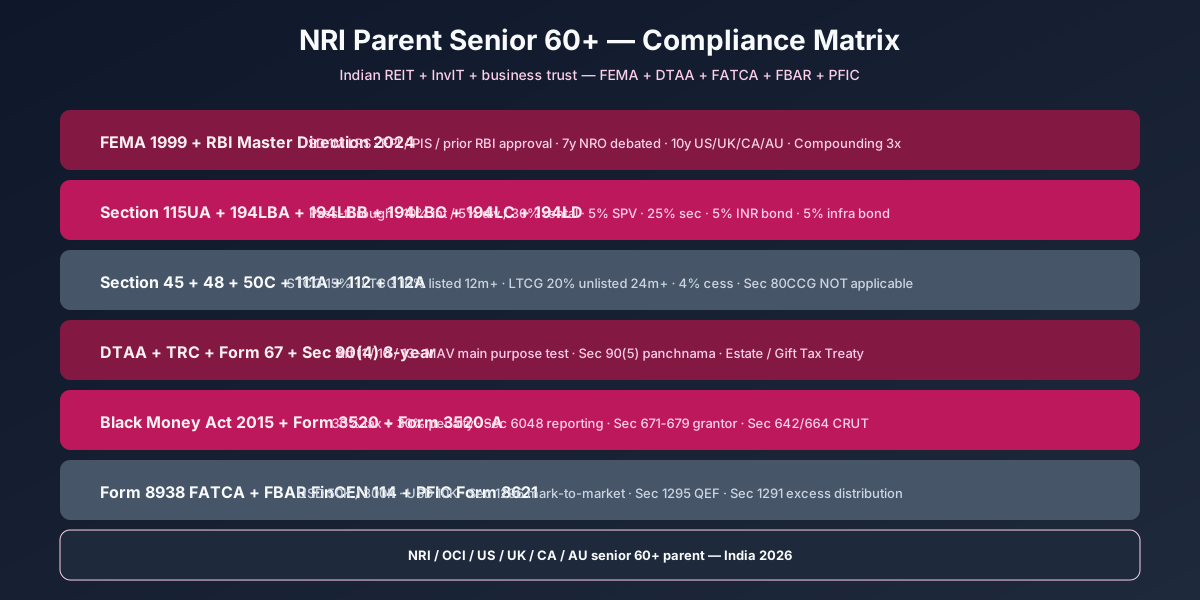
Section 194LBA + 194LBB + 194LBC + 194LC + 194LBD + 194LD + 194N — TDS architecture for REIT + InvIT + business trust distribution
The TDS architecture for NRI / OCI senior 60+ parent receiving distribution from Indian REIT + InvIT + business trust is fundamentally layered. Section 194LBA(1) requires the business trust (trustee) to deduct tax at source before crediting any sum (whether interest + dividend or any other sum) to the account of, or making payment to, a unit-holder (NRI / OCI) — at the rate of (a) 10% on interest income received by the business trust from SPV (where the SPV has exercised option under Section 115BAA / Section 115BAB — domestic corporate tax rate of 22% — and the interest income is paid to non-resident unit-holder), (b) 5% on dividend income received by the business trust from SPV (where the SPV has exercised option under Section 115BAA / Section 115BAB), and (c) 30% on rental income from SPV to business trust (or any other head — corporate tax rate applicable; discussed for completeness). Section 194LBA(2) deals with the rate of TDS on the rental income from SPV to business trust (or the unit-holder where applicable). Section 194LBA(3) provides that the TDS deducted under Section 194LBA shall be treated as final tax for the unit-holder if no deduction is claimed in the return — but the unit-holder can claim credit of TDS in Form ITR-2 / ITR-3 + Form 26AS + AIS (Annual Information Statement) + claim DTAA rate if lower than domestic rate + Section 90(4) 8-year TRC retention + Form 67 mandatory per CBDT Notification 3/2022 + Circular 11/2022 + 12/2022.
Section 194LBB(1) requires the SPV to deduct tax at source at the rate of 5% on interest paid to the business trust (the invIT / REIT / business trust), before crediting the interest income to the account of, or making payment to, the business trust. This is the upstream TDS — SPV pays interest to business trust, business trust pays interest / dividend / rental to unit-holder. Section 194LBC(1) requires the securitisation trust to deduct tax at source at the rate of 25% on income distributed to the investor in the securitisation trust, with Section 194LBC(2) dealing with the corporate tax rate of 25% — but the practical effect is that securitisation trust distributions to NRI / OCI unit-holder face 25% TDS at the trust level, which may be lower than the marginal income-tax rate of 30% + 4% cess = 31.2% but significantly higher than the 10% interest TDS under Section 194LBA(1)(a) for business trust distribution. Section 194LC(1) requires the Indian company to deduct tax at source at the rate of 5% on interest payable to a non-resident (NRI / OCI) on Indian rupee-denominated bond issued by the Indian company between 1 October 2024 and 30 September 2025 — extended for the financial year 2025-26 with conditions. Section 194LD(1) requires the Indian company + business trust to deduct tax at source at the rate of 5% on interest payable to a non-resident (NRI / OCI) on infrastructure bond (long-term listed infrastructure bond) — this rate is reduced from the domestic rate of 20% / 40% (debit rate) per Section 115A(1)(b)(B) — but limited to bonds issued between 1 June 2013 and 1 July 2020 (typically expired; check SEBI RBI guidelines for current bonds). Section 194N applies to cash withdrawal > INR 1 crore in a financial year from a bank account held by a person (not specifically for REIT / InvIT distribution, but applicable if NRI / OCI accumulates cash distribution from REIT / InvIT / business trust in NRO account and withdraws > INR 1 crore — 2% TDS above INR 1 crore, 5% above INR 20 lakh if no ITR filed in last 3 years, per Section 194N(3)).
Practical compliance: NRI / OCI senior 60+ parent holding Indian REIT + InvIT + business trust units must reconcile TDS in Form 26AS + AIS (Annual Information Statement) per CBDT Circular + claim credit in Form ITR-2 / ITR-3 — if TDS deducted at the higher domestic rate (10% / 5% / 30% / 25% under Section 194LBA / 194LBB / 194LBC / 194LC / 194LD) and DTAA rate is lower (e.g. 10% interest under India-USA DTAA Article 11 vs 15% domestic — Section 90(4) 8-year TRC retention required + Form 67 mandatory), NRI / OCI must (a) apply for lower TDS certificate per Section 197 — Form 13 to the AO — for non-resident payee + payee income, with the certificate specifying the lower rate at which the deductor (business trust trustee + SPV + Indian company) shall deduct TDS, or (b) claim refund in ITR-2 / ITR-3 by filing within the due date per Section 139(1) / 139(4) / 139(5) — the refund process typically takes 6-12 months + 4% interest per Section 244A on delayed refund + 6% interest per Section 244A(1)(a) on delayed refund for international transactions per Section 244A(1A) read with Rule 84A — and proper documentation including TRC + Form 67 + Section 90(4) 8-year retention + DTAA Article 11 / 10 / 13 reference + saving clause + MAV main purpose test documentation + Form 8833 treaty disclosure (US person only — Section 6114 + 25% treaty penalty + Section 7701(b) treaty tie-breaker).
NRI parent senior 60+ — Indian REIT + InvIT + business trust subscription flow (8 steps)
Step 1 — Open NRE / NRO demat account + bank account
NRI / OCI senior 60+ parent must open NRE / NRO demat account with a Depository Participant (DP) of CDSL / NSDL + NRE / NRO bank account with an Indian authorised dealer bank per FEMA 1999 + RBI Master Direction 2024. The DP will collect KYC documents including passport + visa + PIO / OCI card + PAN + Indian address proof + FEMA 1999 declaration + Form A2 (Liberalised Remittance Scheme) + AD-1 (Authorised Dealer Form 1 — purchase of foreign exchange for capital account transactions). The NRO demat account holds REIT + InvIT + business trust units bought through Indian rupee funds (taxable income / NRO account credits).
Step 2 — Choose FEMA FPI or FEMA PIS route (or FEMA prior RBI approval for private placement)
Per FEMA 1999 Schedule 2 + RBI FPI Master Direction 2024, NRI / OCI may subscribe to listed REIT + InvIT + business trust units through (a) FEMA FPI (Foreign Portfolio Investor) route — registered with SEBI as FPI per SEBI (Foreign Portfolio Investors) Regulations 2019 — eligible for all listed + privately placed debt securities + equity instruments + REIT + InvIT units + securitisation trust units; (b) FEMA PIS (Portfolio Investment Scheme) route per Schedule 3 of FEMA 1999 + RBI PIS Master Direction 2024 — eligible for listed Indian equity + listed Indian REIT + InvIT units only — aggregate limit 5% of paid-up capital per NRI / OCI + 10% aggregate for all NRI / OCI; or (c) FEMA prior RBI approval route for privately placed REIT + InvIT / business trust units — typically not required for listed units but required for private placement investment > INR 50 crore (RBI AD-1 + FEMA compounding if not obtained).
Step 3 — Place buy order on NSE / BSE (listed) or apply to trustee (private placement)
For listed REIT + InvIT units, place buy order on NSE (National Stock Exchange) + BSE (Bombay Stock Exchange) through demat account — order routed via stockbroker + depository participant + clearing corporation (NSCCL + ICCL) + settlement per T+1 rolling settlement cycle (post SEBI 2024). STT 0.1% on purchase of listed REIT + InvIT unit (Security Transaction Tax Section 98 + 99 + schedule) — STT paid is the trigger for Section 111A STCG 15% eligibility (without STT paid, Section 111A does NOT apply). For private placement, apply to the trustee + manager (per SEBI REIT Regulations 2014 + SEBI InvIT Regulations 2014) — submit application form + KYC + FEMA compliance certificate + bank account details + FEMA prior RBI approval if applicable.
Step 4 — Receive distribution per Section 115UA + Section 194LBA / 194LBB / 194LBC TDS deduction
Trustee of REIT + InvIT / business trust deducts TDS per Section 194LBA(1) before crediting distribution to unit-holder account — at 10% on interest + 5% on dividend + 30% on rental income from SPV to business trust (or any other head — corporate tax rate applicable; discussed for completeness) + 25% on securitisation trust distribution per Section 194LBC. The NRI / OCI receives net distribution after TDS — Form 26AS + AIS (Annual Information Statement) reflects TDS credit. The trustee + SPV file TDS return per Section 203 + Rule 31A + Form 26Q + Form 27Q for non-deductee deductee + TAN + PAN verification + 15 days TDS deposit + quarterly TDS return.
Step 5 — Declare in ITR-2 / ITR-3 + claim DTAA rate + Form 67 mandatory
NRI / OCI senior 60+ parent must declare REIT + InvIT / business trust distribution + capital gains on unit sale in Form ITR-2 (if no business income) or ITR-3 (if business income) per Section 139(1) due date 31 July (audit 31 October) + Section 139(4) belated return + Section 139(5) revised return — within the timeline + Section 234A / 234B / 234C interest on late filing + late payment + deferment of advance tax. Claim DTAA rate (lower than domestic rate) by filing Form 67 (mandatory per CBDT Notification 3/2022 + Circular 11/2022 + 12/2022 stricter rules) + TRC (Tax Residency Certificate) from country of residence (US IRS Form 6166 + Indian competent authority acceptance + Section 90(4) 8-year retention) + Section 90(5) limitation of benefits documentation + panchnama if AO suspects non-genuine treaty claim. Claim refund of excess TDS deducted at higher domestic rate in ITR-2 / ITR-3 — refund typically takes 6-12 months + 4% interest per Section 244A on delayed refund + 6% interest per Section 244A(1)(a) on delayed refund for international transactions.
Step 6 — Capital gains computation on unit sale — Section 45 + 48 + 50C + 111A + 112 + 112A
Sale of listed REIT + InvIT units triggers Section 45 transfer + Section 48 computation + Section 50C stamp duty valuation (REIT / InvIT — immovable property underlying asset — stamp duty value deemed sale consideration if higher + > 10% threshold per Section 50C(2) — note: Section 50C applies to immovable property, REIT + InvIT units are securities, so Section 50C debate — generally NOT applicable to REIT / InvIT unit transfer as units are securities, not immovable property, per CBDT Circular + judicial precedent) + Section 111A STCG 15% (listed + STT paid + 4% cess) + Section 112A LTCG 10% (listed + 12m+ holding + > INR 1 lakh aggregate per year + without indexation + 4% cess) + Section 112 LTCG 20% (unlisted + 24m+ holding + with indexation Section 48(ii) CII 2001 base + 4% cess) + Section 80CCG NOT applicable (RGESS closed 2018) + Section 80C NOT applicable on REIT / InvIT unit sale — Section 80C applies to specified financial instruments including PPF + ELSS + NSC + SCSS + POMIS + 5-year FRSB + 5-year bank FD + life insurance premium + housing loan principal — but NOT REIT / InvIT units. STT 0.1% on sale of listed REIT + InvIT unit is paid by the seller — STT paid is the trigger for Section 111A STCG 15% eligibility.
Step 7 — Repatriate sale proceeds per FEMA USD 1M / year LRS + 7y NRO debated
NRI / OCI senior 60+ parent may repatriate REIT + InvIT / business trust unit sale proceeds per FEMA 1999 + RBI Master Direction 2024. For listed REIT + InvIT units purchased through FEMA FPI route or FEMA PIS route — sale proceeds can be repatriated immediately (no 7-year NRO retention debate for listed REIT / InvIT per RBI Circular 47/2015 + 12/2015) — through NRO demat account + AD-1 + Form A2 + certificate from stockbroker + FEMA compliance certificate from CA + 26QB + 26QC for capital gains tax payment + 26Q + 27Q TDS return verification. For unlisted REIT + InvIT units — FEMA compounding if prior RBI approval not obtained + 7-year NRO retention for original investment + sale proceeds can be repatriated after 7 years of holding per FEMA 1999 + RBI Master Direction 2024 (but FEMA prior RBI approval debate + FEMA compounding penalty up to 3x per FEMA 1999 Section 13). FEMA compounding penalty up to 3x per FEMA 1999 Section 13 may apply for non-compliance with FEMA 1999 + FEMA compounding application to RBI ED per FEMA 1999 Section 13(1) + FEMA compounding order per FEMA 1999 Section 13(2) + FEMA compounding circular FEMA 2017 + FEMA compounding rate per FEMA compounding master direction.
Step 8 — Inheritance transmission — Section 49(1) + 56(2)(vii) FULL EXEMPT + heir Form 8938 FATCA + FBAR FinCEN 114 + PFIC Form 8621
On death of NRI / OCI senior 60+ parent, REIT + InvIT / business trust units are transmitted to the heir (NRI / OCI / US / UK / CA / AU resident child) per SEBI circular 2018 + Companies Act 2013 Section 72 + 105 + depository rules + CDSL / NSDL Byelaws + Operating Instructions + Form TRAN-1 / TRAN-2 transmission forms + death certificate + succession certificate / Will / probate / Letters of Administration as applicable + nominee registration per depository rules. Section 56(2)(vii) FULL EXEMPT the heir receiving REIT / InvIT / business trust unit from a specified relative (deceased parent is 'specified relative' per Section 56(2)(vii)(b) Explanation) — so no deemed gift tax on heir. Cost of acquisition to the heir is the cost to the deceased per Section 49(1) read with Section 55(2) (for immovable property) or Section 49(2)(iii) (for capital asset inherited — REIT + InvIT units debate; generally Section 49(2)(iii) applies for capital asset inherited). US person child inheriting foreign REIT / InvIT unit faces Form 8938 FATCA reporting if > USD 50K end-of-year (single / MFS) or > USD 300K end-of-year (MFJ) + FBAR FinCEN 114 if foreign account aggregate > USD 10K at any point during calendar year + PFIC Form 8621 (Indian REIT / InvIT is typically treated as PFIC for US tax per Section 1295 + Section 1296 + Section 1297 — QEF election or mark-to-market per Section 1296 + Section 1295 + Form 8621 annual filing).
Need help with this?
Share your blocker in one line. Our experts will reply with practical next steps.
NRI parent senior 60+ — Section 194LBA + 194LBB + 194LBC + 194LC + 194LD TDS flow (SPV → business trust → unit-holder)
FEMA USD 1M / year + FEMA FPI + FEMA PIS + FEMA prior RBI approval + 7y NRO + 10y US retention for REIT / InvIT / business trust
FEMA 1999 + RBI Master Direction 2024 framework for NRI / OCI senior 60+ parent investing in Indian REIT + InvIT / business trust is layered. FEMA 1999 Schedule 2 + RBI FPI Master Direction 2024 defines the FEMA FPI (Foreign Portfolio Investor) route — NRI / OCI may invest in listed REIT + InvIT / business trust units through a SEBI-registered FPI (Foreign Portfolio Investor) — typically a fund / institutional investor registered with SEBI as FPI per SEBI (Foreign Portfolio Investors) Regulations 2019, with KYC + PAN + SEBI registration + depository participant + custodian + reporting per SEBI FPI regulations. FEMA 1999 Schedule 3 + RBI PIS Master Direction 2024 defines the FEMA PIS (Portfolio Investment Scheme) route — NRI / OCI may invest in listed Indian equity + listed Indian REIT + InvIT units (NOT business trust units other than REIT / InvIT) — aggregate limit 5% of paid-up capital per NRI / OCI + 10% aggregate for all NRI / OCI — through a designated bank branch in India + PIS account + RBI reporting per RBI PIS Master Direction 2024. FEMA 1999 + RBI Master Direction 2024 requires FEMA prior RBI approval for private placement of REIT + InvIT / business trust units — typically not required for listed units but required for private placement investment > INR 50 crore per FEMA 1999 + FEMA prior RBI approval application through AD-1 bank + FEMA approval from RBI ED per FEMA 1999 + FEMA compounding if not obtained.
Liberalised Remittance Scheme (LRS) USD 1M / year: NRI / OCI senior 60+ parent can remit up to USD 1M per financial year per FEMA 1999 + RBI Master Direction 2024 — for current account transactions (private visit + gift + donation + emigration + maintenance of close relative + business trip + medical treatment + studies abroad) + capital account transactions (acquisition of immovable property outside India + investment in shares + securities + units of business trust outside India + opening of foreign currency account outside India) — through AD-1 bank + Form A2 (Liberalised Remittance Scheme) + PAN + Aadhaar (if available) + FEMA 1999 declaration + KYC. For REIT + InvIT / business trust unit sale proceeds repatriation, the LRS limit may apply if remitting the net proceeds after capital gains tax + TDS to a foreign bank account — but for NRI / OCI investing through FEMA FPI or FEMA PIS route in listed Indian REIT + InvIT units, the sale proceeds are typically treated as current income and can be repatriated immediately without LRS limit (per RBI Circular 47/2015 + 12/2015 + FEMA 1999 + RBI Master Direction 2024 — note: this is debated for unlisted REIT / InvIT units, where FEMA compounding may apply if FEMA prior RBI approval was not obtained).
7-year NRO retention + 10-year US/UK/CA/AU retention debate for REIT / InvIT / business trust: For NRI / OCI inheriting Indian REIT + InvIT / business trust units from a resident Indian deceased, the inheritance transmission is typically treated as 'gift' from the deceased to the NRI / OCI heir under FEMA 1999 — Section 56(2)(vii) FULL EXEMPT the heir receiving REIT / InvIT / business trust unit from a specified relative (deceased parent is 'specified relative' per Section 56(2)(vii)(b) Explanation). The inheritance is typically retained in NRO demat account + NRO bank account — sale proceeds repatriated after 7-year NRO retention per FEMA 1999 + RBI Master Direction 2024 — but for REIT + InvIT / business trust units bought through FEMA FPI or FEMA PIS route, the 7-year NRO retention does not apply (sale proceeds repatriable immediately). For 10-year US/UK/CA/AU retention debate — typically applies to inheritance from a person domiciled in US / UK / CA / AU where the deceased was a long-term resident; FEMA 1999 + RBI Master Direction 2024 + CBDT Circular + Black Money Act 2015 + Form 3520 + Form 8938 FATCA + FBAR FinCEN 114 + PFIC Form 8621 + Section 671-679 grantor trust + Section 642/664 + US estate tax + gift tax + GSTT + Form 706 + Form 709 + Section 877A expatriation tax + covered expatriate + Estate Tax Treaty + Gift Tax Treaty + MAV main purpose test + Section 7701(b) treaty tie-breaker. FEMA compounding penalty up to 3x per FEMA 1999 Section 13 may apply for non-compliance — FEMA compounding application to RBI ED per FEMA 1999 Section 13(1) + FEMA compounding order per FEMA 1999 Section 13(2) + FEMA compounding circular FEMA 2017 + FEMA compounding rate per FEMA compounding master direction + FEMA compounding penalty up to 3x of the amount involved.
NRI parent senior 60+ — FEMA USD 1M / year + FEMA FPI + FEMA PIS flow for Indian REIT + InvIT / business trust (8 steps)
Step 1 — Determine FEMA route — FPI or PIS or FEMA prior RBI approval for private placement
NRI / OCI senior 60+ parent must determine FEMA route — (a) FEMA FPI (Foreign Portfolio Investor) route per FEMA 1999 Schedule 2 + RBI FPI Master Direction 2024 + SEBI FPI Regulations 2019 — typically for institutional + fund investor + HNI + family office + trust — registered with SEBI as FPI; (b) FEMA PIS (Portfolio Investment Scheme) route per FEMA 1999 Schedule 3 + RBI PIS Master Direction 2024 — typically for individual NRI / OCI — aggregate limit 5% paid-up capital per NRI / OCI + 10% aggregate for all NRI / OCI; or (c) FEMA prior RBI approval for private placement of REIT + InvIT / business trust units — typically for institutional + HNI + family office + trust investment > INR 50 crore.
Step 2 — Open NRE / NRO demat + bank account + AD-1 + KYC + FEMA declaration
Open NRE / NRO demat account with Depository Participant (CDSL / NSDL) + NRE / NRO bank account with AD-1 (Authorised Dealer) bank + KYC documents (passport + visa + PIO / OCI card + PAN + Indian address proof + FEMA declaration) + Form A2 (Liberalised Remittance Scheme) + PIS account per RBI PIS Master Direction 2024 (if PIS route). The NRO demat account holds REIT + InvIT / business trust units bought through Indian rupee funds. NRE demat account holds units bought through foreign remittance.
Step 3 — FEMA FPI registration (FPI route) or PIS account opening (PIS route)
For FEMA FPI route — register with SEBI as FPI per SEBI FPI Regulations 2019 + KYC (PAN + Aadhaar + passport + visa + PIO / OCI + tax residency certificate + FATCA / CRS self-certification) + depository participant + custodian + reporting per SEBI FPI regulations. For FEMA PIS route — open PIS account with AD-1 bank per RBI PIS Master Direction 2024 + aggregate limit tracking (5% per NRI / OCI + 10% aggregate for all NRI / OCI) + RBI reporting per RBI PIS Master Direction 2024 + monthly + annual return.
Step 4 — Remit funds per FEMA USD 1M / year LRS (if FPI or PIS foreign remittance)
For FEMA FPI route — remit funds per FEMA USD 1M / year LRS per FEMA 1999 + RBI Master Direction 2024 + Form A2 + AD-1 + FEMA 1999 declaration + 26QB / 26QC (if applicable) + Form 15CB (CA certificate for foreign remittance) + Form 15CA (declarant statement). For FEMA PIS route — remit funds per FEMA USD 1M / year LRS + PIS account + Form A2 + AD-1 + FEMA 1999 declaration + Form 15CB + Form 15CA. LRS limit USD 1M per financial year per NRI / OCI per FEMA 1999 + RBI Master Direction 2024 — for capital account transactions including investment in REIT + InvIT / business trust units.
Step 5 — Buy REIT + InvIT / business trust units per FEMA route + STT paid
For FEMA FPI route — place buy order on NSE / BSE through depository participant + custodian + clearing corporation (NSCCL + ICCL) + T+1 rolling settlement cycle. For FEMA PIS route — place buy order on NSE / BSE through PIS account + stockbroker + AD-1 bank + depository participant. STT 0.1% on purchase of listed REIT + InvIT unit is paid by the buyer — STT paid is the trigger for Section 111A STCG 15% eligibility.
Step 6 — Hold REIT + InvIT / business trust units per FEMA route + nominate per SEBI
Hold REIT + InvIT / business trust units in NRE / NRO demat account per FEMA route + nominate per SEBI circular 2018 + Companies Act 2013 Section 72 + 105 + depository rules + CDSL / NSDL Byelaws + Operating Instructions. Nomination is critical for inheritance transmission — without nomination, the units go through succession certificate / Will / probate / Letters of Administration process which can take 6-24 months + significant cost.
Step 7 — Sell REIT + InvIT / business trust units + repatriate sale proceeds per FEMA route
Sell REIT + InvIT / business trust units on NSE / BSE through stockbroker + depository participant + clearing corporation + T+1 rolling settlement cycle. STT 0.1% on sale of listed REIT + InvIT unit is paid by the seller. Section 45 transfer + Section 48 computation + Section 111A STCG 15% (listed + STT paid + 4% cess) + Section 112A LTCG 10% (listed + 12m+ holding + > INR 1L aggregate + 4% cess). Repatriate sale proceeds per FEMA route — FEMA FPI route immediate repatriation per RBI Circular 47/2015 + 12/2015 — FEMA PIS route immediate repatriation — FEMA prior RBI approval route per FEMA 1999 + RBI Master Direction 2024 + AD-1 + Form A2 + certificate from stockbroker + FEMA compliance certificate from CA.
Step 8 — FEMA compounding if non-compliance + FEMA retention + 7y NRO debated
If FEMA non-compliance (e.g. FEMA FPI route not registered + FEMA PIS route not opened + FEMA prior RBI approval not obtained for private placement) — FEMA compounding penalty up to 3x per FEMA 1999 Section 13 + FEMA compounding application to RBI ED per FEMA 1999 Section 13(1) + FEMA compounding order per FEMA 1999 Section 13(2) + FEMA compounding circular FEMA 2017 + FEMA compounding rate per FEMA compounding master direction + FEMA compounding penalty up to 3x of the amount involved. 7-year NRO retention for inherited REIT + InvIT / business trust units is debated — typically NOT applicable for listed REIT + InvIT units bought through FEMA FPI or FEMA PIS route per RBI Circular 47/2015 + 12/2015 + FEMA 1999 + RBI Master Direction 2024.
DTAA Article 11 interest + Article 10 dividend + Article 13 capital gains + saving clause + Form 67 + Section 90(4) 8-year TRC retention for REIT / InvIT / business trust
DTAA Article 11 interest: India-USA DTAA Article 11(2) permits 10% withholding on interest paid to US person NRI / OCI (with savings clause applying — India retains the right to tax US person on worldwide income, but treaty rate limits Indian source TDS); India-UK DTAA Article 11 — 10% or 15% depending on debt-claim; India-CA DTAA Article 11 — 15%; India-AU DTAA Article 11 — 15%; India-SG DTAA Article 11 — 10% / 15%; India-DE DTAA Article 11 — 10%. For REIT + InvIT / business trust distribution, the interest component (typically 10% of distribution under Section 194LBA(1)(a) for business trust distribution from SPV to unit-holder) is treated as 'interest' under DTAA Article 11 — the lower treaty rate may apply (10% for US person) — but the 10% domestic rate under Section 194LBA(1)(a) is typically equal to or lower than treaty rate, so DTAA benefit may not be material for interest component. However, for dividend distribution (typically 5% under Section 194LBA(1)(b) for business trust distribution from SPV to unit-holder — SPV pays dividend to business trust which pays to unit-holder; the lower rate is 5% Section 194LBA(1)(b) — but DTAA Article 10 dividend rate for US person is 15% — so Section 194LBA(1)(b) 5% is lower than treaty rate — domestic rate applies).
DTAA Article 10 dividend: India-USA DTAA Article 10(2) permits 15% withholding on dividend paid to US person NRI / OCI (with savings clause applying — India retains the right to tax US person on worldwide income, but treaty rate limits Indian source TDS); India-UK DTAA Article 10 — 10% / 15% depending on debt-claim; India-CA DTAA Article 10 — 15%; India-AU DTAA Article 10 — 15%; India-SG DTAA Article 10 — 10% / 15%; India-DE DTAA Article 10 — 10%. For REIT + InvIT / business trust distribution, the dividend component (typically 5% under Section 194LBA(1)(b)) is treated as 'dividend' under DTAA Article 10 — the lower treaty rate may apply if it is lower than 5% domestic rate (which is rare; typically treaty rate 10-15% is higher than 5% domestic rate). DTAA Article 13 capital gains: India-USA DTAA Article 13 permits 15% withholding on capital gains from sale of REIT + InvIT / business trust units (debated — India-USA DTAA Article 13(4) typically limits India's right to tax capital gains from sale of personal property; for immovable property capital gains Article 13(1) gives full taxing right to source country; for REIT / InvIT / business trust units — debated as to whether Article 13(1) immovable property gain or Article 13(4) personal property applies — typically Article 13(4) applies as units are securities, not immovable property, even if the underlying asset is immovable property).
Saving clause + MAV main purpose test: India-USA DTAA Article 1(4) saving clause reserves the right of India + US to tax their respective residents on worldwide income (the US person NRI / OCI is subject to US tax on worldwide income including Indian REIT + InvIT / business trust distribution + capital gains; Indian tax is creditable against US tax per Section 901 + Form 1116 + Section 904 limitation + high-tax kickout + Section 960 GILTI + Section 951 CFC + Section 1291 PFIC + Section 1295 QEF + Section 1296 mark-to-market). MAV (Main Purpose Test) under India-USA DTAA Article 11(5) + 10(6) + 12(5) — if the main purpose of the arrangement is to obtain treaty benefit (e.g. artificially routing income through REIT + InvIT / business trust to obtain lower TDS rate), the AO may deny treaty benefit + apply domestic rate + Section 90(5) limitation of benefits + panchnama if AO suspects non-genuine treaty claim. Form 67 mandatory per CBDT Notification 3/2022 + Circular 11/2022 + 12/2022 stricter rules — NRI / OCI must file Form 67 (acknowledgment) before ITR filing if claiming DTAA rate lower than domestic rate — Form 67 includes TRC + DTAA Article reference + MAV documentation + saving clause documentation + main purpose test + Form 8833 treaty disclosure (US person only — Section 6114 + 25% treaty penalty + Section 7701(b) treaty tie-breaker). Section 90(4) 8-year retention: TRC must be retained for 8 years from end of assessment year — Form 67 must be filed + TRC submitted to AO on demand + Section 90(5) limitation of benefits documentation.
NRI parent senior 60+ — DTAA Article 11 interest + Article 10 dividend + Article 13 capital gains + Form 67 + Section 90(4) 8-year TRC retention
Need help with this?
Share your blocker in one line. Our experts will reply with practical next steps.
Form 8938 FATCA + FBAR FinCEN 114 + PFIC Form 8621 + Section 671-679 grantor trust + Section 642/664 + Form 3520 + Form 3520-A + US estate tax + Section 877A for REIT / InvIT / business trust
Form 8938 FATCA: US person NRI / OCI senior 60+ parent holding Indian REIT + InvIT / business trust units must file Form 8938 Statement of Specified Foreign Financial Assets per Section 6038D + Section 6038D-5 Form 8938 + Section 6662 20-40% accuracy penalty + Section 6663 75% fraud penalty + 40% gross valuation penalty + 75% fraudulent underpayment penalty + Section 6501(c)(8) 6-year statute of limitations on omission of foreign asset — if foreign REIT + InvIT / business trust units aggregate > USD 50K end-of-year (single / MFS) or > USD 300K end-of-year (MFJ) — Form 8938 filed with Form 1040 + Schedule B + Schedule D + Schedule 3 + Form 8949 + Form 1116 (foreign tax credit) + Form 8833 (treaty disclosure). Form 8938 reporting is in addition to (not in lieu of) FBAR FinCEN 114 + PFIC Form 8621 + Form 3520 + Form 3520-A + Form 5471 + Form 8865 + Form 8854 + Form 6012 + Form 706 + Form 709 — Form 8938 reporting applies to specified foreign financial assets including foreign REIT + InvIT / business trust units + foreign demat account + foreign bank account + foreign financial derivative contract + foreign partnership interest + foreign mutual fund + foreign insurance contract with cash value + foreign-issued life insurance + foreign hedge fund + foreign private equity fund + foreign exchange-traded fund.
FBAR FinCEN 114: US person NRI / OCI senior 60+ parent must file FBAR FinCEN 114 Report of Foreign Bank and Financial Accounts per Section 5314 + 31 CFR 1010.350 + 31 CFR 1010.306 + 31 CFR 1010.305 — if foreign account aggregate > USD 10K at any point during calendar year — foreign account includes Indian demat account holding REIT + InvIT / business trust units + Indian bank account + Indian mutual fund account + Indian PPF account + Indian SCSS account + Indian POMIS account + Indian EPF account + Indian NPS account + Indian insurance policy with cash value + Indian REIT + InvIT / business trust account + Indian PMS account + Indian AIF account. FBAR filed electronically with FinCEN + due 15 April (auto-extension to 15 October) — penalty for non-filing up to USD 10,000 per violation (non-willful) + greater of USD 100,000 or 50% of account balance (willful) + criminal penalty up to USD 250,000 / 5 years imprisonment (willful) + 5-year statute of limitations + Section 5322 criminal penalty + Section 5324 structuring.
PFIC Form 8621: Indian REIT + InvIT / business trust is typically treated as PFIC (Passive Foreign Investment Company) for US tax per Section 1295 + Section 1296 + Section 1297 — Indian REIT is a foreign corporation + 75% or more of gross income is passive (rental income + interest + dividend) + 50% or more of assets produce passive income. PFIC consequences: (a) Section 1291 excess distribution regime — excess distribution (distribution > 125% of average distribution over prior 3 years) taxed at highest ordinary income rate + interest charge + capital gains treatment denied; (b) Section 1295 QEF (Qualified Electing Fund) election — NRI / OCI must obtain PFIC annual information statement from Indian REIT + InvIT manager (rarely provided — Indian REIT + InvIT managers typically do not provide PFIC annual information statement as it is not required under Indian law); (c) Section 1296 mark-to-market election — NRI / OCI marks REIT + InvIT units to market at year-end + capital gain / loss treated as ordinary — but Indian REIT + InvIT units must be 'marketable' (regularly traded on a qualified exchange) — NSE + BSE are qualified exchanges + STT paid REIT + InvIT units regularly traded — Section 1296 election typically preferred over Section 1295 QEF election for Indian REIT + InvIT units. Form 8621 annual filing + Section 1295 QEF election or Section 1296 mark-to-market election + Section 1297(e) CFC-PFIC overlap coordination + Section 1298 CFC + PFIC + Section 1291 excess distribution + Section 1291(c)(2) rollover + Section 1291(d) basis adjustment.
NRI parent senior 60+ — Indian REIT + InvIT / business trust compliance checklist (18 items)
- Open NRE / NRO demat account + bank account with CDSL / NSDL Depository Participant + AD-1 bank
- Determine FEMA route — FPI (Schedule 2 FEMA 1999 + RBI FPI Master Direction 2024) or PIS (Schedule 3 FEMA 1999 + RBI PIS Master Direction 2024) or FEMA prior RBI approval for private placement
- Remit funds per FEMA USD 1M / year LRS per FEMA 1999 + RBI Master Direction 2024 + Form A2 + AD-1
- Buy REIT + InvIT / business trust units on NSE / BSE — STT 0.1% on purchase (triggers Section 111A STCG 15%)
- Hold units in demat account + nominate per SEBI circular 2018 + Companies Act 2013 Section 72 + 105
- Receive distribution per Section 115UA pass-through + TDS per Section 194LBA / 194LBB / 194LBC / 194LC / 194LD
- Declare distribution + capital gains in ITR-2 / ITR-3 + claim DTAA rate + Form 67 mandatory + Section 90(4) 8-year TRC retention
- Compute capital gains per Section 45 + 48 + 50C (debated for units — typically NOT applicable) + 111A STCG 15% + 112 LTCG 20% (unlisted) + 112A LTCG 10% (listed) + 4% cess
- Sell units — STT 0.1% on sale by seller — repatriate sale proceeds per FEMA FPI / PIS route — RBI Circular 47/2015 + 12/2015
- Form 8938 FATCA filing if foreign REIT + InvIT / business trust units > USD 50K end-of-year (single / MFS) or > USD 300K end-of-year (MFJ)
- FBAR FinCEN 114 filing if foreign account aggregate > USD 10K at any point during calendar year
- PFIC Form 8621 + Section 1296 mark-to-market election (preferred for Indian REIT + InvIT units — Section 1295 QEF election rarely available)
- Form 3520 + Form 3520-A for foreign trust distribution / ownership if Indian REIT + InvIT / business trust is structured as foreign trust (debated — typically Indian REIT + InvIT is domestic trust per Indian trust deed + FEMA 1999)
- Section 671-679 grantor trust + Section 642/664 charitable remainder + Form 5227 split-interest trust — if NRI / OCI has established a foreign trust holding Indian REIT + InvIT / business trust units
- Inheritance transmission — Section 56(2)(vii) FULL EXEMPT heir receiving REIT / InvIT / business trust unit from specified relative (deceased parent) + Section 49(1) cost inheritance
- Section 90(5) limitation of benefits + MAV main purpose test + panchnama if AO suspects non-genuine treaty claim + Form 8833 (US person)
- FEMA compounding penalty up to 3x per FEMA 1999 Section 13 if FEMA non-compliance + FEMA compounding application to RBI ED
- Section 6662 20-40% accuracy + Section 6663 75% fraud + Section 6677 USD 10,000 foreign trust penalty + Section 6501(c)(8) 6-year statute of limitations on omission of foreign asset
Estate planning conclusion — Indian REIT + InvIT / business trust as part of NRI / OCI / US person senior 60+ parent estate architecture
Indian REIT + InvIT / business trust held by NRI / OCI senior 60+ parent is a yield-oriented, pass-through, demat-account-held, FEMA-compliant, DTAA-coverage-eligible, Black-Money-Act-disclosed, Form-8938-FATCA-reported, FBAR-FinCEN-114-reported, PFIC-Form-8621-elected, FEMA-NRO-7-year-debated asset class that — when properly integrated with Indian Will + codicil + executor + probate + Letters of Administration + succession certificate + Hindu Succession Act 1956 Section 6 coparcener + Indian Trust Act 1882 Section 3+5+6 trust deed + FEMA ED RBI Master Direction 2024 + nominee registration + SEBI circular 2018 + depository rules + CDSL / NSDL Byelaws + Operating Instructions — provides NRI / OCI / US / UK / CA / AU resident heirs with a clean, repatriable, treaty-protected, US-tax-creditable inheritance transmission route. The critical compliance requirements — FEMA FPI / PIS route + FEMA prior RBI approval for private placement + FEMA compounding penalty up to 3x per FEMA 1999 Section 13 + Section 115UA pass-through + Section 194LBA / 194LBB / 194LBC / 194LC / 194LD TDS + Section 111A / 112A / 112 capital gains + Section 90(4) 8-year TRC retention + Form 67 mandatory + Black Money Act 2015 + Form 8938 FATCA + FBAR FinCEN 114 + PFIC Form 8621 + Section 671-679 + 642/664 + FEMA NRO 7y + 10y retention + senior 60+ parent estate — must all be navigated simultaneously to avoid FEMA compounding + Black Money Act 2015 30% tax + 30% penalty + Section 6662 20-40% accuracy + Section 6663 75% fraud + Section 6677 USD 10,000 foreign trust penalty + Form 3520 + Form 3520-A + Form 706 US estate tax + Form 709 US gift tax + Section 877A expatriation tax + covered expatriate + Estate Tax Treaty + Gift Tax Treaty penalties.
Practical estate planning recommendation for NRI / OCI / US person senior 60+ parent holding Indian REIT + InvIT / business trust units: (1) Maintain a comprehensive inventory of all Indian REIT + InvIT / business trust units (listed + unlisted) + FEMA route (FPI / PIS / prior RBI approval) + acquisition date + acquisition cost + fair market value + STT paid + current market value + Form 8938 FATCA + FBAR FinCEN 114 + PFIC Form 8621 + DTAA rate + TRC + Form 67 — annually; (2) Nominate per SEBI circular 2018 + Companies Act 2013 Section 72 + 105 + depository rules + CDSL / NSDL Byelaws + Operating Instructions — nominate all Indian REIT + InvIT / business trust units to the desired heir (typically spouse + children + grandchildren); (3) Execute a comprehensive Indian Will + codicil + executor + Letters of Administration + probate + succession certificate — covering all Indian REIT + InvIT / business trust units + Indian demat account + Indian bank account + Indian mutual fund + Indian PPF + Indian SCSS + Indian POMIS + Indian EPF + Indian NPS + Indian insurance policy + Indian immovable property + Indian movable property + Indian business + Indian trust + Indian LLP + Indian company + Indian AIF + Indian PMS + Indian VDA + Indian crypto + Indian NFT + Indian angel investment + Indian ESOP + Indian RSU + Indian ESOP + Indian superannuation + Indian gratuity + Indian leave encashment + Indian pension + Indian provident fund; (4) Coordinate with US / UK / CA / AU estate planning attorney for Form 706 US estate tax + Form 709 US gift tax + Section 877A expatriation tax + covered expatriate + Estate Tax Treaty + Gift Tax Treaty + MAV main purpose test + Section 7701(b) treaty tie-breaker; (5) Engage a CA + lawyer + FEMA compliance consultant + US tax attorney + FEMA ED RBI Master Direction 2024 consultant for annual FEMA compliance + DTAA Form 67 + Section 90(4) 8-year TRC retention + Black Money Act 2015 + Form 8938 FATCA + FBAR FinCEN 114 + PFIC Form 8621 + Section 6662 / 6663 / 6677 penalty mitigation + FEMA compounding mitigation + FEMA NRO 7y + 10y retention mitigation + Section 56(2)(vii) heir exemption + Section 49(1) cost inheritance. With proper planning, Indian REIT + InvIT / business trust can be a powerful yield-oriented, pass-through, FEMA-compliant, DTAA-coverage-eligible, US-tax-creditable asset class in the NRI / OCI / US person senior 60+ parent estate architecture.
Need help with this?
Share your blocker in one line. Our experts will reply with practical next steps.
Animated decision map

Interactive checkpoint
Turn this guide into a decision file
0 of 4 checked
What is the Section 115UA pass-through taxation for Indian REIT + InvIT / business trust held by NRI / OCI senior 60+ parent?
Section 115UA(1) deems the total income of the business trust (REIT + InvIT / business trust) to be the income of the unit-holder in the same proportion as the unit-holder holds units. Section 115UA(2) treats the business trust as an Association of Persons (AOP) for TDS purposes (Section 194LBA + Section 194LBB + Section 194LBC). Section 115UA(3) requires the trustee + SPV to furnish statements per Rule 5B of Income-tax Rules 1962. The trust itself is generally not taxed at the entity level — instead, income flows through to the unit-holder hands (NRI / OCI senior 60+ parent) per Section 115UA(1). NRI / OCI must declare rental income (Income from House Property), capital gains on unit sale (Income from Capital Gains), interest + dividend distribution (Income from Other Sources) in Form ITR-2 (no business income) or Form ITR-3 (business income) per Section 139(1) due date 31 July (audit 31 October) + claim DTAA rate per Section 90 / 91 + TRC + Form 67 mandatory per CBDT Notification 3/2022 + Circular 11/2022 + 12/2022.
What is the Section 194LBA + 194LBB + 194LBC TDS for NRI / OCI unit-holder receiving distribution from Indian REIT + InvIT / business trust?
Section 194LBA(1) requires the business trust (trustee) to deduct tax at source before crediting any sum to a unit-holder (NRI / OCI) at 10% on interest income received from SPV (Section 115BAA / 115BAB SPV) + 5% on dividend income received from SPV + 30% on rental income from SPV to business trust. Section 194LBA(3) provides that TDS deducted under Section 194LBA shall be treated as final tax for the unit-holder if no deduction is claimed in the return — but unit-holder can claim credit of TDS in Form ITR-2 / ITR-3 + Form 26AS + AIS + claim DTAA rate if lower than domestic rate + Section 90(4) 8-year TRC retention + Form 67 mandatory. Section 194LBB(1) requires the SPV to deduct TDS at 5% on interest paid to the business trust (upstream TDS). Section 194LBC(1) requires the securitisation trust to deduct TDS at 25% on income distributed to investor — significantly higher than 10% / 5% Section 194LBA rate. Section 194LC(1) requires the Indian company to deduct TDS at 5% on Indian rupee-denominated bond interest to non-resident (limited period 1 October 2024 to 30 September 2025 typically extended for FY 2025-26). Section 194LD(1) requires the Indian company + business trust to deduct TDS at 5% on infrastructure bond interest to non-resident (limited period 1 June 2013 to 1 July 2020 typically expired). Section 194N applies to cash withdrawal > INR 1 crore from bank account (2% above INR 1 crore, 5% above INR 20 lakh if no ITR filed in last 3 years).
What is the FEMA USD 1M / year + FEMA FPI + FEMA PIS route for NRI / OCI investing in Indian REIT + InvIT / business trust?
FEMA 1999 + RBI Master Direction 2024 + FEMA 1999 Schedule 2 + RBI FPI Master Direction 2024 + SEBI (Foreign Portfolio Investors) Regulations 2019 — FEMA FPI (Foreign Portfolio Investor) route for listed REIT + InvIT / business trust units — typically for institutional + fund investor + HNI + family office + trust — registered with SEBI as FPI. FEMA 1999 Schedule 3 + RBI PIS Master Direction 2024 — FEMA PIS (Portfolio Investment Scheme) route for listed Indian equity + listed Indian REIT + InvIT units — aggregate limit 5% of paid-up capital per NRI / OCI + 10% aggregate for all NRI / OCI — through designated bank branch in India + PIS account. FEMA prior RBI approval for private placement of REIT + InvIT / business trust units — typically for institutional + HNI + family office + trust investment > INR 50 crore. FEMA 1999 + RBI Master Direction 2024 Liberalised Remittance Scheme (LRS) USD 1M per financial year — for current + capital account transactions including investment in REIT + InvIT / business trust units — through AD-1 bank + Form A2 + FEMA 1999 declaration. FEMA compounding penalty up to 3x per FEMA 1999 Section 13 + FEMA compounding application to RBI ED + FEMA compounding circular FEMA 2017 for non-compliance.
What is the DTAA + TRC + Form 67 + Section 90(4) 8-year retention for NRI / OCI receiving distribution from Indian REIT + InvIT / business trust?
DTAA Article 11 interest — India-USA DTAA Article 11(2) permits 10% withholding on interest paid to US person NRI / OCI (saving clause applies); DTAA Article 10 dividend — India-USA DTAA Article 10(2) permits 15% withholding on dividend paid to US person; DTAA Article 13 capital gains — India-USA DTAA Article 13(4) typically limits India's right to tax capital gains from sale of personal property (REIT + InvIT units debate — typically Article 13(4) applies as units are securities, not immovable property). Form 67 mandatory per CBDT Notification 3/2022 + Circular 11/2022 + 12/2022 stricter rules — NRI / OCI must file Form 67 before ITR filing if claiming DTAA rate lower than domestic rate. TRC (Tax Residency Certificate) from country of residence — US IRS Form 6166 + Indian competent authority acceptance + Section 90(4) 8-year retention from end of assessment year. Section 90(5) limitation of benefits + MAV main purpose test + panchnama if AO suspects non-genuine treaty claim. Form 8833 treaty disclosure for US person — Section 6114 + 25% treaty penalty + Section 7701(b) treaty tie-breaker. Estate Tax Treaty + Gift Tax Treaty + MAV main purpose test + Section 7701(b) treaty tie-breaker for inheritance planning.
What is the Form 8938 FATCA + FBAR FinCEN 114 + PFIC Form 8621 for US person NRI / OCI holding Indian REIT + InvIT / business trust units?
Form 8938 FATCA — Section 6038D + Section 6038D-5 + Form 8938 Statement of Specified Foreign Financial Assets — if foreign REIT + InvIT / business trust units aggregate > USD 50K end-of-year (single / MFS) or > USD 300K end-of-year (MFJ) — filed with Form 1040 + Schedule B + Schedule D + Schedule 3 + Form 8949 + Form 1116 (foreign tax credit) + Form 8833 (treaty disclosure) + Section 6662 20-40% accuracy penalty + Section 6663 75% fraud penalty + 40% gross valuation penalty. FBAR FinCEN 114 — Section 5314 + 31 CFR 1010.350 + 31 CFR 1010.306 + 31 CFR 1010.305 — Report of Foreign Bank and Financial Accounts if foreign account aggregate > USD 10K at any point during calendar year — foreign account includes Indian demat account holding REIT + InvIT / business trust units + Indian bank account + penalty for non-filing up to USD 10,000 per violation (non-willful) + greater of USD 100,000 or 50% of account balance (willful) + criminal penalty up to USD 250,000 / 5 years imprisonment. PFIC Form 8621 — Indian REIT + InvIT / business trust is typically PFIC per Section 1295 + Section 1296 + Section 1297 — Section 1296 mark-to-market election preferred for Indian REIT + InvIT units (NSE + BSE qualified exchanges) + Section 1295 QEF election rarely available (Indian REIT + InvIT managers do not provide PFIC annual information statement) + Section 1291 excess distribution regime worst case.
What is the inheritance transmission for Indian REIT + InvIT / business trust held by NRI / OCI senior 60+ parent?
Inheritance transmission of Indian REIT + InvIT / business trust units to NRI / OCI / US / UK / CA / AU resident heir — per SEBI circular 2018 + Companies Act 2013 Section 72 + 105 + depository rules + CDSL / NSDL Byelaws + Operating Instructions + Form TRAN-1 / TRAN-2 transmission forms + death certificate + succession certificate / Will / probate / Letters of Administration as applicable + nominee registration. Section 56(2)(vii) FULL EXEMPT heir receiving REIT / InvIT / business trust unit from specified relative (deceased parent is 'specified relative' per Section 56(2)(vii)(b) Explanation) — no deemed gift tax. Cost of acquisition to heir is cost to deceased per Section 49(1) read with Section 55(2) (immovable property) or Section 49(2)(iii) (capital asset inherited — REIT + InvIT units debate; generally Section 49(2)(iii) applies). Capital gains on subsequent sale by heir — Section 45 transfer + Section 48 computation + Section 111A STCG 15% (listed + STT paid + 4% cess) + Section 112A LTCG 10% (listed + 12m+ holding + > INR 1L aggregate + 4% cess) + Section 112 LTCG 20% (unlisted + 24m+ + Indexation + 4% cess). US person child inherits foreign REIT + InvIT / business trust unit — Form 8938 FATCA + FBAR FinCEN 114 + PFIC Form 8621 + Form 3520 + Form 3520-A + Section 671-679 grantor trust + Section 642/664 charitable remainder + Form 706 US estate tax + Section 877A expatriation tax + covered expatriate + Estate Tax Treaty + Gift Tax Treaty + MAV main purpose test + Section 7701(b) treaty tie-breaker. FEMA NRO 7-year retention debated — typically NOT applicable for listed REIT + InvIT units bought through FEMA FPI or FEMA PIS route per RBI Circular 47/2015 + 12/2015.
You've done the research. Now get the plan.
The biggest mistake NRIs make is treating Tax + Estate Planning as something they'll figure out later. Later is expensive. Get expert clarity now.