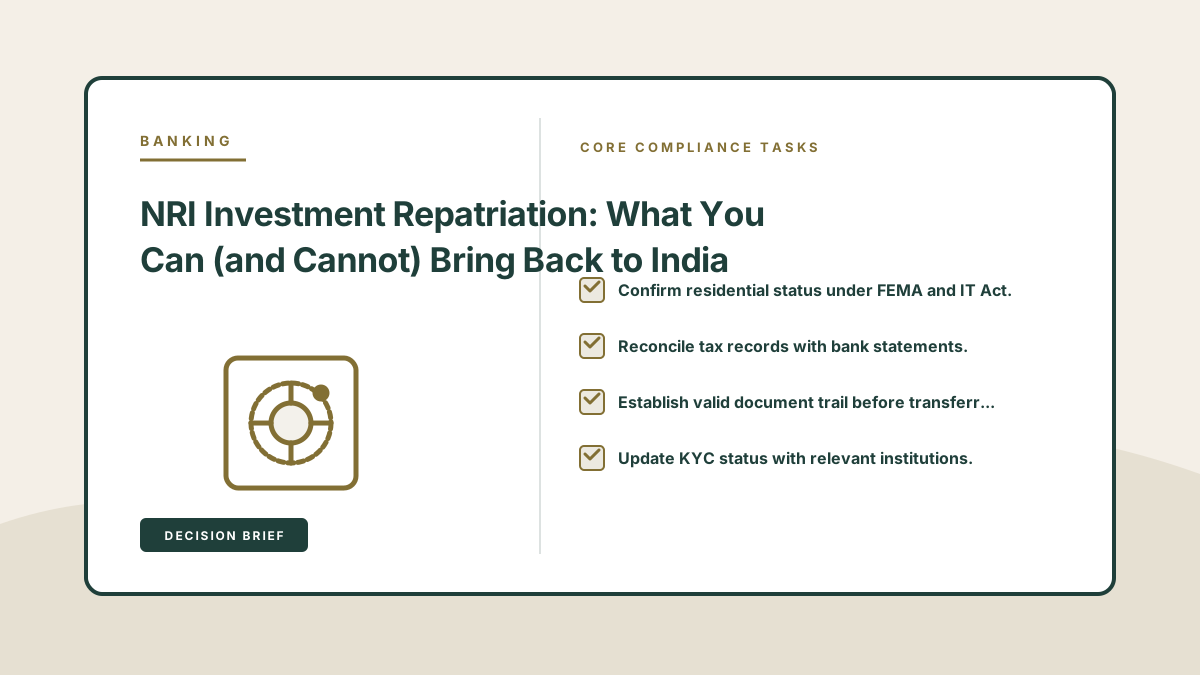
The 60-second version
Understanding FEMA repatriation rules is critical before you start moving money. This guide explains the $1M NRO cap, NRE vs NRO repatriation, FCNR rules, and how to structure your foreign asset transfers.
Fast answer
I separate NRE free repatriation from NRO capped repatriation before I move a rupee. Mixing them is the fastest way to get a bank rejection.
NRO outward transfers usually need Form 15CA/15CB and source proof. Plan the financial year cap before you start multiple transfers.
Repatriation lane quick pick
| Account | Outward cap | Typical paperwork |
|---|---|---|
| NRE | Free repatriation of balance | FEMA declaration at bank |
| NRO | USD 1M per FY | Form 15CA + 15CB + source proof |
| FCNR(B) | Principal per product rules | Bank term sheet |
What to do next
Tag each balance NRE or NRO
Indian income belongs in NRO; foreign earnings funded into India often sit in NRE.
Check USD 1M FY usage
The cap is combined across NRO sources for the financial year.
Prepare CA certificate before booking
Form 15CB timing varies by bank — do not assume same-day transfer.
Full guide
Moving money between countries is where most NRIs run into regulatory trouble. FEMA (Foreign Exchange Management Act) governs every rupee that crosses India's borders, and the rules are strict. Understanding them before you start moving money can save you from frozen accounts, tax notices, and RBI penalties.
Repatriation Rules at a Glance
| Account Type | Repatriation Limit | Tax Implications | Documentation |
|---|---|---|---|
| NRE Savings | Unlimited, fully repatriable | Interest: tax-free. Principal: no tax. | None — freely repatriable |
| NRE FD | Unlimited, fully repatriable | Interest: tax-free. Principal: no tax. | None — freely repatriable |
| NRO Savings | $1 million/year (all banks combined) | Interest: taxable. Principal: no tax. | CA certificate (Form 15CA/15CB) |
| FCNR | Unlimited, fully repatriable | Interest: tax-free. Principal: no tax. | None — freely repatriable |
| RFC | Unlimited, fully repatriable | Tax-exempt during RNOR | None — freely repatriable |
| SNRR (Special Non-Resident Rupee) | Unlimited — for business purposes | Taxed as per residential status | Purpose-specific documentation |
Before Return: The NRE Advantage
While you are still an NRI, NRE accounts are your best friend for repatriation. All funds in NRE accounts — both principal and interest — can be freely repatriated to your foreign bank account with zero restrictions and zero dollar limits.
After Return: The $1M NRO Limit
Once you return and your NRE is converted to a resident account, the repatriation rules change dramatically. Your primary repatriation channel becomes the NRO account, which is restricted to:
- $1 million per financial year across all NRO accounts combined
- CA certification required: Form 15CA (online) and Form 15CB (CA certificate confirming tax compliance)
- Only current income and capital: Not for transferring future income streams
Foreign Assets: Keep or Repatriate?
One of the most common questions: "Should I bring all my foreign money to India?" The answer: not necessarily.
Good Reasons to Keep Money Abroad:
- Diversification — INR has historically depreciated against USD (~3-4% annually)
- Future foreign expenses — children's education abroad, foreign travel
- If you might return abroad within 5-7 years
- You hold US retirement accounts (401k, IRA) that are best left untouched until retirement
Good Reasons to Bring Money to India:
- Buying a primary residence in India
- You need INR liquidity for daily expenses and investments
- Indian fixed deposits offer 7-8% interest (vs 4-5% in USD)
- Tax optimization — NRE interest is tax-free in India
- You have no near-term plans to leave India again
Remitting Money Out of India (After Return)
Once you are a resident, sending money OUT of India is governed by the Liberalised Remittance Scheme (LRS):
- $250,000 limit per person per financial year
- Can be used for: education, medical treatment, travel, investment, gifts, maintenance of close relatives abroad
- Cannot be used for: margin trading, purchasing lottery tickets, prohibited activities
- Tax Collected at Source (TCS): 5% on amounts above ₹7 lakh (can be claimed as credit in ITR)
For the official RBI regulations, refer to the RBI FEMA FAQs and consult a qualified chartered accountant for personalized advice.
Planning visual
Need help with Banking?
Share your blocker in one line. Our experts will reply with practical next steps.
Animated decision map

Decision workflow map
Community signal
What to watch in real discussions
Treat repeated complaints as risk signals rather than official advice. This page does not link to community search results.
Interactive checkpoint
Turn this guide into a decision file
0 of 4 checked
What is the annual repatriation limit from NRO accounts?
NRIs can repatriate up to $1 million per financial year from NRO accounts, subject to tax compliance and CA certification (Form 15CA/15CB). This limit applies to all NRO accounts combined across all banks.
Is there any repatriation limit on NRE accounts?
No. NRE accounts (both principal and interest) are fully and freely repatriable at any time. There is no dollar limit on NRE repatriation. This is a key advantage of keeping funds in NRE before returning to India.
Can I repatriate money from my RFC account?
Yes. RFC accounts have no repatriation limit — funds can be freely moved back abroad at any time. This is one of the key advantages of RFC accounts for returning NRIs who want flexibility.
What happens to my foreign assets when I become a resident?
Under FEMA, you can continue to hold foreign assets acquired while you were an NRI — even after becoming a resident. You do not need RBI permission for 'legacy' foreign assets. However, acquiring new foreign assets as a resident is restricted under the Liberalised Remittance Scheme ($250,000/year limit).
Your NRE account redesignation has a deadline.
Banks don't remind you. You need the right account stack before salary, rent, and EMIs start moving. Get the exact sequence.