529 Plan for an Indian University: Eligibility Checklist
Check whether an Indian or overseas university qualifies for US 529 withdrawals. Verify institution status, campus, expenses and records before paying fees.
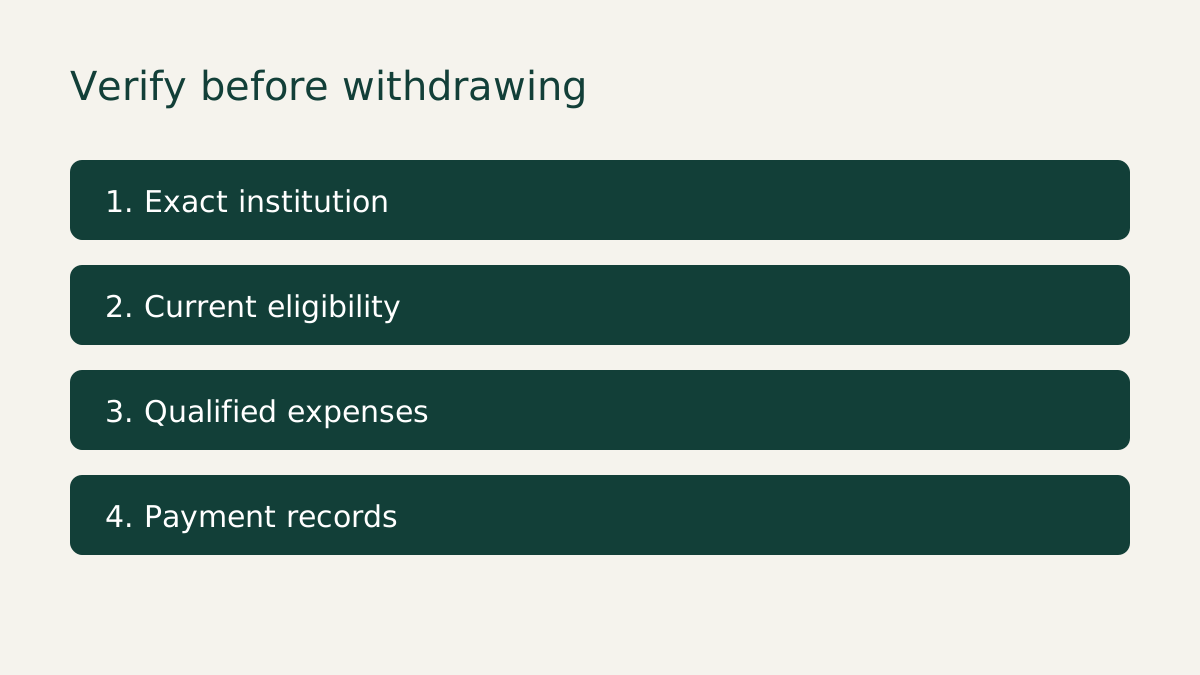
The 60-second version
A 529 plan can pay qualified higher-education expenses at an eligible foreign institution, but Indian recognition, a familiar university name or a school-code search result is not enough. Verify the exact institution's eligibility to participate in a US Department of Education student-aid program before relying on a tax-free withdrawal.
The institution test comes before the withdrawal
For college and university expenses, IRS guidance defines an eligible institution by eligibility to participate in a student-aid program administered by the US Department of Education. That can include foreign institutions. The test is not simply whether the institution is accredited in India, teaches in English, has an international partnership or appears on a list supplied by an education consultant.
This page does not certify any named Indian university. We could read the IRS guidance on 12 October 2026, but could not retrieve the current Federal Student Aid international-school PDF reliably. A claim that every Indian institution is eligible—or that none can ever qualify—would go beyond the evidence checked here. Ask for institution-specific confirmation before distributing funds.
Use the 529 plan after moving to India guide for the broader keep-or-withdraw decision. This checklist addresses the narrower question: what evidence should support a payment to a particular campus? For wider school choices, return to the Schools & Family hub.
What does—and does not—prove eligibility
| Information you find | What it establishes | Next verification |
|---|---|---|
| Indian recognition or accreditation | Local academic standing, not the US 529 tax test by itself | Confirm US Department of Education program eligibility |
| A federal school code | A useful identifier to investigate | Match the institution, location and current program status; do not stop at a code |
| A foreign-school list entry | Evidence about the institution and the list's stated category/date | Check whether its status establishes participation eligibility, not merely loan deferment |
| An eligible parent university overseas | Information about that institution | Verify that your child's exact campus/program is covered; a partner name is insufficient |
| A plan administrator's ability to process a withdrawal | Operational access to your money | Separately substantiate the institution and qualified expenses for tax purposes |
| A consultant's statement that all overseas fees qualify | Advice that needs supporting evidence | Ask for the current primary-source basis and retain the reply |
A verification sequence before the fee deadline
Identify the legal institution and campus
Use the admission letter and invoice, not the marketing name. Record the awarding institution, teaching campus, country and degree program.
Check current Department of Education information
Search the official Federal Student Aid resources and current foreign-school information. Preserve the dated entry and its status description. If a list uses 'deferment only', do not treat the label as proof of the 529 eligibility test without clarification.
Ask the institution a precise question
Request written confirmation that this institution and campus are eligible to participate in a US Department of Education student-aid program. Ask for the identifier and current status supporting that answer.
Confirm the plan's distribution process
Ask who can receive funds, how foreign invoices are handled and which records the administrator requires. Administrative acceptance is not a guarantee of either US or Indian tax treatment.
Calculate expenses that actually qualify
Separate tuition, required fees, books and supplies from travel and personal spending. Confirm applicable room-and-board limits and at-least-half-time enrollment requirements before including living costs.
Match the payment and distribution records
Keep invoice dates, proof of enrollment, receipts, bank records, distribution confirmation and Form 1099-Q. Coordinate scholarships and education credits so the same expense is not used twice.
Use another funding source if eligibility remains unresolved
Do not request a distribution described as qualified merely because tuition is due. Preserve the 529 while obtaining a documented answer or have an adviser calculate the consequences of a nonqualified distribution.
A qualifying university does not make every expense qualifying
The IRS distinguishes the institution from the expense. For higher education, required tuition, fees, books, supplies and equipment may qualify; computer and related internet costs are addressed in the guidance. Room and board has enrollment and amount limitations. Flights, family relocation costs and ordinary personal spending do not become qualified tuition expenses simply because they are necessary for your move.
Read the current edition of Publication 970 rather than copying an old blog's annual limits. The page checked today covers tax year 2025 and includes updates for 2026; Topic 313 also contains newer provisions. This article deliberately does not apply school-level K–12 limits or Roth-rollover rules to a university payment. Those are separate questions with separate conditions.
Scholarships and credits also change the calculation. Keep a worksheet showing which bills support which benefit. A bank transfer equal to the total invoice proves payment, not that every component qualifies. Separate refundable deposits, optional activities and accommodation charges before instructing a distribution.
Hypothetical example: why the earnings portion matters
| Illustrative assumption | Amount or result |
|---|---|
| Distribution (hypothetical; not a reader's account) | $10,000 |
| Contributions returned within that distribution | $7,000 |
| Earnings within that distribution | $3,000 |
| If none of the payment is qualified and no exception applies | The earnings portion—not the full distribution—is the starting point for US taxable-earnings analysis |
| Illustrative 10% additional tax on those $3,000 earnings | $300, separate from any ordinary income tax and state consequences |
US tax qualification is not an Indian tax ruling
A distribution that qualifies for US treatment does not automatically receive identical treatment in India. The account owner, beneficiary, residential status, source and character of income and reporting duties require a separate analysis. Do not assume OCI status, an Indian address or a US-citizen child settles those questions.
Keep the plan open only if its administrator permits your updated address and account circumstances. Do not use an inaccurate address to avoid residency checks. If the child might study at another institution later, preserving the account while confirming eligibility can be different from cashing it out now. Discuss account and beneficiary changes with the administrator rather than assuming they are costless in every jurisdiction.
Need help with Schools & Family?
Share your blocker in one line. Our experts will reply with practical next steps.
Your pre-distribution evidence file
- Admission letter and exact campus identity
- Current eligibility evidence and written institution response
- Plan administrator's distribution instructions
- Itemized invoice and enrollment status
- Scholarship/credit allocation worksheet
- Payment, currency-conversion and distribution records
- US and India advice where your circumstances require it
The funding decision
Planning visual

Animated decision map

Community signal
What to watch in real discussions
Treat repeated complaints as risk signals rather than official advice. This page does not link to community search results.
Interactive checkpoint
Turn this guide into a decision file
0 of 4 checked
Can a 529 plan be used internationally?
Yes, qualified higher-education expenses at an eligible foreign institution can qualify. Confirm the exact institution's eligibility to participate in a US Department of Education student-aid program and the expense requirements; location alone is not the test.
Can I use a 529 plan for an Indian university?
Only if the institution and expense meet the applicable US requirements. This guide does not certify any Indian institution. Obtain current primary evidence and written confirmation rather than relying on accreditation or a country-wide claim.
Does a federal school code prove 529 eligibility?
Treat the code as an identifier to investigate, not the end of the check. Match current status, institution and campus to the statutory eligibility test. Seek clarification when an entry is categorized as deferment only.
Can I open a 529 account in India?
A US 529 is not an Indian government education-savings product. Whether a particular US plan accepts an applicant living in India depends on its identification and residency requirements. Ask the administrator; do not assume every foreign resident can open one.
Are flights and moving costs qualified university expenses?
They do not qualify merely because the student attends an eligible university. Separate tuition and qualifying education expenses from transport and relocation costs, and verify any living-cost claim under the relevant IRS limits.
What if I cannot prove the university qualifies before tuition is due?
Use another lawful funding source while investigating, or obtain advice on a nonqualified distribution. Do not label the withdrawal qualified without evidence. Keep the expense and distribution records for the final tax calculation.
School admissions close fast — and some only take students in April.
Curriculum, timing, and location all need to be decided before you choose a neighborhood. Get clarity now.